Compare every Japan city in September →
Stay in Osaka in September
125 hotels in the Trip.com pool for Osaka, from US$13 a night.
Opens Trip.com on Fri 3 Sep to Sun 5 Sep 2027; change the dates there.
September in Osaka is a negotiation with the tail end of summer. The heat is still real (daily highs around 30°C (87°F) that feel closer to 35 with the humidity) but the worst of the August furnace has broken just enough that you can spend a full afternoon outside without feeling like you're slowly melting. The defining feature of the month, though, is typhoon season. Osaka sits in the path of Pacific typhoons that peak in August and September, and while a direct hit is unlikely in any given year, the peripheral effects (bands of heavy rain, transit disruptions, a day or two of grey skies) are common enough that you should plan around them rather than hope they won't happen.
That said, September has a genuine trump card: the Kishiwada Danjiri Matsuri, held in mid-September about 20 minutes south of central Osaka. Massive wooden floats weighing four tonnes get hauled at a dead sprint through narrow streets, with teams of young men leaning off the roofs. It is loud, chaotic, and occasionally dangerous in a way that feels deeply un-curated. If festivals are your thing, this alone might justify the timing.
Crowds thin noticeably after Obon in mid-August, and hotel rates drop from their summer peaks. You'll still contend with domestic tourists during Silver Week (the cluster of public holidays around September 15-23), but outside that window, Osaka in September is a city settling back into its working rhythm: the locals are out again, the restaurants aren't packed to the gills, and you can get a seat at a counter in Dotonbori without queueing for forty minutes.
Why visit in September
- Kishiwada Danjiri Matsuri is one of Japan's most raw, physically intense festivals: held mid-September and drawing far fewer international tourists than Gion Matsuri or Nebuta
- Hotel rates drop 20-30% from summer peaks outside of Silver Week, with good availability at mid-range places in Namba and Shinsaibashi
- Early autumn seasonal food starts appearing: sanma (Pacific saury) grilled over charcoal, fresh nashi pears, and the first matsutake mushrooms at Kuromon Market
- Late September evenings cool to around 23°C (73°F), making after-dark walking through Shinsekai and the Dotonbori canal side comfortable again
Worth knowing
- Typhoon season is active: expect at least one weather disruption during the month, ranging from a day of heavy rain to cancelled trains and grounded flights
- Humidity sits around 76%, which combined with 30°C highs makes midday outdoor sightseeing genuinely draining, especially at exposed sites like Osaka Castle's upper grounds
- 197mm of rain across roughly 14 days means you'll lose at least a few planned outdoor hours to downpours that arrive with little warning
- Silver Week (mid-to-late September) causes a sharp domestic tourism spike: hotels near Namba and Umeda can sell out, and bullet train reservations fill up days in advance
Best for
Think twice if
September straddles summer and autumn but leans heavily toward summer. Daytime highs average 30.4°C (87°F) and lows hover around 22.9°C (73°F), though early September can still push above 33°C. Humidity at 76% makes the perceived temperature several degrees higher. Rain totals around 197mm spread across 14 days: these tend to arrive as sudden, heavy afternoon downpours rather than all-day drizzle, though typhoon-adjacent weather can bring 48 hours of sustained rain. The month gets noticeably cooler in its final week, and by the last days of September, mornings start to carry a hint of crispness that August never had.
Seasonal caution
- Typhoon season peaks in August-September: Osaka occasionally takes direct hits but more commonly experiences peripheral effects: heavy rain bands, wind gusts over 70 km/h, and suspended rail service on the JR and private lines. Check the Japan Meteorological Agency forecasts daily and keep hotel/airline rebooking policies in mind.
- Heat illness remains a risk through mid-September, particularly for visitors not acclimatized to high humidity. Midday temperatures combined with 76% humidity produce a heat index well above the actual air temperature: hydrate aggressively and take air-conditioned breaks.
Year-round climate
Averages from the last 5 years.
| Month | Avg high (°C) | Avg low (°C) | Rainfall (mm) |
|---|---|---|---|
| Jan | 9 | 1 | 42 |
| Feb | 10 | 1 | 61 |
| Mar | 15 | 5 | 123 |
| Apr | 20 | 10 | 158 |
| May | 23 | 14 | 235 |
| Jun | 27 | 20 | 253 |
| Jul | 32 | 25 | 202 |
| Aug | 33 | 26 | 206 |
| Sep | 30 | 23 | 197 |
| Oct | 24 | 15 | 135 |
| Nov | 18 | 9 | 97 |
| Dec | 12 | 3 | 44 |
Holidays and festivals in September
Public holidays
- Respect for the Aged Day(敬老の日)20 September 2027
- Autumnal Equinox Day(秋分の日)23 September 2027
Headline events
Kishiwada Danjiri Matsuri
September 14-15 (main days; related events the weekend before)
Four-tonne wooden festival floats hauled at full sprint through the narrow streets of Kishiwada, with runners leaping onto the roofs and crowds pressing dangerously close. One of Japan's most physically intense and least sanitized major festivals: injuries happen, and that's considered part of it. The energy is unlike anything in the typical Osaka tourist circuit.
Best things to do in September
Attend Kishiwada Danjiri Matsuri
festivalGet to Kishiwada early: the float processions start in the morning and the energy peaks by midday. The floats round tight corners at speed while crowds press in from all sides. Find a spot along the main route near Kishiwada Station or along the kankan-ba straightaway where the floats accelerate. The sound of the wooden wheels on asphalt and the coordinated shouting of the pulling teams carries for blocks.
The matsuri is held only on September 14-15, with related events the preceding weekend. Miss these dates, miss the festival entirely.Booking tipTake the Nankai Main Line from Namba Station: about 20 minutes. Arrive before 9 AM for a good viewing position. Trains back to Osaka will be packed in the evening; consider staying for the evening lantern-lit procession and catching a later train.
Tsukimi moon viewing at Sumiyoshi Taisha
culturalSumiyoshi Taisha, one of Osaka's oldest shrines, hosts a formal moon-viewing ceremony (Kangetsu-sai) with traditional gagaku court music performed on the arched Taiko-bashi bridge over the shrine pond. The reflection of the full moon on the water, the sound of the sho mouth organ: it is a genuinely contemplative evening in a city that's usually anything but quiet.
Kangetsu-sai is tied to the harvest moon, which falls in mid-to-late September (exact date shifts with the lunar calendar). This is an annual event you cannot experience in other months.Booking tipFree to attend, but arrive at least an hour before the ceremony starts to get a position near the bridge. The shrine is a 3-minute walk from Sumiyoshitaisha Station on the Nankai line.
Early autumn evening walks along Nakanoshima
walkingNakanoshima (the long, narrow island between the Dojima and Tosabori rivers in central Osaka) becomes genuinely pleasant for evening walks in late September as temperatures ease below 25°C. The riverside promenade past the rose garden (still in late bloom), the neoclassical Nakanoshima Library, and the contemporary art museum is about 2 km end to end. The river reflects the lights of the Kitahama high-rises.
Late September marks the first evenings cool enough for comfortable riverside walking since May. The rose garden's autumn flush begins in late September, and the lack of peak-season crowds means the promenade feels local rather than touristic.Day trip to Minoo Park for early-turning maples
natureMinoo (also spelled Minoh), about 30 minutes north of Umeda, is Osaka's most accessible mountain-valley park. The main trail follows a stream uphill to a 33-meter waterfall. While the famous full autumn color peaks in November, the first scattered patches of red and orange appear on the maples at higher elevations by late September, and you'll have the trail mostly to yourself compared to the November crush.
Late September offers the first hints of color change on the upper trail without the November crowds that can make the path feel like a queue. The momiji tempura (deep-fried maple leaves) sold at trailside stalls is available and freshly made.Booking tipTake the Hankyu Minoo Line from Umeda. No booking needed. Go on a weekday morning for the quietest experience.
Seasonal kappo dining: the autumn menu transition
foodSeptember is when Osaka's kappo and kaiseki restaurants shift their menus from summer to autumn. Chefs start working with hamo (pike conger, still in season from summer), sanma, early matsutake, and ginkgo nuts. A counter seat at a neighborhood kappo restaurant (where the chef prepares each course in front of you) is one of the best food experiences in Japan, and in September you're catching the kitchen at a creative peak as two seasons overlap.
The summer-to-autumn menu crossover in September produces combinations you won't see in any other month: hamo alongside sanma, summer vegetables next to early autumn mushrooms. Many chefs consider this their most interesting menu period.Booking tipBook 3-5 days ahead for well-regarded kappo spots in Kitashinchi and Fukushima. A counter seat for omakase typically runs 8,000-15,000 yen per person.
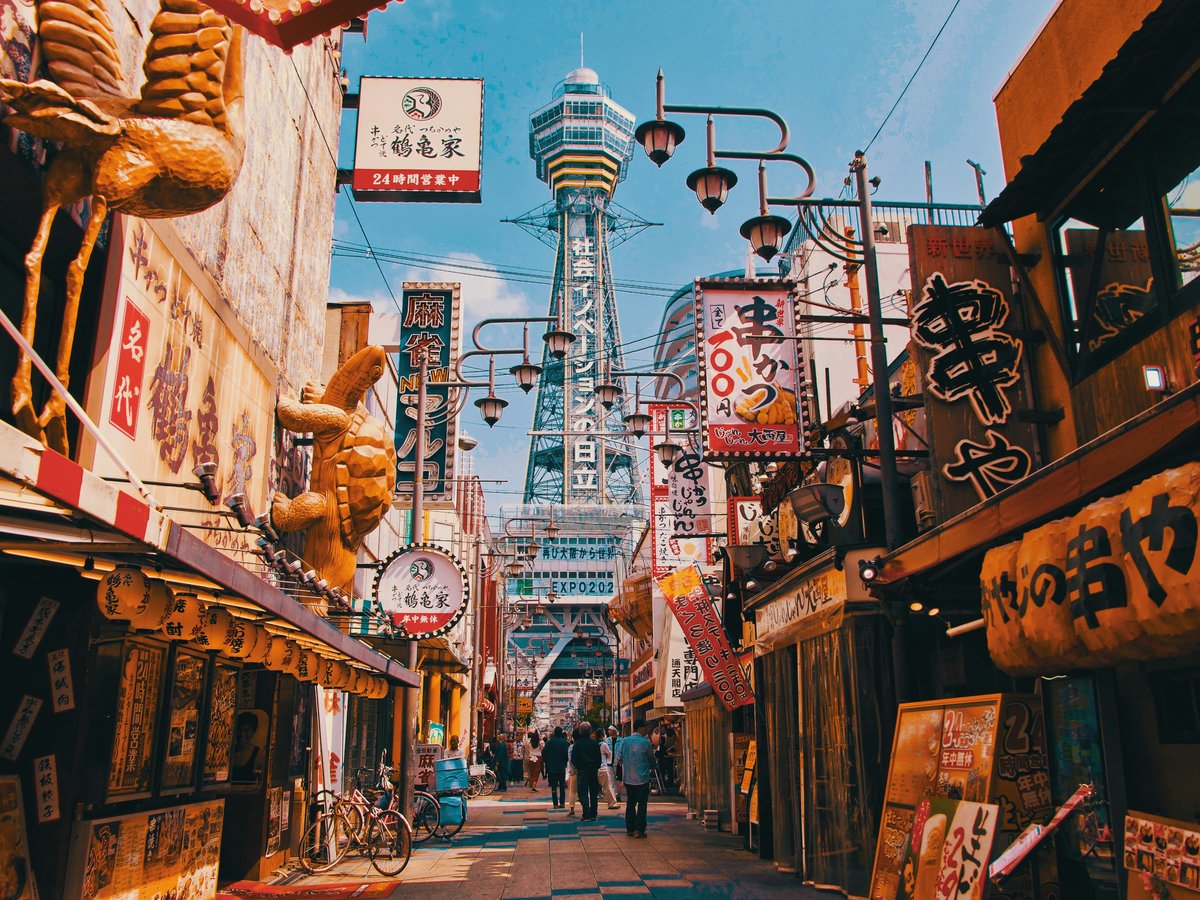
Explore Shinsekai and Tsutenkaku Tower at dusk
culturalThe retro entertainment district of Shinsekai (neon signs, kushikatsu (deep-fried skewer) joints, and the Tsutenkaku Tower) takes on a different quality in September evenings. The summer heat kept daytime foot traffic down, but as the sun drops and temperatures ease, the narrow streets fill up. The smell of frying oil and the clatter of pachinko machines is the backdrop. Climb Tsutenkaku for the sunset view south over Tennoji Park.
September evenings are the sweet spot: warm enough to eat and drink outside at the street-level kushikatsu stands, but not the oppressive heat that makes July-August Shinsekai feel like standing inside a deep-fryer.Browse Kuromon Market for autumn-arrival seasonal produce
foodKuromon Market in Nippombashi is Osaka's main public food market, and September is when the stalls begin transitioning from summer to autumn stock. Look for the first matsutake on display (priced like jewels), stacks of nashi pears, and fresh sanma laid out on ice. The tuna and seafood stalls are quieter than during peak tourist months: you can talk to the vendors.
The autumn produce transition happens in real time during September: each week brings new seasonal arrivals. Early in the month it still looks like summer; by late September, the stalls have visibly shifted.What to eat in September
In season: fruit
Nashi (Japanese pear)
Crisp, juicy, and slightly grainy in texture: nothing like a Western pear. September is peak season, and the Nijuseiki and Kosui varieties from nearby Tottori and Nara prefectures show up at fruit stands across Osaka. Best eaten cold.
Budō (grapes): Shine Muscat
September is peak grape season, and Shine Muscat grapes are everywhere: pale green, seedless, with a honeyed sweetness and a skin so thin you eat them whole. Sold at fruit parlors, department store depachika, and street stalls near Kuromon Market. Not cheap, but worth trying at least once.
On menus now
Sanma (Pacific saury)
The defining autumn fish of Japan, arriving in markets and izakaya from early September. Grilled whole over charcoal with just salt, served with grated daikon and a squeeze of sudachi citrus. The smell of sanma grilling outside small restaurants in Tenma and Nakazakicho is one of the first signals that autumn is coming.
Hiyashi udon with sudachi
The last gasps of summer cold-noodle culture overlap with the arrival of fresh sudachi citrus from Tokushima. Thick Osaka-style udon served ice-cold with sudachi squeezed over the top: tart, refreshing, and specific to this brief seasonal window.
In markets
Matsutake mushrooms
The first matsutake of the season appear in late September at premium grocers and high-end kappo restaurants. Domestic matsutake commands staggering prices (you might see a single mushroom for over 10,000 yen) but the fragrance when grilled or steamed in a dobin mushi (teapot broth) is unlike any other mushroom.
Festival food
Tsukimi dango
Small round rice dumplings stacked in a pyramid, traditionally offered during the September moon-viewing season (Tsukimi, around the autumn equinox). You'll find them at wagashi shops in Nakanoshima and department store basement food halls, often alongside seasonal displays of susuki grass.
Regular events in September
Sumiyoshi Taisha Kangetsu-sai (Moon Viewing Festival)Free
Formal moon-viewing ceremony at Sumiyoshi Grand Shrine with gagaku court music, poetry readings, and bunraku puppet performances on the illuminated shrine grounds. The harvest moon reflected in the shrine pond beneath the arched bridge is the central image of the evening.
Mid-to-late September (date follows the lunar calendar: usually within a few days of the autumn equinox)Silver Week public holidaysFree
A cluster of Japanese public holidays: Respect for the Aged Day (3rd Monday of September) and Autumnal Equinox Day (around September 22-23): that creates a long weekend or, in good years, a nearly week-long break. Domestic travel spikes sharply. Not an event per se, but it reshapes the entire tourism landscape for the month.
September 15-23 (varies by year; the gap between the two holidays sometimes aligns into a full week off)Osaka Autumn Grand Sumo Tournament
The September basho (sumo tournament) is held at Edion Arena Osaka (formerly Osaka Prefectural Gymnasium) in Namba. Fifteen days of professional sumo: the crack of the tachiai collision, the ritual salt-throwing, the surprisingly tense atmosphere in a sport that looks slow until you see it live. Even if you don't follow sumo, one afternoon in the arena is a spectacle.
Mid-September (15 consecutive days, typically starting the second Sunday of the month)Kishiwada Danjiri Matsuri: September Trial Run (Shiken-biki)Free
The weekend before the main Danjiri Matsuri, Kishiwada holds a trial run (shiken-biki) where the floats are pulled through the streets at a somewhat less frantic pace. Fewer crowds, good photo opportunities, and a chance to see the floats up close without the main-event crush.
The Saturday and Sunday one week before the main festival (usually early September)Best places this September
Osaka Castle Park (Osaka-jo Koen)
parkThe park surrounding Osaka Castle covers about 106 hectares and is one of the few central green spaces where you can escape the concrete for a while. In September, the outer moat reflects the castle tower against green foliage that's just starting to think about turning. Early mornings before 9 AM, the joggers and tai chi practitioners outnumber tourists. The Nishinomaru Garden on the west side is the quieter, more photogenic section.
Chuo-kuNakanoshima Park and Rose Garden
parkThe long island between Osaka's two rivers has a public rose garden that begins its second annual bloom in late September. The park stretches between the neoclassical Central Public Hall and the National Museum of Art. Evenings along the river here are some of the most pleasant walking in the city once the September heat begins to break.
NakanoshimaSumiyoshi Taisha
shrineOne of Japan's oldest Shinto shrines, predating the use of Buddhist influence in shrine architecture: the buildings have a distinctively austere, ancient style. The arched Taiko-bashi bridge over the pond is the iconic image. September brings the Kangetsu-sai moon-viewing ceremony, but even outside festival nights, the shrine grounds are calm and largely tourist-free compared to Kyoto's major shrines.
SumiyoshiShinsekai
neighborhoodThe retro entertainment district south of Tennoji feels like a time capsule of mid-20th-century Osaka. Kushikatsu restaurants with their no-double-dipping sauce rule, the Tsutenkaku Tower lit up in neon, narrow alleys packed with tiny bars. September evenings (warm but no longer brutal) are the right temperature for wandering here with a beer in hand.
ShinsekaiMinoo Park and Waterfall
natureA forested river valley 30 minutes north of Umeda by train. The 2.8 km trail from the station to the 33-meter Minoo Falls follows a stream through a maple-lined gorge. Late September brings the first scattered color changes at higher elevations and the appearance of momiji tempura (deep-fried maple leaf) stalls along the path.
MinooKuromon Market
marketOsaka's main food market stretches about 600 meters through covered arcades in Nippombashi. The September shift from summer to autumn produce is visible week by week: fresh sanma, nashi pears, early mushrooms arriving alongside the last of the summer fruits. Less tourist-packed than peak months; you can browse and sample at a human pace.
NippombashiTennoji Park and Keitakuen Garden
gardenThe public park adjacent to Tennoji Station includes the Keitakuen, a traditional circular garden originally built as a private villa garden. In September, the garden's pond reflects the late-summer greenery and the first subtle shifts toward autumn. The adjacent Osaka City Museum of Fine Arts sits at the park's north end. A good midday retreat from the concrete heat.
Tennoji
Your packing checklist
Tick items off as you pack. Your progress saves in this browser.
All packed — have a great trip.
Insider tips
The Osaka Autumn Grand Sumo Tournament in September is one of three annual tournaments held outside Tokyo, and tickets for upper-level seats (jiyuseki) go on sale the morning of each match day at Edion Arena Osaka: arrive by 7:30 AM and you can usually get in for about 2,000 yen without advance booking. The atmosphere on the final weekend days is electric.
For Kishiwada Danjiri Matsuri, skip the main intersection viewing area (it's shoulder-to-shoulder by 8 AM) and walk two or three blocks south along the route toward the harbor side. The floats pass through tighter streets there, closer to the crowd, and you can move. The evening lantern procession after dark is, to be fair, the more photogenic part of the festival and far less packed.
Department store basement food halls (depachika) at Hankyu Umeda and Takashimaya Namba are where Osaka residents buy their seasonal produce: the matsutake mushroom displays in late September are theatrical, and you can sample seasonal wagashi and grilled sanma from vendors at a fraction of restaurant prices.
If a typhoon warning goes up, don't try to power through your itinerary. Japanese transit operators proactively suspend service (sometimes 12 hours before the storm arrives) and they announce resumption times in advance. Use the JR West app (English available) to track line status. Spend the day in Namba's underground shopping arcades (Namba Walk, Namba Parks) where the weather is irrelevant.
The stretch of Nakazakicho between Umeda and Tenma: a neighborhood of converted old wooden houses turned into tiny cafes, galleries, and vintage shops: is at its most walkable in late September evenings. Most of these places don't appear on tourist maps and close by 8 PM. Go after 4 PM on a weekday.
Avoid these mistakes
- Booking a rigid outdoor-heavy itinerary with no flexibility for typhoon disruptions. September averages at least one weather event that can ground flights or suspend trains for a day. Build in at least one buffer day, and keep an indoor backup plan (museum, cooking class, depachika tour) ready for each outdoor day.
- Visiting Kishiwada Danjiri Matsuri expecting a polished, tourist-friendly event. The festival is genuinely rough: floats weigh four tonnes and move fast, the crowd surges are real, and there's no safety barrier between you and the action. Keep children close, don't stand on corners where floats turn, and wear shoes you can move quickly in.
- Packing for autumn because the calendar says September. Osaka in early-to-mid September is still summer by any practical measure: 30°C, humid, sun-drenched. Bring what you'd pack for July in a subtropical city. The autumn wardrobe can wait until late October.
- Planning to see autumn foliage. Some travel sites list September as 'early autumn' for Japan, but Osaka's maples don't begin turning until mid-November. If you come in September expecting red leaves, you'll see nothing but green. The late-September color hints at Minoo are scattered individual branches, not a display.
Practical tips for September
Book hotels outside the Silver Week window (roughly September 15-23) for the best rates: the week before and after are noticeably cheaper. Typhoon season means checking the Japan Meteorological Agency forecast daily and having the JR West app installed for real-time transit alerts in English. Many smaller restaurants and izakaya in neighborhoods like Fukushima and Tenma close for a few days during Silver Week as owners take their own holidays: call ahead or check Google Maps hours if you're targeting a specific spot. Convenience stores (7-Eleven, Lawson, FamilyMart) are your best friends for grab-and-go onigiri and cold drinks during oppressively humid days. Carry cash, while IC cards (ICOCA/Suica) work on transit and at convenience stores, many of Osaka's best small restaurants and street food stalls in Shinsekai and around Kuromon Market remain cash-only. Trains run until roughly midnight; if you're out late in Dotonbori or Amerikamura, keep an eye on the last departure time for your line.
FAQ
Is September a good time to visit Osaka?
It's decent but not ideal. You're dealing with lingering summer heat (highs around 30°C/87°F), high humidity, and active typhoon season. The tradeoffs are lower hotel prices outside Silver Week, thinner crowds than peak season, and the raw spectacle of Kishiwada Danjiri Matsuri. If you can handle heat and accept that weather might disrupt a day or two, September works, but October and November are objectively better months for comfortable sightseeing.
What is the weather like in Osaka in September?
Hot and humid, with rain. Average highs sit around 30.4°C (87°F) and lows around 22.9°C (73°F), with humidity at 76%. Expect about 197mm of rainfall across 14 days: often as sudden heavy downpours rather than all-day grey. Early September still feels like full summer; by the last week, evenings cool noticeably and you'll sense autumn approaching. Typhoon season is the wildcard: peripheral storm bands can bring a day or two of heavy wind and rain.
Is Osaka crowded in September?
Moderate. International tourist numbers are below the October-November autumn peak, and domestic summer holidays (Obon) wrapped up in August. The exception is Silver Week (the cluster of public holidays around September 15-23) when domestic travelers flood the city. Hotels near Namba and Dotonbori sell out, trains are packed, and popular restaurants have long waits. Outside Silver Week, September is one of the quieter months for visiting major sites like Osaka Castle.
Can you see autumn leaves in Osaka in September?
No. Osaka's autumn foliage season doesn't start until mid-November and peaks in late November to early December. In September, everything is still green. If you visit Minoo Park in the last week of September, you might spot a few individual maple branches beginning to turn at higher elevations, but it's scattered hints rather than anything you'd plan a trip around.
What should I do if a typhoon hits during my September trip to Osaka?
Stay indoors and don't fight the transit shutdowns. Japanese rail operators suspend service proactively (sometimes half a day before the storm arrives) and announce estimated resumption times. Download the JR West app for English-language alerts. Spend storm days in Osaka's extensive underground shopping networks (Namba Walk, Whity Umeda) or in museums like the National Museum of Art on Nakanoshima. Hotels will generally be understanding about late checkouts during severe weather. Most typhoons pass through within 24 hours, and normal service resumes quickly once they clear.
Things to Do in Osaka in September
 Free cancellation
 Osaka Kickstart: Hotspots & Hidden Gems Tour
Day trip: free cancellation.
via Viator Free cancellation
 Sushi Making Osaka Roll and Authentic Japanese Sushi Class
Cooking class: 1.7 hours, free cancellation.
via Viator Free cancellation
 Ultimate Osaka Walking Tour: Castle, Dotonbori, Gems & Lunch
Day trip: free cancellation.
via Viator Free cancellation
 Kyoto Day Tour: Fushimi Inari, Arashiyama, Kinkaku-ji & Kiyomizu
Day trip: 10 hours, free cancellation.
via Viator Free cancellation
 Osaka Local Foodie Walking Tour in Dotonbori and Shinsekai
City tour: 3 hours, free cancellation.
via Viator Free cancellation
 From Kyoto / Osaka: Kyoto Must-see Spots & Nara Park One Day Tour
Day trip: 9 hours, free cancellation.
via ViatorFind a flight to Osaka
Live fares to Osaka appear here once cookies are accepted.
Last verified by automated review (v1.7.2) on . What is automated review?