Stay in Varanasi in November
59 hotels in the Trip.com pool for Varanasi, from US$5 a night.
Opens Trip.com on Fri 6 Nov to Sun 8 Nov 2026; change the dates there.
November is Dev Deepawali month, and that alone puts Varanasi on the short list. On Kartik Purnima, the full moon of the Hindu month of Kartik, more than a million earthen oil lamps are lit along the stone steps of the ghats lining the Ganges. The riverfront glows. Boat passengers drift past the arc of fire while the sound of Sanskrit chants and temple bells carries from expanded aarti ceremonies at multiple ghats. Fireworks launch from Ramnagar Fort on the far bank. For sheer visual scale, no other night on Varanasi's calendar comes close.
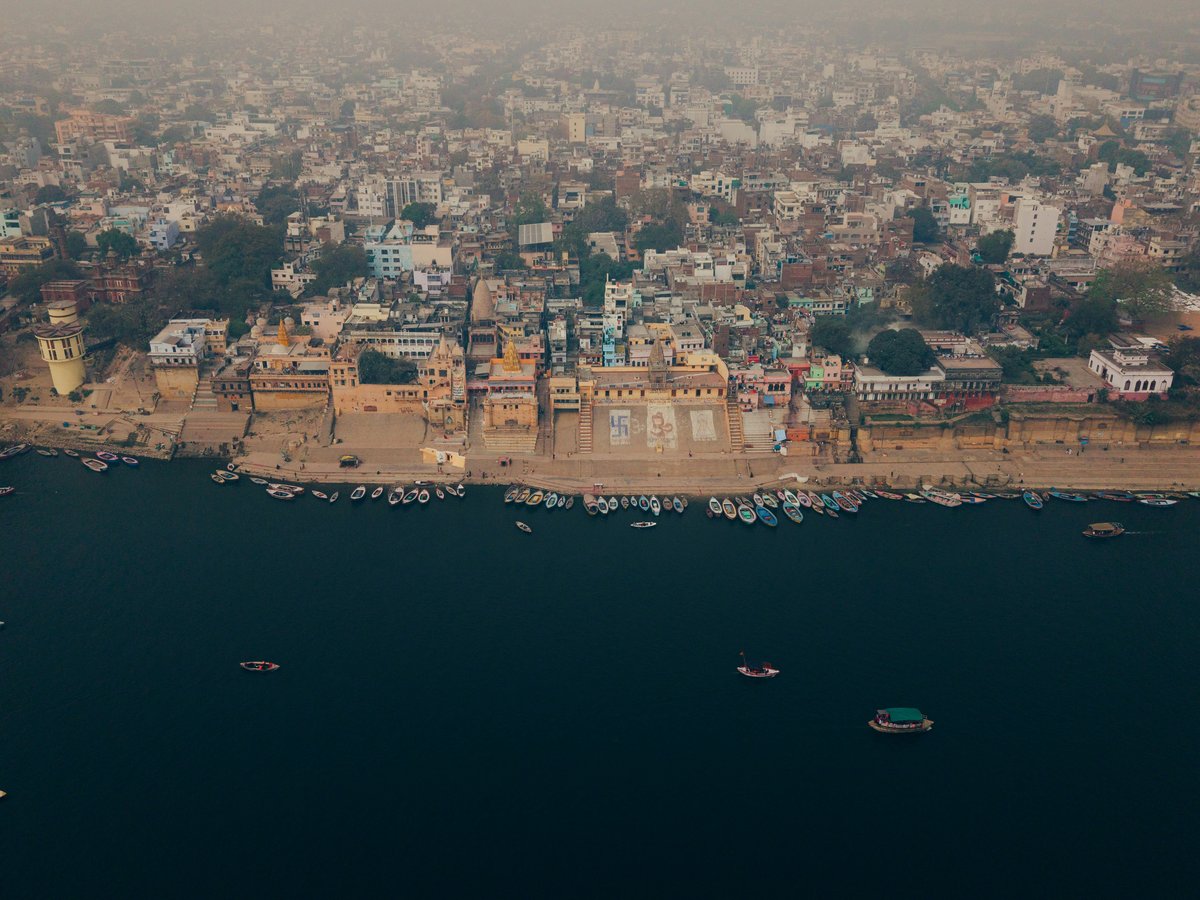
The trade-off is Varanasi's air. November sits at the peak of Indo-Gangetic crop-burning season, when agricultural stubble fires across Punjab and Haryana send a thick grey haze southeast. Varanasi occupies the plain's low basin and traps it. AQI readings above 200 are routine, and spikes beyond 350 happen during bad weeks. You might walk down to Dashashwamedh Ghat at dawn, the cold morning air scratching your throat through the haze, and find the opposite bank invisible behind a wall of grey. For travelers with asthma or serious respiratory sensitivity, this is a genuine health consideration, not a minor annoyance.
The weather, apart from the haze, is nearly ideal. Highs around 28°C (82°F), lows near 16°C (61°F), and rainfall that barely registers at 5mm for the entire month. The monsoon ended roughly 6 weeks prior, so the ghats are dry, the lanes of the old city between Godowlia and Manikarnika are walkable, and the Ganges has settled into its winter channel. Pack an N95 mask for bad-air mornings, and if respiratory issues are a serious concern, consider late February instead.
Why visit in November
- Dev Deepawali on Kartik Purnima draws over 100,000 spectators to the ghats for one of India's most photogenic nights, with the entire waterfront lit by oil lamps from Assi Ghat to Raj Ghat.
- Post-monsoon water levels have fully receded, making all 84 ghats accessible by foot for the first time since June and reopening the full 6-kilometre riverside walking trail.
- Comfortable temperatures after months of 35°C-plus heat and monsoon humidity make full-day walking through the narrow old-city lanes feasible without heat exhaustion risk.
- Rainfall drops to a negligible 5mm for the entire month, making outdoor plans and boat rides highly reliable compared to monsoon months that can deliver 300mm or more.
Worth knowing
- Crop stubble burning across Punjab and Haryana sends haze into the Gangetic basin, regularly pushing Varanasi's air quality into unhealthy ranges throughout the month.
- Ghat-facing accommodation near the main ceremony sites fills up weeks ahead of Dev Deepawali, and last-minute bookings may strand you in Sigra or Cantonment, a 3km rickshaw ride from the riverfront.
- The narrow lanes of the old city around Vishwanath Gali become extremely congested during festival weeks, with some alleys near the main temple impassable by midday.
Best for
Think twice if
November marks Varanasi's transition from post-monsoon warmth into the edge of winter. Rain has stopped almost entirely, and skies would be clear most days if not for the regional haze drifting in from agricultural burning to the northwest. Mornings along the Ganges start with river mist in the second half of the month as overnight temperatures dip further. By late November, evenings carry a noticeable chill that catches visitors in short sleeves off guard. The air feels significantly drier than the August-September monsoon peak, though the visible haze from Punjab and Haryana contradicts what your skin tells you.
Seasonal caution
- November sits at the peak of Indo-Gangetic crop-burning season. The haze tends to be worst before midday and on windless mornings. Monitor real-time readings through the CPCB app or IQAir, and plan outdoor activities for afternoons when the air tends to thin. Children and travelers with lung conditions should consult a doctor before committing to a November visit.
Year-round climate
Averages from the last 5 years.
| Month | Avg high (°C) | Avg low (°C) | Rainfall (mm) |
|---|---|---|---|
| Jan | 21 | 10 | 12 |
| Feb | 27 | 13 | 10 |
| Mar | 33 | 19 | 12 |
| Apr | 39 | 24 | 2 |
| May | 39 | 27 | 41 |
| Jun | 38 | 28 | 158 |
| Jul | 34 | 27 | 304 |
| Aug | 32 | 26 | 306 |
| Sep | 32 | 26 | 256 |
| Oct | 31 | 22 | 98 |
| Nov | 28 | 16 | 5 |
| Dec | 23 | 12 | 10 |
Holidays and festivals in November
Public holidays
- Diwali (Deepavali)(दीपावली)8 November 2026
When is Diwali in 2026?
8 November 2026
Diwali is a major cultural celebration in Varanasi. In 2026 it falls on 8 November 2026.
Headline events
Dev Deepawali
Falls on Kartik Purnima. The date shifts with the Hindu lunar calendar, landing between early and late November depending on the year.
The festival of lights of the gods falls on the full moon of the Hindu month of Kartik. Oil lamps cover every stone step along the Ganges riverfront, turning the ghats into a continuous arc of firelight for kilometres. Priests perform expanded aarti ceremonies across multiple ghats, and the entire city converges on the waterfront after sundown. This is Varanasi's signature annual event, the reason many visitors time their trip for November.
Best things to do in November
Boat ride during Dev Deepawali
culturalHire a wooden rowboat from one of the southern ghats and drift north along the entire lit waterfront on the night of Kartik Purnima. From the river, the ghat steps form a single glowing wall. The boat passes through plumes of incense smoke, and you can feel the heat of the lamps on your face as you pass close to the lower steps.
Dev Deepawali happens once a year, on Kartik Purnima in November. No other month offers this view from the water.Booking tipNegotiate and pay for your boat 2-3 days ahead. Prices double on the night itself, and all boats near the central ghats are claimed by late afternoon.
Dawn boat ride on the Ganges
sightseeingA pre-sunrise boat ride past the bathing ghats, cremation pyres, and morning ritual-goers. The boatman rows slowly along the waterfront while the city wakes. The smell of sandalwood smoke and marigold garlands drifts across the water as the sun clears the eastern bank.
Post-monsoon water levels are stable. Morning mist in November adds a soft atmospheric quality that the clearer winter months of December and January lack.Booking tipAgree on the price at the ghat before boarding, not after. Expect higher rates during festival weeks.
Walk the full ghat trail from Assi to Raj Ghat
walkingThe roughly 6km riverside trail connects 84 ghats along the Ganges, passing through cremation sites, bathing areas, wrestling akharas, and crumbling Mughal-era structures. The path is uneven stone steps and narrow platforms the entire way. Expect 3-4 hours at a walking pace with stops.
The monsoon recession has exposed the full trail for the first time since June, and the moderate temperature makes the complete route feasible in a single morning.Half-day excursion to Sarnath
culturalThe archaeological site 10km north of Varanasi is where Siddhartha Gautama delivered his first sermon after attaining enlightenment. The Dhamek Stupa, the Ashoka Pillar remains, a deer park, and the Sarnath Museum (founded 1910, housing the original Ashoka Lion Capital that became India's national emblem) are all within walking distance of each other.
The outdoor stupa complex and deer park are comfortable to explore at current temperatures. The same walk in April or May, with highs near 39°C, is genuinely punishing.Booking tipThe museum closes on Fridays. Arrive early on weekends to avoid school groups.
Early morning Malaiyo tasting in the old city
foodWalk the lanes near Kachori Gali before sunrise to find vendors setting out their clay pots of seasonal milk foam. Cold morning air, the smell of saffron, vendors calling out from doorways, and the texture of the foam dissolving on your tongue before you've fully woken up. You eat it standing at the stall.
The foam can only form in cold night air, so this experience is impossible during Varanasi's long hot season from March through October. November is the earliest it appears.Booking tipNo booking needed, but arrive before 8am. The foam collapses as the day warms.
Photography at dawn along the cremation ghats
photographyManikarnika and Harishchandra, Varanasi's two primary cremation ghats, are active around the clock. At dawn, funeral pyres, morning bathers, and sadhus share the same waterfront steps. The light at this hour, filtered through November's river mist, creates images with a depth that clear-sky months rarely produce.
November's lower sun angle and morning mist create a light quality distinct from summer's harsh, flat overhead glare. The ghats are also fully exposed rather than partially submerged by monsoon water.Booking tipBe respectful at cremation ghats. Photography is generally permitted from a distance at Manikarnika but not up close. Harishchandra tends to be more relaxed about cameras.
Evening Ganga Aarti at Dashashwamedh Ghat
culturalSeven priests perform a synchronized fire ceremony every evening at sunset, swinging large brass lamps in choreographed patterns while chanting fills the air. The smell of camphor and ghee, the sharp clang of bells, conch shells sounding across the water. The ceremony runs about 45 minutes.
The nightly aarti runs year-round, but cooler November evenings make standing in the packed crowd far more bearable than during the April-September heat. During Dev Deepawali week, the ceremony expands across multiple ghats.Booking tipArrive 30-45 minutes early to claim a spot on the ghat steps. A pre-booked boat on the river offers a wider perspective if the crowd is too dense.
What to eat in November
In season: fruit
Amla
Indian gooseberry peaks across the Gangetic plain in November. Sold raw with salt at street stalls, or preserved as murabba in sugar syrup. Tart enough to make your eyes water, but locals eat them daily through the winter months.
On menus now
Chura matar
Flattened rice tossed with fresh green peas, cumin, green chilies, and a squeeze of lime. The first harvest of tender peas reaches Varanasi's vegetable markets in November, making this a seasonal breakfast staple across the old city.
Nimona
A thick curry of mashed fresh green peas cooked with tomatoes, ginger, and whole spices, specific to the Purvanchal region around Varanasi. November's first pea harvest makes this the right month. You'll find it at dhabas and home-style restaurants near Lanka and Assi.
Gajar ka halwa
Grated red winter carrots slow-cooked in milk and ghee with cardamom. The deep-red Delhi-type carrots that yield the best halwa start arriving in late November at Varanasi's wholesale markets near Kotwali.
Street food peaks
Malaiyo
Varanasi's signature winter street food appears when overnight temperatures fall below roughly 15°C. Sweetened, saffron-tinged milk is left outdoors in shallow clay pots, and the cold night air creates a delicate foam scooped into bowls and garnished with pistachios. Vendors in the Godowlia lanes typically start in early-to-mid November and sell only between dawn and 9am, as the foam collapses in daytime warmth.
Gur ki gajak
A brittle of toasted sesame seeds bound with fresh jaggery from the new sugarcane pressing season across eastern Uttar Pradesh. The first batches of fresh gur reach Varanasi sweetshops by November, and the gajak is typically sold in thin slabs wrapped in newspaper.
Regular events in November
Ganga MahotsavFree
A 5-day government-organized cultural festival of classical music, folk dance, and artisan exhibitions held at various ghats in the days before Dev Deepawali. Evening performances feature regional musicians and dancers against the ghat backdrop, and the event draws both tourists and Varanasi residents.
5 days before Kartik Purnima, shifting annually with the lunar calendarChhath PujaFree
A 4-day festival dedicated to the Sun god, deeply significant across the Bhojpuri-speaking belt of eastern UP and Bihar. Devotees fast for 36 hours and stand waist-deep in the Ganges at sunrise and sunset, offering thekua sweets, fruits, and sugarcane. Assi Ghat and several southern ghats are primary ceremony sites in Varanasi.
6 days after Diwali, falling in late October or November depending on the yearNag NathaiyaFree
A theatrical re-enactment of Krishna's victory over the serpent Kaliya, performed on boats in the Ganges at Tulsi Ghat. Actors in elaborate costumes perform on a floating stage while thousands watch from the ghat steps. A tradition specific to Varanasi.
Day after Kartik Purnima, the day following Dev DeepawaliBest places this November
Dashashwamedh Ghat
landmarkThe ceremonial heart of Varanasi's riverfront and the epicenter of Dev Deepawali. Stone steps lead down to the river in a wide arc, flanked by temples and small shops. During Kartik Purnima, every step holds oil lamps. The ghat connects directly to the Vishwanath Gali bazaar lanes leading toward Kashi Vishwanath Temple.
GodowliaRamnagar Fort
historic siteAn 18th-century sandstone fort on the eastern bank of the Ganges, built by the Kashi Naresh royal family. Houses a museum of vintage cars, ivory palanquins, astronomical instruments, and arms. The ferry crossing from Tulsi Ghat takes about 20 minutes on calm post-monsoon water, and the open-air ramparts are pleasant to explore in November's moderate heat.
RamnagarSarnath
archaeological siteThe site of Buddha's first sermon, 10km north of the old city. An auto-rickshaw from Godowlia takes about 30 minutes. The Dhamek Stupa, Ashoka Pillar remains, deer park, and museum cluster within easy walking distance. November's temperatures make the outdoor circuit comfortable in a way that the April-May heat does not allow.
SarnathBharat Kala Bhavan
museumA university museum at Banaras Hindu University (founded 1920) with one of India's significant collections of miniature paintings, sculptures, and textiles spanning 3,000 years. A good midday retreat when outdoor haze peaks. The BHU campus, with wide tree-lined avenues, feels like a different city from the old-town lanes.
LankaAssi Ghat
landmarkThe southernmost of the major ghats, popular with long-stay travelers, yoga students, and academics from nearby BHU. The morning aarti here draws a more local crowd than the central ghats, and the wide platform hosts a small market selling textiles and handicrafts. Cafes and guesthouses line the road above.
AssiTulsi Ghat
landmarkNamed after the poet-saint Tulsidas who composed the Ramcharitmanas here in the 16th century. During Ganga Mahotsav, this ghat hosts classical music concerts and cultural performances in the evenings. It also serves as the traditional stage for the Nag Nathaiya boat performance the day after Dev Deepawali.
Tulsi Ghat area
Your packing checklist
Tick items off as you pack. Your progress saves in this browser.
All packed — have a great trip.
Insider tips
Ghat-facing rooms between Munshi Ghat and Meer Ghat tend to be cheaper than the stretch nearest Dashashwamedh, and they are still a 10-minute walk to the main aarti. The river views are comparable. The noise is less.
For the Dev Deepawali boat experience, hire from Assi Ghat rather than the central area. The south-to-north drift lets you see the entire lit waterfront unfold ahead of you. Book and pay 2-3 days ahead, as boats get claimed and prices double on the night.
If the haze is thick, check real-time AQI on the CPCB app or IQAir before committing to a morning walk. The haze typically thins by early afternoon, so flip your schedule and explore museums or the BHU campus in the morning, then hit the ghats after lunch.
Varanasi Junction (station code BSB) has a prepaid auto-rickshaw counter inside the station building. Use it. Drivers outside the exit quote 3-4x the standard fare to arriving tourists, and the markup only grows during festival season.
The most experienced Malaiyo vendors cluster in the lanes off Kachori Gali. Ask locals which stall is best this season. The answer changes year to year, but the lanes are short enough to try two or three in one chilly morning.
Avoid these mistakes
- Arriving without N95 masks and trying to find quality ones in the old city at the last minute. Medical shops near Godowlia do stock them, but quality varies and prices climb during festival weeks. Buy before you fly.
- Booking a ghat-facing room for Dev Deepawali week without expecting noise. Loudspeakers, fireworks, and crowd noise typically continue until 2-3am on the full moon night. Light sleepers should book a room one block back from the riverfront.
- Attempting to navigate the old city lanes by auto-rickshaw during festival days. Alleys near the main temple narrow to under 2 metres, and motor traffic seizes completely. Walking is the only real option through those lanes during peak hours.
- Missing Dev Deepawali because of a date miscalculation. Kartik Purnima follows the Hindu lunar calendar and falls on a different Gregorian date each year. Confirm the exact date before booking flights, not after.
Practical tips for November
Book ghat-facing accommodation 6-8 weeks ahead if your visit overlaps with Dev Deepawali. Flights into Lal Bahadur Shastri International Airport (VNS) fill up and prices rise for the festival period, so booking 3-4 weeks early helps. At the current exchange rate of roughly 96 INR per 1 USD, Varanasi remains affordable for international visitors. Varanasi scores 5.8 out of 10 for solo-traveler safety (see the TTDI Solo-Safety Index), so standard urban precautions apply in the dense old-city lanes after dark. Dress modestly at all ghats and temples, covering shoulders and knees. Most shops in the old city close by 9-10pm even during festival season, so plan evening meals early. The narrow lanes become one-directional pedestrian flows during major festival days, and the flow direction reverses at major intersections. Watch where the majority is heading before committing to a lane.
FAQ
Is November a good time to visit Varanasi?
November is one of the strongest months for a Varanasi visit, ranked 2nd out of 12. The weather is comfortable, rainfall is negligible, and Dev Deepawali is the city's most spectacular annual event. The significant trade-off is air quality from crop burning across northern India, which regularly pushes readings to unhealthy levels. For most travelers, the festival and weather outweigh the haze. Those with respiratory sensitivities should weigh this carefully or consider late February instead, when temperatures are similar but skies tend to be cleaner.
What is the weather like in Varanasi in November?
Days are warm and dry with the monsoon well behind and virtually no rainfall expected. Nights cool enough for a light jacket, especially in the second half of the month when pre-dawn temperatures can feel genuinely chilly on the river. The air feels drier and more comfortable than the monsoon season, though regional haze from agricultural burning often replaces cloud cover with a persistent grey veil that tends to thin after midday.
Is Varanasi crowded in November?
Yes, particularly around the Dev Deepawali full moon. The central ghats near the main ceremony sites become densely packed on Kartik Purnima night, and old-city lanes near the temples can feel overwhelming. Accommodation fills weeks ahead for the festival window. Outside that concentrated peak, November crowds are present but manageable. Tourist season is firmly underway, with more foreign visitors and domestic pilgrims than in monsoon or summer months. The southern ghats below Harishchandra tend to be quieter throughout.
Is Varanasi suitable for families with children in November?
Varanasi scores 4.8 out of 10 for family friendliness (see the TTDI Family-Friendliness Index). The narrow, uneven lanes and steep ghat steps require constant supervision for young children. November's air quality adds a health concern for developing lungs. That said, older children who can handle uneven terrain and sensory intensity tend to find the ghat ceremonies and boat rides genuinely memorable. The Sarnath deer park, 10km north of the old city, offers a calmer family-friendly outing.
Things to Do in Varanasi in November
 Free cancellation
 Full Day Sightseeing Of Varanasi - Ultimate 1 Day in Varanasi
Day trip: 10 hours, free cancellation.
via Viator Free cancellation
 Private Full-Day Varanasi Tour with Boat Ride
Day trip: 12 hours, free cancellation.
via Viator Free cancellation
 Photo Tour In Holy Varanasi
Day trip: 3.5 hours, free cancellation.
via ViatorFind a flight to Varanasi
Live fares to Varanasi appear here once cookies are accepted.
Last verified by automated review (v1.7.2) on . What is automated review?