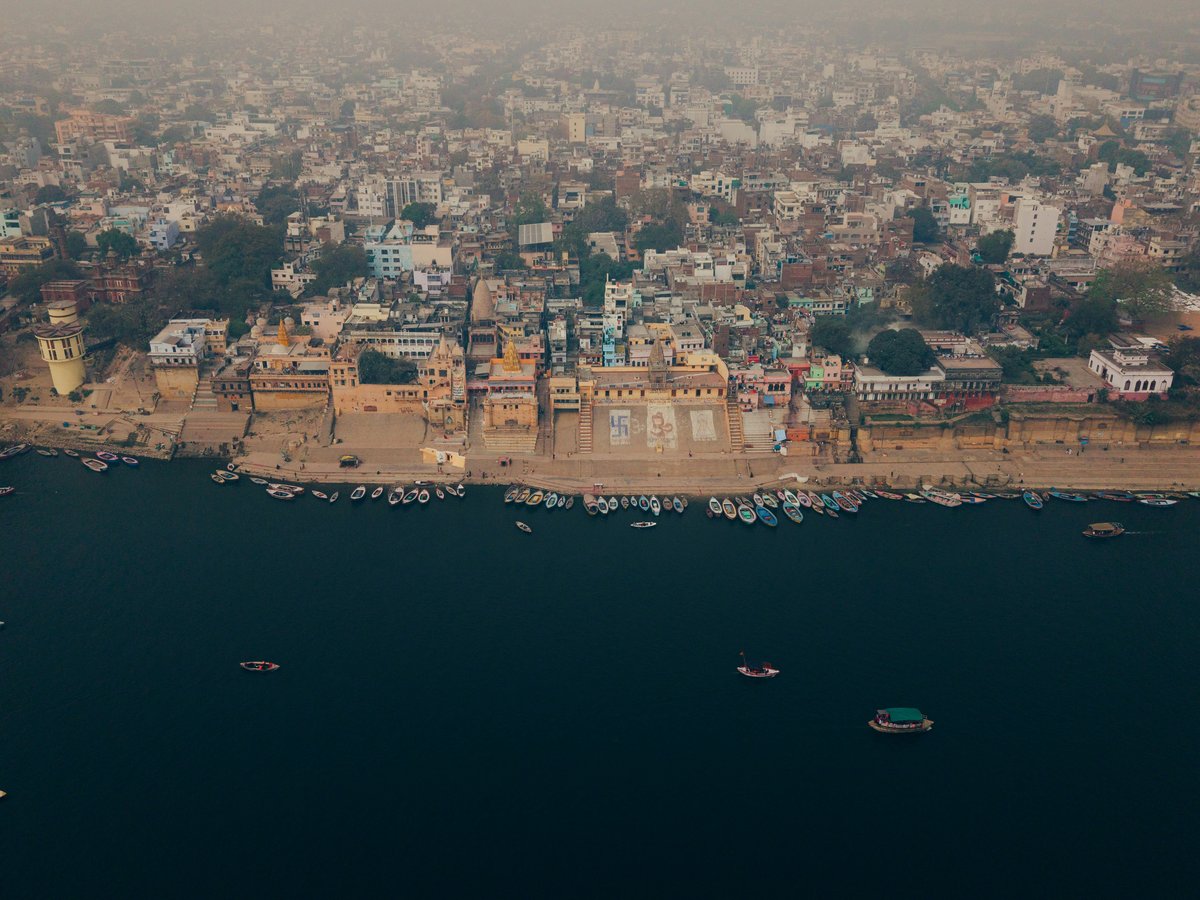
Varanasi bends along the western bank of the Ganges in a loose crescent, with 84 stone ghats forming a nearly 7-kilometer stairway down to the river. The oldest neighborhoods sit directly behind these ghats, packed into alleys so narrow that two people struggle to pass each other. Head west from the river and the city loosens. Streets widen near Godowlia Chowk, the commercial roundabout about 500 meters inland from Dashashwamedh Ghat. Continue west through Sigra and you reach the Cantonment area near Varanasi Junction railway station, roughly 5 kilometers from the water. South of the old city, the Banaras Hindu University campus and the Lanka intersection form a student quarter with a completely different feel. Sarnath, the Buddhist pilgrimage site, sits about 10 kilometers to the northeast. The monsoon is currently in full effect, with temperatures at 30.1°C, humidity around 75%, and light showers throughout the day. The feels-like temperature reaches 35.3°C, which is standard August weather for this stretch of Uttar Pradesh. Most visitors stay either within walking distance of the ghats or around Lanka, where auto-rickshaws to the river cost ₹100-150.
Neighborhoods
-
Dashashwamedh & Godowlia
This is the gravitational center of the city. Dashashwamedh Ghat hosts the nightly Ganga Aarti ceremony around 6:45 PM, when 5 to 7 priests perform synchronized fire rituals on a raised platform above the river. The ghat stays crowded from about 4 AM, when bathers descend the stone steps in the dark, until well past the aarti ends. Walk inland and you hit Godowlia Chowk, the commercial intersection where the old city meets wider roads. The noise level between the two is relentless. Horn honking, temple bells, hawkers, and cycle-rickshaw bells layer over each other without pause. Silk shops, brass vendors, and paan stalls fill the connecting lanes. The smell of sandalwood incense competes with diesel exhaust at every turn. Guesthouse terraces on the upper floors of lane-side buildings give direct views of the river, though rooms tend to be small and stifling in the summer months. The crowd density at evening aarti regularly exceeds several thousand people on the ghat steps.
- Best for
- First-time visitors, photographers, pilgrims who want to be at the center of the Ganga Aarti atmosphere
- Key streets
- The main lane from Dashashwamedh Ghat to Godowlia Chowk, Meer Ghat Road, the side lanes branching north toward Manikarnika Ghat
-
Assi Ghat
The southern anchor of the ghat system, where the Assi nala meets the Ganges. This is where the foreign backpacker scene settled starting in the 1990s, and it still draws long-stay travelers, yoga students, and gap-year crowds. Cafes with English menus, yoga shalas, Ayurvedic massage rooms, and guesthouses with river-facing terraces cluster within a 10-minute walk of the ghat steps. The pace is noticeably slower than Dashashwamedh. You might hear more English and Hebrew spoken here than Hindi on some mornings. A morning cultural program called Subah-e-Banaras runs at the ghat periodically, with classical music and folk performances starting around dawn. The residential feel is stronger here too. Local families use the ghat for laundry and evening walks, and the surrounding lanes have vegetable carts and small grocery shops alongside the tourist cafes.
- Best for
- Solo travelers on longer stays, yoga practitioners, budget travelers who want ghat access without the intensity of the central ghats
- Key streets
- Assi Ghat Road (the main approach from the south), the lanes between Assi Ghat and Tulsi Ghat heading north, Shivala Road running roughly parallel one block inland
-
Old City (Vishwanath Gali)
The spiritual and architectural core of Varanasi. The alleys here squeeze to 1 to 2 meters wide. Motorcycles scrape past crumbling plaster walls. Cows have permanent right of way. The Kashi Vishwanath Temple, rebuilt by Ahilyabai Holkar in 1780, sits at the center of this maze, with the Gyanvapi Mosque standing adjacent. Security checkpoints at the temple complex mean queues of 30 to 90 minutes during peak hours. The Kashi Vishwanath Corridor, completed in 2021, opened a wide paved approach to the temple. Step one lane off it and you are back in the old Varanasi of carved wooden balconies, exposed brick, and tiny shrines wedged between doorways. Mind you, this is not a comfortable area for anyone with mobility issues. Sound bounces off the close walls, amplifying everything. The residential buildings above the lanes date back 200 to 300 years, with carved jharokha balconies and plaster revealing layers of brick underneath.
- Best for
- Those who want to understand Varanasi on its own terms, pilgrims visiting Kashi Vishwanath, photographers willing to navigate tight spaces
- Key streets
- Vishwanath Gali (the main temple lane), Bengali Tola, Lahori Tola, the lanes approaching Manikarnika Ghat (the primary cremation ghat to the north)
-
Lanka & BHU
Lanka is the busy intersection at the northern gate of Banaras Hindu University, and the area around it feels like a mid-sized Indian college town rather than an ancient sacred city. Budget dhabas, photocopy shops, bookstores, and student hostels line the main road. Inside the BHU campus itself, the mood shifts entirely. Tree-lined avenues stretch across the 1,300-acre grounds. The New Vishwanath Temple, completed in 1966, stands near the center and is open to visitors of all backgrounds. Bharat Kala Bhavan, the university museum founded in 1920, holds miniature paintings, Mughal-era textiles, and a sculpture collection spanning 1,500 years. The campus is calm enough for evening walks, with birdsong audible over the traffic noise that dominates everywhere else in the city.
- Best for
- Budget travelers, students, those who want quiet accommodation with auto-rickshaw access to the ghats for about ₹100-150 for the 4 km ride
- Key streets
- Lanka intersection, the main internal avenue through BHU campus, Nagwa Road connecting eastward to the ghat area
-
Cantonment
About 5 kilometers west of the ghats, the Cantonment area is where Varanasi looks most like any other North Indian city. Wide roads laid on a British-era grid, a few colonial bungalows behind high compound walls, chain hotels like the Taj Gateway and Ramada, and Varanasi Junction railway station. St. Mary's Cathedral sits in this part of the city, a reminder of the garrison presence that shaped the neighborhood's layout. To be fair, the area lacks the density and sensory weight of the old city. But it has reliable infrastructure. Working ATMs, 24-hour pharmacies, mobile phone shops, and air-conditioned restaurants are all easy to find here. The air feels noticeably less humid than at the river, and the wider streets let you walk without pressing against walls or stepping over temple offerings.
- Best for
- Travelers arriving late by train, families with small children who need predictable hotel standards, anyone who wants air conditioning and hot water guaranteed
- Key streets
- The Mall Road area near the station, Parade Kothi Road, the stretch of GT Road between Varanasi Junction and Sigra
-
Sarnath
About 10 kilometers northeast of the ghats, Sarnath feels like a different place entirely. The Dhamek Stupa, a cylindrical stone tower standing about 43 meters high, marks the site where the Buddha is said to have delivered his first sermon in the 5th century BCE. The surrounding archaeological park is quiet and green, with deer wandering the lawns. Sarnath Museum, established in 1910, holds the original Ashoka Lion Capital, the 3rd-century BCE sculpture that became the national emblem of India, alongside dozens of Gandhara and Gupta-period pieces. Several Southeast Asian countries maintain monasteries in the area, each built in its own national architectural style. Thai, Tibetan, Japanese, Chinese, and Burmese temple compounds sit within walking distance of one another. The village beyond the archaeological park is small, with unpaved side roads and the sound of monastery bells carrying across the fields in the evening.
- Best for
- History and archaeology enthusiasts, Buddhist pilgrims, anyone who needs a half-day break from the old city's intensity
- Key streets
- Ashoka Marg (the main road through the archaeological zone), Dharmapal Road, the monastery loop connecting the Thai, Tibetan, and Japanese temple compounds
-
Sigra
A middle-class residential neighborhood roughly halfway between the ghats and the Cantonment. Sigra is where Varanasi's professional class tends to live, and the infrastructure reflects it. Good standalone restaurants line Sigra-Mahmoorganj Road, a multiplex cinema operates near IP Mall, and private hospitals including Heritage Hospital sit within the neighborhood. Mid-range hotels here cost less than comparable rooms near the ghats, and the area strikes a balance between the old city's sensory overload and the Cantonment's blandness. Auto-rickshaws to both the ghats and the railway station take 15 to 20 minutes. The streets are busy during the day but settle down after 10 PM, quiet enough that you can sleep with windows open. You might notice the temperature feels a degree or two cooler here than at the river, where humidity pools against the stone.
- Best for
- Mid-range travelers, families planning a 4 to 5 day visit, those who want to explore daily without living inside the noise
- Key streets
- Sigra-Mahmoorganj Road, the area around IP Mall, the road toward Bhelupur Crossing
FAQ
Where should a first-time visitor to Varanasi stay?
For a first visit of 2 to 3 nights, staying near Dashashwamedh Ghat or Assi Ghat puts you within walking distance of the ghats, the Ganga Aarti, and the old city lanes. Dashashwamedh is the most central location but brings the highest noise and crowd levels. Assi Ghat is calmer, with more cafe and yoga options and a slower pace. If you want predictable hotel standards with air conditioning, the Cantonment near the railway station is reliable but means an auto-rickshaw ride each way to the river.
Is Varanasi safe for solo travelers?
Varanasi scores 5.8/10 for solo-traveler safety (see the TTDI Solo-Safety Index). The ghat areas and old city lanes are generally safe during daylight, with enough foot traffic that you are rarely isolated. After dark, the alleys behind the ghats become poorly lit and easy to get disoriented in. Common issues for solo travelers include aggressive touts, overcharging auto-rickshaw drivers, and commission scams at silk shops where a driver steers you to a particular store for a kickback. Pre-negotiating rickshaw fares and walking away from unsolicited shop recommendations helps considerably.
How family-friendly is Varanasi as a destination?
Varanasi scores 4.8/10 for family friendliness (see the TTDI Family-Friendliness Index). The old city's narrow alleys, open cremation ghats, uneven steps, and aggressive traffic make it difficult with strollers or small children. That said, families with older kids who can handle sensory overload often find the cultural exposure worth the logistics. The Cantonment and Sigra neighborhoods have family-suitable hotels, and Sarnath makes for a calmer, greener day trip. Avoid the central ghats area with small children during evening aarti, when crowd density peaks.
Is Varanasi welcoming for LGBTQ+ travelers?
Varanasi scores 3.5/10 for LGBTQ+ friendliness (sourced from TTDI's editorial rubric). Public displays of affection between same-sex couples tend to draw stares and potentially hostile reactions, particularly in the conservative old city neighborhoods. That said, Varanasi is also home to a visible hijra community that participates in religious ceremonies at the ghats. The backpacker areas around the southern ghats are more relaxed overall, though open LGBTQ+ venues do not currently exist anywhere in the city. Discretion is the practical reality here.
Can digital nomads work from Varanasi?
Varanasi scores 3.2/10 for digital-nomad suitability (sourced from TTDI's editorial rubric). Wi-Fi at guesthouses is inconsistent, and power cuts still happen during monsoon season, sometimes several times a day. The cafe scene around the southern ghats has a few spots with workable connections, but bandwidth drops during peak hours. Coworking spaces are essentially nonexistent. Mobile data on Jio or Airtel 4G is often more reliable than fixed-line internet for video calls. Varanasi works for a few days of light-bandwidth work but is not currently practical as a longer-term remote base.
How much should I budget for accommodation in Varanasi?
At the current exchange rate of 1 USD to 95.69 INR, Varanasi is one of the cheaper major destinations in India. A basic guesthouse room near the ghats runs ₹500-1,200 per night, roughly $5-13. Mid-range hotels in the residential neighborhoods charge ₹1,500-3,500 ($16-37). Chain hotels near the railway station start around ₹5,000-8,000 ($52-84) for an air-conditioned room with reliable hot water. During peak season from October through March, and especially around Dev Deepawali in November, ghat-area guesthouse prices can double, and advance booking becomes necessary.
Last verified by automated review (v1.7.2) on . What is automated review?