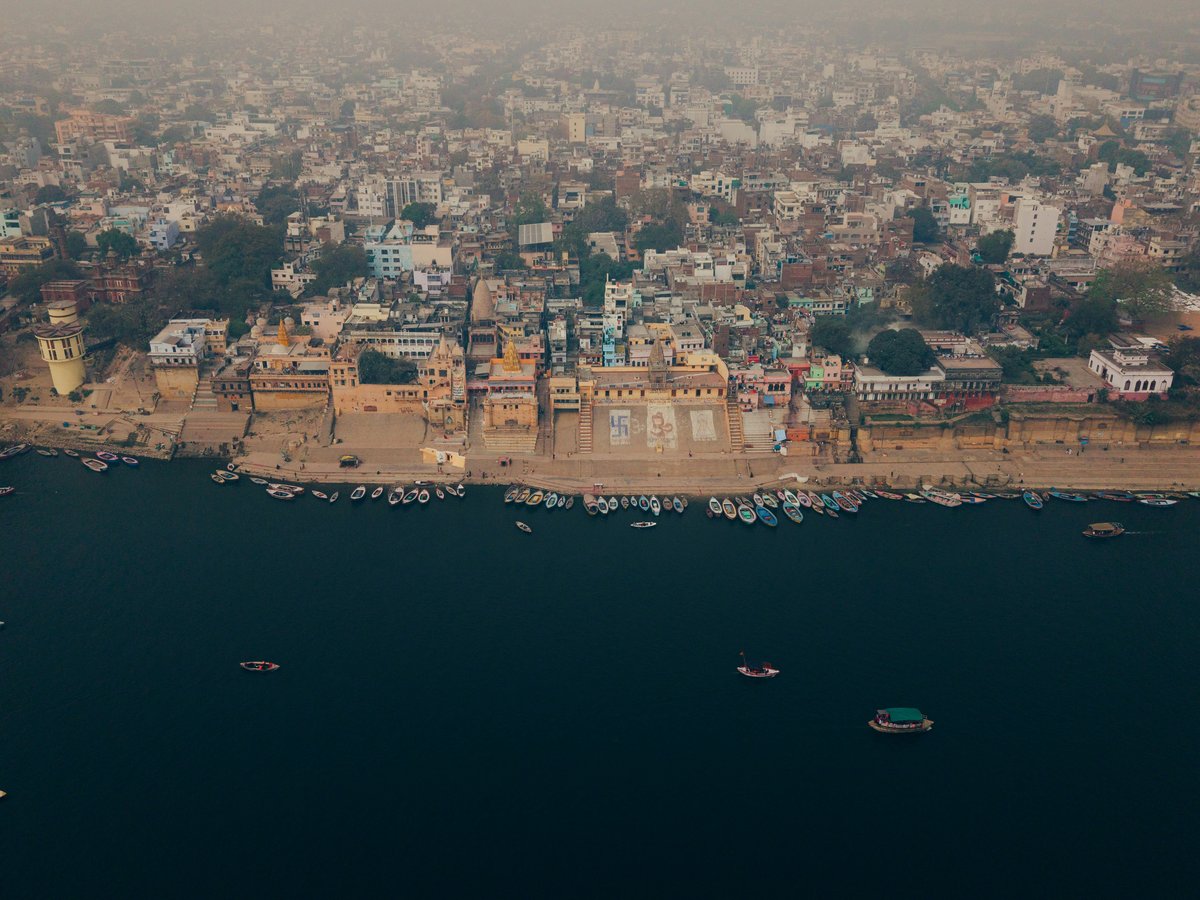
Varanasi is likely among the oldest continuously inhabited cities on earth. Its recorded history stretches back roughly 3,000 years. More than 80 ghats line about 6 kilometers of the Ganges' western bank, all of them permanently open public space. No tickets, no barriers, open 24 hours. You walk down stone steps polished by centuries of bare feet and find yourself surrounded by morning yoga, laundry spread across warm stone, cricket matches, and cremation pyres within a few hundred meters of each other. More than 20 temples within a square kilometer of the riverfront rarely charge entry, and the old city's tangled lanes are free to walk at any hour. At roughly 95.7 INR to 1 USD, even ticketed sites lean affordable by international standards. But the Varanasi that stays with you lives in what costs nothing. Dawn light on the Ganges at 5 a.m. Sandalwood and marigold smoke drifting through the aarti at Dashashwamedh. Temple bells at Vishwanath before the city wakes. The riverfront between Panchganga Ghat and Manikarnika likely predates the Mughal period and stays open around the clock.
Free attractions
-
Dashashwamedh Ghat
The city's most prominent ghat sits at the end of Vishwanath Gali, roughly halfway along the riverfront. The wide stone steps accommodate thousands of people daily. You'll find flower sellers, sadhus, massage practitioners, and photographers here at all hours. The atmosphere shifts considerably between the quiet 5 a.m. scene and the dense evening crowd that gathers for the nightly fire ceremony. No entry fee, no hours, always accessible.
Dashashwamedhghat -
Assi Ghat
The southernmost of the major ghats, where the Assi River meets the Ganges. It tends to attract a younger crowd, with university students from nearby BHU and long-term foreign visitors. A large Shiva lingam sits under a peepal tree at the ghat's edge. Morning puja here is smaller and more intimate than the Dashashwamedh ceremonies. The ghat doubles as a de facto public park, with people exercising, reading, and eating street food on the steps throughout the day.
Assighat -
Manikarnika Ghat
Varanasi's primary cremation ghat, where funeral pyres burn continuously. The fires have reportedly not gone out in centuries. The ghat sits roughly 400 meters north of Dashashwamedh along the riverfront walkway. The smell of burning wood and the sound of chanted prayers make this the most intense sensory stop on the ghat walk. Visiting is free, though the atmosphere demands respect and photography is not permitted near the pyres.
Manikarnikaghat -
Kashi Vishwanath Corridor
The expanded temple complex around the original Kashi Vishwanath Temple opened after a major reconstruction completed in 2021. The corridor itself, with its colonnaded walkways and views of the temple spires, is free to walk through after passing a security check. Mind you, the inner sanctum of the original temple remains accessible to Hindu visitors only. The corridor offers views of both the temple and the adjacent Gyanvapi Mosque, a juxtaposition that captures centuries of layered history. Bags and phones must be deposited at the locker facility before entry.
Vishwanathtemple complex -
Tulsi Manas Mandir
A white marble temple built in 1964, dedicated to Lord Ram. The walls carry verses from the Ramcharitmanas, the Hindi retelling of the Ramayana written by the poet Tulsidas, who lived in Varanasi in the 16th century. The temple is open to visitors of all backgrounds, no entry fee. The interior is cool even in summer, and the carved marble panels reward slow examination. It sits on Durgakund Road, about 2 kilometers from the riverfront.
Durgakundtemple -
Sankat Mochan Hanuman Temple
Local tradition credits Tulsidas with founding this temple in the 16th century. It sits in a quiet compound about 1.5 kilometers south of the main ghat area. Langur monkeys populate the grounds and are considered part of the sacred atmosphere. The temple draws locals more than tourists, which gives it a different texture from the riverside sites. Tuesday and Saturday evenings see the largest attendance for special puja services. Free entry, open to all.
Sankat Mochantemple -
Sarnath Museum
The Archaeological Survey of India established this museum in 1910 at the site where the Buddha delivered his first sermon after attaining enlightenment. The collection includes the original Lion Capital of Ashoka, India's national emblem, dating to the 3rd century BCE. Normal admission runs around INR 25 for Indian visitors and considerably more for foreign nationals. That said, ASI sites typically waive fees on August 15 (Independence Day) and January 26 (Republic Day). The museum sits about 10 kilometers northeast of the main ghat area in the town of Sarnath.
Sarnathmuseum -
Bharat Kala Bhavan
Banaras Hindu University opened this museum in 1920 on its sprawling campus south of Assi Ghat. The collection holds over 100,000 artifacts spanning Indian art history, from miniature paintings and textiles to Mughal-era manuscripts. A nominal entry fee applies on regular days. The museum tends to participate in International Museum Day on May 18 with free admission, though confirming the current year's schedule at the gate is worth the small effort.
BHU Campusmuseum -
Benia Bagh
A historic public maidan in the Benia Bag neighborhood, likely dating to the colonial era. The open ground functions as a park, cricket pitch, and community gathering space. Morning walkers and joggers use it before the heat builds. It sits roughly 1 kilometer west of the main riverfront, offering a breather from the density of the ghat-side lanes. Free, always open.
Benia Bagpark -
BHU Campus Grounds
The Banaras Hindu University campus covers roughly 1,300 acres south of Assi Ghat. The grounds are planted with mature trees, and the wide roads feel startlingly quiet compared to the old city's lanes. The New Vishwanath Temple (Birla Temple) inside the campus is open to visitors of all faiths, no charge. You can walk from the main gate to the temple in about 20 minutes along a shaded avenue. Security may ask for ID at the gate.
Lankapark and campus -
Durgakund
A large rectangular pond flanked by the Durga Temple, surrounded by a paved walkway and shade trees. Turtles surface in the green water for food scraps tossed by visitors. The Durga Temple, also called the Monkey Temple for the resident rhesus macaques, is free to enter, though non-Hindu visitors may be limited to the outer courtyard. The combined pond-and-temple area works as an informal park, especially in the early morning. It sits on Durgakund Road between the Lanka crossing and Assi.
Durgakundpark and temple pond
Free activities
-
Ghat Walk from Assi to Manikarnika
The roughly 4-kilometer walk along the ghats follows the stone steps and elevated walkways from south to north. You pass through at least 30 named ghats, each with a different character. Some are wide and busy, others narrow and overgrown. The route takes about 90 minutes at a comfortable pace, though you'll likely stop often. The textures shift constantly. Smooth flagstone gives way to crumbling medieval brick, then polished modern granite at the renovated sections. Early morning, around 5:30 to 7:00, is the most atmospheric time, with bathers, priests, and dhobi wallahs all working the river simultaneously.
Riverfrontwalking route -
Vishwanath Gali and Godowlia Market
The narrow lane connecting Godowlia crossing to the Kashi Vishwanath Temple is one of the densest commercial streets in northern India. Silk shops, brassware vendors, booksellers, and sweet shops compete for attention on both sides. Browsing costs nothing, and shopkeepers in Varanasi tend to be less aggressive than in, say, Jaipur or Delhi. The sweet shops offer the chance to smell fresh jalebis frying in ghee. Worth noting that the lane narrows to about 2 meters wide in places, and during evening hours the foot traffic slows to a near standstill.
Vishwanathmarket browsing -
Walking the Old City Galis
The lanes of the old city form a maze between the main road and the riverfront. Most are too narrow for vehicles. You'll encounter small neighborhood temples every 50 meters or so, sometimes with offerings still smoking. The walls carry painted advertisements for silk shops and astrologers alongside genuine Mughal-era stonework. The area between Meer Ghat and Panchganga Ghat, in the Muslim weaving quarter, offers a look at handloom Banarasi silk production. Some weavers will let you watch their looms if you ask politely.
Old Citywalking and culture -
Malviya Bridge Viewpoint at Sunrise
The Malviya Bridge (also called Rajghat Bridge) at the northern end of the ghat line offers a free elevated view of the full riverfront at sunrise. The panorama extends from Raj Ghat in the north to the distant curve near Assi. The bridge carries rail traffic, so the vibration of passing trains adds to the experience. The eastern bank of the Ganges, largely undeveloped sandy flats, catches the first light in a way that photographs well. The walk from the old city to the bridge takes about 25 minutes.
Rajghatviewpoint -
Ramnagar Fort Exterior and Riverbank
The 18th-century fort of the Maharaja of Benares sits on the eastern bank of the Ganges, opposite Tulsi Ghat. The interior museum charges a small fee, but the fort's exterior, the surrounding riverbank, and the approach through Ramnagar village are free. The red sandstone walls look particularly striking in late afternoon light. A pedestrian ferry crosses the river to the fort from the western bank for a nominal fare of about INR 20 to INR 30, though you can also reach it by road via the bridge.
Ramnagarhistoric site and walking -
Silk Weaving Workshops in the Muslim Quarter
The neighborhoods between Madanpura and Alaipura are home to thousands of handloom weavers producing Banarasi silk saris. Some workshop owners allow visitors to watch the weaving process, which involves wooden looms, punch-card patterns, and silk thread in dozens of colors. The rhythmic clack of the looms carries through the narrow lanes. There is no organized tour or fee structure. You walk through the area, listen for the sound of working looms, and ask. Most weavers are happy to explain their craft if you show genuine interest.
Madanpuracraft and culture
Free events
-
Ganga Aarti at Dashashwamedh Ghat
Daily, starting at sunset (approximately 18:00 in winter, 19:00 in summer)A choreographed fire ceremony performed by a group of young priests on a raised platform at the ghat's edge. The ritual involves large brass lamps, incense, conch shells, and synchronized movements set to devotional chants. The sound reverberates off the surrounding buildings and across the water. Hundreds of people gather nightly on the steps and in boats on the river. No tickets, no reserved seating. If you arrive 30 to 45 minutes early, you can secure a spot with a clear sightline. The ceremony runs about 45 minutes.
Dashashwamedh Ghat -
Subah-e-Banaras
Select mornings, often Sunday, typically 5:30 to 7:00 (schedule varies seasonally)A morning cultural program at Assi Ghat that features classical music, folk performances, and poetry recitals. The event started as a tourism initiative and has become a semi-regular fixture. Performers sit on a temporary stage near the water while the audience gathers on the ghat steps. The combination of live music and the visual backdrop of the river at dawn is hard to match anywhere else in India. Check locally for the current schedule, as it tends to run on select mornings rather than daily.
Assi Ghat -
Ramnagar Ram Lila
Annual, during Dussehra season (September or October, roughly 31 days ending on Vijayadashami)A month-long dramatic retelling of the Ramayana performed in and around Ramnagar Fort, recognized by UNESCO as Intangible Cultural Heritage. The production moves through different outdoor locations each evening, with the audience following the performers on foot. It has been performed annually since the early 19th century under the patronage of the Maharaja of Benares. The scale is hard to convey. Entire neighborhoods become stages. Free to attend, though reaching Ramnagar from the old city requires either a boat or road transport.
Ramnagar Fort and surrounding grounds -
Dev Deepawali
Annual, Kartik Purnima (full moon, usually mid to late November)Fifteen days after Diwali, on the full moon of Kartik (typically November), the ghats are decorated with over a million earthen oil lamps. The entire riverfront glows from Assi to Raj Ghat. Many buildings along the ghats are illuminated with additional lighting. The main ceremonies center around Dashashwamedh and Panchganga Ghat. Free to watch from any ghat. Boat operators charge premium fares on this night.
All ghats, centered on Dashashwamedh and Panchganga -
Mahashivratri Celebrations
Annual, February or March (Hindu calendar date varies)The night of Shiva is Varanasi's most significant religious observance, given that the city is considered Lord Shiva's earthly home. Processions move through the old city lanes from late evening through dawn. Temples stay open all night. The atmosphere along the ghats fills with chanting, drumming, and the thick smell of cannabis-laced bhang, which is legal and traditional during this festival. Free to participate in or observe from any public space.
Citywide, concentrated at Kashi Vishwanath and the ghats
Seasonal Notes for Budget Visitors
Varanasi's monsoon season, roughly July through September, brings humidity that currently hovers around 96% with temperatures near 27°C that feel closer to 35°C. Light drizzle is common during this period. The upside for budget travelers is that ghat crowds thin considerably, and the Ganges rises dramatically, sometimes submerging the lower steps entirely. The river changes color from its dry-season grey-green to a silty brown. October through March is the more comfortable window, with December and January mornings dropping to around 5°C to 8°C along the river. The cool season also coincides with most of the major free festivals, including both Dev Deepawali and Mahashivratri mentioned in this guide. April through June brings temperatures above 40°C. The ghats empty out by mid-morning, but the pre-dawn hours, around 4:30 to 5:30 a.m., still drop below 35°C even in May.
Practical Considerations for Free Varanasi
Varanasi rates a 5.8 out of 10 for solo-traveler safety (see the TTDI Solo-Safety Index). The main risk areas for solo visitors are the narrow, poorly lit galis after dark and the persistent touts around Dashashwamedh. Petty scam attempts, particularly fake guides and inflated boat fares, are common but rarely dangerous. For families, the city scores 4.8 out of 10 on family friendliness (see the TTDI Family-Friendliness Index). The terrain is the main challenge. Steep, uneven ghat steps and the absence of railings make strollers and wheelchairs impractical along the riverfront. LGBTQ+ visitors should be aware that Varanasi scores 3.5 out of 10 on LGBTQ+ friendliness (sourced from TTDI's editorial rubric). India's Supreme Court struck down Section 377 in 2018, but Varanasi remains socially conservative. Public displays of affection between same-sex couples are likely to draw unwanted attention. Digital-nomad infrastructure remains limited, with inconsistent Wi-Fi and few coworking spaces outside a handful of cafes near Assi Ghat. For more on navigating the city itself, Wikivoyage's transport overview at https://en.wikivoyage.org/wiki/Varanasi#Get_around covers auto-rickshaw rates and walking distances between neighborhoods.
What Used to Be Free (or Appears Free but Is Not)
A few sites in Varanasi are sometimes listed as free but currently are not. The Sarnath archaeological zone surrounding the Dhamek Stupa charges admission for both Indian and foreign visitors, separate from the museum fee described in the attractions list above. Ramnagar Fort's interior museum charges around INR 15 to INR 25. Boat rides on the Ganges are never free, despite occasionally appearing in free-things-to-do lists. Even the shortest trip from one ghat to the next runs INR 100 to INR 200 per person, and sunrise boat rides have been reaching INR 300 to INR 500 per seat in recent years. The Kashi Vishwanath Temple's VIP darshan line, when offered, sometimes carries a fee, though standard entry through the corridor remains free. St. Mary's Cathedral in the Cantonment area has no entry fee, but it functions as a parish church rather than a visitor attraction. Opening hours outside of Sunday services can be unpredictable.
Sources
City orientation, transport, and safety information referenced from Wikivoyage's Varanasi article at https://en.wikivoyage.org/wiki/Varanasi, including sections on arriving (https://en.wikivoyage.org/wiki/Varanasi#Get_in), local transit (https://en.wikivoyage.org/wiki/Varanasi#Get_around), attractions (https://en.wikivoyage.org/wiki/Varanasi#See), food districts (https://en.wikivoyage.org/wiki/Varanasi#Eat), and safety (https://en.wikivoyage.org/wiki/Varanasi#Stay_safe). Content is available under CC-BY-SA. Ground-truth data includes currency rates from Frankfurter (observed 2026-08-21), weather from Open-Meteo (observed 2026-08-23), and TTDI editorial scores computed from a weighted multi-source rubric. Sarnath Museum and Bharat Kala Bhavan founding dates verified via Wikidata entries Q1567294 and Q23035092 respectively.
FAQ
Is the Ganga Aarti at Dashashwamedh Ghat really free to watch?
Yes, the nightly ceremony is free from the ghat steps. There is no ticketed area and no official charge. Some people watch from boats on the river, which does cost money. Boat operators set their own rates, typically INR 100 to INR 300 per person for aarti viewing. On the ghat itself, you may encounter people claiming to collect donations or offering premium seating. These are unofficial. A spot in the first three rows typically requires arriving 30 to 45 minutes before the ceremony begins.
Can non-Hindu visitors enter the temples for free?
Most temples in Varanasi are free regardless of background. Tulsi Manas Mandir and the New Vishwanath Temple at BHU both welcome visitors of all faiths. Sankat Mochan Hanuman Temple is similarly open. The original Kashi Vishwanath Temple allows only Hindu visitors into the inner sanctum, though the surrounding corridor is open to all after security screening. Durga Temple at Durgakund may limit non-Hindu visitors to the outer courtyard. When in doubt, ask at the entrance. No temple in Varanasi charges a mandatory entry fee.
Are there free walking tours available in Varanasi?
Organized free walking tours occasionally operate on a tip-based model, but they come and go. The more reliable free walk is a self-guided route along the ghats from Assi in the south to Manikarnika in the north, which passes through the core of the city's riverfront life. The old city galis between Godowlia and the river are also best covered independently. Wikivoyage's attractions section at https://en.wikivoyage.org/wiki/Varanasi#See provides a useful orientation to the main sights. The entire riverfront is walkable without a guide.
What is the best time of year to visit Varanasi on a budget?
October through February offers the most comfortable weather for spending long hours outdoors at the ghats and temples. This window also overlaps with the major free festivals. The monsoon months bring fewer tourists and lower accommodation rates, with guesthouse rooms near Assi Ghat starting around INR 400 to INR 600 per night during the July-through-September low season.
Is Varanasi safe for solo travelers at the free attractions?
The free attractions are generally safe during daylight hours. The ghats are populated from before dawn until well after dark, and the presence of other visitors, pilgrims, and locals provides a natural layer of security. The old city lanes become poorly lit and disorienting after sunset, so first-time visitors might want to stick to the main ghats and arterial roads in the evening. Wikivoyage's safety section at https://en.wikivoyage.org/wiki/Varanasi#Stay_safe covers common scams and areas to exercise caution. The most frequent issues are aggressive touts near major temples and unofficial guides who approach near Dashashwamedh.
Do the Sarnath Museum and Bharat Kala Bhavan ever offer free entry?
Both museums charge nominal admission on regular days. The Sarnath Museum, as an Archaeological Survey of India site, has historically waived entry on the national holidays mentioned in its listing above. Bharat Kala Bhavan tends to participate in International Museum Day as described in its entry. These policies can shift year to year, so confirming at the gate or checking the ASI website before your visit is worth the small effort.
Last verified by automated review (v1.7.2) on . What is automated review?