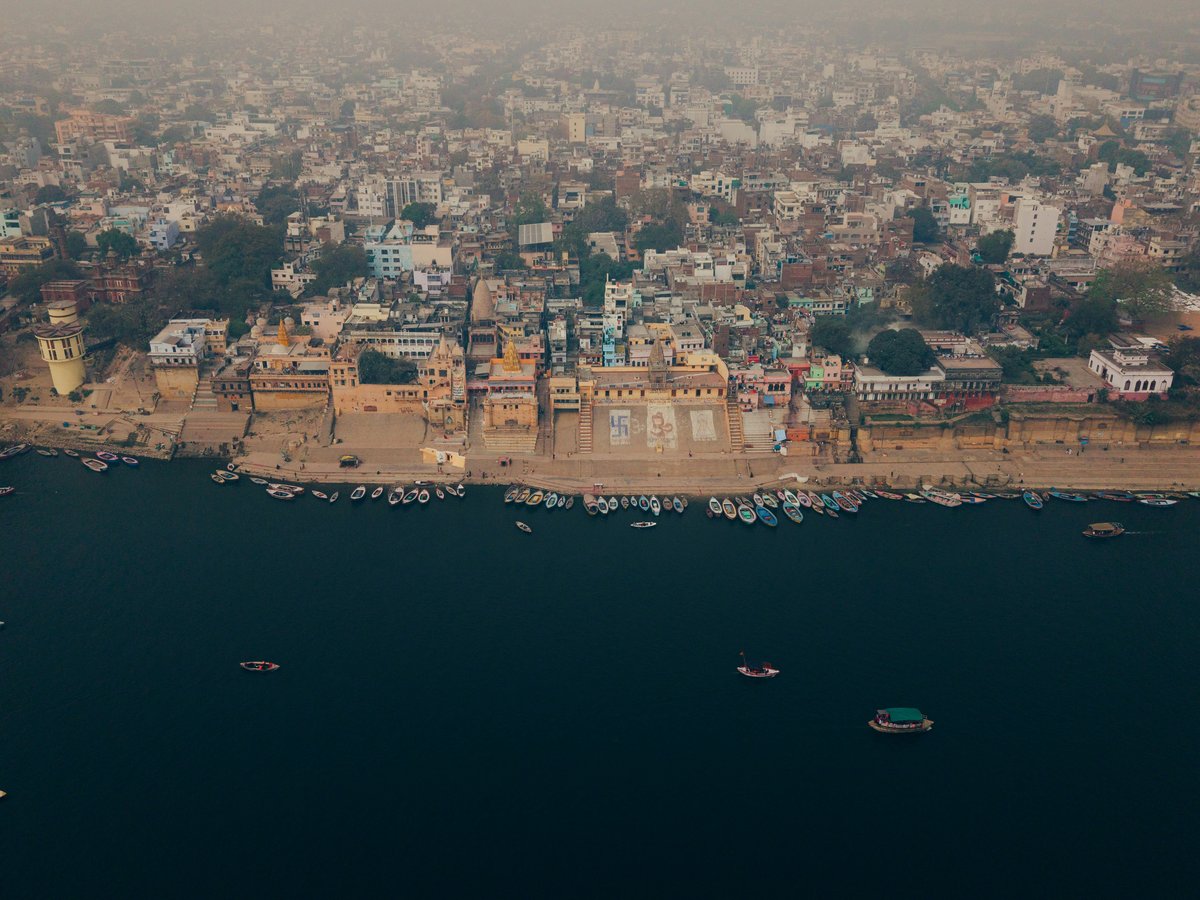
Varanasi sits on the western bank of the Ganges in Uttar Pradesh, about 80 meters above sea level on the Indo-Gangetic Plain. Over 80 stone ghats run from Assi Ghat in the south to Raj Ghat near the railway bridge, covering roughly 6 kilometers of stepped waterfront. You'll feel worn sandstone under your soles at Dashashwamedh Ghat and smell woodsmoke mixed with marigold near the cremation grounds. The elevation varies by less than 10 meters across the entire metropolitan area, and the nearest real hills, the Vindhyan ridges, sit about 70 kilometers to the south. October through February is the window for comfortable outdoor activity, when daytime highs settle between 15°C and 25°C. Summers push past 45°C by May. In mid-August, temperatures run around 30.1°C but humidity near 75% and light monsoon showers make the ghat steps slick, with the perceived temperature closer to 35°C. The city scores 5.8 out of 10 for solo-traveler safety (see the TTDI Solo-Safety Index), so well-lit ghats and secured valuables matter after dark. To be fair, Varanasi is not a conventional outdoor-adventure destination. The terrain is flat alluvial plain, the infrastructure favors pilgrims over trekkers, and the summer heat is genuinely dangerous. But the Ganges riverfront offers something no mountain trail can replicate, and the few excursions into the Vindhyan foothills reward those willing to drive 90 minutes south.
Outdoor activities
-
Ghat Promenade Walk: Assi to Manikarnika
The stretch from Assi Ghat north to Manikarnika Ghat covers roughly 4 kilometers of uneven stone steps, narrow connecting lanes, and open waterfront platforms. You'll pass Tulsi Ghat, the smaller cremation pyres at Harishchandra Ghat, and the wide plaza at Dashashwamedh Ghat where the evening Ganga Aarti draws hundreds of spectators nightly. Expect to step around cows, sleeping dogs, and drying laundry between Kedar Ghat and Meer Ghat. The sound of temple bells carries across the water from 5 AM onward, and chai vendors set up every 200 meters or so along the upper steps. Mornings before 7 AM offer the best light and smallest crowds. During monsoon months, the lower steps at some ghats sit underwater, which forces detours up into the lanes.
- Difficulty
- Easy, but uneven footing requires attention
- Duration
- 2-3 hours with stops
- Best season
- October to February
-
Cycling to Sarnath
The 10-kilometer ride from the old city to Sarnath follows a mix of main roads and quieter stretches through Varanasi's northern suburbs. Traffic is genuinely chaotic in the first 3-4 kilometers near Godowlia crossing. Once past the railway overpass, the road opens and flattens. Several rental shops near Assi Ghat offer single-speed bicycles for 100-150 INR per day. The route passes St. Mary's Cathedral in the cantonment area, a stone church that makes a reasonable halfway rest stop. The entire route is flat. Allow time at the far end to walk the Sarnath archaeological zone before riding back.
- Difficulty
- Easy terrain, moderate traffic navigation required
- Duration
- Half day (4-5 hours round trip with stops)
- Best season
- November to February
-
Bird Watching Along the Ganges Floodplain
The Ganges floodplain north of Raj Ghat and the marshy areas near Ramnagar attract migratory species between November and February. Sarus cranes, painted storks, and several kingfisher species appear along the river's edge during winter months. After the monsoon recedes in October, sandy banks emerge where waders and terns congregate. No formal trails exist here. You'll walk along riverbanks and through muddy fields. Bring binoculars and expect wet feet. Early mornings between 6 and 8 AM tend to be most productive, when mist sits low on the Ganges and the birds are active along the shallows.
- Difficulty
- Easy
- Duration
- 2-3 hours
- Best season
- November to February
-
Akhara Visit at Tulsi Ghat
Varanasi has maintained its traditional kushti wrestling culture for centuries, and several akharas, open-air wrestling pits, still operate along the ghats. The pit near Tulsi Ghat is among the more active. Wrestlers train in packed-earth arenas starting around 5:30 AM, doing exercises with stone nals and wooden joris before sparring. You can watch from the edges. The thud of bodies hitting compacted clay and the thick smell of mustard oil are distinctive. The Tulsi Ghat akhara is an active training space, not a performance for tourists. Ask the wrestlers before photographing their practice.
- Difficulty
- Spectator only
- Duration
- 30-60 minutes
- Best season
- Year-round (mornings only)
-
Sunrise Yoga at Assi Ghat
Several independent teachers run drop-in yoga sessions on the steps of Assi Ghat starting between 5:30 and 6:00 AM. Sessions typically last 60-90 minutes and cost 200-300 INR. The Ganges reflects orange-pink dawn light during winter months, and the sound of water lapping against the lower steps provides steady background rhythm. The stone is hard on knees and hips, so bring a mat or thick towel. During monsoon months, sessions move to covered areas nearby. Guesthouse staff near Assi Ghat can point you toward the more experienced of the 5-6 instructors who rotate through the area.
- Difficulty
- Beginner to intermediate depending on instructor
- Duration
- 60-90 minutes
- Best season
- October to March
Day hikes
-
Chandraprabha Wildlife Sanctuary Trails
The Vindhyan foothills about 70 kilometers south of Varanasi hold Chandraprabha Wildlife Sanctuary, spread across roughly 78 square kilometers of dry deciduous forest and rocky terrain. The trails here are the closest thing to real hiking accessible from the city. Two waterfalls, Rajdari and Devdari, sit about 1 kilometer apart. A rough forest path connects them through terrain that involves scrambling over exposed rocks and tree roots. Nilgai, wild boar, and langur monkeys are common along the trail. The drive from Varanasi takes about 2 hours each way through Chandauli district, so leave by 6 AM. Local guides are available at the sanctuary entrance for around 300-500 INR and know which paths are passable after rain.
- Difficulty
- Moderate (rocky terrain, scrambling near the falls)
- Duration
- Full day (2 hours driving each way, 3-4 hours walking)
- Best season
- October to March (falls run strongest September through November after the monsoon)
-
Chunar Fort Hill Walk
Chunar Fort sits on a rocky promontory above the Ganges, about 40 kilometers southwest of Varanasi. The walk from the base village to the fort entrance climbs roughly 60-70 meters over a paved but steep ramp. The fort itself is extensive. You can spend an hour or more walking its walls and ramparts, which offer long views up and down the river valley. Stone walls date from various periods, with Mughal and British-era additions layered over older construction. The site sees few tourists on weekdays, which gives it a quiet, slightly overgrown character. The exposed ramparts get very hot after 10 AM in any season except winter, so arrive early and bring 2 liters of water.
- Difficulty
- Easy to moderate (one sustained uphill section of about 15 minutes)
- Duration
- Half day (90 minutes each way by road, 1.5-2 hours at the fort)
- Best season
- November to February
-
Sarnath Archaeological Circuit Walk
More of a long flat walk than a hike, the circuit around Sarnath's archaeological and religious sites covers about 5 kilometers if you include the Thai, Japanese, Chinese, and Tibetan temples that ring the ancient core. The route is entirely on paved roads or packed earth. It starts at the main archaeological park, loops through the adjacent Mulagandha Kuti Vihara, and follows the road past international Buddhist temples that each country has built in its own architectural style. The contrast between a gilded Thai roof and a minimalist Japanese meditation hall within 200 meters of each other is genuinely interesting. Pack water, because shade is intermittent along the temple road between Sarnath's core and the outlying monasteries.
- Difficulty
- Easy (flat, paved or packed earth throughout)
- Duration
- 2-3 hours at a relaxed pace
- Best season
- October to February
Water activities
-
Sunrise Rowing Boat Ride Along the Ghats
The signature Varanasi water experience. Wooden rowing boats seat 4-6 passengers and launch from most major ghats. Dashashwamedh Ghat and Assi Ghat are the busiest departure points. A 2-hour ride at dawn takes you downstream past the cremation ghats and back. The light at sunrise turns the sandstone steps gold and orange while the splash of bathers, the clang of bells, and low chanting from prayer groups fill the air. Negotiate the price before boarding. A private 2-hour boat should cost 300-500 INR at current rates, where 1 USD converts to roughly 96 INR. Avoid the touts near Dashashwamedh who quote 2,000-3,000 INR to foreign visitors. Mornings are calm on the water. By 10 AM, motor boats and larger ferries churn up wakes that make the ride less pleasant.
- Difficulty
- Easy (passenger activity)
- Duration
- 1.5-2 hours
- Best season
- Year-round, but October to February for comfortable temperatures
-
Cross-River Ferry to the Eastern Bank
Small passenger ferries cross the Ganges from ghats near Dashashwamedh to the eastern bank village below Ramnagar Fort throughout the day. The crossing takes 15-20 minutes depending on the current and the season. During monsoon months the river widens considerably and the current runs fast, which makes the crossing slower and rougher. From November onward, the river narrows and sandy islands emerge mid-channel where you can walk. The fare runs 10-20 INR per person. The eastern bank is rural and quiet. You can walk along the sandy flats on the far side for a kilometer or two in either direction, with clear views of the ghat skyline across the water.
- Difficulty
- Easy (passenger ferry)
- Duration
- 30-45 minutes including crossing and return
- Best season
- November to March (calmer water, exposed sandbars for walking)
-
Evening Boat Viewing of the Ganga Aarti Ceremony
Every evening at Dashashwamedh Ghat, priests perform the Ganga Aarti with large flaming brass lamps, incense, and synchronized chanting. A boat anchored about 30-40 meters offshore gives you a wider view of the full ceremony and avoids the dense crowd on the steps. The flickering firelight reflects off the dark water surface, and the sound of bells and conch shells carries clearly from the ghat. The ceremony starts after sunset, currently around 6:30 PM in August and closer to 5:30 PM by December. Arrange a boat 30-45 minutes before it begins, as the waterfront spots fill quickly. Expect 100-200 INR per person in a shared boat. The smoke and incense smell stronger from the water than from the ghat itself, which is worth noting if you have respiratory sensitivity.
- Difficulty
- Easy (passenger activity)
- Duration
- 1-1.5 hours
- Best season
- Year-round
Parks & gardens
-
Deer Park at Sarnath
The park sits about 10 kilometers northeast of the old city, on the site where Gautama Buddha is said to have delivered his first sermon. The grounds are flat and well-maintained, with mowed lawns shaded by ashoka trees where parakeets nest. A small herd of spotted deer still lives in the enclosure, which is how the park got its English name. The Dhamek Stupa, a solid cylinder of stone and brick standing about 43 meters high, anchors the central lawn. Ruins of several monasteries spread across the surrounding grounds. The Sarnath Museum, established in 1910, holds Mauryan-era sculptures recovered from the excavations, including the original Lion Capital. Weekday mornings before 10 AM are quiet enough to sit on the grass and listen to the birds.
Highlights: Dhamek Stupa (43 meters), spotted deer enclosure, monastery ruins, 1910 archaeological museum with Mauryan-era sculpture
-
Banaras Hindu University Campus
FreeBHU's campus covers more than 1,300 acres south of Assi Ghat and feels like a different city entirely. Wide tree-lined avenues connect academic buildings separated by lawns, gardens, and shaded walkways. The Vishwanath Temple at the center draws religious visitors, but the appeal for outdoor time is the sheer scale of open green space. Morning joggers circle the main roads starting at dawn, and the botanical section near the science faculty has labeled specimen trees worth examining. Bharat Kala Bhavan, the university museum founded in 1920, sits inside the campus and makes a natural midpoint during a walking loop. The full perimeter circuit covers about 6 kilometers on paved roads.
Highlights: Tree-lined avenues, botanical section with labeled specimens, Vishwanath Temple grounds, 6-kilometer perimeter circuit
-
Benia Bagh
FreeOne of Varanasi's older public parks, Benia Bagh sits in the central city near the Benia neighborhood. It covers perhaps 3-4 acres, which is modest, but it serves as a morning gathering point for neighborhood walkers, cricket players, and families with young children. Mature banyan and neem trees provide shade across most of the park, and concrete benches line the central paths. The park fills at dawn and again at dusk. Midday it empties out in the heat. It functions as one of the few flat, open green spaces in the otherwise dense old city.
Highlights: Mature banyan and neem trees, morning walking circuit, neighborhood cricket, central-city green space
-
Ramnagar Fort Grounds
The fort sits on the eastern bank of the Ganges, about 14 kilometers from the old city by road or a shorter distance by boat across the river. Built in the 18th century by the Kashi Naresh, the sandstone walls enclose courtyards, a museum of royal artifacts, and riverside terraces with clear views back toward the western ghats. The walk from the boat landing to the main gate takes about 15 minutes through a dusty village road lined with tea stalls. During the annual Ramlila in October, the grounds outside the walls fill with spectators for the 31-day theatrical cycle that UNESCO has recognized as intangible cultural heritage.
Highlights: Riverside terraces, views of the western-bank ghats, royal artifact museum, October Ramlila performance grounds
Practical tips
- Footwear for the ghats
- The ghat steps are uneven, worn smooth by centuries of foot traffic, and slippery when wet. Sturdy sandals with good grip work better than hiking boots, which overheat within 30 minutes in any season except deep winter. You'll need to remove footwear at temple entrances frequently, so slip-on styles save real time. During monsoon months, standing water on the lower ghats and muddy paths along the riverbank make quick-dry water shoes worth packing. Barefoot on the ghat stone after 10 AM between April and September will burn your soles.
- Sun protection and heat management
- From March through June, direct sun on the exposed ghats drives perceived temperatures well above the already extreme 40-45°C ambient heat. A wide-brimmed hat, SPF 50+ sunscreen, and long sleeves in breathable fabric are essential for any outing longer than 30 minutes. Even in December, midday sun at this latitude can burn fair skin within 45 minutes. Finish outdoor activities by 10 AM during summer months. If you're heading to Chandraprabha in the warmer shoulder months, the forest canopy provides some relief, but the drive there in an unairconditioned auto-rickshaw does not.
- Hydration
- Carry at least 2 liters of water for any outing longer than an hour. Sealed bottled water is sold at shops along the main ghats for about 20 INR per liter, but supply thins out at the Chandraprabha sanctuary and on the eastern bank near Ramnagar. Oral rehydration salt packets are available at every pharmacy for about 15 INR each and worth carrying on any full-day excursion outside the city. The combination of heat, humidity, and physical exertion on uneven terrain causes faster dehydration than most visitors from temperate climates expect.
- Monsoon conditions from July through September
- The Ganges rises several meters during peak monsoon, submerging the lower ghats entirely. Waterfront walks that are straightforward in December become impassable in August. The upper ghats remain accessible but the stone steps grow slick with rain and algae. Forest trails at Chandraprabha can wash out after heavy rainfall, and the access roads through Chandauli may be impassable for hours after a downpour. Check locally before driving out. That said, the post-monsoon weeks in October offer the most dramatic river scenery, with the water running high and fast and the city freshly washed by 3 months of rain.
- Ganges water quality and health
- The Ganges at Varanasi is not safe for swimming by international health standards, despite the thousands of local residents who bathe daily. The Namami Gange program has improved conditions at certain stretches, but coliform counts remain well above WHO guidelines in most independent testing. If you enter the water during a boat boarding or a ceremonial dip, avoid submerging your face, cover any open cuts, and wash with soap afterward. The stretch near Assi Ghat tends to be cleaner than the central ghats near the cremation sites. Many visitors dip their hands or feet as a gesture of respect. That decision is personal, but make it with the water-quality data in mind.
FAQ
When is the best season for outdoor activities around Varanasi?
October through February gives the most comfortable conditions, with daytime highs between 15°C and 25°C, low humidity, and almost no rain. The post-monsoon weeks in October and November are particularly rewarding because the river runs high and the air has cleared after months of rainfall. March is warm but manageable before 10 AM. April through June is punishing, with regular 45°C days that make any extended outdoor time a genuine health risk. July through September brings the monsoon, which limits access to the lower ghats and can make the Chandraprabha sanctuary trails impassable.
Is Varanasi suitable for families with children who want outdoor time?
The city scores 4.8 out of 10 for family friendliness (see the TTDI Family-Friendliness Index), and the outdoor options reflect that rating. Boat rides on the Ganges work well for children of all ages, and Deer Park at Sarnath is a genuine draw for younger kids who'll enjoy the spotted deer enclosure. The BHU campus has enough open space for running around safely. However, the ghat walk involves uneven steps, persistent touts, and open cremation sites, which some families find overwhelming. Chaotic traffic throughout the old city makes cycling with children impractical. The Sarnath circuit and Ramnagar Fort are the most family-compatible day trips.
Do I need a guide for outdoor activities in Varanasi?
For your first ghat walk, a guide helps because the connecting lanes are genuinely confusing and poorly signed. Guesthouse staff near Assi Ghat can arrange a morning walking companion for 500-800 INR. At Chandraprabha sanctuary, a local guide knows which trails are passable after rain and where wildlife tends to gather, and costs 300-500 INR at the entrance. For boat rides and the Sarnath circuit, you can manage without one. The Sarnath archaeological park has information boards in English and Hindi at each major ruin, and the temple road beyond is a single loop.
How polluted is the Ganges at Varanasi, and can I still enjoy the river?
The pollution is documented in multiple independent studies and it is real. However, most river activities in Varanasi happen on the water, not in it. A sunrise rowing boat keeps you dry, and the sensory experience of being on the Ganges at dawn is not diminished by what flows beneath the hull. The full-immersion dip that Hindu pilgrims take is a different matter, and visitors who choose to do it should take the health precautions described in the practical tips above. Worth noting, the government's Namami Gange program has built new sewage treatment capacity at Varanasi, but the gap between installed capacity and actual treated volume remains significant according to Central Pollution Control Board reports.
Last verified by automated review (v1.7.2) on . What is automated review?