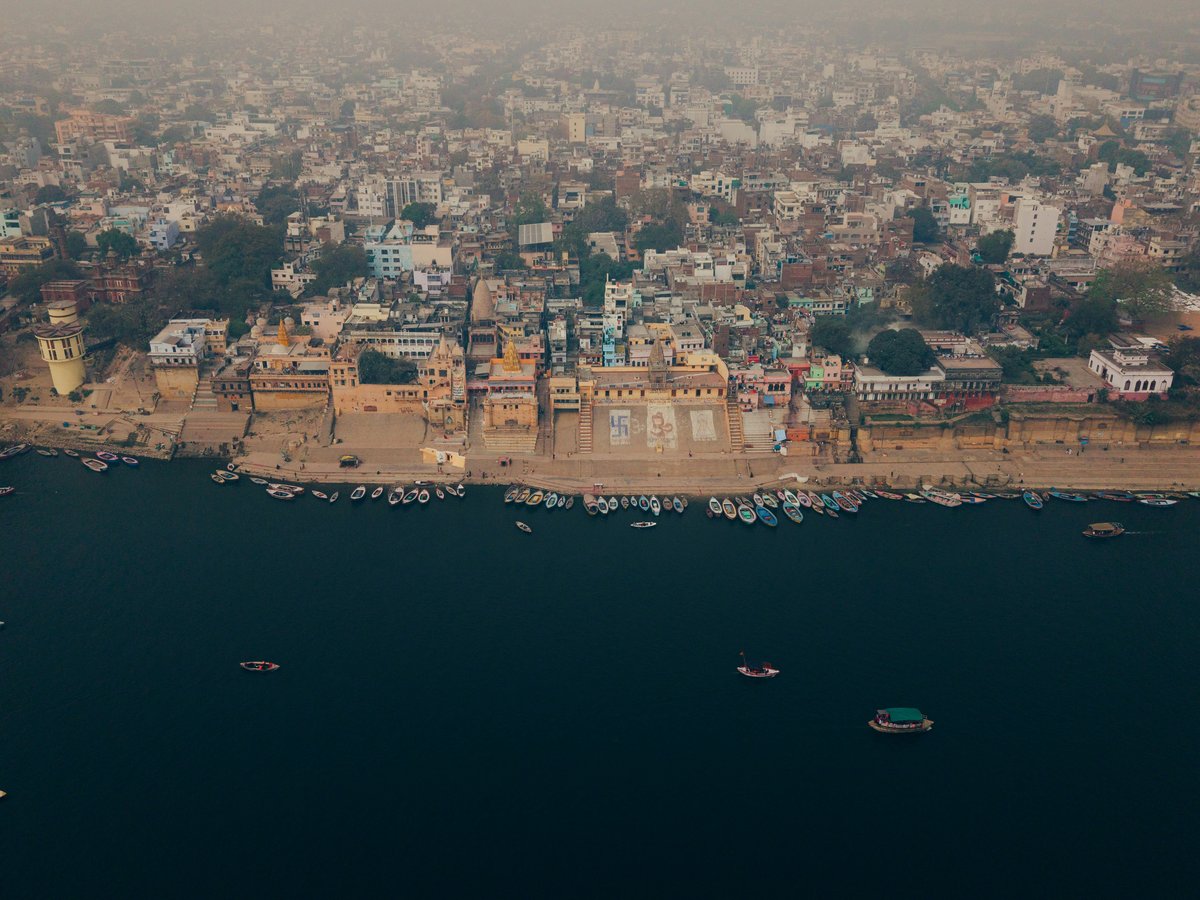
What's the must-see thing in Varanasi?
The Ganga Aarti at Dashashwamedh Ghat, held nightly at sunset. Seven priests swing five-tiered brass lamps over the Ganges while conch shells and bells carry across the water. Arrive an hour early for a step seat, or pay 100-200 INR for a boat view from the river. No reservation needed. Rain or shine, about 45 minutes.
The ceremony starts around 6:45pm at Dashashwamedh Ghat. Arrive by 5:30pm to claim a spot on the stone steps. The fourth or fifth row up tends to give you the best angle on the full choreography. Each lamp weighs roughly 15kg, and you can feel the thrown heat from three rows back. The camphor and sandalwood incense burns thick enough that the temple bells seem to vibrate in your chest rather than your ears. From a boat on the river, the smoke arrives softer, though you trade the sound intensity for a wider angle on the ghat's full sandstone facade. The ceremony runs through monsoon downpours without pause. In August, humidity currently sits around 75%, and the stone retains the day's heat well past sundown. The crowd on any given night is still majority Indian families and pilgrims. That ratio matters.
Hire a wooden rowboat at Dashashwamedh at 5:15am the next morning. The fare runs 200-400 INR for an hour depending on your negotiation, and the boatman rows south along roughly 84 ghats in a 6.8km arc. You'll pass Manikarnika Ghat, the principal cremation ground, where funeral pyres burn 24 hours a day. The wood smoke carries a sweet, heavy scent that is unmistakable. Photograph the ghats from the river but not the cremation proceedings. That boundary is firm and enforced by the families present. The early light turns the sandstone facades amber and pink, and the sound at that hour is mostly oars in water and distant temple bells starting the first prayers. The midday temperature currently reads around 30°C with a feels-like closer to 35°C, so the pre-dawn start is practical, not romantic.
Your third stop sits 10km northeast of the ghats. Sarnath is where the Buddha reportedly delivered his first sermon after attaining enlightenment, and the Dhamek Stupa, a 43-metre cylinder of stone and brick from the 5th century CE, marks the traditional spot. The Sarnath Museum, open since 1910, houses the original Lion Capital of Ashoka, the four-lion sculpture that became India's national emblem in 1950. An auto-rickshaw from the old city costs 150-250 INR one way. Budget 2 hours. The grounds are quiet compared to the ghats, almost dissonantly so. Green lawns, birdsong, a small deer park. The carved geometric bands on the Dhamek Stupa, likely added during the Gupta period, are still crisp enough to trace with your fingers at eye level.
Between the three picks, the old city itself is half the experience. The lanes of Vishwanath Galli press close enough to touch both sides with outstretched arms. They carry the smell of fried kachori, marigold garlands, and woodsmoke in shifting proportions depending on the block. You'll pass Banarasi silk shops where weavers still work handlooms visible through open doorways. Blue Lassi Shop near Manikarnika Ghat has been serving thick fruit lassi from the same narrow storefront for decades. Varanasi scores 5.8/10 for solo-traveler safety (see the TTDI Solo-Safety Index). The main risks tend to be touts and navigation confusion rather than violence. The lanes between Dashashwamedh and Manikarnika have no vehicle access, walkable but hard to leave quickly if you feel overwhelmed. Keep a charged phone with offline maps. At the current rate of about 1 USD to 96 INR, a full day covering all three picks runs under 1,500 INR in transport and entry fees. The Sarnath Museum charges 300 INR for foreign visitors. None of the three requires advance booking.
The top three
Dashashwamedh Ghat (evening Ganga Aarti)
The nightly Ganga Aarti is the single scene that defines Varanasi. The crowd sits shoulder-to-shoulder on the stone steps, still majority pilgrims rather than tourists, and that ratio tells you something about the ceremony's weight. Free from the ghats, a couple hundred rupees by boat.
Manikarnika Ghat (sunrise boat ride)
India's principal cremation ground, where funeral pyres have burned continuously for centuries. Best experienced from a pre-dawn rowboat when wood smoke and morning light hit the sandstone facades together. Confronting, but it is the reason Varanasi exists.
Sarnath
A necessary counterweight to the ghats. Where Varanasi is dense and loud, Sarnath is open grass and birdsong. The site carries weight in Buddhist history that gives the city a dimension most visitors miss by never leaving the riverfront.
Verified attractions
Sourced from Wikidata and OpenStreetMap: each entry links to its authoritative page.
-
Kashi Vishwanath Temple
place of worshipHindu temple in Varanasi, Uttar Pradesh, India
View on Wikidata -
Dhamek Stupa
place of worshipstupa at Sarnath, Uttar Pradesh, India
View on Wikidata -
Chaukhandi Stupa
place of worshipBuddhist stupa in Varanasi, Uttar Pradesh, India
View on Wikidata -
Gyanvapi Mosque
place of worshipMosque in India
View on Wikidata -
Ramnagar Fort
castlefortification near the Ganga River in Varanasi, India
View on Wikidata -
Alamgir Mosque
place of worshipmosque in Varanasi, India
View on Wikidata -
Sarnath Museum
museumarchaeological museum in Saranath
View on Wikidata -
New Vishwanath Temple
place of worshiptemple in India
View on Wikidata -
Durga Mandir, Varanasi
place of worshiptemple in India
View on Wikidata -
Sankat Mochan Hanuman Temple
place of worshipHindu temple in Varanasi, Uttar Pradesh, India
View on Wikidata -
Vishalakshi Temple
place of worshiptemple dedicated to Vishalakshi in India
View on Wikidata -
Bharat Mata Mandir
place of worshiptemple in Varanasi, India
View on Wikidata -
Tulsi Manas Mandir
place of worshiptemple in India
View on Wikidata -
Nepali Mandir
place of worshipHindu temple in Varanasi, India
View on Wikidata -
Ratneshwar Mahadev temple
place of worshiptemple in India
View on Wikidata -
Annapurna Devi Mandir
place of worshiptemple in India
View on Wikidata -
Bharat Kala Bhavan
museumuniversity museum located in Banaras Hindu University, Varanasi
View on Wikidata -
Kaal Bhairav Mandir, Varanasi
place of worshiptemple in India
View on Wikidata -
Durga Mandir
place of worshiptemple in India
View on Wikidata -
Hindu temples in Varanasi
place of worshiptemple in India
View on Wikidata -
Ramnagar Fort
castlefort in India
View on Wikidata -
Chunar Fort
castlefort of India
View on Wikidata -
Lalita Gauri Mandir
place of worshiptemple in India
View on Wikidata -
Chandrawati Jain temple
place of worshipjain temple in the state of Uttar Pradesh
View on Wikidata -
Mrityunjay Mahadev Mandir
place of worshiptemple in India
View on Wikidata -
Sankata Devi Mandir
place of worshipHindu temple in Varanasi, Uttar Pradesh, India
View on Wikidata -
Shri Tilbhandeshwar Mahadev Mandir
place of worshiptemple in India
View on Wikidata -
St. Mary’s Cathedral
churchReligious church building located in Varanasi, Uttar Pradesh, India
View on Wikidata -
Swarved Mahamandir
place of worshipHindu temple at Varanasi, India
View on Wikidata -
Chandrika Devi Temple, Lucknow
place of worshipHindu Temple in Uttar Pradesh, India
View on Wikidata
Last verified by automated review (v1.7.2) on . What is automated review?