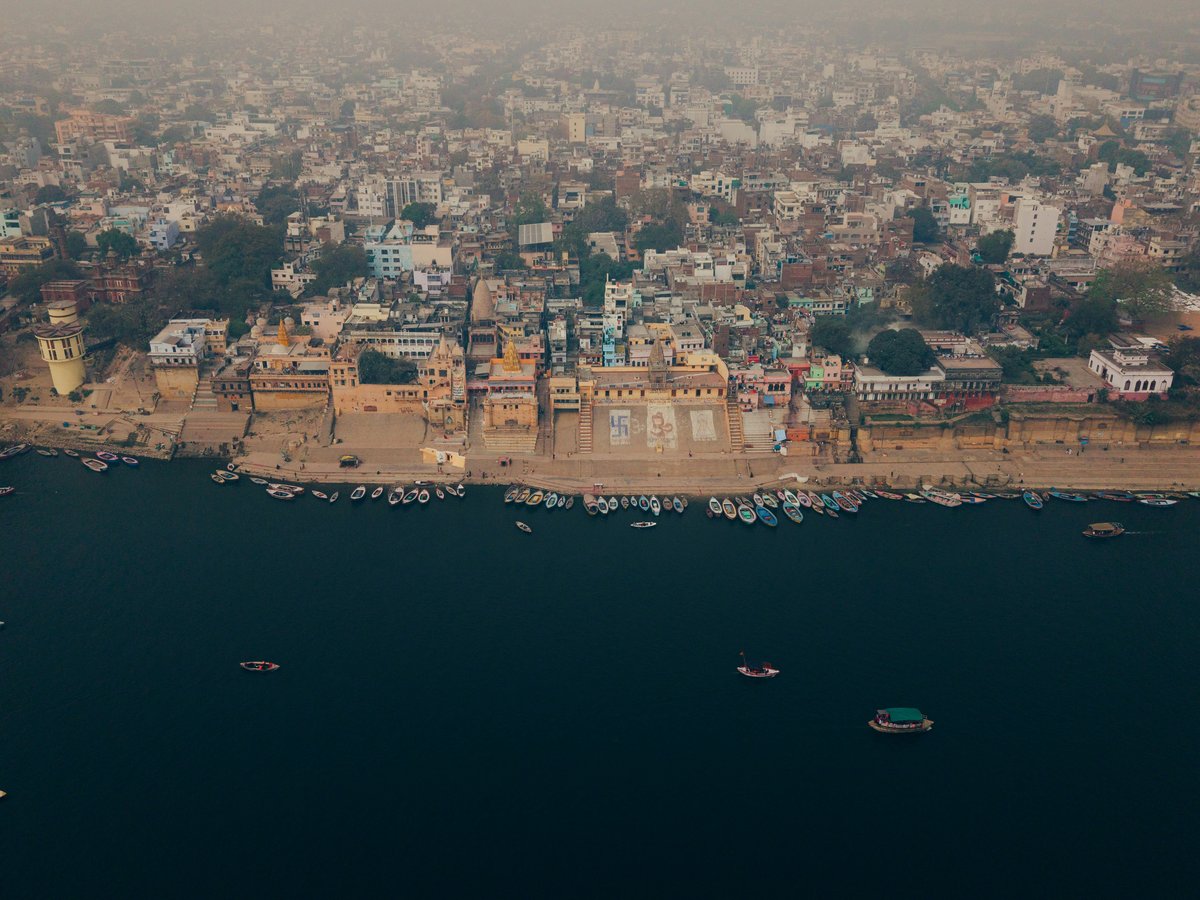
Stay in Varanasi in April
59 hotels in the Trip.com pool for Varanasi, from US$5 a night.
Opens Trip.com on Fri 2 Apr to Sun 4 Apr 2027; change the dates there.
April in Varanasi is, to put it plainly, hot. The average high reaches 38.9°C (102°F) with lows around 23.8°C (75°F), and by mid-month the stone lanes of the old city feel like a slow cooker. Humidity hovers near 32%, so the heat is dry rather than sticky, but that distinction matters less when you're climbing the steep steps of Kedar Ghat at noon. The Ganges runs low this month. Banks of cracked silt appear where water usually laps at the lower ghat steps, and tourist numbers fall to a fraction of the November peak.
That said, April brings Ram Navami to a city that takes the Ramayana personally. Processions wind through Godowlia and past Tulsi Manas Mandir, and devotional singing echoes off the ghat walls well into the night. Hanuman Jayanti follows roughly a week later, with celebrations centered on Sankat Mochan Temple in the Durgakund neighborhood. The Sankat Mochan Sangeet Samaroh, a multi-day Indian classical music festival, typically runs at the same time. If Indian devotional or classical culture draws you more than comfortable weather, April offers an intimate window that the peak-season crowds would never allow.
The heat shapes your entire daily plan. Before 7 a.m. and after 5 p.m. are your windows for outdoor exploration. The 10 hours between belong to shade, cold lassi, and the ceiling fan in your guesthouse. If that ratio of downtime to exploration sounds poor, October through February would serve you far better.
Why visit in April
- Hotel rates along the ghats drop to their annual lows. Guesthouses in Assi and Sonarpura typically discount 40-50% from November peak-season rates.
- The ghats are remarkably uncrowded. Dashashwamedh Ghat, where peak-season evenings draw hundreds of spectators for the aarti, draws a few dozen in April.
- Ram Navami processions through the old city offer an unfiltered view of Varanasi's devotional life, with few foreign tourists around to buffer the experience.
- The Sankat Mochan Sangeet Samaroh brings acclaimed Indian classical musicians to Sankat Mochan Temple for free, multi-night performances.
Worth knowing
- Midday temperatures regularly push past 40°C in the shadeless lanes of Vishwanath Gali and Chowk. You'll have roughly 4-5 usable outdoor hours per day, all before 7 a.m. or after 5 p.m.
- The Ganges runs at one of its lowest levels of the year. Wide mudflats and exposed silt banks replace the water's edge at many of the 84 ghats, which limits riverside walks and changes the look of the riverfront considerably.
- Dust carried by the loo winds (hot westerlies common from April through June) coats clothes, cameras, and food left uncovered for more than a few minutes. The grit is noticeable around the open cremation area at Manikarnika Ghat.
- Most tour operators and guides reduce their offerings in the off-season. Finding an English-speaking guide or a boatman willing to do a midday trip takes more effort than it would in cooler months.
Best for
Think twice if
April is the tail end of Varanasi's dry season, and the last full month before pre-monsoon moisture creeps in from the Bay of Bengal. Rain is effectively absent, averaging around 2mm for the entire month. The hot loo winds blow intermittently from the Thar Desert to the west, carrying fine dust that settles on every surface. Sweat evaporates instantly in the dry air, which tricks your body into underestimating fluid loss. Nights offer partial relief as the temperature drops noticeably, but the stone and brick of the old city radiate stored heat well past sunset. Expect sharp, direct sun from about 8 a.m. onward, with the UV index regularly reaching 10 or 11.
Seasonal caution
- Sustained heat exposure risk. April temperatures enter medically dangerous territory for prolonged outdoor activity, especially on the open ghats and in unshaded old-city lanes where circulation is minimal. Limit exposure between 10 a.m. and 4 p.m., carry water at all times, and watch for early signs of heat exhaustion (headache, dizziness, nausea, clammy skin).
- Loo winds. Hot, dry westerlies from the Thar Desert blow through the Gangetic plain intermittently from April through June, carrying fine particulate dust that can irritate eyes and lungs. Travelers with asthma or similar conditions should carry appropriate medication and consider a lightweight dust mask.
Year-round climate
Averages from the last 5 years.
| Month | Avg high (°C) | Avg low (°C) | Rainfall (mm) |
|---|---|---|---|
| Jan | 21 | 10 | 12 |
| Feb | 27 | 13 | 10 |
| Mar | 33 | 19 | 12 |
| Apr | 39 | 24 | 2 |
| May | 39 | 27 | 41 |
| Jun | 38 | 28 | 158 |
| Jul | 34 | 27 | 304 |
| Aug | 32 | 26 | 306 |
| Sep | 32 | 26 | 256 |
| Oct | 31 | 22 | 98 |
| Nov | 28 | 16 | 5 |
| Dec | 23 | 12 | 10 |
Headline events
Ram Navami
Early to mid-April (varies annually with the Hindu lunar calendar)
Hindu festival celebrating the birth of Lord Rama on the ninth day of Chaitra Navratri. Varanasi's deep Ramayana connection (Tulsidas composed the Ramcharitmanas at Tulsi Ghat) makes the city's celebration particularly fervent. Temple rituals run from dawn to midnight, and public readings of the Ramcharitmanas draw devotees from across Uttar Pradesh.
Best things to do in April
Pre-dawn boat ride on the Ganges
sightseeingHire a rowboat from Assi Ghat or Dashashwamedh Ghat and drift north past the cremation ghats while the sun comes up. The low water level in April brings the boat closer to the ghat steps, and the sunrise through the dust haze creates a particular amber light you won't see in the clear-sky months of December or January.
Minimal tourist traffic means you'll likely have a boat to yourself. Boatmen compete for the few fares available, so prices are more negotiable than in peak season.Booking tipNegotiate the fare directly at the ghat the evening before. Agree on duration and route before boarding, not midway.
Ram Navami celebrations in the old city
culturalFollow the Ram Navami processions through the lanes of Godowlia and around Tulsi Manas Mandir. Temples hold continuous bhajan sessions, and the chai stalls stay open late to serve the crowds of local devotees. The energy is concentrated and genuine because the audience is largely local.
Ram Navami typically falls in early to mid-April. Varanasi's Ramayana connection makes this one of the most significant cities in India for the festival.Evening Ganga Aarti at Dashashwamedh Ghat
culturalThe nightly fire ceremony runs year-round, performed by a team of priests on a raised platform facing the river. In April, the smell of camphor and incense mixes with the warm evening air, and the brass lamp flames reflect off the dark water below the half-empty ghat steps.
April's thin crowds mean you can stand at the front by arriving 15-20 minutes early, instead of the 90 minutes required in November or December.Sarnath Museum and Dhamek Stupa
culturalThe archaeological museum, founded in 1910, houses the original Ashoka Lion Capital (now India's national emblem) and a collection of Gandhara-era sculpture. The Dhamek Stupa sits in the deer park where the Buddha is said to have given his first sermon. The 10 km trip from the old city takes about 30 minutes by auto-rickshaw.
The indoor museum offers genuine relief from the heat. Off-season means you can spend time with the Ashoka capital without other groups pressing in behind you.Booking tipCheck the museum's weekly closure day before making the trip. Most ASI-managed museums close one day per week.
Silk shopping in Chowk
shoppingVaranasi is one of India's major silk-weaving centers, and the covered bazaar lanes of Chowk are where wholesale and retail shops sit side by side. The textiles range from lightweight silk scarves to heavy Banarasi saris with gold zari work. The air inside the shops smells of starch and fresh dye.
The shaded lanes are several degrees cooler than the open ghats, making this a natural midday activity. Off-season shopkeepers are more willing to negotiate and less likely to rush you.Bharat Kala Bhavan at Banaras Hindu University
culturalThis university museum, founded in 1920, houses miniature paintings, ancient sculptures, and a collection of medieval textiles. The BHU campus itself is one of the largest in Asia, with tree-lined avenues in the Lanka neighborhood that provide welcome shade.
Indoor galleries are a genuine refuge when outdoor exploration becomes unsafe. The museum sees fewer visitors in April, and the campus trees make the walk from the Lanka gate more bearable than crossing the open ghats.Dawn walk through the old city galis
sightseeingThe narrow lanes between overhanging buildings in the Godowlia and Sonarpura neighborhoods create continuous shade that the open ghat areas lack entirely. Before 7 a.m., the stone underfoot is still cool, and the old city wakes around you with chai stalls firing up, flower sellers stringing marigold garlands, and the sound of morning prayers from neighborhood temples.
The pre-dawn window is more valuable in April than in temperate months because the contrast with the afternoon heat makes it feel urgent. The lanes are empty enough to walk freely, without the shoulder-to-shoulder press of peak season.What to eat in April
Street food peaks
Kulfi
Dense, slow-frozen Indian ice cream appears on pushcarts from April onward. The malai and mango varieties are the seasonal draws, and the kulfi wallah's bell ringing through the lanes of Kabir Chaura is one of those sounds you'll remember.
Dahi Chaat
Varanasi's chaat stalls run year-round, but April's heat makes the cold yogurt-topped varieties (dahi puchka, dahi papdi) more appealing than the fried options. Kachouri Gali serves some of the city's best, and vendors are less rushed in the off-season.
What to drink
Aam Panna
April brings kairi (raw mangoes) to Varanasi's markets, and this sour, cumin-and-black-salt cooler appears in clay pots at vendor stalls across Godowlia. The tangy, earthy taste is the definitive flavor of a Gangetic summer.
Thandai
Varanasi's signature spiced cold milk drink blends almonds, fennel seeds, rose petals, black pepper, and saffron. The shops along Vishwanath Gali serve it year-round, but demand peaks once temperatures climb past 35°C. The closest thing to a Varanasi-specific summer drink, minus the alcohol.
Sattu Sharbat
Roasted gram flour shaken with cold water, salt, lemon, and cumin. Every chai stall in Lanka and Assi adds a sattu option when the heat arrives. The grainy, savory taste grows on you, but it is the Gangetic plain's answer to heat exhaustion.
Bael Sharbat
Wood apple ripens in the Gangetic plain from April onward. Vendors mash the fragrant pulp with water and sugar into a slightly gritty sherbet sold at roadside stalls. The aroma is distinctive and sweet.
Regular events in April
Hanuman JayantiFree
Birthday of the deity Hanuman, celebrated with processions and all-day prayers at Sankat Mochan Temple and smaller neighborhood shrines across Varanasi. The temple sees continuous devotional singing from early morning.
Mid-April (full moon of the Chaitra month, varies annually)Sankat Mochan Sangeet SamarohFree
Multi-day Indian classical music and dance festival held at Sankat Mochan Temple. Leading vocalists, instrumentalists, and tabla players perform through the night in the open-air temple compound. Free and open to everyone.
Typically coincides with Hanuman Jayanti, mid-AprilMahavir JayantiFree
Celebrates the birth of Mahavira, the 24th Tirthankara of the Jain tradition. Varanasi's Jain community marks the day with temple processions, particularly around the Jain temples in the Bhelupur neighborhood.
Early to mid-April (13th day of Chaitra Shukla, varies annually)Ambedkar JayantiFree
National holiday marking the birthday of Dr. B.R. Ambedkar on April 14. Public gatherings and commemorative events take place throughout the city, particularly around BHU and the Lanka area. Government offices and some businesses close for the day.
April 14Best places this April
Sarnath
museum and historical siteThe archaeological park and museum complex 10 km north of the old city. The museum's indoor galleries provide relief from the heat while housing one of India's most significant Buddhist sculpture collections. The deer park grounds around the Dhamek Stupa are quieter in April than at any other time of year.
SarnathBharat Kala Bhavan
museumThe BHU campus museum holds miniature paintings, sculptures from the Gupta period, and medieval textiles. The shaded walk from the Lanka gate through the university's tree-lined avenues is itself a reprieve from the exposed ghats.
LankaRamnagar Fort
historical siteAn 18th-century sandstone fort and palace across the Ganges from the main ghats. The Saraswati Bhawan museum inside holds palanquins, vintage weaponry, and ornate period furniture. April's low water level exposes the wide riverbank beneath the fort walls, which is photogenic at dawn.
RamnagarAssi Ghat
ghatThe southernmost of the main ghats, popular with long-stay travelers and university students from nearby BHU. The morning chai scene continues despite the heat, and in April you can sit on the steps without competing for space. The ghat faces east, so it catches the first light.
AssiTulsi Manas Mandir
templeA modern marble temple built in 1964, with verses from the Ramcharitmanas carved into its white walls. Particularly active during Ram Navami, when devotees fill the courtyard and the reading of the epic text runs continuously. The marble interiors stay cool relative to the outside temperature.
DurgakundNarad Ghat
ghatOne of the quieter ghats in the old city stretch. April's low river level reveals lower terraces and carved stone steps that remain submerged from July through October. Local washermen work on these levels, and the foot traffic is minimal compared to the tourist-heavy ghats further north.
Old CityChowk Market
marketThe old city's main commercial corridor, where silk shops, brassware stalls, and spice merchants operate in covered lanes. The shade from the overhanging upper stories creates a noticeably cooler microclimate. In April, the off-season pace means shopkeepers have time for unhurried conversation.
ChowkSt. Mary's Cathedral
historical siteA historical church in the cantonment area, well away from the ghat-side intensity. The quiet, cool interior contrasts with the dominant Hindu and Buddhist sites, and in April you will likely have the building entirely to yourself.
Cantonment
Your packing checklist
Tick items off as you pack. Your progress saves in this browser.
All packed — have a great trip.
Insider tips
April's low tourist numbers give you real leverage on boat fares. With so few passengers, boatmen along Dashashwamedh and Assi compete for every fare. A dawn round trip between Assi Ghat and Manikarnika Ghat costs significantly less than the same route in December. Settle on the price, route, and duration before you step into the boat.
The low river level in April reveals lower terraces and carved stones at Kedar Ghat and Narad Ghat that spend July through October underwater. These quieter levels are where local washermen work and where some of the oldest carved stonework sits undisturbed.
The Ganga Aarti at Dashashwamedh runs nightly year-round, but April's smaller audience means front-row standing by arriving a short time before it begins. In November, you would need to claim your spot well over an hour early for the same view.
If you're staying in a ghat-facing guesthouse, ask for a top-floor room with terrace access. The river breeze after sunset is the best natural cooling available, and many locals sleep on their rooftops from April through June. Your guesthouse owner likely does the same.
Avoid these mistakes
- Scheduling a walking tour of the old city between 10 a.m. and 4 p.m. The lanes around Vishwanath Gali trap radiated heat from the stone walls, and heatstroke is a genuine medical risk. Move all exploration to before 7 a.m. or after 5 p.m.
- Underestimating water needs because the dry conditions feel deceptive. In low humidity, dehydration sets in faster than in tropical heat because your sweat evaporates before you register it. Carry at least 2 liters and add electrolyte sachets to every second bottle.
- Assuming the ghat steps are comfortable to sit on at any hour. By mid-morning the stone absorbs enough heat to burn through thin clothing. Bring something to sit on for any extended stay, or use the shaded chai stalls set back from the main steps.
Practical tips for April
Most guesthouses along the ghats rely on window AC units rather than central cooling. Confirm yours is working before check-in, since ceiling fans alone will not get you through an April night. Book ghat-facing rooms on upper floors when possible. They catch the river breeze after sunset. Many old-city restaurants shift hours during the hot months, closing by 2 p.m. and reopening around 5 p.m., so plan meals accordingly. Varanasi Junction railway station includes a cooled waiting room for ticketed passengers, useful during long layovers. For the 10 km trip to Sarnath, consider an AC car over an open auto-rickshaw. Lal Bahadur Shastri International Airport (VNS) is about 26 km northwest of the old city, and the pre-paid taxi counter inside the terminal prevents fare disputes on arrival. April brings no major closures or restricted-access periods beyond the normal weekly museum closure days.
FAQ
Is April a good time to visit Varanasi?
Honestly, no. April is one of the 4 hardest months to visit Varanasi, with daytime heat that limits outdoor exploration to early morning and evening hours. The draws are real. Rock-bottom prices, near-empty ghats, and Ram Navami celebrations suit a particular kind of traveler. If you handle heat well and care about religious festivals or photography, April can work. For most visitors, October through February offers a far more comfortable experience.
What is the weather like in Varanasi in April?
Hot and bone-dry. Temperatures climb quickly after sunrise and stay elevated until well past sunset. Rainfall is near zero for the entire month, and the loo winds from the western deserts occasionally push dust through the city. Nights are warm but noticeably cooler, and evening walks along the ghats become the highlight of most days. Expect to plan your entire itinerary around avoiding the midday sun.
Is Varanasi crowded in April?
Not at all. April is deep off-season. You will share the evening Ganga Aarti with local devotees rather than organized tour groups, and the narrow lanes of Godowlia feel spacious compared to the shoulder-to-shoulder traffic of November and December. This is one of the genuine advantages of an April visit, and it transforms the experience at popular spots.
Is it safe to walk around Varanasi alone in April?
Varanasi scores 5.8 out of 10 for solo-traveler safety (see the TTDI Solo-Safety Index). The main risks in April are heat-related rather than crime-related. Stay hydrated, avoid the open ghat steps during peak sun hours, and keep to well-lit areas in the old city after dark. The Assi and Lanka neighborhoods near BHU tend to feel more relaxed for solo travelers, particularly women, than the denser old-city lanes around Chowk.
Are there any festivals in Varanasi in April?
Yes, several. Ram Navami (early to mid-April, date varies annually) is the most significant, with temple rituals and processions across the city. Hanuman Jayanti follows about a week later, and the Sankat Mochan Sangeet Samaroh, a free Indian classical music festival at Sankat Mochan Temple, typically runs alongside it. Ambedkar Jayanti on April 14 is a national holiday with public commemorations. Mahavir Jayanti, a Jain observance, also falls in early to mid-April.
Things to Do in Varanasi in April
 Free cancellation
 Full Day Sightseeing Of Varanasi - Ultimate 1 Day in Varanasi
Day trip: 10 hours, free cancellation.
via Viator Free cancellation
 Private Full-Day Varanasi Tour with Boat Ride
Day trip: 12 hours, free cancellation.
via Viator Free cancellation
 Photo Tour In Holy Varanasi
Day trip: 3.5 hours, free cancellation.
via ViatorFind a flight to Varanasi
Live fares to Varanasi appear here once cookies are accepted.
Last verified by automated review (v1.7.2) on . What is automated review?