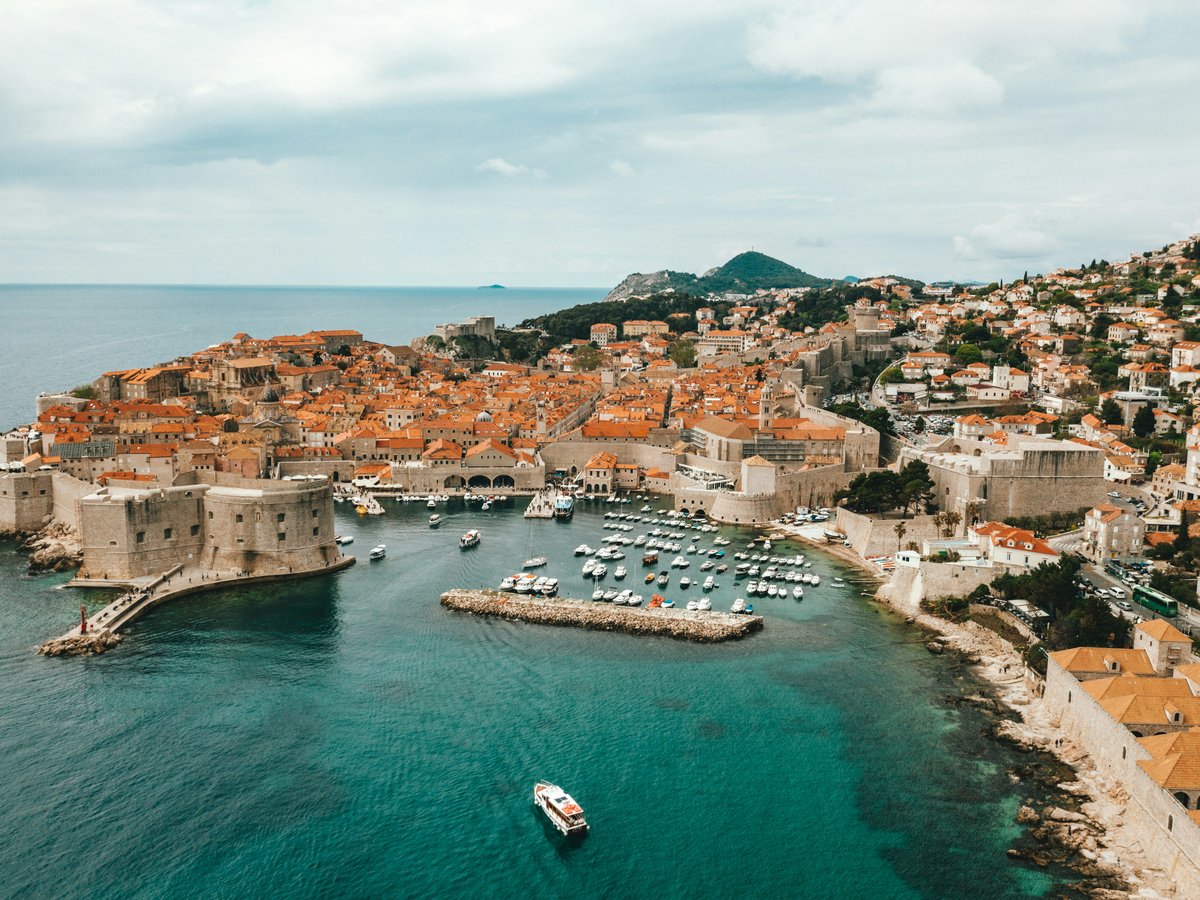
Stay in Dubrovnik in May
75 hotels in the Trip.com pool for Dubrovnik, from US$54 a night.
Opens Trip.com on Fri 7 May to Sun 9 May 2027; change the dates there.
May in Dubrovnik falls in the transition between spring's last rains and the bone-dry summer ahead. Daytime temperatures reach a comfortable 22°C (71°F), the Adriatic is warming toward swimmable, and the July-August cruise-ship crush hasn't fully landed yet. Precipitation has already dropped significantly from the heavy winter months. The city still averages around 75mm of rainfall across roughly 9 days in May, nearly double what June typically brings, so you'll likely get a few grey mornings where the limestone pavement of Stradun stays damp until noon. Storms here tend to blow through in an hour or two.
The trade-off works for most travelers. Hotel rates in Pile and Ploče typically sit 20-30% below their July peaks. The Gradske zidine, Dubrovnik's famous city walls, still have enough breathing room that you can pause to photograph the terracotta rooftops without someone's elbow in your frame. Restaurants in Stari Grad accept reservations they'd wave off in August. Mind you, it's not empty. Cruise ships do call at Gruž harbor, sometimes 2-3 per day by late May, and the Stradun fills noticeably between 10am and 4pm when passengers come ashore.
Water temperature is the real limiting factor. The Adriatic hovers around 17-19°C in early May, which keeps most swimmers on shore until the second half of the month. If guaranteed beach days matter more than sightseeing comfort, June or July is the safer bet.
Why visit in May
- Temperatures around 22°C (71°F) make walking the city walls and Old Town comfortable for hours, unlike July's 31°C heat that drives visitors indoors by noon.
- Hotel rates in Stari Grad and Ploče run 20-30% lower than peak July-August prices, with more availability at properties that sell out months in advance for summer.
- Cruise ship arrivals at Gruž harbor are building but haven't reached peak frequency. Early May weekdays can still feel relatively uncrowded inside the walls.
- Spring wildflowers cover the hillside up Mount Srđ, and the Trsteno Arboretum, 18km northwest of the city, hits peak bloom with its Renaissance-era gardens.
Worth knowing
- Rainfall of roughly 75mm across 9 days means you might lose 1-2 afternoons to showers. June drops to around 45mm, so waiting one month reduces this noticeably.
- Adriatic water temperature hovers around 17-19°C in early May. That's cold enough that most swimmers wait until the second half of the month, when it reaches 19-20°C.
- Late May sees a noticeable jump in day-trippers from cruise ships docking at Gruž. On 2-3 ship days, Stradun becomes shoulder-to-shoulder between 10am and 3pm.
- Some seasonal restaurants and beach bars in Lapad and Babin Kuk don't open until late May or early June, limiting evening dining options outside Stari Grad.
Best for
Think twice if
May brings mild, gradually warming days with occasional rain showers that tend to clear within an hour or two. Mornings start cool around 14°C (57°F) and warm to roughly 22°C (71°F) by early afternoon. The sea remains quite cool in the first two weeks, typically 17-18°C. Humidity at 72% feels noticeable but not oppressive. Wind off the Adriatic picks up on some afternoons, particularly along the exposed stretches near Tvrđava Lovrijenac.
Year-round climate
Averages from the last 5 years.
| Month | Avg high (°C) | Avg low (°C) | Rainfall (mm) |
|---|---|---|---|
| Jan | 12 | 5 | 249 |
| Feb | 13 | 5 | 170 |
| Mar | 14 | 7 | 230 |
| Apr | 17 | 9 | 140 |
| May | 22 | 14 | 160 |
| Jun | 28 | 19 | 48 |
| Jul | 31 | 22 | 42 |
| Aug | 30 | 21 | 73 |
| Sep | 26 | 17 | 156 |
| Oct | 21 | 13 | 178 |
| Nov | 17 | 9 | 370 |
| Dec | 14 | 6 | 209 |
Holidays and festivals in May
Public holidays
- International Workers' Day(Međunarodni praznik rada)1 May 2027
- Corpus Christi(Tijelovo)27 May 2027
- National Day(Dan državnosti)30 May 2027
Best things to do in May
Walk the Gradske zidine (City Walls)
sightseeingThe 1,940-meter circuit atop Dubrovnik's 13th-century walls is the city's signature experience. The route takes 1-2 hours and offers views down into the terracotta-roofed Old Town on one side and the Adriatic on the other. Entry points sit near Pile Gate and Ploče Gate.
May temperatures around 22°C make the exposed wall circuit comfortable. In July and August, the same walk at 31°C with no shade becomes genuinely punishing, and the crowds force single-file shuffling in narrow sections.Booking tipArrive by 8am at the Pile Gate entrance to walk the first section facing east with the morning sun behind you. The walls open at 8am in May.
Kayak around the Old Town walls
outdoorSea kayak tours launch from Pile beach, circle beneath the western walls and Tvrđava Bokar, then cross to Lokrum island, about 600 meters offshore. The full loop typically takes 3 hours, with a swimming stop at Betina Cave.
Calm spring seas and 22°C air make for comfortable paddling without the midday heat that turns summer kayaking into an endurance test. You'll see the walls from water level with fewer boats buzzing around than in peak season.Booking tipMorning departures at 9am tend to have the flattest water. Afternoon wind off the Adriatic can pick up from the south and make the return paddle harder.
Day trip to Lokrum island
day_tripThe forested island sits 600 meters off Dubrovnik's Old Town, reachable by a 15-minute ferry from the Old Port. Lokrum has a botanical garden established in 1959, a Benedictine monastery from the 11th century, a saltwater lake called Mrtvo More (Dead Sea), and rocky swimming coves along its eastern shore.
May offers warm enough weather to explore the island's trails without the July-August crowds that fill every sunbathing rock. The botanical garden's Mediterranean collection is in full spring growth, and the peacocks that roam the island are actively displaying.Booking tipFerries run every 30 minutes from the Old Port starting at 9am in May. Last return is at 6pm. There's no accommodation on Lokrum, so everyone leaves on the last boat.
Cable car to Mount Srđ
sightseeingThe Dubrovnik Cable Car climbs 405 meters from its base station in Ploče to the summit of Srđ in under 4 minutes. At the top you'll find the Napoleonic-era Fort Imperial, now a museum covering the 1991-92 Siege of Dubrovnik, and panoramic views across the Old Town, Lokrum, and the Elafiti Islands.
Spring visibility tends to be clearer than summer's haze, and the hillside is green with wildflowers rather than the brown scrub of August. The terrace at the summit is a comfortable 18-19°C, not the 35°C+ it reaches in midsummer.Booking tipGo up 45 minutes before sunset for the best light on the Old Town's terracotta roofs. The last car down runs at 9pm in May.
Visit Trsteno Arboretum
natureThis Renaissance-era garden 18km northwest of Dubrovnik dates to 1492, when the Gučetić-Gozze family began planting specimens brought back from maritime trade routes. The garden covers 25 hectares and includes two enormous Oriental plane trees, each over 500 years old, with canopies spanning roughly 30 meters.
May is peak bloom. The wisteria, roses, and oleander are at their best, and the garden's 500-year-old plane trees are in full leaf. By July the Mediterranean sun scorches much of the lower planting, and the garden loses its lushness.Booking tipTake the number 12 or 15 bus from Dubrovnik's main bus station. The ride takes about 30 minutes. Allow 2 hours for the garden and its waterfront terrace overlooking the sea.
Explore the Elafiti Islands
day_tripThe three inhabited Elafiti Islands, Koločep, Lopud, and Šipan, sit 30-60 minutes by ferry northwest of Dubrovnik's Gruž harbor. Koločep has no cars and 2 tiny villages connected by a footpath through pine forest. Lopud has Šunj beach, one of the few sandy beaches in the Dubrovnik region. Šipan is the largest at 16km², with olive groves and a handful of konobas.
Spring temperatures make the walking trails on all three islands comfortable. Šunj beach on Lopud is still quiet enough to find a spot on the sand, which becomes nearly impossible by July. Jadrolinija ferries from Gruž run the island route year-round.Booking tipThe early Jadrolinija ferry from Gruž (departing around 9:15am in May) lets you visit two islands in one day. Alternatively, half-day boat tours cover all three islands but spend less time on each.
Wine tasting in the Pelješac peninsula
food_drinkThe Pelješac peninsula, about 90 minutes north of Dubrovnik, is Croatia's premier wine region. The Dingač and Postup appellations on the peninsula's steep south-facing slopes produce Plavac Mali, a bold red grape related to Zinfandel. Wineries like Saints Hills, Miloš, and Matuško offer tastings.
The vines are in active growth with new green shoots, and the peninsula's hillsides are green rather than the parched brown of August. May is still quiet enough that most wineries accept walk-ins for tastings, which becomes harder from June onward.Booking tipCombine the drive with a stop at Ston for oysters and the town's 5.5km medieval walls. The D8 coastal road from Dubrovnik to Pelješac has excellent views but limited passing lanes, so budget 90 minutes each way.
Swim at Banje Beach
outdoorDubrovnik's most central beach sits immediately east of Ploče Gate, with views across to Lokrum island and the Old Town walls rising behind. The beach is pebble, about 100 meters long, with a beach club on one side and a free public section on the other.
By late May the Adriatic reaches 19-20°C, which is bracing but swimmable for most people. The beach still has open space on the public side, unlike July when towels are edge to edge by 10am.Booking tipThe free public section is to the right as you face the water. Arrive before 10am on weekdays for the best spots. Bring water shoes for the pebbles.
What to eat in May
In season: fruit
Jagode (Croatian strawberries)
Strawberry season peaks across coastal Croatia in May. Roadside vendors along the D8 highway and stalls at Tržnica Gruž sell them by the kilogram, often picked that morning from fields in the Neretva valley, about 100km north of Dubrovnik.
On menus now
Grilled sardines (srdele na žaru)
Spring sardine season brings the year's freshest catch to Dubrovnik's konobas. The sardines are smaller and more tender than the autumn run. Restaurants along Od Puča in Stari Grad typically serve them butterflied, grilled over open flame, and dressed with olive oil and lemon.
Stonski makaruli (Ston-style hand-rolled pasta)
This hand-rolled pasta from the town of Ston, 55km from Dubrovnik on the Pelješac peninsula, appears on spring menus across the region. The pasta is typically served with a slow-cooked meat sauce and grated aged cheese. May is a good time to drive out to Ston for the original.
Rozata (Dubrovnik crème caramel)
Available year-round, but the spring version benefits from fresh local eggs that are richer in May. This Dubrovnik-specific custard dessert gets its distinctive aroma from rose liqueur (rozalin) folded into the batter. Nearly every konoba in Stari Grad serves its own version.
In markets
Divlje šparoge (wild asparagus)
The tail end of wild asparagus season runs through early May. Locals forage thin, slightly bitter stalks from the hillsides around Dubrovnik and serve them in frittata-style dishes or scrambled with eggs. You'll find them at Tržnica Gruž while they last.
Paški sir (Pag Island cheese)
Spring milk from sheep on the island of Pag, about 500km up the coast, produces the year's best young Paški sir. May is when the soft, fresh wheels start appearing at cheese shops and market stalls in Dubrovnik. The flavor is milder and creamier than the aged versions sold year-round.
Regular events in May
Festa svetog Vlaha (aftermath)
While the main Feast of St. Blaise falls on February 3rd, May still sees smaller liturgical observances at the Cathedral of the Assumption of the Virgin Mary, where the saint's relics are displayed. The Dubrovnik Symphony Orchestra often schedules spring concerts at the Rector's Palace (Knežev dvor) during this period.
Throughout MayDubrovnik Craft Beer Festival
Local and regional Croatian craft breweries set up stalls in the Lazareti complex, a 17th-century quarantine building outside Ploče Gate. The event typically draws 15-20 breweries over a weekend, with food stalls and live music in the courtyard.
Mid-to-late May (dates vary)Tržnica Gruž Saturday MarketFree
The covered and open-air market at Gruž harbor runs daily, but Saturday mornings bring extra vendors from the Konavle valley and Pelješac peninsula selling seasonal produce, honey, olive oil, and Paški sir. The market has operated at this site since the 1950s.
Every Saturday morningBest places this May
Stradun (Placa)
landmarkDubrovnik's 300-meter main street, paved in polished limestone that reflects the light on clear mornings. The street runs from Pile Gate to the Clock Tower at the eastern end. Onofrio's Large Fountain, built in 1438, sits near the Pile entrance. In May, the Stradun is busy between 10am and 4pm on cruise-ship days but quieter at dawn and after 5pm.
Stari GradKnežev dvor (Rector's Palace)
museumThis 15th-century Gothic-Renaissance palace served as the seat of the Rector of the Republic of Ragusa. The ground floor houses a museum with the original keys to the city gates, 16th-century pharmacy equipment, and the Rector's private chambers. The atrium hosts classical concerts on spring evenings.
Stari GradTvrđava Lovrijenac (Fort Lovrijenac)
landmarkThis fortress perched on a 37-meter cliff west of Pile Gate was built in the 11th century as a freestanding defense against both land and sea attack. The walls facing the sea are 12 meters thick. In summer it becomes the stage for Hamlet during the Dubrovnik Summer Festival, but in May you can explore it without the theatrical infrastructure blocking the views.
PileLokrum Island
natureA 15-minute ferry ride from the Old Port brings you to this 72-hectare island nature reserve. The Benedictine monastery at the island's center dates to 1023. The Dead Sea (Mrtvo More), a small saltwater lake connected to the Adriatic through an underwater channel, warms up faster than the open sea and might reach 20°C by late May.
Trsteno Arboretum
natureOne of the oldest arboretums in southeastern Europe, established in 1492 by the Dubrovnik noble family Gučetić-Gozze. The two Oriental plane trees near the entrance are among the largest and oldest in Europe. A Neptune fountain from the 18th century overlooks the sea from the garden's lowest terrace. Peak bloom in May makes this the best month to visit.
War Photo Limited
museumA photography gallery on Antuninska ulica in the Old Town, dedicated to conflict photography from the 1990s wars in the former Yugoslavia and other conflicts. The gallery's permanent collection includes work by photographers who documented the 1991-92 Siege of Dubrovnik. It typically opens for the season in May or early June.
Stari GradBuža Bar
barAn open-air bar built into the cliffs on the southern side of the Old Town walls, accessible through a hole in the wall marked by a small sign on Crijevićeva ulica. You sit on flat rocks above the Adriatic. In May, you might get a seat without a 30-minute wait, which becomes standard by July.
Stari GradGruž Harbor and Market
marketThe working harbor 3km west of the Old Town is where cruise ships dock and local ferries depart for the Elafiti Islands. The daily Tržnica Gruž market sells Neretva valley produce, Pelješac wine, and fresh fish. The harbor area has less polish than the Old Town but gives a more lived-in feel of daily Dubrovnik.
Gruž
Your packing checklist
Tick items off as you pack. Your progress saves in this browser.
All packed — have a great trip.
Insider tips
Enter the city walls at the Ploče Gate entrance rather than Pile. Most tour groups and cruise-ship passengers start at Pile and walk counterclockwise, so the first 30 minutes of your walk in the opposite direction will have noticeably fewer people.
The Buža bars on the south-facing cliffs close when it rains and have no covered seating. Check the sky before making the walk through the Old Town to get there.
Dubrovnik's Old Town has only a few ATMs, concentrated near Stradun. The ones inside the walls charge higher withdrawal fees than the Erste Bank and OTP Bank machines at Gruž or Lapad.
The 1A and 1B city buses connect Pile Gate to Gruž harbor and Lapad in about 15 minutes. A single ticket costs 15 kuna from the driver (12 kuna if you buy it at a kiosk beforehand). They run every 10-15 minutes in May.
For fresh seafood at local prices, walk past the Old Town to the Gruž harbor area. Konobas along Obala Stjepana Radića serve the same grilled fish for 30-40% less than the equivalent meal on Od Puča inside the walls.
Avoid these mistakes
- Buying Dubrovnik City Walls tickets at the Pile Gate entrance during peak cruise-ship hours (10am-2pm). The queue can stretch 30 minutes on 2-3 ship days. Buy online in advance or walk to the Ploče Gate entrance, where lines are typically shorter.
- Assuming the Adriatic is warm enough for swimming in early May. Water temperatures of 17-18°C in the first two weeks catch visitors off guard. Wait until late May for 19-20°C if swimming matters to your trip.
- Spending every meal inside the Old Town walls. Prices in Stari Grad restaurants reflect the location premium. Lapad, Gruž, and even the Ploče neighborhood outside the walls have good food at notably lower prices.
- Not checking the cruise-ship schedule before planning your Old Town day. Websites like Dubrovnik Port Authority publish the docking calendar. On 0-ship days, the Old Town feels like a different city.
- Trying to drive into or near the Old Town. There is essentially no parking inside the walls, and the few lots near Pile Gate fill early and charge premium rates. Park at Gruž or Lapad and take the bus.
Practical tips for May
Book accommodation in Lapad or Gruž rather than inside the Old Town walls if you want better value and quieter evenings. The 1A bus reaches Pile Gate in 15 minutes. May is warm enough for outdoor dining every evening, but bring a light layer for after 9pm when the breeze off the Adriatic picks up. Check the Dubrovnik Port Authority's cruise schedule before planning your Old Town sightseeing days. On days with 2-3 ships docked at Gruž, consider spending the morning on Lokrum or the Elafiti Islands and entering the Old Town after 4pm when the day-trippers have returned to their ships. Restaurants in Stari Grad often have outdoor seating available without a reservation on May weekday evenings, but Friday and Saturday still fill up. Reserve for weekend dinners.
FAQ
Is May warm enough to swim in Dubrovnik?
It depends on your tolerance. The Adriatic around Dubrovnik typically sits at 17-18°C in early May and warms to 19-20°C by the end of the month. Some people swim happily at 19°C, others find it too cold. The Dead Sea lake on Lokrum island tends to warm faster than the open coast and might hit 20°C a week or two before the main beaches.
How many cruise ships dock in Dubrovnik in May?
May sees a gradual ramp-up. Early May might have 0-1 ships on some days, while late May can see 2-3 ships docking at Gruž harbor on the busiest days. The Dubrovnik Port Authority publishes the schedule online. On multi-ship days, 4,000-8,000 day-trippers can flow into the Old Town between roughly 10am and 4pm.
Is May part of Dubrovnik's rainy season?
Not really. Dubrovnik's heaviest rain falls between October and January, when monthly totals regularly reach 150-200mm. By May, rainfall has dropped to around 75mm spread across about 9 days. Showers tend to be brief, often clearing within an hour. It's a transition month, wetter than summer but far drier than autumn and winter.
Should I book restaurants in advance in May?
For weekday dinners, most restaurants in Stari Grad still have walk-in availability in May. Weekend evenings fill up faster, especially at well-known spots like Nautika near Pile Gate or Proto on Široka ulica. A same-day reservation by early afternoon usually secures a table on Fridays and Saturdays. By contrast, July-August requires booking days or weeks ahead at popular places.
What is the best way to get from Dubrovnik Airport to the Old Town?
Dubrovnik Airport (DBV) sits 22km southeast of the city near Čilipi. The Atlas airport shuttle bus runs to Pile Gate and takes about 30-40 minutes, with departures timed to match incoming flights. A taxi or private transfer costs roughly 250-300 kuna and takes 25 minutes. There's no rail connection. In May the shuttle isn't as crowded as peak summer, so it's reliable enough for most travelers.
Things to Do in Dubrovnik in May
 Free cancellation
 Small Group Blue Cave and Sunj Beach Boat Tour from Dubrovnik
Outdoor experience: 4 hours, free cancellation.
via Viator Free cancellation
 Full-Day Elaphite Islands Cruise from Dubrovnik with Lunch
Day trip: 8 hours, free cancellation.
via Viator Free cancellation
 Montenegro Day Trip from Dubrovnik with Optional Boat Trip
Day trip: free cancellation.
via Viator Free cancellation
 Mostar and Kravice Waterfalls Semi-Private Tour from Dubrovnik
Day trip: 10.5 hours, free cancellation.
via Viator Free cancellation
 Dubrovnik Elaphiti Islands Cruise with Lunch, Drinks and Swim
Day trip: free cancellation.
via Viator Free cancellation
 Kravice Waterfalls, Mostar and Pocitelj Day Trip from Dubrovnik
Day trip: free cancellation.
via ViatorFind a flight to Dubrovnik
Live fares to Dubrovnik appear here once cookies are accepted.
Last verified by automated review (v1.7.2) on . What is automated review?