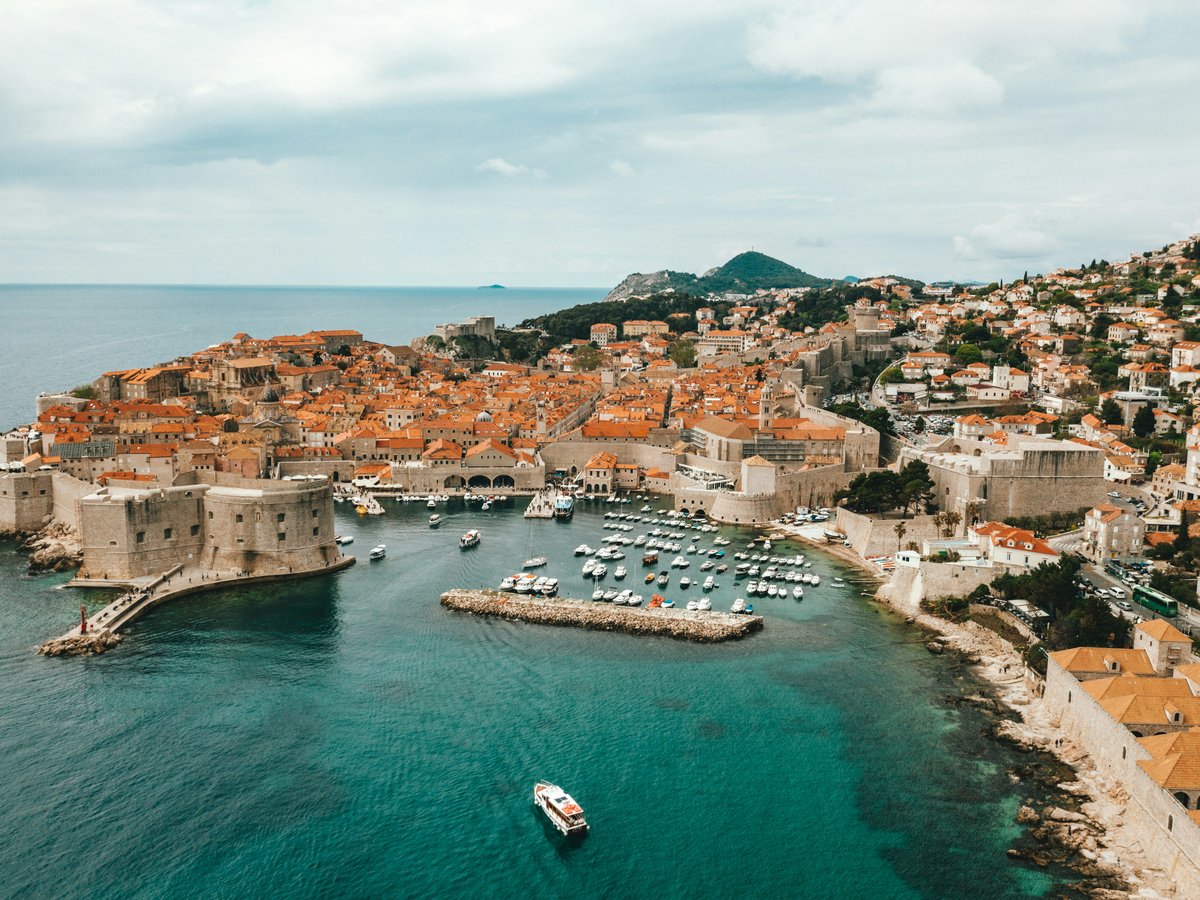
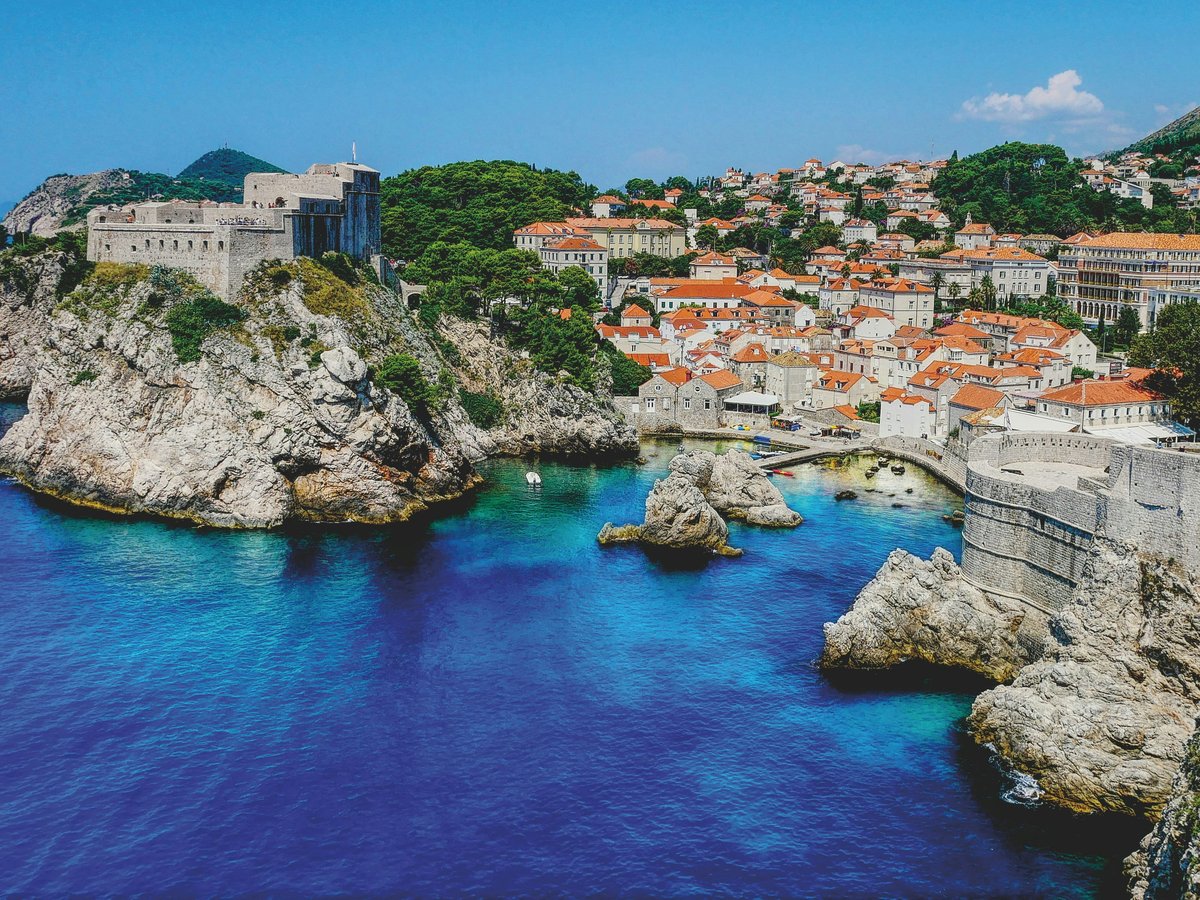
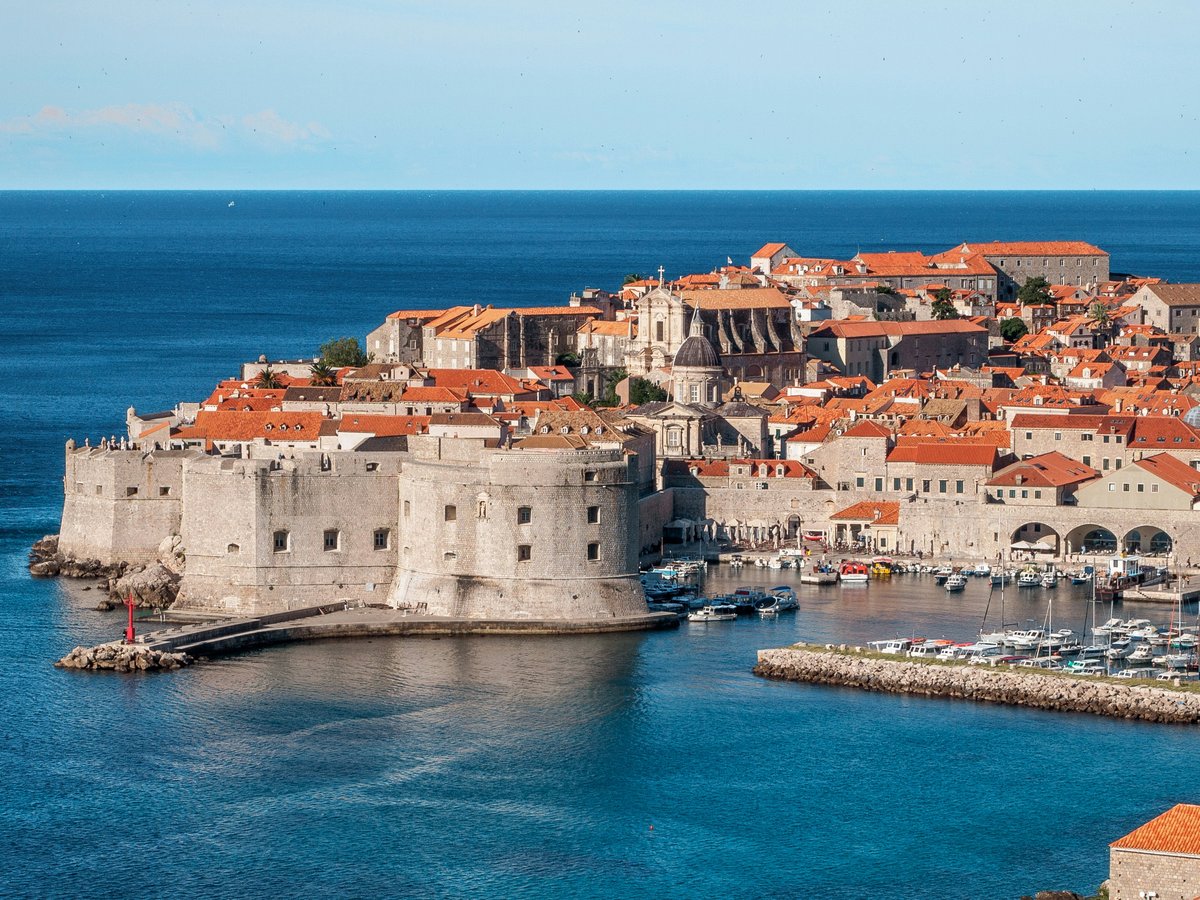
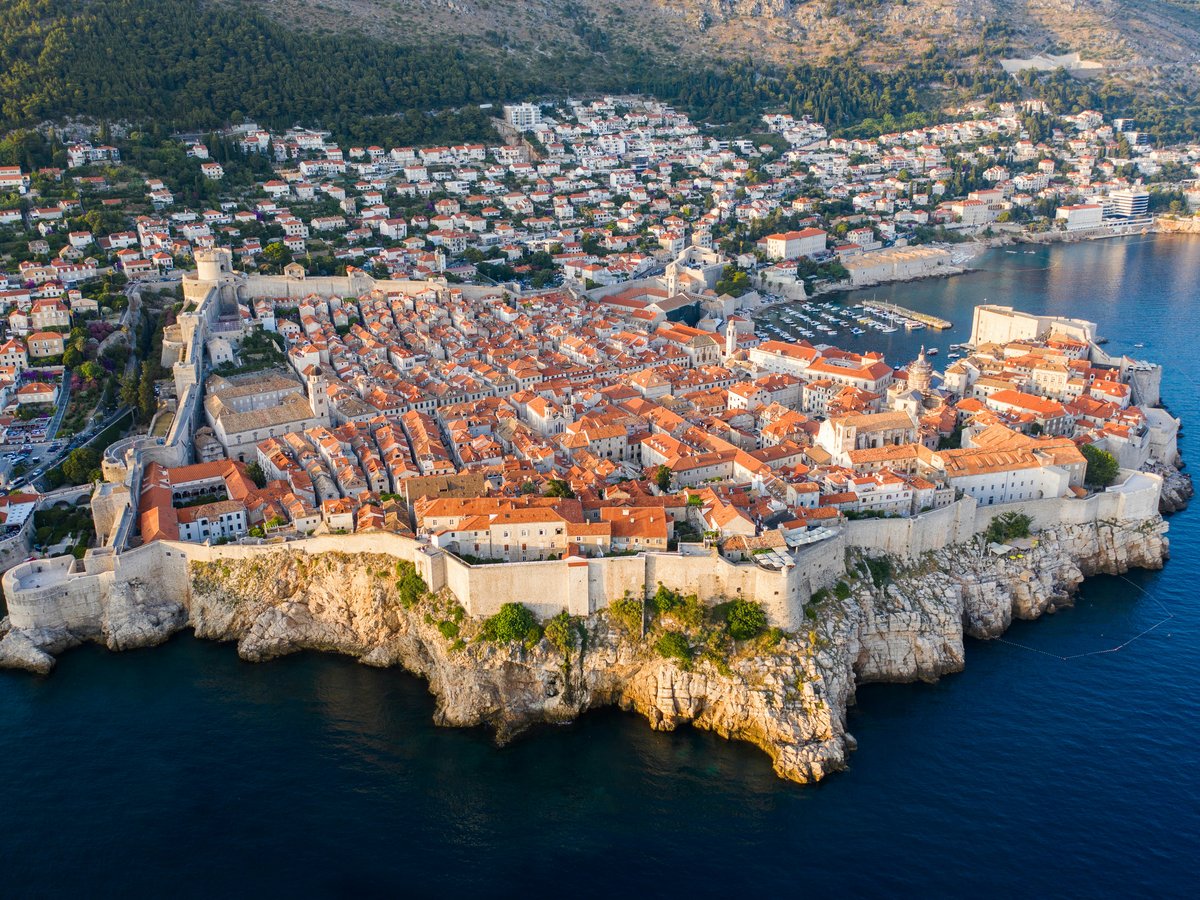
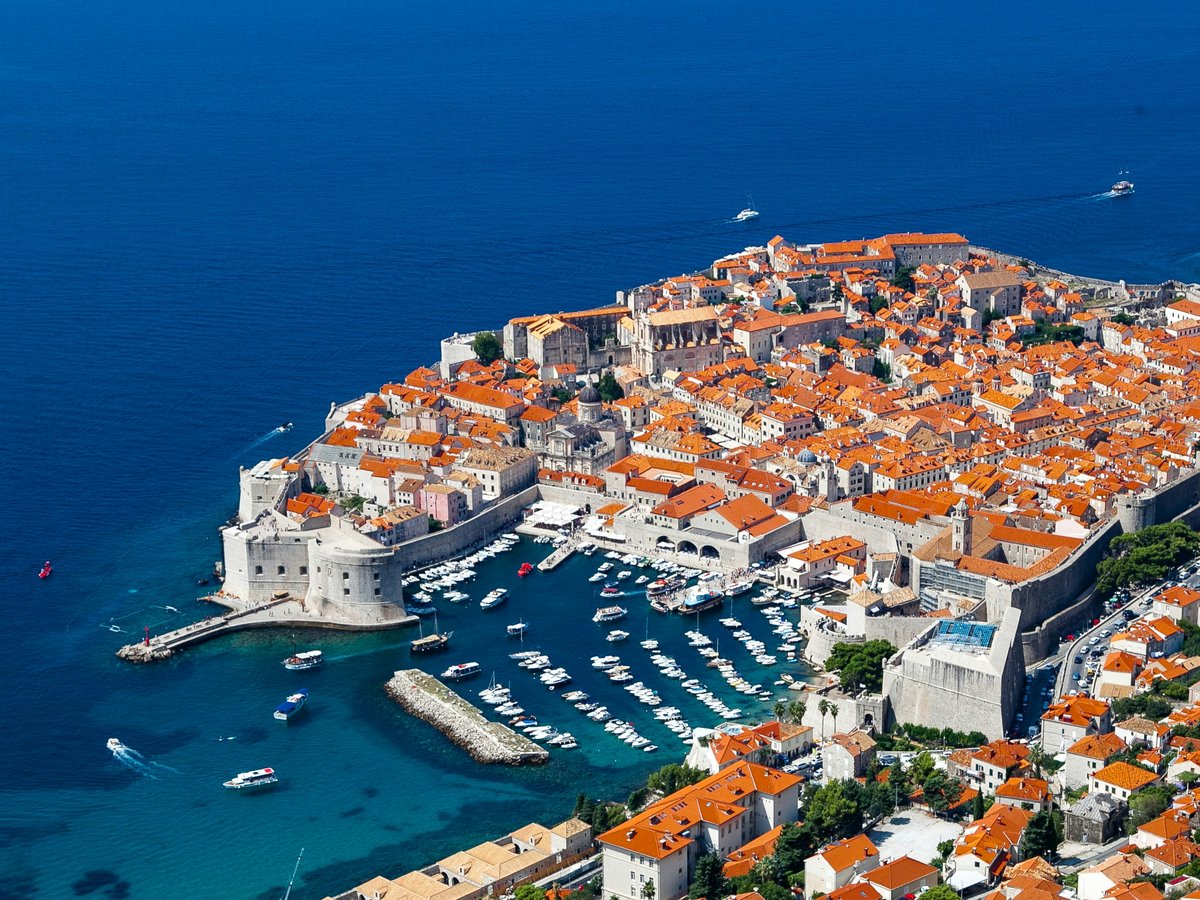
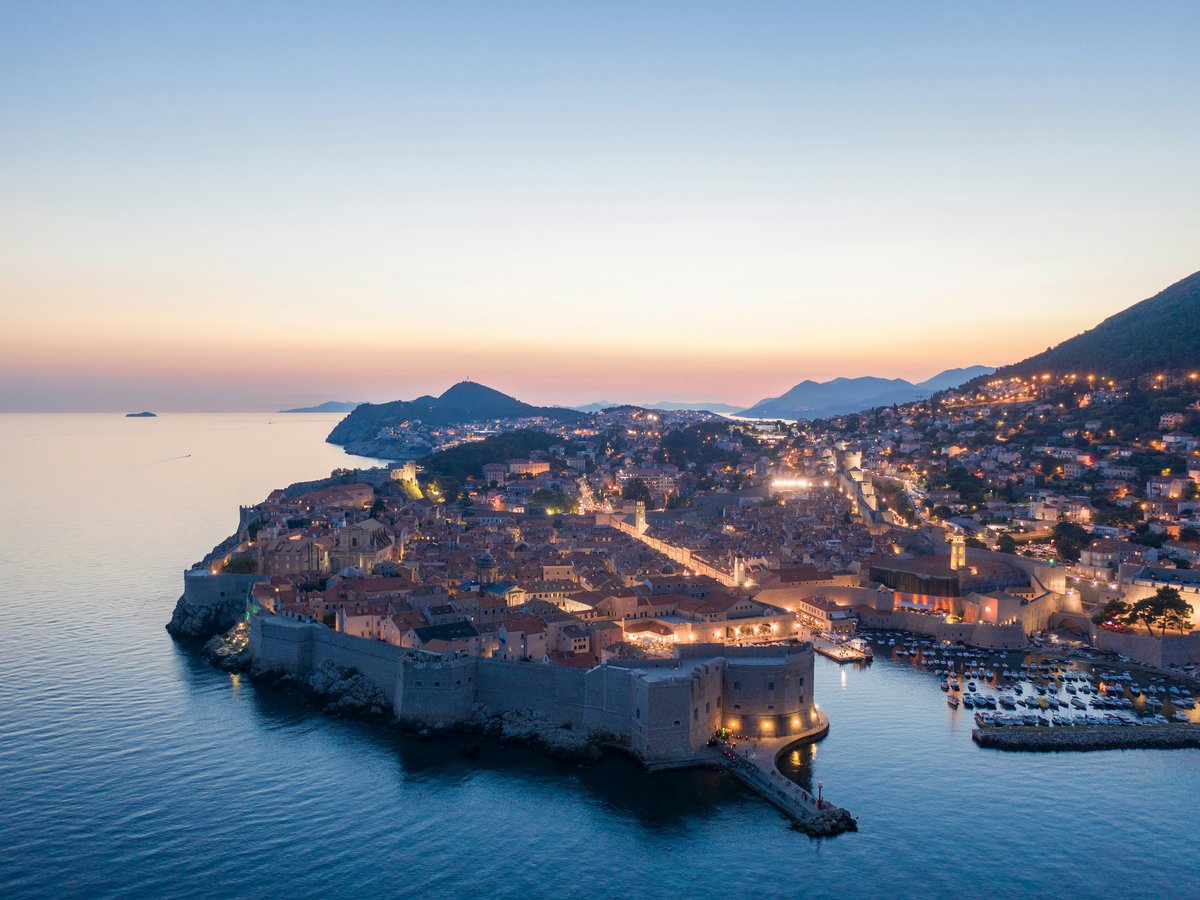
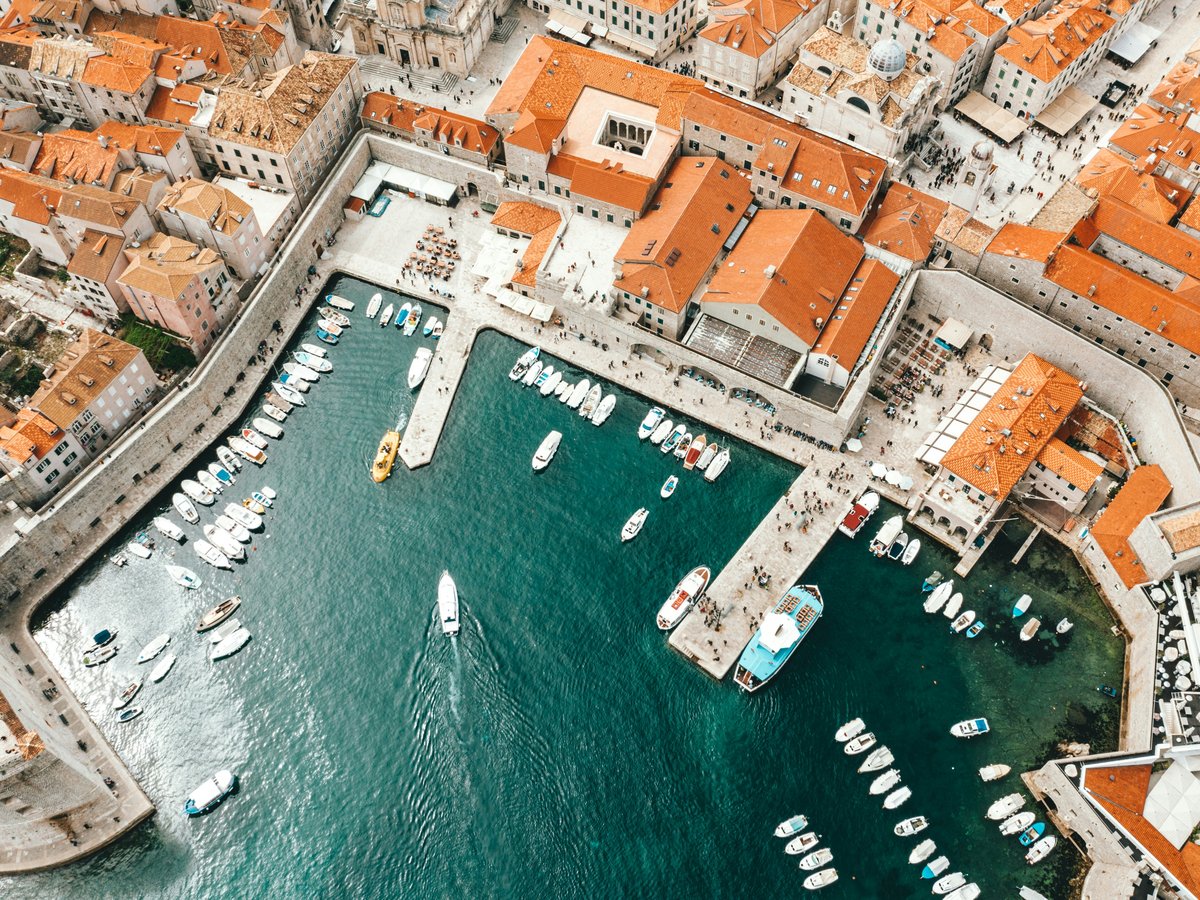
Dubrovnik sits on a narrow limestone shelf where the Dinaric Alps drop almost vertically into the Adriatic, a city whose walled old town occupies less than a single square kilometre yet held off the Ottoman Empire for centuries as an independent maritime republic. The Stradun, the main limestone-paved street running the length of the core, was once a marshy channel separating the Roman settlement on a rocky islet from the Slavic settlement on the slopes of Mount Srđ; it was filled in during the twelfth century, and you can still read that origin in the street's gentle curve and the difference in building character on either side. Most of the city's roughly 42,600 residents live outside the walls, in neighbourhoods like Lapad, a residential peninsula with its own beaches and a slower rhythm, or Gruž, where the cruise port and the daily green market sit side by side and where you're more likely to hear Croatian spoken at full speed than the careful English of the old town. The walls themselves run nearly two kilometres in an unbroken circuit, and walking them early, before day-trippers arrive from their ships, gives you an overhead view of terracotta roofs almost entirely replaced after the 1991 siege, when the city was shelled for seven months. You can still spot the colour difference between original and replacement tiles from the wall walk, a quiet record of damage and repair that no plaque quite captures. Afternoons tend to empty the old town as heat builds against the stone; locals retreat to the swimming rocks below the Buža bars, informal openings cut through the seaward wall where you sit with a cold Ožujsko and watch the island of Lokrum, ten minutes away by ferry and completely uninhabited, hold its dark forested silhouette against the flat water.
Dubrovnik in photos
Dubrovnik right now
Answers about Dubrovnik
-
Airport to city
Dubrovnik Airport (DBV) is 22 km southeast of the Old Town in Čilipi. The airport shuttle bus costs €8 and takes 35 minutes to Pile Gate, timed to flight arrivals. Taxis cost €35-40 for the 25-minute ride. Bolt is cheaper at €28-33. After midnight, pre-book a private transfer through your hotel for €40-50.
Read the full answer → -
Best time to visit
May and late September through mid-October give you warm Adriatic swimming weather between 20°C and 26°C, manageable crowds on the Stradun, and hotel rates in Lapad 30-40% below their July peaks. June works but cruise traffic builds by mid-month. Avoid July and August unless the Dubrovnik Summer Festival (10 July to 25 August) is your reason for going.
Read the full answer → -
Cost per day
Budget €50-60/day ($57-69) covers a hostel dorm in Lapad, bakery burek, and self-catered dinner. Midrange €150 ($172) gets a three-star hotel, the city walls ticket at €35, and seafood dinner near Gundulićeva Poljana. Luxury reaches €400+ ($459). Croatia adopted the euro in January 2023. The biggest hidden cost is the city walls entry, which rose from €25 to €35 since 2022.
Read the full answer → -
Cultural etiquette
Dubrovnik runs on a few unspoken rules that trip up first-timers. Greet with 'Dobar dan' before asking for anything. Tip 10-15% at sit-down restaurants. Cover shoulders and knees at Dubrovnik Cathedral and St Blaise's Church. Never refer to the 1991-92 siege casually or treat it as Game of Thrones scenery.
Read the full answer → -
Best day trips
Lokrum Island sits 15 minutes by ferry from Dubrovnik's Old Port and works as a half-day escape, while Mostar (130 km, 3 hours by bus, around €16 each way) fills a proper full day. Cavtat is 20 km south by bus 10 for €2. Ston, 55 km northwest, pairs oyster tasting at Mali Ston with a walk along 5.5 km of 14th-century walls.
Read the full answer → -
Digital nomads
Dubrovnik works for focused nomads who avoid summer crowds. Hrvatski Telekom fiber delivers 50-100 Mbps in Lapad and Gruž apartments for €900-1,400/month in shoulder season. Coworking is limited to 2-3 spaces city-wide. Croatia's Digital Nomad Visa grants non-EU workers 1 year with €2,540/month income proof. Skip June-August when cruise ship crowds push rents up 40-50%.
Read the full answer → -
Family-friendly
Dubrovnik scores 6 out of 10 for families. The Old Town's 200+ stone steps defeat every stroller made, so children under 5 need a carrier. Kids age 5+ manage well. Lokrum Island (15-minute ferry, free peacocks, shallow saltwater lake) is the best family half-day. Summer heat above 30°C demands early-morning starts.
Read the full answer → -
Food culture
Dubrovnik's cooking centers on Dalmatian seafood and slow-cooked meat under iron bells (peka). The best meals are outside the Old Town walls, in neighborhoods like Gruž and Lapad, where konobas serve crni rižot for 12-18 EUR. Lunch, not dinner, is the main event, typically noon to 2pm. Fresh fish is sold by the kilo, and Mali Ston's oysters are a 60km day trip.
Read the full answer → -
Getting around
Walk inside the walls, Libertas city buses between neighborhoods, Uber or Bolt for the airport and late nights. Dubrovnik has no metro. Stari Grad is car-free, roughly 500 meters from Pile Gate to Ploče Gate. Buy bus tickets at Tisak kiosks for about 2 EUR rather than paying the 2.50 EUR on-board fare.
Read the full answer → -
How to get there
Dubrovnik Airport (DBV) sits 20 km southeast of the Old Town at Čilipi. No nonstop flights run from North America. Connect through London, Frankfurt, Munich, or Istanbul on British Airways, Lufthansa, Croatia Airlines, or Turkish Airlines. From the UK, nonstop flights take 2.5-3 hours. From the US East Coast, one-stop trips run 10-13 hours. Summer round-trip fares from the US sit between $800 and $1,300.
Read the full answer → -
Is it safe?
Dubrovnik rates 8.5/10 for solo safety (see the TTDI Solo-Safety Index), and assaults on tourists are rare. The risks that catch people are physical: polished limestone on the Stradun, midday July heat on the City Walls, cruise-morning crowds at Pile Gate, and cliff jumps after drinks at the Buža bars.
Read the full answer → -
Language basics
Croatian, written in Latin script with 5 extra letters (č, ć, š, ž, đ). You can read street signs and menus without learning a new alphabet. English proficiency in Dubrovnik's Old Town sits around 7/10, higher among under-40 service workers. Two phrases matter most. 'Hvala' (thank you) and 'dobar dan' (good day) are social signals, not formalities.
Read the full answer → -
Layover guide
Yes, if your layover at Dubrovnik's Čilipi Airport is 6 hours or longer. The Atlas shuttle or Libertas city bus reaches the Old Town walls in 35-40 minutes for about 8 EUR. Croatia is in the Schengen Area, so passengers on Schengen flights skip immigration entirely. Budget 90 minutes for return and security.
Read the full answer → -
LGBTQ-friendly
Dubrovnik scores 6.2/10 for LGBTQ+ friendliness (sourced from TTDI's editorial rubric). Croatia recognizes same-sex life partnerships since 2014 but not marriage. The city has no dedicated queer venues, though the tourism-heavy Old Town is tolerant in practice. Same-sex couples won't face hostility inside the walls, but public affection draws occasional glances.
Read the full answer → -
Where locals go
Dubrovnik locals live and socialize in Gruž and Lapad, not inside the Old Town walls. The Gruž open market runs daily until 2pm. Lapad's Uvala bay has cafes where the same faces show up every morning. For evening drinks, locals drive 10 minutes north to Orašac or south to Cavtat to skip Old Town prices.
Read the full answer → -
Must-see
Walk the city walls. The 1,940-metre circuit around the Old Town takes about 90 minutes, costs €35, and opens at 8am in summer. Go early. By 10am the limestone heats up, shade disappears, and cruise-ship passengers from Gruž port fill the narrow walkway three abreast. Morning light on the terracotta rooftops below is the photograph of Dubrovnik.
Read the full answer → -
Solo travel
Dubrovnik earns a solo safety score of 8.5/10 (see the TTDI Solo-Safety Index), rated 8.5/10 overall for solo-friendliness. The walled Stari Grad is compact enough to memorize in an afternoon. Buža Bar and free walking tours from the Onofrio Fountain are where solo travelers meet people. Single supplements run high inside the walls, but Lapad studio apartments cut costs by 40%.
Read the full answer → -
This week
Dubrovnik runs on a cruise-ship clock. Tuesday through Thursday, 2-4 ships dock at Gruž and send thousands through the Pile Gate by 10am. Monday and Friday tend to be lighter. Plan mornings at Banje Beach or Lokrum Island, then enter the walls after 6pm when the limestone Stradun cools and the crowds thin.
Read the full answer → -
3-day itinerary
Day 1 stays inside the walled Old Town on foot. Walk the 1,940-metre city walls at 8am before the cruise ships dock, then the Rector's Palace and Dubrovnik Cathedral. Day 2 takes the ferry to Lokrum Island and the Srđ cable car at sunset. Day 3 rides Bus 10 southeast to Cavtat for the harbour, the Meštrović mausoleum, and black cuttlefish risotto.
Read the full answer → -
What to avoid
Skip Prijeko's touted restaurants, the midday walk on the Walls of Dubrovnik, and the Srđ cable car queue at sunset in August: walk the walls at the 8am opening, eat one lane back from Stradun, and refuse the dollar conversion at Euronet ATMs near Pile Gate. Cruise crowds peak between 9am and 1pm.
Read the full answer → -
What to pack
Rubber-soled shoes with real grip are the single most important item for Dubrovnik. Stari Grad's polished limestone streets turn slippery after rain, and the 1,940-meter city walls circuit has uneven stone steps in 30°C+ summer heat. Pack a wide-brimmed hat, reef-safe SPF 50, water shoes for Banje Beach's gravel shore, and a plug adapter for Croatia's 230V Type C/F outlets.
Read the full answer → -
Where to stay
Stay in Ploče for a first visit, the hillside neighborhood east of Stari Grad's Ploče Gate. You're 5 minutes on foot from the Old Town walls, with Lokrum Island views and none of the late-night bar noise. Budget $140-280 per night. For better value, Lapad peninsula runs $70-150, 20 minutes west by bus, with real beaches and cheaper restaurants.
Read the full answer →
Deep guides for Dubrovnik
-
Best Time to Visit Dubrovnik, by Season
Dubrovnik's climate ranges from a 12.0°C January high to 30.9°C in July. The best month depends on what kind of trip you are planning. Here is the trade-off for each season, and the single best window for five kinds of traveller.
Read the guide → -
Dubrovnik Restaurants: What's Worth It
A tier-by-tier verdict on twelve cafes locals prefer to the Stradun terraces. The splurge tier earns a specific trip across town. The workaday tier is good because it is always there. Each venue named, placed, and given a verdict on who it is for.
Read the guide →
Curated lists for Dubrovnik
accommodation
-
Best boutique hotels
Dubrovnik's hotel inventory spreads from the working port at Gruž to the car-free Elaphiti Islands, and the best accommodation decision starts with choosing which stretch of that coast to wake up on. The Old Town walls get the postcards, but the neighborhoods with rooms worth booking sit in a wider arc: harbor-front Gruž for ferry access, the Lapad peninsula for beach proximity, hillside settlements like Giman and Lozica for residential calm, and the islands for a pace the mainland cannot match. Nightly rates range from $107 in Zaton to $190 in Gruž, and ratings cluster high; several mid-range picks score above 8.8. The eight neighborhoods below are ordered by hotel density, not prestige. Each one answers a different version of the same question: how close do you want to be to the walls, and how much quiet do you need when you get back from them?
See the picks → -
Best hostels
Dubrovnik breaks into two distinct stay zones for budget travelers who want hostel beds without paying Old Town rack rates. The walled city pulls most first-timers toward Banje and the eastern beaches, where stone alleys and the Stradun are a short walk from the door. Further along the Rijeka Dubrovačka inlet, Rozat trades fortress walls for residential quiet and apartment-style rooms at lower density. Neither area asks you to ride a bus for half an hour to reach the water; both keep the Adriatic close. The real question is whether you want the density of the old fortifications or the calm of a village where tourism thins out. Dubrovnik's hostel inventory is slim compared to Split or Zagreb, so the two neighborhoods below represent genuinely different experiences rather than marginal address differences. Book near the walls for walkability and noise; book the inlet for space and stillness.
See the picks → -
Best luxury hotels
Dubrovnik's luxury hotel map divides neatly. One cluster hugs the coastline near the Old Town walls, where the walk to Pile Gate takes minutes. The other stretches west along the Lapad peninsula, trading proximity for pool decks, open grounds, and lower nightly rates. Most visitors booking luxury here are choosing between those two frames: immediacy or breathing room. Ratings across these 12 properties cluster high, so the meaningful differentiator is fit, not score. Some properties stack resort amenities with casino floors and diving programs; others rely on square addresses and intimacy. The zone and the amenity set matter more than the stars. This list runs the full coastal arc. Read each property's location and what it offers before you sort by price.
See the picks → -
Where to stay
Dubrovnik's accommodation map splits into three distinct zones: the walled Old Town and its steep approaches, the Lapad peninsula curving west toward sunset beaches, and the offshore islands reachable by ferry from Gruž harbor. Most first-timers default to the Old Town, which delivers the limestone-and-sea postcard but charges for the privilege and empties after the cruise ships leave. The peninsula neighborhoods, from Uvala Lapad through Babin kuk, spread hotels along a coastal path connecting pebble coves and pine-shaded swimming platforms; prices drop with each bay you pass. Gruž sits at the ferry and bus terminal, useful for island-hoppers and travelers catching early departures. The islands (Lopud and Koločep's Gornje Čelo) trade convenience for empty beaches and car-free silence, with the last ferry back setting the curfew. Between these poles the mid-range tier runs strong, with several options scoring above 8.8 for under $200 a night, while the luxury tier clusters along cliff edges and private coves where the Adriatic fills the window. Dubrovnik is small enough that a poor location choice costs you time, not access; the question is whether you want limestone alleys or pine shade, cruise-ship energy or island quiet.
See the picks →
attractions
-
Best free attractions
Dubrovnik is famous for the things you pay to enter (the wall walk, the cable car, the cathedral treasury) and the assumption creeps in that this is where the city keeps its best material. It isn't. The list below is five places that cost nothing to reach and nothing to stand in: a group of hills on the coast, a lived-in neighbourhood of Dubrovnik that most visitors never step into, the public square at Luža, the named ground of Gundulićs, and an arboretum that is worth the ride to reach. A pair of grippy shoes helps at the first. An unhurried afternoon helps at most of them. None ask for admission. Free in Dubrovnik does not mean second-best; it means the money you did not spend on a ticket is better spent on the meal afterwards, or on the wine on the terrace when the sun finally turns kind. Come to these first; buy the ticketed views second, if at all.
See the picks → -
Best museums
Dubrovnik's museums cover nearly a century and a half of collecting, which is a better reason to visit them than the weather. The oldest names on this list date from 1872, two more from the years just before the war, 1938 and 1940, one from 1949, and the newest from 2008. Taken together, they let you read the city in layers: natural history, the material of everyday life, archaeology, the sea, and the recent war. They suit a traveller who has walked the streets once and now wants to know what they were looking at. Plan around the clocks rather than the brochures. The Maritime Museum shuts on Wednesdays, the Rector's Palace opens every day from 09:00 to 18:00, and the war museum stays open until 22:00, so an evening visit is possible. Pick three, give each a proper hour, and leave the rest for a second trip.
See the picks → -
Must-see attractions
Dubrovnik's must-see list is made of stone, and it suits visitors who would rather read a city than photograph it. The defensive wall is part of a UNESCO World Heritage Site, the cathedral dates to 1670, a church to 1528, and a synagogue to 1408; two fortresses complete the picture, with Lovrijenac doubling as a theater and Minčeta standing as the other. Croatia's Register of Cultural Goods lists both the Rector's Palace and Sponza Palace. The order below is deliberate: start with the buildings that explain how the place was governed and defended, then slow down for the churches, the fountain and the clock tower, which reward a second look more than a first. This is not a checklist to race through before the heat sets in. Pick a few, give each the hour it asks for, and let the rest wait for another morning. Hours and addresses are given where the record holds them; where it does not, we say so rather than guess.
See the picks →
food
-
Best cafes
Dubrovnik's cafe map splits cleanly in two: the Old Town inside the walls, where every table is a stage set and rents run high, and the working districts up the coast (Lapad, Gruž, the harbour road along Obala Stjepana Radića) where the coffee is for people who live here. Both are worth your morning. The list below is arranged so you can read Dubrovnik through its cups: a Stradun institution with a phone line older than most of the pastry counters around it, a specialty roaster on a weekday-only schedule, an all-night sandwich window for the ferry crowd, and a handful of neighbourhood rooms mapped street-by-street in OpenStreetMap. Every address, cuisine tag, and service hour below is drawn from that public record, so you can cross-check any of it before you go. What follows is not a ranking of the prettiest terraces on Stradun; it is a working guide to where the coffee is honest, the hours are what the door says, and the room is worth the sit.
See the picks → -
Best restaurants
Dubrovnik's restaurant scene divides along geography. Inside the walls of the Old Town and up the slope toward Ploče, the kitchens run ceremonial: long tastings, sea views priced accordingly, tasting menus written for guests who came for the postcard. Follow the peninsula west to Lapad and Gruž, or south to Mlini, and the register changes: konobas that open for lunch and stay past midnight, pizzerias the neighbourhood uses, vegetarian rooms that would have been unimaginable here a decade ago. The list below leans into that second Dubrovnik. It runs from a Croatian-Mediterranean room on Ulica Bana Josipa Jelačića to a Bosnian grill on Iva Vojnovića, from a seafront dining room on Kardinala Stepinca to a Balkan corner and two vegetarian kitchens that take the category seriously. Cuisines cross (regional, Mediterranean, seafood, Italian pizza, burger, balkan, pasta) but the constant is the same: real addresses, real phones, hours you can plan around. Skip the walk-up traps on Stradun; the twelve rooms below are where the city eats when it is not performing.
See the picks →
Browse by traveler type
- For foodies
Dubrovnik for foodies
- For families with kids
Dubrovnik for families
- For digital nomads
Dubrovnik for digital nomads
- For solo travelers
Dubrovnik for solo travelers
- For couples
Dubrovnik for couples
- For budget travelers
Dubrovnik on a budget
- For luxury travelers
Dubrovnik for luxury travelers
- For first-timers
Dubrovnik for first-time visitors
Book experiences in Dubrovnik
 Free cancellation
 Small Group Blue Cave and Sunj Beach Boat Tour from Dubrovnik
Outdoor experience: 4 hours, free cancellation.
via Viator Free cancellation
 Full-Day Elaphite Islands Cruise from Dubrovnik with Lunch
Day trip: 8 hours, free cancellation.
via Viator Free cancellation
 Elaphiti Islands Full-Day Cruise from Dubrovnik with Lunch
Day trip: 8 hours, free cancellation.
via Viator Free cancellation
 Montenegro Day Trip from Dubrovnik with Optional Boat Trip
Day trip: free cancellation.
via Viator Free cancellation
 Mostar and Kravice Waterfalls Semi-Private Tour from Dubrovnik
Day trip: 10.5 hours, free cancellation.
via Viator Free cancellation
 Blue Cave, Lopud, and Sunj Beach Speedboat Tour from Dubrovnik
Outdoor experience: 4 hours, free cancellation.
via Viator Free cancellation
 Dubrovnik Elaphiti Islands Cruise with Lunch, Drinks and Swim
Day trip: free cancellation.
via Viator Free cancellation
 Kravice Waterfalls, Mostar and Pocitelj Day Trip from Dubrovnik
Day trip: free cancellation.
via Viator Free cancellation
 Dubrovnik: 7 Caves & Blue Cave Speedboat Tour (4h)
Outdoor experience: 4 hours, free cancellation.
via Viator Free cancellation
 Dubrovnik Old Town History - Small Group Walking Tour
City tour: 1.5 hours, free cancellation.
via Viator Free cancellation
 E-Tuk Tuk Tour in Dubrovnik
Day trip: 1.8 hours, free cancellation.
via Viator Free cancellation
 Small Group Blue Cave & Elaphiti Islands Boat Tour from Dubrovnik
Outdoor experience: 4 hours, free cancellation.
via ViatorBrowse by interest
Find a flight to Dubrovnik
Live fares to Dubrovnik appear here once cookies are accepted.
Last verified by automated review (v1.7.2) on . What is automated review?