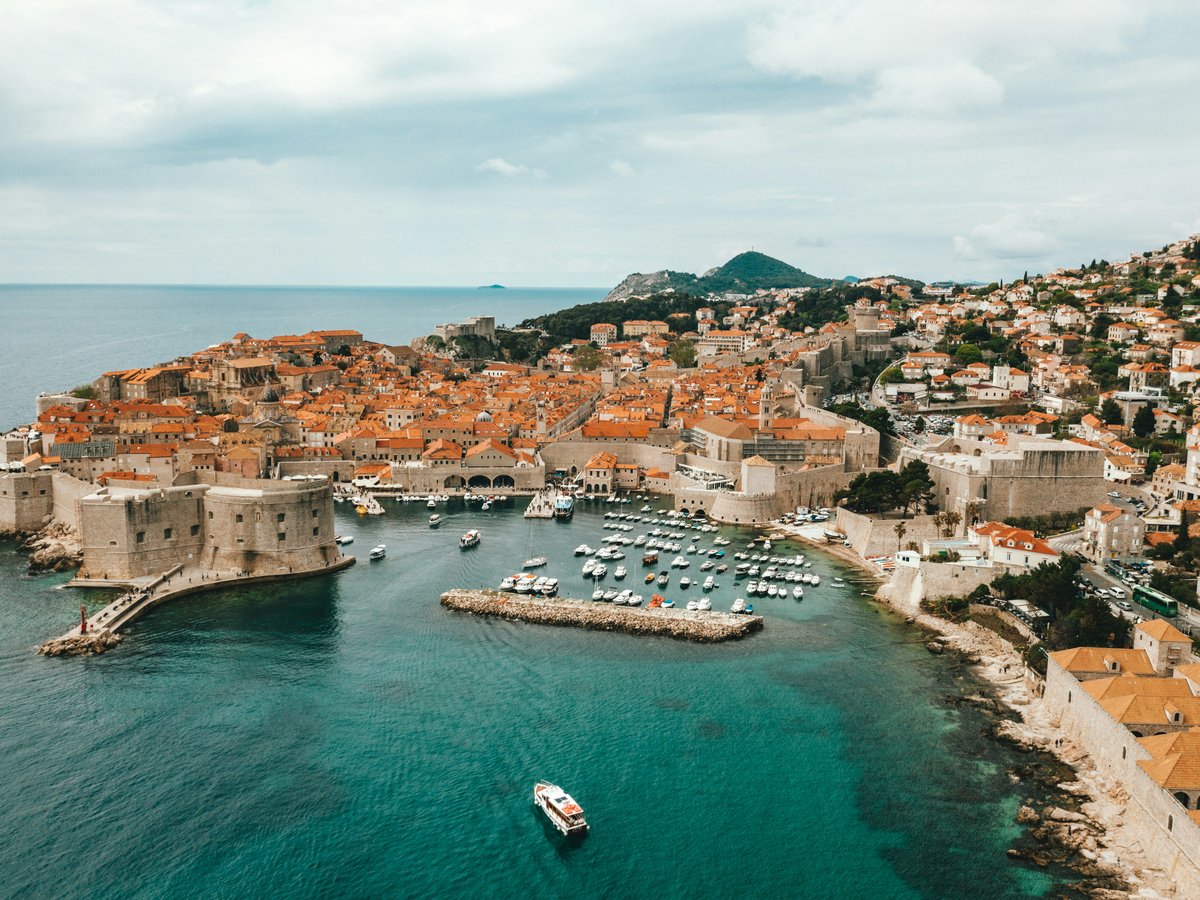
Dubrovnik sits on a narrow strip of southern Dalmatian coast, squeezed between the Adriatic and the rocky karst hills of Srđ. The city is smaller than most visitors expect. From the Pile Gate on the west side of the Old Town walls to the Ploče Gate on the east, it's a 10-minute walk along the Stradun. Most of the neighborhoods fan out to the northwest along the coast, connected by a single main road (Ulica Ante Starčevića becomes Šetalište Kralja Zvonimira as it reaches the Lapad peninsula). Think of it as a string of beads. The Old Town is the easternmost bead. Ploče clings to the hillside immediately east and above it. Moving west, you pass through Pile, then Boninovo, down into the working harbor at Gruž, and finally out to the Lapad peninsula and Babin Kuk at the western tip. The local bus system (Libertas, 15 kuna per ride from a kiosk, 20 on board, though they've switched to euros now at around 2 EUR) runs lines 4 and 6 along this spine every 15 minutes or so. You can walk from Gruž to Pile Gate in about 25 minutes. The whole city has roughly 42,000 residents, and in summer the Old Town alone might hold 8,000 visitors on a given afternoon. That density matters when you're choosing where to sleep.
Neighborhoods
-
Stari Grad (Old Town)
Stone, sun, and crowds. The walled city is 300 meters wide at most, built on limestone that's been polished smooth by 600 years of foot traffic. The Stradun runs its full length at the bottom of a shallow valley between two ridges of residential streets. In the morning, before the cruise ships unload around 10 AM, you might have the Jesuit Stairs nearly to yourself. By midday the Stradun feels like a shopping mall concourse. After 8 PM, when the day-trippers have gone back to their ships, the side streets get quiet enough to hear conversations drifting out of upper-floor windows. The buildings are uniformly pale limestone with green shutters, a rebuilding standard imposed after the 1667 earthquake that leveled most of the medieval city. The air smells like warm stone and laundry detergent from the lines strung between buildings on the narrower lanes.
- Best for
- Couples and history-focused travelers who want to wake up inside the walls and don't mind hauling luggage up stone steps. No cars allowed inside, so everything goes on your back or on a hand cart.
- Key streets
- The Stradun (Placa) is the obvious artery, but Od Puča street, running parallel one block south, has more interesting shops and fewer tourists. Prijeko street, one block north, is lined with restaurants that all look identical, most of them mediocre tourist traps with near-identical menus. Ulica Između Polača connects Stradun to the Dominican Monastery. The small square behind the Cathedral (Bunićeva Poljana) is where locals sit.
-
Ploče
Ploče starts right outside the eastern Ploče Gate and climbs steeply up the hillside toward the Srđ ridgeline. The streets are terraced, with long stone staircases connecting them. Most accommodation here sits above the Old Town, and the views from breakfast terraces look straight down onto the terracotta rooftops and the island of Lokrum. It's residential in feel, with fewer restaurants than you'd expect for a neighborhood this close to the walls. The architecture is a mix of old stone villas, some dating to the early 1900s, and a handful of larger hotels like the Excelsior and Grand Villa Argentina. Banje Beach sits at the bottom of the hill, a pebbly strip that charges around 40 EUR for two loungers and an umbrella in peak season, though you can use the free public section on the left side.
- Best for
- Travelers who want to be within a 5-minute walk of the Old Town but prefer sleeping somewhere quieter, with views. Suited to couples and anyone who doesn't mind stairs. Families with strollers will struggle with the gradients here.
- Key streets
- Frana Supila runs along the coast from the Ploče Gate toward Banje Beach and the Excelsior hotel. It's the main artery. Ulica Vlaha Bukovca climbs uphill from Frana Supila, and the streets that branch off it (like Ulica Iva Vojnovića) have some of the best-positioned rental apartments in the city. The Lazareti complex, a row of old quarantine buildings at the foot of Ploče, now hosts a cultural center and occasional live music.
-
Pile
Pile is really a transitional zone, a small neighborhood outside the western Pile Gate where the pedestrian world of the Old Town meets the traffic of the modern city. The main feature is the Pile Gate itself, with its stone drawbridge and the statue of St. Blaise (Sveti Vlaho) above the arch. Buses stop here (the main transit hub for the Old Town), taxis queue, and tour groups assemble. It's noisy during the day but calms down after sunset. The neighborhood has a handful of hotels and rental apartments on the steep streets climbing toward Fort Lovrijenac. The residential buildings are a mix of postwar concrete and older stone, with none of the uniformity you see inside the walls. A few restaurants and cafes cluster near the bus stop, mostly catering to the crowd flowing to and from the Pile Gate.
- Best for
- Budget-conscious visitors who want to be at the Old Town's doorstep without paying Old Town prices. The bus connections here make it practical for daytrips to Cavtat, Trsteno Arboretum, or the Elaphiti islands ferry from Gruž.
- Key streets
- Ulica Branitelja Dubrovnika runs from the Pile Gate bus stop northwest toward Boninovo. Ulica od Tabakarije drops steeply south toward the rocks and sea below Fort Lovrijenac, passing the Buža-area cliffs. The small square at Pile Gate (Brsalje) has a few cafe terraces where you can watch the procession of visitors entering and leaving the walls.
-
Gruž
Gruž is the working end of Dubrovnik. The harbor handles the big cruise ships (which dock at the long quay or tender in) and the Jadrolinija ferries to Korčula, Hvar, and the Elaphiti islands. It smells like diesel fuel and fish near the port, and like fresh produce and cheese around the open-air market (Tržnica Gruž), which has been running in some form since the 1500s. The neighborhood lines both sides of the inlet, with the market and main shops on the south side and a more residential stretch climbing the hill to the north. Apartment prices here run 30-50% lower than equivalent places in the Old Town or Ploče, and you get the trade-off of a 20-minute bus ride or 25-minute walk to the Pile Gate. The restaurants around the market serve the locals, not the tourists, and the difference shows in portion size and price. There's an actual supermarket (Konzum) and hardware stores. People live here year-round.
- Best for
- Long-stay visitors, families who need a supermarket and a flat surface for a stroller, and anyone who values eating well on a budget over proximity to the walls. Also the most practical base for island-hopping, since the ferry terminal is a 5-minute walk.
- Key streets
- Obala Stjepana Radića runs along the waterfront and is the main road through Gruž, lined with palm trees and café terraces. The market sits at the end near the Gruž bridge. Ulica Pera Čingrije on the north side of the harbor has a string of fish restaurants. The pedestrian area near the old Gruž bridge (Most dr. Franja Tuđmana) is where the morning market crowd spills over into the cafes.
-
Lapad
Lapad is a peninsula that juts out west of Gruž, covered in Aleppo pine and Mediterranean cypress. It feels like a different city from the Old Town. The pace drops. Streets are wider, the architecture is mid-century hotel blocks mixed with residential apartments and a few surviving Austro-Hungarian era villas. The main promenade (Šetalište Kralja Zvonimira) runs along the south coast of the peninsula, lined with hotels, ice cream stands, and a surprising number of good pizzerias. Uvala Lapad beach sits at the end, a sandy-gravelly cove about 200 meters wide. The water is calm and shallow for the first 15-20 meters, which makes it noticeably better for young kids than the pebbly city beaches. The evening passegiata along the promenade draws families and couples, and the sunsets looking west toward the Elaphiti islands are genuinely good.
- Best for
- Families with children under 10, anyone who wants a beach-resort atmosphere with restaurant variety, and travelers who prefer a hotel with a pool over an atmospheric stone apartment. It's also a solid base for older travelers or anyone with mobility issues since the terrain is flatter than Ploče or the Old Town.
- Key streets
- Šetalište Kralja Zvonimira is the main pedestrian promenade and the spine of the neighborhood. Ulica Kardinala Stepinca connects Lapad to Gruž and the main bus routes. Masarykov Put runs along the north side of the peninsula and is quieter, more residential. The small square at the intersection of Šetalište and the beach road (near Hotel Kompas) is where the evening crowd gathers.
-
Babin Kuk
Babin Kuk is the rocky tip of the Lapad peninsula, dominated by three large resort hotels (the Valamar complex and the now-renovated Hotel President). It feels like an enclosed resort zone. The shoreline is rugged, with several small pebbly coves accessible by paths through the pine forest. Copacabana Beach, an artificial pebbly beach on the north side, has a waterslide and jet-ski rentals in summer. The neighborhood has limited restaurant options outside the hotel properties, and after 10 PM it's remarkably quiet for a place with 2,000-plus hotel beds. The pine forest that covers most of the interior of the peninsula is dense enough that the air temperature drops 2-3 degrees Celsius under the canopy, which matters in August when Dubrovnik regularly hits 35°C.
- Best for
- Package-holiday families, resort-style travelers who want pools, organized kids' activities, and reliable half-board without needing to navigate the city. Also suits anyone who wants to swim in multiple coves without leaving the neighborhood.
- Key streets
- Ulica Iva Dulčića is the main road in, connecting Babin Kuk to Lapad and the bus route. The walking paths through the pine forest between the Valamar hotels and Copacabana Beach are the real draw. There's a small cluster of shops and restaurants near the Hotel President entrance.
-
Boninovo
Boninovo is the hillside residential area between Pile and Gruž that most visitors pass through without noticing. It sits above the main road (Ulica Ante Starčevića) on a slope covered in stone apartment buildings, small gardens, and a few boutique hotels. The neighborhood has a medical center (Opća bolnica Dubrovnik) and a couple of local bakeries and cafes that cater to residents, not tourists. The 30-story communist-era Hotel Libertas ruin used to loom over the coastline here but has finally been redeveloped. The views from the upper streets look south over the Adriatic and east toward the Old Town walls, though you're too far to walk casually (15-20 minutes to Pile Gate, downhill on the way there, uphill coming back).
- Best for
- Travelers who want a quiet residential base with lower prices than Ploče but more character than Lapad. Works for remote workers or longer stays where you'd rather have a neighborhood bakery than a hotel breakfast buffet.
- Key streets
- Ulica Ante Starčevića is the main throughfare running along the coast. Ulica Petra Krešimira IV climbs uphill into the residential heart. The small park near the Boninovo bus stop has benches under mature pines where older residents sit in the evenings.
FAQ
Is it worth staying inside the Old Town walls or is nearby better?
Staying inside the walls puts you in the middle of the atmosphere, particularly at night after the day-trippers leave, and early morning when the Stradun is nearly empty. That said, most Old Town apartments sit up 50-80 stone steps with no elevator, the streets are loud until about 11 PM during summer, and there are no supermarkets inside the walls. A room in Ploče or Pile gives you a 5-minute walk to the gates with more practical amenities and typically 20-30% lower prices. The tradeoff depends on how much the atmosphere at dawn and midnight matters to you versus daily convenience.
How long does it take to get between neighborhoods by bus?
The Libertas bus network runs along a single main coastal road, so transit times are predictable. From Lapad to Pile Gate on the number 6 bus takes about 12-15 minutes. From Gruž to Pile Gate is about 8-10 minutes on lines 1A or 1B. From Babin Kuk to Pile Gate is about 20 minutes. Buses run every 10-15 minutes in summer and every 20-30 minutes in winter. A single ticket costs 2 EUR from a kiosk or newsstand (Tisak), or slightly more from the driver. Taxis between Lapad and Pile Gate run about 10-12 EUR on the meter.
Which neighborhood has the best food scene for dinner?
The Old Town has the highest concentration of restaurants, but also the highest prices and the most tourist traps (Prijeko street is the worst offender). Gruž has the best value, with konobas near the market serving local dishes at prices 30-40% below Old Town equivalents. Lapad has decent variety along the Šetalište promenade, particularly for pizza and grilled fish, and tends to be more family-friendly in the evening. For a single best-meal experience, Ploče and the hillside above Gruž have a few standout spots that combine quality with views. Pantarul in Lapad (Ulica Kralja Tomislava 1) currently might be the most consistently praised restaurant outside the walls, with a tasting menu around 55-65 EUR per person.
Where should families with young kids base themselves in Dubrovnik?
Lapad or Babin Kuk. Both have shallow, calmer beaches (Uvala Lapad and Copacabana), flat promenades suitable for strollers, supermarkets within walking distance, and hotels with pools and kids' programs. The Old Town is beautiful but its steep steps and polished-stone streets are difficult with a stroller, and the crowds in summer can be stressful with small children. Gruž is also practical for families on a budget, with the market, supermarkets, and the ferry port for easy daytrips to Lokrum island (the 15-minute crossing from the Old Port is a hit with kids, with peacocks, a saltwater swimming lake, and a ruined Benedictine monastery).
When do cruise ship crowds hit the Old Town, and how do you avoid them?
Cruise ships typically start discharging passengers between 9 and 10 AM. Peak density inside the walls runs from about 10:30 AM to 3 PM. On heavy days (sometimes 3-4 ships docking simultaneously, adding 8,000-10,000 day visitors), the Stradun becomes shoulder-to-shoulder. The city has been experimenting with crowd-management gates at the Pile entrance since 2023. To avoid the worst of it, enter the Old Town before 9 AM or after 5 PM. Dubrovnik's port schedule is published online and updated weekly, so you can check how many ships are expected on a given day and plan your Old Town visit for a lighter morning.
Is Dubrovnik walkable or do you need a car?
You do not need a car in Dubrovnik, and having one is mostly a liability. Parking in or near the Old Town costs 8-12 EUR per hour in summer, the streets are narrow and confusing, and the one-way system around Gruž and Pile requires local knowledge. The bus network covers all the main neighborhoods for 2 EUR a ride. A car becomes useful only if you plan to drive to Montenegro (Kotor is about 2 hours), Mostar in Bosnia (2.5 hours), or explore the Pelješac peninsula wine region. For those trips, renting for a single day from one of the agencies on Ulica Ante Starčevića makes more sense than keeping a car for your whole stay.
Last verified by automated review (v1.7.2) on . What is automated review?