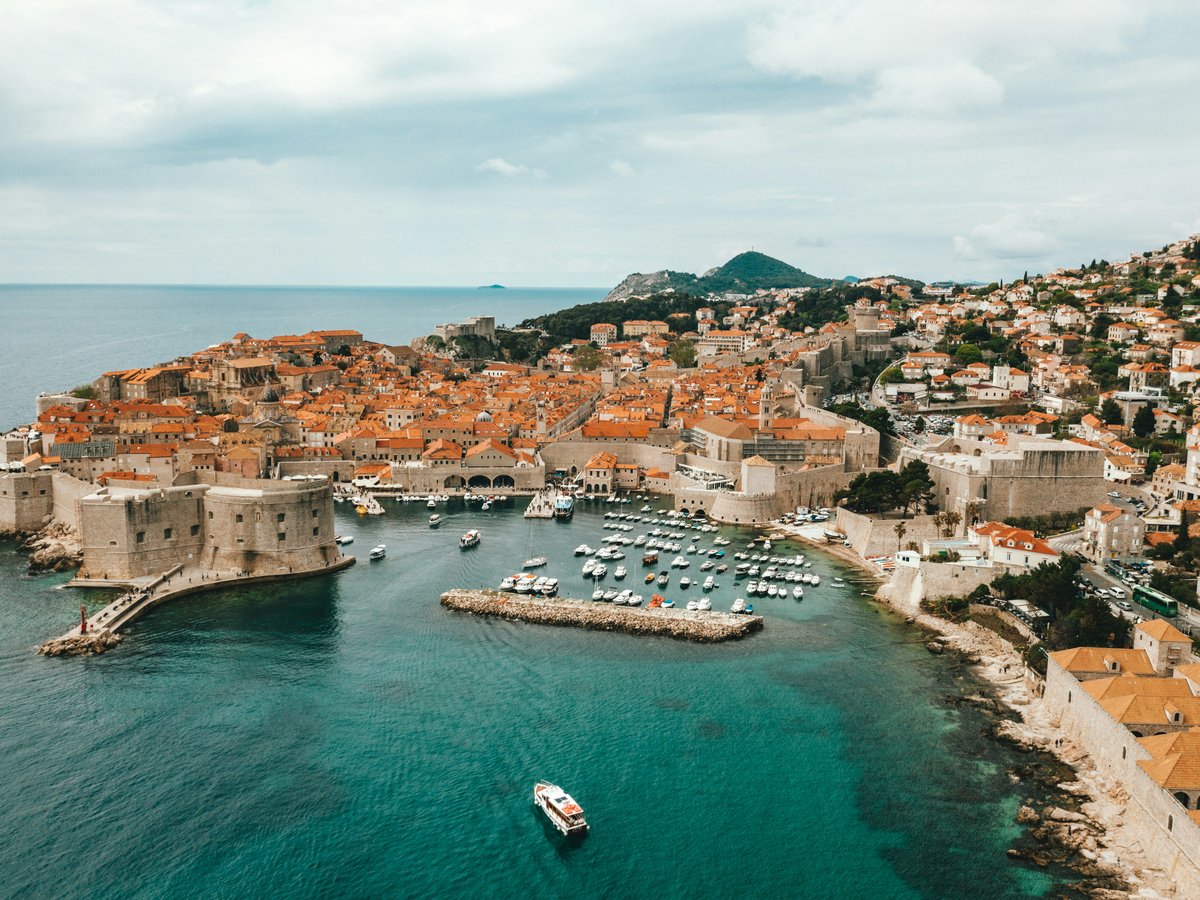
Dubrovnik sits on a narrow strip of limestone coast where the Dinaric Alps drop sharply into the Adriatic. The city's 42°N latitude puts it in the same climate band as Rome, which means 250-plus days of sunshine per year and summer temperatures that regularly reach 33°C by mid-July. Mount Srđ rises 412 metres directly behind the Old Town, and the Elafiti Islands scatter across the sea to the northwest. The Konavle Valley stretches south toward Montenegro, carved by the short, cold River Ljuta. You'll find the terrain is overwhelmingly karst. The rock is pale, porous, and unforgiving on ankles. The sea tends to be remarkably clear, with underwater visibility reaching 15 to 20 metres on calm days between May and October. Mind you, this is not a wilderness destination in the backcountry sense. It is a compact, densely historical coastline where a 2-hour hike ends at a 600-year-old fortress and a morning kayak passes under medieval ramparts. The outdoor character here is shaped by that collision of rough Mediterranean terrain and dense human settlement.
Outdoor activities
-
Sea kayaking around Dubrovnik's city walls
Paddling along the base of Dubrovnik's western walls gives you a perspective the walking tourists on top never get. Most guided tours launch from Pile Bay or Banje Beach, loop past Bokar Fortress and Fort Lovrijenac, then cross to Lokrum Island. The water under the walls is generally calm in the morning, but a southern wind (jugo) can push swell against the rocks by early afternoon. You'll likely share the route with a few dozen other kayakers in peak season. Groups typically run 8 to 12 people. Solo rental is possible but less common through the main operators. The paddle to Lokrum takes roughly 20 minutes at a comfortable pace, covering about 1 kilometre of open water.
- Difficulty
- Easy to moderate, no prior experience needed for guided trips
- Duration
- 2.5 to 3 hours for the standard guided tour
- Best season
- April through October, with the calmest mornings in May and June
-
Rock climbing at Dubrovnik's coastal crags
The limestone cliffs along the coast south of Dubrovnik toward Cavtat have developed a small but committed climbing scene. Routes at Park Orsula and the cliffs near Sveti Jakov range from about 5a to 7b on the French scale. The rock is sharp karst, so expect abrasion on your hands until you adjust. Several local outfitters run half-day sport climbing sessions for visitors with basic fitness. The routes tend to be short, 12 to 20 metres, but the exposure over the Adriatic makes even moderate grades feel committing. Worth noting, the holds can be slippery with sea spray when the wind picks up.
- Difficulty
- Moderate to difficult depending on grade chosen
- Duration
- Half day, typically 3 to 4 hours with instruction
- Best season
- March through May and September through November, when temperatures stay below 28°C
-
Mountain biking in the Konavle Valley
The Konavle region south of Dubrovnik, stretching roughly 30 kilometres to the Montenegrin border, has a network of gravel roads and old agricultural paths running between villages like Čilipi, Gruda, and Ljuta. The terrain undulates between 50 and 400 metres above sea level, with some sharp climbs on loose stone. You'll pass through olive groves, abandoned stone houses, and patches of dense maquis scrub. Bike rental is available in Dubrovnik and Cavtat. The D8 highway runs the coast, but the interior tracks are where the riding gets interesting. Expect to encounter the occasional farm vehicle and not much else.
- Difficulty
- Moderate, some steep loose-surface sections
- Duration
- 4 to 6 hours for a full loop through the valley
- Best season
- April through June and September through October
-
Snorkelling at Lokrum Island
Lokrum sits about 600 metres off Dubrovnik's Old Town harbour, and its eastern shore has rocky coves where the water drops off quickly to 3 or 4 metres. The underwater rock formations along the south side of the island support sea urchins, small octopus, and schools of salema and damselfish. The Dead Sea (Mrtvo More), a small saltwater lake connected to the Adriatic by an underground channel on Lokrum's southern tip, is popular for swimming but less interesting for snorkelling. Bring your own gear if you can. Ferries from the Old Port run every 30 minutes in summer for about 200 kuna round trip. The island closes to visitors at sunset.
- Difficulty
- Easy
- Duration
- Allow a full half-day including ferry and exploration
- Best season
- June through September for warmest water, typically 22 to 25°C
-
Zip-lining above the Dubrovnik hills
A zip-line course runs on the slopes behind Dubrovnik, accessed from the upper cable car station area on Srđ. The course has multiple lines, the longest stretching roughly 300 metres, and passes above scrubby hillside with views toward the Elafiti Islands. It is a commercial operation and firmly in the adventure-tourism category, but the elevation and the speed do produce a genuine rush. The harness work and safety briefing take about 20 minutes before you start. It tends to sell out on cruise ship days, so booking ahead is practical from June through August.
- Difficulty
- Easy, no fitness requirement beyond basic mobility
- Duration
- About 2 hours including transport and briefing
- Best season
- April through October, closed in heavy wind
-
Coasteering along the Lapad peninsula
A few operators run coasteering sessions along the rocky shoreline west of the Old Town, typically starting near Lapad and working south. The activity combines low cliff jumping (3 to 8 metres), swimming between rock formations, and scrambling over wave-cut limestone shelves. Water depth varies, so you follow a guide who knows which entry points are safe. The rock is rough underfoot. Wetsuit shoes are non-negotiable. The Adriatic is warm enough from June onward that a wetsuit top is optional, though most operators provide one. Groups tend to cap at 8 people.
- Difficulty
- Moderate, requires confidence in open water and some agility
- Duration
- 3 hours
- Best season
- June through September
Day hikes
-
Mount Srđ via the Serpentina trail
The most accessible proper hike from the Old Town follows the old zigzag path (locals call it the Serpentina) from behind Buža Gate up to the summit of Srđ at 412 metres. The trail is rocky, exposed, and has no shade for most of its length. In July, the stone radiates heat back at you. Start early. The path gains about 350 metres of elevation over roughly 1.5 kilometres of switchbacks. At the top you'll find the Napoleonic-era Fort Imperial, which now houses a museum about the 1991 siege. The cable car runs back down if your knees have had enough. That said, the descent is the harder part on this terrain, so many hikers walk up and ride down.
- Difficulty
- Moderate, steep and exposed with loose rock sections
- Duration
- 45 minutes to 1 hour up, 30 to 40 minutes down
- Best season
- March through May and October through November, too hot from June to September unless you start before 7 AM
-
Dubrovnik Old Town walls circuit
Walking the full 1,940-metre circuit of the city walls is technically an urban walk, but the terrain, the stairs, and the heat make it a genuine physical effort. The walls reach 25 metres high in places, and the route includes steep staircases at the Minčeta Tower (the highest point) and the harbour-side section near St. John's Fortress. There is zero shade on most of the circuit. The stone surface can reach 50°C under direct sun in July. Entry was around 200 kuna at last check. The circuit takes most people 90 minutes at a comfortable pace with stops, but the fitter you are and the less you photograph, the faster it goes.
- Difficulty
- Easy to moderate, but taxing in summer heat
- Duration
- 1.5 to 2 hours for the full circuit
- Best season
- Year-round, but strongly prefer mornings before 9 AM in summer
-
Lokrum Island nature loop
Lokrum's trail network covers the island's roughly 72 hectares with a main loop of about 3 kilometres. The paths pass through dense holm oak forest, along low cliff edges, and up to Fort Royal, a 19th-century French fortification at the island's highest point (96 metres). The shade under the canopy keeps temperatures several degrees cooler than the mainland. The southern side of the island is rockier and more exposed. The Dead Sea (Mrtvo More) is a natural saltwater pool on the south end where you can swim between trail sections. Ferries depart Dubrovnik's Old Port from April through November.
- Difficulty
- Easy, well-marked flat to gently undulating paths
- Duration
- 1.5 to 2.5 hours depending on swimming stops
- Best season
- April through October, the ferry schedule is the limiting factor
-
Velika and Mala Petka ridge walk above Lapad
The Petka peninsula west of the Old Town rises to about 130 metres and has a network of paths through pine forest and maquis along the ridge. The walk from Lapad Bay up through the woods to the summit area and back takes you past remnants of Austro-Hungarian military installations. The trail surface alternates between packed earth, exposed rock, and concrete fragments from old fortifications. Views from the ridge extend across Gruž harbour, north to the Elafiti Islands, and south toward the Old Town. It rarely feels crowded even in high season because most visitors stay closer to the beaches.
- Difficulty
- Easy to moderate, short but with some uneven terrain
- Duration
- 1 to 1.5 hours for a comfortable loop
- Best season
- Year-round, the pine cover provides shade even in summer
-
Konavle highlands walk from Čilipi toward Sniježnica
For something more ambitious, the hills above the Konavle Valley rise toward Mount Sniježnica at 1,234 metres, the highest peak in the Dubrovnik region. Most day hikers drive or bus to Čilipi, then follow marked trails from the upper villages into the limestone uplands. The terrain above 600 metres is open grassland and bare rock with limited water sources. You might encounter shepherd paths and feral goats. The full push to the summit is a long day and requires good navigation. A shorter option follows the lower trails through the valley's agricultural terraces and returns through Gruda, which takes 3 to 4 hours and keeps the elevation moderate.
- Difficulty
- Difficult for the summit (1,234m), moderate for the lower valley loop
- Duration
- 6 to 8 hours for the summit, 3 to 4 hours for the lower valley option
- Best season
- May through June and September through October, snow possible above 1,000m in winter
Water activities
-
Swimming at Banje Beach
Banje is the closest proper beach to the Old Town, sitting directly below the Ploče Gate with a view across to Lokrum. The beach is a mix of pebble and coarse sand. The front section is managed by a beach club that charges for sun loungers (around 200 to 300 kuna for a pair), but the public section to the left remains free. Water temperature reaches about 24 to 25°C in August. The entry is pebbly and slopes quickly. Morning light hits the beach full-on, so it can feel like a grill by noon. The beach gets genuinely packed on days when 3 or more cruise ships are in port.
- Difficulty
- Easy
- Duration
- As long as you like
- Best season
- May through October for comfortable swimming, peak crowds July and August
-
Kayaking to Betina Cave Beach
Betina Cave is a small pebbly beach tucked inside a partially enclosed sea cave on the coast between the Old Town and Sveti Jakov. It is reachable by kayak or by a steep footpath, but arriving by water is the better experience. The cave mouth faces roughly south, so it catches midday light that turns the water inside a pale turquoise. The paddle from Banje Beach takes about 15 to 20 minutes depending on conditions. There is no shade once inside, and the cave amplifies the heat. Bring more water than you think you need.
- Difficulty
- Easy to moderate, requires basic kayaking ability and comfort near rocks
- Duration
- 1.5 to 2 hours round trip from Banje
- Best season
- May through September, avoid days with south wind pushing swell into the cave
-
Swimming at Sveti Jakov Beach
About a 20-minute walk east of the Old Town, below the Hotel Bellevue. Getting down requires descending roughly 150 stone steps cut into the cliff. That return climb in the afternoon heat is a workout. The beach itself is pebbly, maybe 100 metres long, and faces south. It tends to be less crowded than Banje because those stairs discourage casual visitors. The water is clean and the drop-off is gradual for the first few metres before deepening. A small beach bar operates in season. To be fair, the view back toward the city walls from the water is the real draw here.
- Difficulty
- Easy swimming, moderate access due to steep staircase
- Duration
- Half day
- Best season
- June through September
-
Day sailing to the Elafiti Islands
The Elafiti archipelago, Koločep, Lopud, and Šipan, sits 30 to 50 minutes by boat northwest of Dubrovnik's Gruž harbour. Koločep has no cars and about 150 permanent residents. Lopud's Šunj Beach is one of the few genuine sandy beaches in the Dubrovnik area, a crescent of fine sand on the island's south side. Šipan is the largest at about 16 square kilometres and has olive groves, small villages, and a pace that makes Dubrovnik feel like Manhattan. Day sailing trips run regularly from Gruž, and you can also take the Jadrolinija ferry that connects all three islands. Swimming stops in coves along the route are standard on sailing charters.
- Difficulty
- Easy, no experience needed for organised sailing trips
- Duration
- Full day, typically 8 to 10 hours
- Best season
- May through October, with the calmest seas in June and early July
-
Visiting the River Ljuta springs in Konavle
The River Ljuta rises from karst springs near the village of Ljuta in the Konavle Valley, about 25 kilometres south of Dubrovnik. The spring water emerges at roughly 11 to 13°C year-round. The river is short, only about 3 kilometres before it reaches the sea, but the upper section near the springs runs fast and cold through a green gorge with small cascades. Old stone watermills sit along the banks, some dating to the 15th century. Swimming in the pools is possible but bracing. This is more of a half-day excursion than a pure water activity. Combine it with a walk through the Konavle villages and a meal in Gruda, where several family restaurants serve lamb cooked under a peka bell.
- Difficulty
- Easy, flat walking along the river
- Duration
- 2 to 3 hours at the springs and river, plus transport
- Best season
- April through June when water flow is strongest, though accessible year-round
Parks & gardens
-
Gradac Park
FreeGradac sits on the hillside above the western approach to the Old Town, between Hotel Argentina's area and the Pile Gate. It is the largest green space within walking distance of the walls, with mature Aleppo pines providing genuine shade. The paths are uneven stone and packed earth. You'll hear the cicadas before you see the park in summer. Benches along the seaward edge look out toward Lokrum, and the light in late afternoon turns the island a deep amber colour. The park connects to the walking path that leads down to Danče beach, a small rocky swimming spot below.
Highlights: Pine-shaded walking paths, elevated Adriatic views toward Lokrum, direct access to Danče beach below
-
Trsteno Arboretum
Technically 18 kilometres northwest of Dubrovnik's centre, Trsteno is Croatia's oldest arboretum, established by the Gučetić-Gozze noble family in the late 15th century. Two Oriental plane trees near the entrance are each over 500 years old, with canopies spanning roughly 17 metres. The Renaissance garden layout has survived wars, including shelling damage in the 1990s, and contains a baroque aqueduct fountain with Neptune and nymph statues. The collection includes over 300 plant species. The smell of rosemary and laurel is almost aggressive on a hot afternoon. Entrance was around 70 kuna at last check. Bus 12 from Dubrovnik runs along the coastal road and stops nearby.
Highlights: Two 500-year-old Oriental plane trees, Renaissance fountain with Neptune statue, terraced Mediterranean plant collection descending to the sea
-
Park Orsula
FreeA small clifftop park east of the Old Town, perched on the hillside above the road to Cavtat. It is rough around the edges in a way that feels deliberate. The vegetation is maquis. Wild rosemary and sage. The park was the site of a church damaged in the 1991 shelling, and the ruins still stand. In summer, the amphitheatre space hosts open-air concerts and film screenings. During the day it is quiet and largely empty, which is the appeal. The coastal views from the stone terrace extend south past the Dubrovnik Bridge toward the Konavle coast.
Highlights: Ruined church from 1991 conflict, open-air amphitheatre used for summer events, clifftop panorama south along the coast
-
Lokrum Island Botanical Garden
The Benedictine monastery grounds on Lokrum were converted into a botanical garden in 1959 by the Yugoslav Academy of Sciences and Arts. The collection leans heavily on subtropical and tropical species that wouldn't survive on the mainland coast, including eucalyptus, agave, and several cacti. Peacocks roam freely and have been on the island since the Habsburg period. The garden is not manicured in a formal sense. Things grow over things. The air inside the walled garden section is noticeably warmer and more humid than the rest of the island, a microclimate effect of the sheltered stone enclosure.
Highlights: Subtropical plant collection within monastery ruins, free-roaming peacocks, the sheltered microclimate garden behind monastery walls
-
Đorđić-Mayneri Park (Gundulić Park area)
FreeA compact terraced garden above the Ploče Gate area, sometimes grouped with the broader Gundulić neighbourhood green spaces. The park dates to the 19th century and has a formal layout with stone staircases and low hedges. It is small enough that you might walk through it in 5 minutes, but the proportions are elegant, and the shade from the cypresses is welcome in August. The stone is warm underfoot. A few cats tend to own the lower terrace. It does not draw crowds, which is part of its value when the Old Town below is packed with 8,000 cruise visitors.
Highlights: 19th-century terraced layout, cypress-shaded staircases, quiet retreat above the busy Ploče Gate
Practical tips
- Sun protection
- Dubrovnik's summer UV index regularly hits 9 or 10 between 11 AM and 3 PM. The limestone and sea surface reflect UV back at you from below, so you burn faster than the temperature suggests. SPF 50 minimum, reapplied every 90 minutes if sweating. A wide-brim hat is more useful than a cap because the back of your neck and ears take serious punishment on the Srđ trail. Sunglasses with UV400 protection are essential on the water.
- Water and hydration
- Dubrovnik's tap water is safe and comes from the Ombla spring. Fill bottles at your accommodation before heading out. On Mount Srđ there is nowhere to buy water until the summit cafe, and on Lokrum the options are limited to one or two seasonal kiosks. In July and August, plan for at least 1 litre per hour of hiking. Dehydration headaches are the most common medical complaint among tourists doing the walls walk.
- Footwear
- The karst limestone around Dubrovnik is sharp and uneven. Sandals and flip-flops are fine on the Stradun but dangerous on anything that passes as a trail, including the Srđ path. Lightweight hiking shoes with ankle support and good grip work for all the day hikes listed here. For beach access and coasteering, neoprene water shoes protect your soles from urchins and razor-edged rock.
- Timing around cruise ships
- On days when 3 or more cruise ships dock, the Old Town, Banje Beach, and the walls circuit become markedly more crowded between roughly 10 AM and 4 PM. Port schedules are published at the Dubrovnik Port Authority website. The kayaking operators know this and some offer early 8 AM departures specifically to avoid the congestion on the water. Lokrum gets busy by noon on cruise days but tends to clear after 3 PM when groups return to their ships.
- Trail conditions and marking
- Trail marking outside the main tourist routes is inconsistent. The Srđ Serpentina and Lokrum paths are well-trodden and obvious. Anything in the Konavle highlands or the Petka ridge relies on faded paint blazes and occasional cairns. Download offline maps (OpenStreetMap-based apps like Mapy.cz or OsmAnd show these trails well). The limestone is slippery when wet, which happens rarely in summer but is a real factor from November through March.
- Seasonal wind patterns
- The bura (northeast wind) blows cold and hard in winter, sometimes gusting above 100 km/h, and makes coastal kayaking and sailing dangerous. The jugo (southeast wind) is warmer but brings swell and cloud, and tends to build over 2 to 3 days before breaking. Summer maestral winds from the northwest pick up most afternoons around 1 to 2 PM and provide relief from the heat but chop up the sea surface. Morning is almost always the better time for water activities.
FAQ
What is the best time of year for outdoor activities in Dubrovnik?
May and early June tend to offer the best balance. Air temperatures sit around 22 to 27°C, the sea reaches 20 to 22°C (swimmable for most people), and the summer crowds have not fully arrived. September and October are similarly pleasant, with warmer sea temperatures of 22 to 24°C and shorter queues. July and August are extremely hot for hiking, with daytime highs of 30 to 35°C, though they remain the peak months for water activities.
Do I need to book kayaking and water activities in advance?
In July and August, yes. The main kayaking operators around Pile Bay and Banje fill their morning slots 2 to 3 days ahead, and afternoon departures go nearly as fast on cruise ship days. In May, June, and September you can often book 1 day ahead or even walk up. Sailing trips to the Elafiti Islands should be reserved at least 3 days in advance in peak season.
Is the Srđ cable car a good alternative to hiking the mountain?
The cable car takes about 4 minutes to cover the 778-metre route from its lower station near Buža Gate to the summit. A round-trip ticket was around 200 kuna at last check. It is a reasonable option if you want the views without the 45-minute climb, and many hikers walk up via the Serpentina then ride down. The cable car stops running in high winds and has scheduled maintenance closures, usually in January and February, so check ahead in the off-season.
Are there any outdoor activities suitable for families with young children?
Lokrum Island works well for families. The ferry from the Old Port takes 10 minutes, the trails are flat and shaded, the Dead Sea saltwater pool is shallow and sheltered, and the peacocks keep younger kids entertained. Šunj Beach on Lopud Island is sandy, which is rare in this region and much more comfortable for small children than Dubrovnik's pebbly city beaches. The Gradac Park paths are pushchair-accessible on the main routes.
How crowded are the outdoor activities during peak summer season?
Dubrovnik received over 1.5 million visitors in recent peak years, and July and August absorb a disproportionate share. The city walls, Banje Beach, and Lokrum see the heaviest pressure. Kayaking groups stack up along the western walls by mid-morning. That said, the Petka peninsula trails, Sveti Jakov Beach (below those 150 stairs), and the Konavle Valley remain relatively quiet even in August because they require slightly more effort to reach. The pattern is consistent: anything requiring a 15-minute walk or a bus ride past the Old Town drops the crowd density significantly.
Is it safe to swim off the rocks outside of designated beaches in Dubrovnik?
Generally, yes, but with caveats. The Adriatic coast around Dubrovnik is rocky limestone, and sea urchins are common in shallow areas. Water shoes make a meaningful difference. Currents are typically mild close to shore, though the channel between the mainland and Lokrum can have a noticeable cross-current on windy days. Avoid swimming near the harbour mouth where boat traffic is regular. Several spots along the Lapad coast and below Park Orsula are used by locals for rock swimming but are not officially marked or lifeguarded.
Outdoor experiences in Dubrovnik
 Free cancellation
 Small Group Blue Cave and Sunj Beach Boat Tour from Dubrovnik
Outdoor experience: 4 hours, free cancellation.
via Viator Free cancellation
 Blue Cave, Lopud, and Sunj Beach Speedboat Tour from Dubrovnik
Outdoor experience: 4 hours, free cancellation.
via Viator Free cancellation
 Dubrovnik: 7 Caves & Blue Cave Speedboat Tour (4h)
Outdoor experience: 4 hours, free cancellation.
via Viator Free cancellation
 Small Group Blue Cave & Elaphiti Islands Boat Tour from Dubrovnik
Outdoor experience: 4 hours, free cancellation.
via Viator Free cancellation
 Dubrovnik Sea Kayaking Tour of Lokrum Island and Betina Cave
Outdoor experience: 2 hours, free cancellation.
via Viator Free cancellation
 Morning and Day Tours - Sea Kayaking & Snorkelling Dubrovnik
Outdoor experience: 2 hours, free cancellation.
via Viator Free cancellation
 Blue & Green Cave,Sunj beach Small Group Tour with Speedboat
Outdoor experience: 4 hours, free cancellation.
via Viator Free cancellation
 Private Elaphite Islands Speedboat Tour from Dubrovnik
Outdoor experience: free cancellation.
via Viator Free cancellation
 Dubrovnik Countryside ATV Safari with Brunch
Outdoor experience: 4 hours, free cancellation.
via Viator Free cancellation
 Blue & Green Caves speedboat small GroupTour with Šunj Beach
Outdoor experience: 4 hours, free cancellation.
via Viator Free cancellation
 Elaphite Islands Cruise and Blue Cave Snorkeling Boat Tour from Dubrovnik
Outdoor experience: free cancellation.
via Viator Free cancellation
 Mljet National Park and 3 Island Boat Tour from Dubrovnik
Outdoor experience: 10 hours, free cancellation.
via ViatorLast verified by automated review (v1.7.2) on . What is automated review?