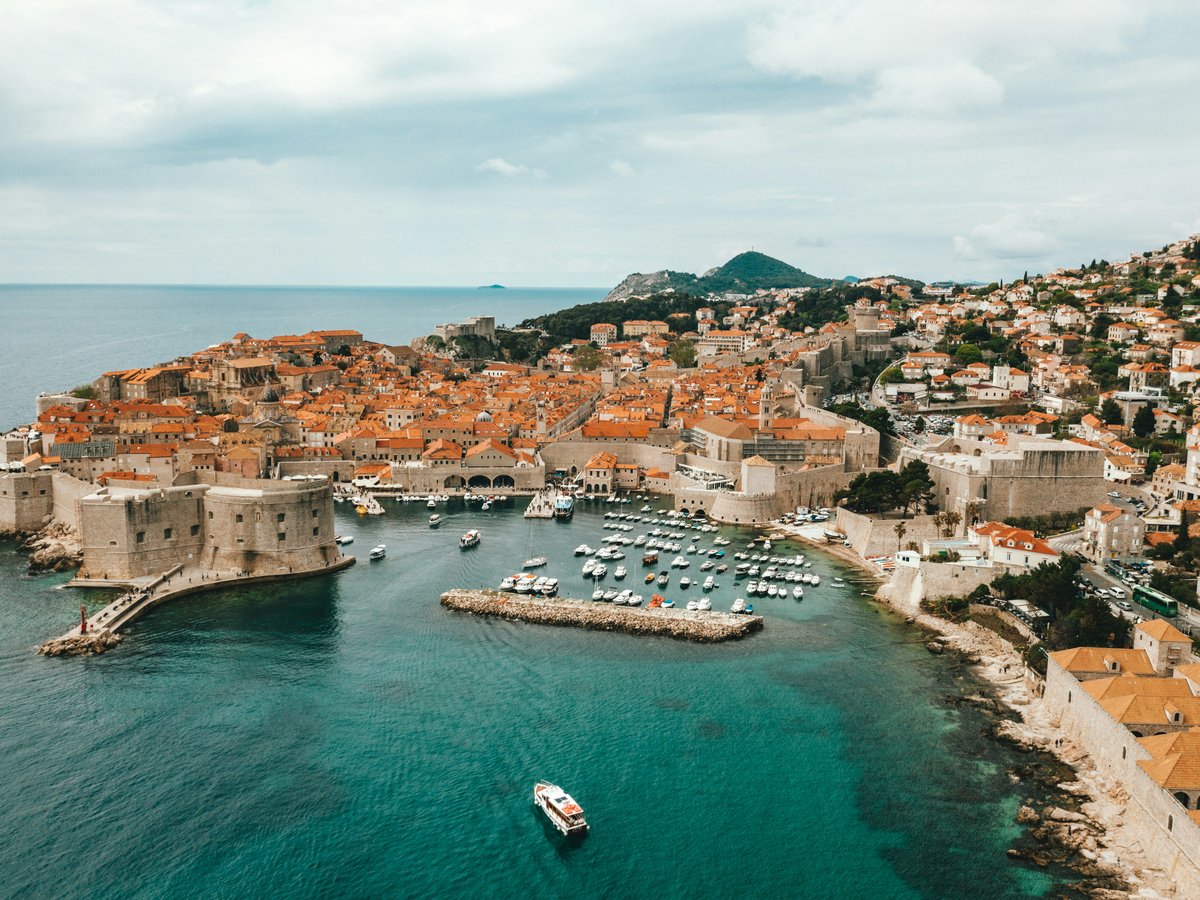
Stay in Dubrovnik in January
75 hotels in the Trip.com pool for Dubrovnik, from US$54 a night.
Opens Trip.com on Fri 1 Jan to Sun 3 Jan 2027; change the dates there.
January is Dubrovnik's quietest month, and that quiet cuts both ways. Daytime temperatures sit around 12°C (54°F), dropping to about 4.5°C (40°F) after dark, and the city typically sees around 95mm of rain spread across 11 days. The cruise ships that pack Stari Grad with thousands of day-trippers each summer morning are gone entirely. You might have Stradun to yourself on a Wednesday at 10am, the polished limestone reflecting a low winter sky, with nothing but your footsteps and the rattle of shutters in the bura wind.
That said, this is genuinely deep low season. A good number of restaurants and bars within the Old Town walls close from late October through March or April. Lokrum Island, the forested retreat a 15-minute ferry ride from the Old Port, is closed to visitors until spring. The cable car to Mount Srđ runs a reduced schedule and sometimes shuts down entirely during strong northeasterly gusts. You'll find a residential, working Dubrovnik in January, not the polished tourist production of July and August. Whether that appeals likely depends on what kind of traveler you are.
Hotel rates drop to their lowest point of the year, often 50-70% below summer pricing. The Dubrovnik Winter Festival (Dubrovački zimski festival) usually continues through early January with concerts at Revelin Fort and around the Old Town. Epiphany on January 6 draws locals to Dubrovnik Cathedral for services and a modest celebration. After the 6th, the city settles into its true winter rhythm, with some weeks passing without a single organized tour group entering the Pile Gate.
Why visit in January
- Stari Grad is nearly empty. The City Walls (Gradske zidine), which draw hour-long queues in July, are typically walkable with no wait at all. Stradun at 9am in January feels like a private city.
- Hotel and apartment rates drop 50-70% below the summer peak. Accommodation across Pile, Ploče, and Lapad is at its cheapest point of the year, making Dubrovnik genuinely affordable for the first time since October.
- Winter light gives the city's Baroque limestone a different quality. The low afternoon sun hitting Sponza Palace (Palača Sponza) around 3pm produces the kind of warm stone tones that photographers travel for.
- Day trips to Mali Ston for fresh oysters are at their seasonal best. The Ston channel harvest peaks in the winter months, roughly November through March.
Worth knowing
- Around 95mm of rainfall across an average of 11 rainy days. January storms can arrive heavy and linger for 2-3 days at a stretch, though you'll typically get longer dry spells between them than in November or December.
- Many restaurants, bars, and shops within the Old Town walls close for winter. You may find only 30-40% of summer dining options operating, with the reliable year-round spots concentrated in Gruž and Lapad rather than inside the walls.
- Lokrum Island is closed to visitors. The Mount Srđ cable car runs a limited winter schedule and may close entirely during bura wind episodes, which can last 1-3 days.
- Daylight hours are short. Sunset falls around 4:45pm in early January, giving roughly 9 hours of usable light for sightseeing.
Best for
Think twice if
January tends to be Dubrovnik's coldest month, though 'cold' here is relative. The Adriatic coast stays milder than inland Croatia, so you won't see snow in the city itself, though the mountains behind Dubrovnik sometimes get a dusting. Mornings can feel raw, especially when the bura wind is blowing down from the northeast. That's a dry, cold gust that funnels through the mountain passes and can make 8°C feel closer to 2°C. Rain usually arrives in longer spells rather than quick afternoon showers, sometimes settling in for 2 or 3 days before clearing. When it does clear, you'll get stretches of 4-5 dry days with pale blue sky and a low sun that warms the limestone walls of Stari Grad enough to sit outside for a coffee in Pile. The sea is grey-green and rough, around 14°C (57°F), and the salt smell carries further in the cold air. Humidity sits around 72%, which keeps the damp feeling present even on technically dry days.
Seasonal caution
- The bura wind, a cold northeastern gale, can reach gusts over 100 km/h (60+ mph) along the Dubrovnik coast in January. Episodes typically last 1-3 days and may close the Mount Srđ cable car, cancel ferry services to the islands, and make walking exposed sections of the City Walls uncomfortable or unsafe. Check the Croatian Meteorological Service (DHMZ) forecast before planning outdoor activities.
- The polished limestone surfaces throughout the Old Town, particularly Stradun and the steep stepped lanes off it, become extremely slippery in rain. The 1,940-metre City Walls walk includes uneven and narrow sections with limited railings that become hazardous in wet conditions. Grip-soled footwear is a safety matter, not a comfort preference.
Year-round climate
Averages from the last 5 years.
| Month | Avg high (°C) | Avg low (°C) | Rainfall (mm) |
|---|---|---|---|
| Jan | 12 | 5 | 249 |
| Feb | 13 | 5 | 170 |
| Mar | 14 | 7 | 230 |
| Apr | 17 | 9 | 140 |
| May | 22 | 14 | 160 |
| Jun | 28 | 19 | 48 |
| Jul | 31 | 22 | 42 |
| Aug | 30 | 21 | 73 |
| Sep | 26 | 17 | 156 |
| Oct | 21 | 13 | 178 |
| Nov | 17 | 9 | 370 |
| Dec | 14 | 6 | 209 |
Holidays and festivals in January
Public holidays
- New Year's Day(Nova Godina)1 January 2027
- Epiphany(Bogojavljenje, Sveta tri kralja)6 January 2027
Best things to do in January
Walk the City Walls without crowds
sightseeingThe 1,940-metre circuit atop Dubrovnik's medieval walls takes about 90 minutes and offers views over terracotta rooftops, the Adriatic, and Lokrum Island. In January, you might share the path with a handful of other visitors rather than the 5,000+ daily walkers of peak summer. The ticket office at Pile Gate rarely has a queue.
Summer queues of 60+ minutes at the Pile Gate entrance disappear entirely. You can stop and photograph without blocking foot traffic.Booking tipWalls open at 9am in winter and close around 3pm, earlier than summer. Start by 9:30am to finish in good light.
Day trip to Mali Ston for oysters
food and drinkThe 60km drive north along the coast to Mali Ston passes through the Pelješac peninsula wine country. At the waterside restaurants, a plate of 6-8 freshly shucked oysters from the Ston channel runs about 10-15 EUR. Pair them with a glass of local Plavac Mali from the Dingač vineyards, grown on the steep slopes 20 minutes further up the peninsula.
Winter is peak oyster season in the Ston channel. January harvests tend to produce the plumpest, most flavourful specimens of the year.Booking tipBota Šare and Kapetanova Kuka are the two best-known oyster restaurants. Neither typically requires a reservation in January, but calling a day ahead avoids a wasted trip if they've closed for a slow week.
Explore Rector's Palace and the Cultural History Museum
cultureThe Knežev dvor (Rector's Palace) on Pred Dvorom street dates to the 15th century and served as the seat of the Republic of Ragusa's government. The museum inside holds period furniture, Ragusan coins, pharmacy jars, and portrait paintings. In January, you can spend 2 hours examining the collection at your own pace in near-empty rooms.
No tour groups blocking the courtyard or filling the narrow interior rooms. The atrium with its Gothic-Renaissance arches is particularly photogenic in low winter light.Booking tipCombined tickets covering Rector's Palace, the Maritime Museum, and Revelin Fort offer better value than individual entries.
Wine tasting in Pelješac
food and drinkThe Pelješac peninsula, an hour north of Dubrovnik, is Croatia's most important red wine region. Vineyards around Dingač and Postup produce Plavac Mali from old vines planted on steep, south-facing slopes above the sea. In January, winemakers are between harvests and tend to have more time for tastings. Saints Hills, Miloš, and Madirazza all welcome visitors by appointment.
Winemakers are less busy between harvest and spring pruning, so tastings feel less rushed. You'll likely sit with the owner rather than a hired guide.Booking tipEmail or call 2-3 days ahead. Some smaller producers close their tasting rooms in deep winter without notice.
Visit the Franciscan Monastery and Europe's third-oldest pharmacy
cultureThe Franciscan Monastery (Franjevački samostan) sits at the western end of Stradun, near the Pile Gate. Its 14th-century cloister has Romanesque double columns and a garden courtyard. Inside, the monastery pharmacy has been operating since 1317, making it one of the oldest in continuous use in Europe. The small museum displays mortars, distillation vessels, and manuscript recipe books.
Summer crowds make the narrow cloister uncomfortable to linger in. January lets you sit on the stone bench in the courtyard and absorb the space.Hike Mount Srđ via the Serpentina trail
outdoorWhen the bura is calm, the old zigzag trail from the upper edge of the Old Town to the 412-metre summit of Mount Srđ takes about 60-75 minutes. The path is rocky and exposed in places. From the top, you look down over the entire walled city and the island-dotted coast stretching toward Cavtat. The Imperial Fort (Fort Imperial) at the summit houses a small museum about the 1991-92 siege.
Cool temperatures make the steep, exposed climb far more comfortable than in 35°C summer heat. Clear January days offer visibility stretching to the Elafiti Islands.Booking tipCheck the bura forecast on DHMZ before starting. The trail is exposed and dangerous in strong wind. If the cable car is running, you can ride up and walk down instead.
Explore Gruž market (Gradska tržnica Gruž)
food and drinkThe covered market in Gruž, about 3km west of the Old Town, is where Dubrovnik residents shop. In January, stalls carry winter produce from the surrounding countryside. Expect cabbages, kale, chard, dried figs, walnuts, olive oil, and those fragrant Neretva tangerines. The fish section has the morning's catch from local boats, usually including dentex, sea bass, and squid.
Without tourist crowds, the market runs on local rhythms. Vendors have time to talk, and you'll see what Dubrovnik residents cook in winter.What to eat in January
In season: fruit
Mandarine (Neretva tangerines)
Small, fragrant tangerines from the Neretva River delta, about 100km northwest of Dubrovnik, are at their sweetest through January. Street vendors along Gruž harbour sell bags of them for a few kuna. The peel is loose and the segments are seedier than what you might be used to, but the flavour is intensely aromatic.
On menus now
Brudet (Dalmatian fish stew)
A slow-cooked stew of mixed white fish, typically scorpionfish and monkfish, simmered in tomato, vinegar, onion, and olive oil. January is when this dish feels most at home on Dubrovnik tables. Restaurants in Gruž and along the Lapad waterfront tend to serve richer, heavier winter versions with polenta on the side. The vinegar tang cuts through the cold-weather richness.
Pašticada
Dalmatia's celebration beef stew, braised for hours in prošek wine with prunes, carrots, and a sweet-sour tomato base. Traditionally a feast-day dish, it appears on winter menus across the Old Town and Gruž. The meat is fork-tender after 4-5 hours of cooking, and most places serve it over homemade gnocchi. You'll find it at Konoba Dubrava in Gruž most January evenings.
Street food peaks
Fritule
Small fried dough balls dusted with powdered sugar, scented with lemon zest and sometimes raisins or rakija. They appear at Christmas markets in December and linger through early January around the Old Town. Best eaten warm from a street vendor near Onofrio's Fountain, where the sugar sticks to your fingers in the damp air.
In markets
Stonske kamenice (Mali Ston oysters)
The oyster beds in the Ston channel, about 60km northwest of Dubrovnik, reach their peak harvest in the winter months. January oysters from Mali Ston tend to be plump and briny, pulled fresh from the cold Adriatic. Several waterfront restaurants in Mali Ston serve them raw with lemon or lightly grilled. Worth the drive.
Regular events in January
Epiphany (Bogojavljenje)Free
January 6 marks Epiphany, locally called Sveta tri kralja (Three Kings). Morning services at Dubrovnik Cathedral draw local families. Some parishes along the coast hold a sea-blessing ceremony where a priest throws a cross into the harbour and young men dive after it. The holiday effectively marks the end of the Christmas season.
January 6Dubrovnik Winter Festival (closing events)
The Dubrovački zimski festival typically runs from November through early-to-mid January, with its final concerts, choir performances, and small exhibitions scheduled in the first week. Events take place at Revelin Fort, the Marin Držić Theatre, and churches within the Old Town. Check the Dubrovnik Tourist Board site for exact dates, which shift each year.
Early January (varies)Best places this January
Stradun (Placa)
landmarkDubrovnik's 300-metre main street runs from Pile Gate to the Clock Tower. The polished limestone underfoot, worn smooth by centuries of foot traffic, catches the low January sun. Without summer crowds, you can notice details that disappear in the crush. The Renaissance facades, the drainage channels, the subtle slope toward the eastern end.
Old TownCity Walls (Gradske zidine)
landmarkThe 1,940-metre circuit of medieval fortifications reaches up to 25 metres high and 6 metres thick. January means near-solitary walking. The section along the seaward southern wall, with views down to the rocks and crashing waves below, feels completely different in winter light and wind.
Old TownFort Lovrijenac (Tvrđava Lovrijenac)
landmarkThe freestanding fortress on a 37-metre cliff west of the Pile Gate was built to guard the sea approach. In summer it serves as a theatre venue for the Dubrovnik Summer Festival. In January, you'll have the ramparts to yourself, with views back toward the Old Town and out to the open Adriatic.
PileDominican Monastery (Dominikanski samostan)
museumThe 14th-century monastery near the Ploče Gate contains a quiet Gothic cloister and a museum with a notable collection of 15th and 16th-century Dubrovnik School paintings, including works by Nikola Božidarević and Lovro Dobričević.
Old TownWar Photo Limited
museumA small gallery on Antuninska street in the Old Town that exhibits photojournalism from conflicts worldwide. Rotating exhibitions. The space is thoughtfully curated and intimate. Check winter opening hours, as they vary year to year.
Old TownGruž harbour and waterfront
neighborhoodThe working harbour 3km west of the Old Town is where local life happens in January. The morning fish market, the produce market, cafes with harbour views, and the departure point for the few winter ferry routes. A 30-minute walk from the Old Town along the coast, or a quick ride on bus 1A or 1B.
GružCavtat
day tripA quiet coastal town 20km south of Dubrovnik, reachable by bus 10 in about 40 minutes. Its harbour promenade, the Račić Mausoleum by sculptor Ivan Meštrović, and a handful of year-round restaurants make it a good half-day trip. Far fewer closures than the Old Town in winter.
Trsteno Arboretum
parkA Renaissance garden and arboretum 18km northwest of Dubrovnik, maintained since 1492 by the Gučetić-Gozze noble family. The garden holds a 500-year-old Oriental plane tree and an aqueduct-fed Neptune fountain. Open year-round, though winter hours are shorter. Game of Thrones fans will recognize it as the Tyrell gardens.
Your packing checklist
Tick items off as you pack. Your progress saves in this browser.
All packed — have a great trip.
Insider tips
The City Walls ticket office at Ploče Gate (the eastern entrance near the Dominican Monastery) almost never has a queue, even in summer. In January, it's a formality. Starting from Ploče means you hit the spectacular seaward southern wall first, with morning light on the water.
Gruž is where Dubrovnik residents eat in winter. Konoba Dubrava, Šumica, and Posat stay open year-round and serve proper Dalmatian cooking at local prices. The Old Town's few open winter restaurants tend to charge summer-adjacent rates to fewer diners.
If the bura wind shuts down the cable car, you can still reach the top of Srđ by taxi (about 15 EUR one way) via the switchback road. The driver will know whether conditions up top are tolerable.
The Buža Bar (the famous cliff-perch bar outside the southern walls) closes for winter. Don't walk the narrow lane looking for it. The similar Buža II also shuts. For waterside drinks, try the cafes along Banje Beach near Ploče Gate, a few of which stay open on dry winter days.
Dubrovnik's bus system (Libertas) runs reduced winter schedules. Lines 1A, 1B, and 6 cover the useful routes (Pile Gate to Gruž, Lapad, and Babin Kuk). Buy a Libertas card at a kiosk for cheaper per-ride fares than paying the driver in cash.
Pack a portable phone charger. January's 9 hours of daylight and cold temperatures drain smartphone batteries faster than usual, and you'll be relying on your phone for maps, DHMZ weather checks, and restaurant lookups more than in summer when everything is open and obvious.
Avoid these mistakes
- Booking accommodation inside the Old Town walls without checking if nearby restaurants will be open. In January, entire streets within the walls go dark after 6pm. Staying in Gruž or Lapad puts you closer to the year-round dining scene.
- Assuming the cable car runs every day. Bura wind closures in January can last 1-3 days without warning. Build flexibility into your itinerary rather than banking on a specific day for the Srđ summit.
- Wearing smooth-soled shoes on the Old Town limestone. This is not about comfort. The polished stone surfaces become genuinely hazardous in rain, and the stepped alleys off Stradun are steep. Every winter sees slips and falls from visitors in fashion footwear.
- Planning a packed daily itinerary without rain contingencies. January averages 11 rainy days. Having 2-3 indoor options (Rector's Palace, the Dominican Monastery museum, War Photo Limited) for each outdoor plan prevents wasted days.
- Skipping Gruž entirely. Most visitors stick to the Old Town and miss Dubrovnik's best winter produce market, its most reliable restaurants, and the actual rhythm of the city outside the walls.
Practical tips for January
Most Old Town attractions operate on reduced winter hours, typically 9am-3pm or 10am-4pm, and some close on Sundays. Confirm times on the Dubrovnik Museums website (dumus.hr) before walking over. The City Walls close at 3pm in January, a full 4.5 hours earlier than their summer closing time, so plan that walk for the morning. ATMs inside the Old Town walls work year-round, but the exchange bureau near the Pile Gate may keep irregular winter hours. Croatia switched to the euro in January 2023, so you won't need kuna. Dubrovnik Airport (DBV) is 20km south of the city. The Atlas airport shuttle runs to the Pile Gate area but on a reduced winter schedule, so check departure times or arrange a taxi (roughly 35 EUR, fixed rate). Mobile data coverage is reliable throughout the city and coast, including on the Srđ summit and along the Pelješac peninsula.
FAQ
Is January a good time to visit Dubrovnik?
It depends on what you want. January is the quietest, cheapest month, with near-empty streets and 50-70% lower hotel rates. But many Old Town restaurants close for winter, Lokrum Island is shut, and you'll likely encounter rain on about 11 of 31 days. If you're drawn to atmospheric off-season cities and don't need beach weather, January has a stark appeal. If you want the full Dubrovnik experience with outdoor dining and island-hopping, May or October are better bets.
How cold does Dubrovnik get in January?
Daytime highs sit around 12°C (54°F) and overnight lows drop to about 4.5°C (40°F). Snow in the city itself is rare, though you might see it on the mountains behind town. The bura wind is the real factor. When it blows, windchill can make 8°C feel closer to 2°C, and it funnels through the Old Town streets with force.
Are the Dubrovnik City Walls open in January?
Yes, but on reduced winter hours, typically 9am to 3pm. The walls may close temporarily during heavy rain or very strong bura wind for safety reasons. The 1,940-metre circuit takes about 90 minutes. In January, you might share it with a dozen other visitors rather than the thousands who walk it daily in summer.
Can I take a ferry to the Elafiti Islands in January?
Jadrolinija runs a reduced winter ferry schedule to Koločep, Lopud, and Šipan, but departures are far fewer than summer, sometimes only 1-2 per day, and cancellations happen when seas are rough. Lokrum Island is closed entirely until spring. If island-hopping is a priority, plan your trip for late April through October instead.
What is there to eat in Dubrovnik in January?
Winter is peak season for Mali Ston oysters (a 60km day trip), hearty dishes like brudet (fish stew) and pašticada (slow-braised beef), and Neretva tangerines from the delta 100km north. Fewer Old Town restaurants are open, but year-round spots in Gruž like Konoba Dubrava and Šumica serve proper Dalmatian winter cooking. The Gruž produce market has fresh fish, winter greens, and local olive oil daily.
Things to Do in Dubrovnik in January
 Free cancellation
 Small Group Blue Cave and Sunj Beach Boat Tour from Dubrovnik
Outdoor experience: 4 hours, free cancellation.
via Viator Free cancellation
 Montenegro Day Trip from Dubrovnik with Optional Boat Trip
Day trip: free cancellation.
via Viator Free cancellation
 Kravice Waterfalls, Mostar and Pocitelj Day Trip from Dubrovnik
Day trip: free cancellation.
via Viator Free cancellation
 Dubrovnik: 7 Caves & Blue Cave Speedboat Tour (4h)
Outdoor experience: 4 hours, free cancellation.
via Viator Free cancellation
 Dubrovnik Old Town History - Small Group Walking Tour
City tour: 1.5 hours, free cancellation.
via Viator Free cancellation
 Dubrovnik Elafiti Islands Cruise with Lunch, Drinks and Pickup
Day trip: free cancellation.
via ViatorFind a flight to Dubrovnik
Live fares to Dubrovnik appear here once cookies are accepted.
Last verified by automated review (v1.7.2) on . What is automated review?