Osaka tends to get reduced to its food reputation, which is fair enough — the smell of sizzling batter drifts through half the neighborhoods in this city. But even if you never spend a yen on admission, Osaka has a texture that rewards just being present. The shrine grounds are hushed and cedar-scented before 8 AM. The river walks along the Dotonbori canal catch golden light in late afternoon. Markets let you browse without a hard sell. And the locals, who are famously more approachable than their Tokyo counterparts, seem genuinely pleased when visitors wander into their neighborhood spots. What makes Osaka particularly generous for zero-budget travelers is the density of the free layer: centuries-old temple compounds, castle grounds that spread across hectares, public parks with legitimate botanical collections, and entire commercial streets that function as open-air theater. You could spend three full days here without buying a ticket to anything and still feel like you barely started.
Free attractions
-
Sumiyoshi Taisha (住吉大社)
One of Japan's oldest shrines, and the atmosphere still holds. The distinctive Sumiyoshi-zukuri architecture — those straight-angled roofs without the typical upward curves — predates Chinese Buddhist influence on Japanese building. The arched Taikobashi bridge over the pond is the postcard shot, but the quieter inner compounds behind the main hall tend to be where you actually feel the age of the place. Grounds stay open from roughly 6:00 to 17:00, no admission charge. It gets busy during Hatsumode in January, but on a weekday morning you might have the main approach nearly to yourself.
Sumiyoshi-kuShrine -
Namba Yasaka Shrine (難波八阪神社)
The giant lion head stage — about 12 meters tall — is one of those structures that looks unreal in photos and somehow more unreal in person. The open mouth serves as a stage for performances during shrine festivals. Beyond the lion, the shrine grounds are small but well kept, and entry is free at all times. Worth noting: it sits just a few minutes' walk south of Namba station, so it slots easily into a Dotonbori day without requiring a detour.
NambaShrine -
Shitenno-ji (四天王寺) — Outer Grounds
Founded in 593, this is considered one of Japan's first Buddhist temples. The outer grounds and the long approach from Tennoji Station are free to walk — stone lanterns line the path, and the flea market on the 21st and 22nd of each month fills the grounds with vendors. The inner precinct and the Gokuraku-jodo Garden carry small admission fees, currently around ¥300 each, so those aren't truly free. But the temple atmosphere on the outer approach is substantial on its own. The scent of incense reaches you before the main gate comes into full view.
TennojiTemple -
Hozen-ji (法善寺)
A tiny temple tucked into a stone-paved alley just south of Dotonbori. The draw is the Mizukake Fudo statue, covered in a thick layer of moss from decades of visitors splashing water over it as a prayer ritual. The alley itself — Hozen-ji Yokocho — carries an atmosphere that photographs only partly capture: wet stone underfoot, paper lanterns overhead, the low murmur from the small bars that line both sides. Free to visit at any hour.
NambaTemple -
CUPNOODLES MUSEUM OSAKA IKEDA (カップヌードルミュージアム 大阪池田)
The museum dedicated to Momofuku Ando's invention of instant ramen, located in Ikeda about 20 minutes north of central Osaka by Hankyu Takarazuka Line. Admission to the museum itself is free — you walk through the history of cup noodles, see the original shed where Ando developed chicken ramen in 1958, and browse a floor-to-ceiling wall displaying every instant noodle variety ever produced. The hands-on workshop where you design your own cup costs ¥500, but the museum visit alone is worth the trip up there and costs nothing.
IkedaMuseum -
Japan Mint Museum (造幣博物館)
Housed in the original Meiji-era red brick building on the Mint Bureau grounds in Kita-ku. The museum covers the history of Japanese currency with displays of coins, medals, and minting equipment going back centuries. Free admission, though visiting hours tend to be limited to weekday business hours — check before making the trip. Separate from the famous cherry blossom walkway on the same grounds, which opens for about one week each April, also free.
Kita-kuMuseum -
Osaka Castle Park (大阪城公園)
The grounds around Osaka Castle spread across roughly 106 hectares, and all of it is free to walk. The moats, the stone walls, the plum and cherry groves — none of that costs anything. The castle tower museum inside the keep costs ¥600, and it's a concrete reconstruction, honestly skippable if you're watching your budget. The park itself is the real draw: joggers circle the outer moat in the morning, picnickers spread out under the plum trees in February and March, and the whole southeast corner near Osaka Business Park tends to be overlooked and genuinely peaceful. The sound of crows echoing off the stone walls gives the place a particular character.
Chuo-kuPark -
Nakanoshima Park (中之島公園)
A narrow island sandwiched between two branches of the Tosabori and Dojima rivers, right in the middle of the business district. The eastern end has a rose garden with roughly 3,700 plants across nearly 90 varieties — at peak bloom in May and October, the scent carries across the paths. Free at all hours. The western end is anchored by the Osaka City Central Public Hall, a 1918 neoclassical building that's free to walk into and admire during open hours. The whole island feels like a pause button in the middle of a busy city.
Kita-kuPark -
Utsubo Park (靱公園)
A long, narrow green strip in the Nishi-ku business district, known locally for its rose garden on the east side — smaller than Nakanoshima's but arguably better maintained. Tennis courts, a playground, and a central lawn where office workers eat lunch under the trees. The park has a slightly different feel than Osaka's showpiece greens; it's more of a neighborhood spot, and the mix of dog walkers, skateboarders, and salary workers eating onigiri on benches feels distinctly local. The roses peak around the same May and October windows as Nakanoshima.
Nishi-kuPark -
Minoo Park (箕面公園)
Technically in the city of Minoh, but reachable in about 30 minutes from Umeda on the Hankyu Minoh Line. The park follows a forested gorge up to Minoo Falls, a 33-meter waterfall that's the payoff for a roughly 40-minute walk on a paved path. The trail is shaded by maples that turn blazing orange and red in November — momiji tempura (fried maple leaves) sold along the path is a local specialty. The park, the falls, and the trail are all free. It smells like damp cedar and leaf mulch, especially after rain. Cool even in summer.
MinohPark
Free activities
-
Dotonbori and Tombori River Walk
The pedestrian walkway along the Dotonbori canal stretches for about 600 meters between Nipponbashi and Dotonboribashi. At night, the neon signs reflect off the water and the whole strip turns into sensory overload: grilled octopus smoke, the mechanical crab and blowfish signs clacking overhead, touts calling out from restaurant doors. The walk is free, the people-watching is first-rate, and you can spend an hour here without anyone pressuring you to buy. The Glico Running Man sign is at the Ebisu Bridge midpoint — the crowd gathers there like it's a public stage.
Namba / DotonboriWalking route -
Tenjinbashi-suji Shopping Street (天神橋筋商店街)
At roughly 2.6 kilometers, this is considered the longest covered shopping street in Japan. It runs from Tenjinbashi in the south up toward Tenjimbashisuji Rokuchome Station. The shops lean local — rice crackers, kelp, pickles, secondhand bookstores, small curry joints — and the overhead arcade keeps it dry in rain. Free to walk end to end. The southern section near Osaka Tenmangu shrine tends to have more food stalls and foot traffic. You'll notice the character of the shops shifting as you move north; the far end is quieter, more residential in feel.
Kita-kuMarket / walking route -
Kuromon Market (黒門市場) browsing
Known as Osaka's kitchen, Kuromon runs for about 580 meters near Nipponbashi. In recent years it's shifted from a wholesale fish market to more of a tourist-oriented street food strip, and prices have risen accordingly — but browsing is free, and watching the vendors prep seafood is legitimate entertainment on its own. The tuna cutting, the shellfish grilling over open flames, the stacks of uni on ice — the visual and olfactory experience costs nothing. Early morning, before 9 or so, still catches some of the old wholesale energy.
NipponbashiMarket -
Shinsekai neighborhood walk
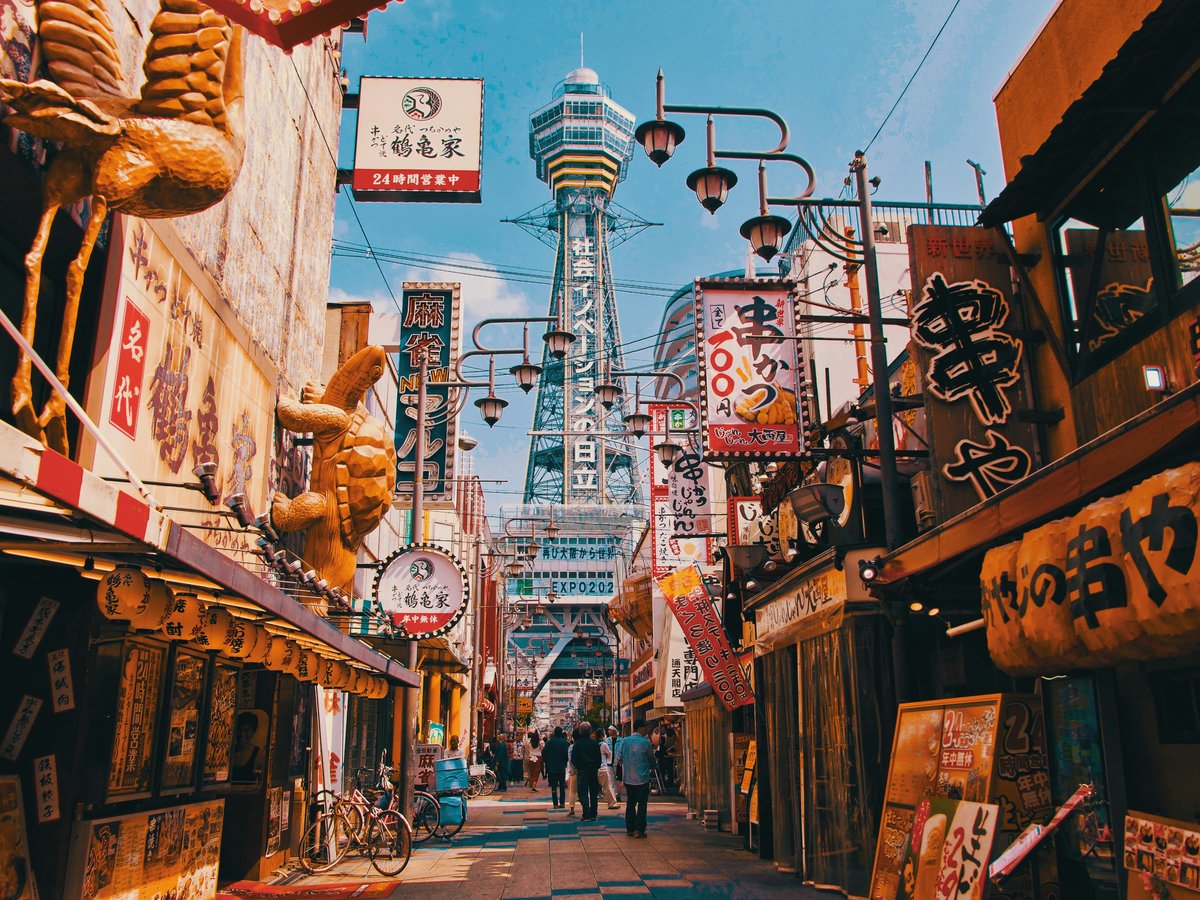
The district around Tsutenkaku Tower has a gritty, retro atmosphere that sets it apart from the polished commercial zones elsewhere in Osaka. The side streets are lined with kushikatsu shops, game parlors, and hand-painted signage that looks like it hasn't been updated since the 1970s. Free to explore. The energy shifts noticeably between daytime — when elderly locals play shogi at the game centers and the light falls flat between the buildings — and evening, when the neon flickers on and the beer starts flowing. The tower observation deck has an admission fee (currently around ¥900), but the streetscape beneath it is the real show.
ShinsekaiNeighborhood walk -
Nakanoshima riverside walk
Following the Dojima River along the north bank and the Tosabori River along the south, this route connects the rose garden at the eastern tip to the National Museum of Art and Science Museum to the west. The walk is flat, shaded in sections, and passes some of Osaka's best-preserved Meiji and Taisho-era buildings. At dusk the bridges light up and the water catches the city in long broken reflections. Roughly 3 kilometers end to end, entirely free, and far quieter than the Dotonbori strip.
NakanoshimaWalking route -
Osaka Mint Bureau cherry blossom walkway (造幣局 桜の通り抜け)
Each April, for about one week, the Japan Mint Bureau opens its grounds to the public for the sakura no torinuke — a 560-meter-long corridor of cherry trees, many of them late-blooming yaezakura varieties you won't see in the standard parks. The dates shift each year depending on bloom conditions, typically mid to late April. Free admission, though the specific dates are announced only a couple of weeks in advance. The walk is one-way and it gets crowded — weekday mornings are your best window for breathing room. The variety of blossom colors, from deep pink to near-white, is wider than most hanami spots.
Kita-kuSeasonal walk
Free events
-
Tenjin Matsuri (天神祭)
July 24-25, annuallyOne of Japan's three great festivals and Osaka's signature summer event. The July 24 Yoimiya features shrine rituals and a massive street procession from Osaka Tenmangu; July 25 is the main day with a boat procession on the Okawa River and fireworks visible from both banks. Free to watch from the riverbanks and streets, though the prime spots fill up hours in advance. The heat and humidity in late July are relentless — expect to be drenched in sweat standing in the crowd, but the atmosphere is worth the discomfort.
Osaka Tenmangu Shrine and Okawa River -
Kishiwada Danjiri Matsuri (岸和田だんじり祭)
Mid-September, annually (Saturday and Sunday before Respect for the Aged Day)Massive wooden floats weighing several tons are pulled at full sprint through narrow streets, whipping around corners on two wheels while a team leader dances on the roof. It is genuinely dangerous and genuinely thrilling. Kishiwada is about 25 minutes south of Namba on the Nankai Line. Free to watch from the street, though arriving early is critical for a decent sightline. The sound of the wooden wheels scraping pavement at speed stays with you.
Kishiwada, south of central Osaka -
Toka Ebisu at Imamiya Ebisu Shrine (今宮戎神社 十日戎)
January 9-11, annuallyThree days of festivities honoring Ebisu, the deity of business prosperity. Roughly a million visitors pass through the small shrine grounds over the three days, buying decorated bamboo branches called fukuzasa for good luck. The shrine visit and the atmosphere are free; you only pay if you buy the branches or food from the stalls that pack the surrounding streets. The energy is festive and chaotic — a wall of people shuffling through the shrine approach, the clapping of hands in prayer, vendors shouting.
Imamiya Ebisu Shrine, Namba -
Sumiyoshi Taisha Otaue Shinji (住吉大社 御田植神事)
June 14, annuallyA rice-planting ritual that has been performed for over 1,700 years, held on the shrine's sacred rice paddy. Dancers and musicians in traditional dress perform as the actual planting takes place — it is part spiritual ceremony, part agricultural theater. Free to attend and watch from the surrounding area. The pace is slow and deliberate, which makes it feel like a different century entirely.
Sumiyoshi Taisha, Sumiyoshi-ku -
Midosuji Illumination (御堂筋イルミネーション)
Nightly, November through JanuaryThe ginkgo-lined Midosuji boulevard between Umeda and Namba lights up nightly from November through January, stretching roughly 4 kilometers — one of the longest illumination displays in Japan. Free to walk along. The trees shift through color sequences, and the sidewalk LED displays change design each year. In early November the ginkgo leaves tend to still be on the trees, creating a layered effect of natural gold and artificial light that is quite distinctive. The cold air and the warm light make for a good late-evening walk.
Midosuji boulevard, Umeda to Namba
What looks free but isn't
A few spots in Osaka appear free on first impression but carry admission charges worth knowing about. Osaka Castle's tower museum costs ¥600 — the park around it is free, but the interior exhibits aren't. Tsutenkaku Tower's observation deck currently runs about ¥900 for the general floor. Spa World in Shinsekai charges admission for its bathing facilities. Shitenno-ji's inner precinct and Gokuraku-jodo Garden are roughly ¥300 each, separate from the free outer grounds. Osaka Aquarium Kaiyukan sits around ¥2,700. To be fair, some of these are worth the price — but they don't belong on a zero-budget itinerary, and it helps to know the boundary before you queue up.
Free temple and shrine mornings
Osaka's shrines and temples keep their grounds open from early morning — typically around 6:00 or sunrise — and visiting before 9:00 gives you a different city entirely. Sumiyoshi Taisha at dawn, with mist still sitting on the pond and the Taikobashi bridge reflected cleanly in the water, is arguably more atmospheric than any paid attraction in the city. The smaller neighborhood shrines — Ikukunitama Shrine near Tennoji, Osaka Tenmangu near Tenjinbashi — tend to be completely empty before 8:00 and carry that particular quiet of old wood and swept gravel. If you're jetlagged and awake at 5:30, use it. The light at that hour is soft and the stone paths are still damp from overnight humidity.
Seasonal free experiences worth timing a trip around
Osaka's free offerings shift with the calendar, and some windows are significantly better than others. Cherry blossom viewing in late March through early April fills Osaka Castle Park, Kema Sakuranomiya Park along the Okawa River, and the Mint Bureau walkway with picnickers and photographers — the blossoms last roughly a week at peak, and the timing varies by year. The plum groves at Osaka Castle bloom earlier, usually late February into March, and draw noticeably fewer crowds. Autumn maple viewing peaks in late November at Minoo Park, where the gorge trail becomes a corridor of red and gold. Summer brings the Tenjin Matsuri in July and the Naniwa Yodogawa Fireworks Festival in August, both free to watch from the riverbanks. Winter has the Midosuji Illumination and the quieter, colder atmosphere of the shrine circuits — fewer tourists, shorter lines at Dotonbori, and a different quality of light over the canals.
FAQ
Is Osaka Castle free to visit?
The castle grounds and surrounding park are completely free and open daily — that includes the moats, the stone walls, the gardens, and the jogging paths. The tower museum inside the castle keep costs ¥600 for adults. You can get the full castle experience from outside without paying anything. The interior museum covers Toyotomi Hideyoshi and the castle's history, but the building is a 1931 concrete reconstruction, and most visitors find the exterior and grounds more rewarding than the exhibits inside.
Are temples and shrines in Osaka free to enter?
Shrine grounds in Japan are almost universally free to enter — that covers Sumiyoshi Taisha, Namba Yasaka Shrine, Osaka Tenmangu, and the smaller neighborhood shrines. Temples are more mixed: the main grounds and approach are typically free, but some charge for inner halls, gardens, or special exhibitions. Shitenno-ji's outer grounds are free while the inner precinct and garden carry small fees. As a general rule, if you can see it from the open grounds, you can experience it without paying.
What is the best free thing to do in Osaka at night?
Walking Dotonbori along the Tombori River Walk after dark is the obvious answer, and it's obvious for good reason — the neon reflected in the canal water, the noise, the smoke from the takoyaki grills, the crowd energy. If you want something quieter, the Nakanoshima riverside area has a different character: lit bridges, the water moving slowly past illuminated buildings, office workers heading home. During November through January, the Midosuji Illumination adds a 4-kilometer light display along the main boulevard between Umeda and Namba.
Can I browse Osaka's markets without spending money?
You can walk through any of Osaka's markets for free, and the sensory experience — watching fish being butchered at Kuromon, smelling grilled shellfish, seeing kelp and pickle stalls at Tenjinbashi-suji — is worth the visit on its own. Nobody will pressure you to buy. That said, the Shitenno-ji flea market on the 21st and 22nd of each month is likely the best free market experience in the city: hundreds of vendors spread across the temple grounds selling antiques, secondhand kimono, ceramics, and used books.
How many days can I fill in Osaka without paying for attractions?
Comfortably three to four full days. Between the shrine and temple visits, the park walks, the neighborhood explorations in Shinsekai and Dotonbori, the market browsing, and a day trip to Minoo Falls, you'd have packed days without running out of free things to see. After four days you might start doubling back on neighborhoods, though even then the markets and street life shift depending on the day of the week and time. Budget your food money separately — Osaka is a difficult city to walk through without eating something.
Is the CUPNOODLES MUSEUM in Osaka really free?
The museum in Ikeda is free to enter. You can walk through the full exhibition, see the recreation of Momofuku Ando's workshop shed, and browse the instant noodle timeline without paying anything. The My CUPNOODLES Factory workshop, where you design and fill your own cup, costs ¥500 per cup. The Chicken Ramen Factory workshop is ¥1,000 and requires advance reservation. But the museum experience on its own — which is genuinely well done — is completely free. It's about 20 minutes from Umeda on the Hankyu Takarazuka Line to Ikeda Station.
Last verified by automated review (v1.7.2) on June 4, 2026. What is automated review?