Stay in Split in January
71 hotels in the Trip.com pool for Split, from US$21 a night.
Opens Trip.com on Fri 1 Jan to Sun 3 Jan 2027; change the dates there.
January is the quietest month in Split, and arguably the hardest sell. The city that draws over a million visitors between June and September shrinks to its year-round population of around 180,000, and roughly half the restaurants and bars along the Riva promenade are closed until March. Daytime temperatures reach about 11.7°C (53°F) with nights dropping to 4.5°C (40°F), and 162mm of rainfall spreads across 11 days. The bura, a cold northeasterly wind that funnels through gaps in the Dinaric Alps, can appear without warning and knock the perceived temperature down by 5-10°C for hours or days at a stretch.
There is, to be fair, a version of this city in January that appeals to a specific kind of traveler. The Palace walls feel startlingly old when your footsteps echo off the stone of the Peristyle instead of being swallowed by tour-group noise. Hotel rates drop to a fraction of summer prices. The konobas that stay open through winter serve the slow-braised, heavy Dalmatian food that locals genuinely eat, not the grilled-fish-and-mixed-salad menus aimed at July visitors.
Mind you, this is not a beach trip and not an island-hopping trip. Bačvice sits empty except for joggers. Ferry schedules to Hvar and Brač run once daily at best, and bura cancellations can strand you with little notice. If your image of Split involves turquoise water and golden-hour drinks at a waterfront bar, wait for late May at the earliest.
Why visit in January
- Hotel and apartment rates drop 50-60% from the July peak, putting a central studio that costs 100+ EUR per night in summer within the 30-40 EUR range
- Diocletian's Palace and the Cathedral of Saint Domnius are nearly empty of tourists, allowing quiet, unhurried exploration of the Roman-era complex
- Winter menus at local konobas feature slow-cooked Dalmatian dishes like pašticada and brodetto that rarely appear during the tourist-oriented summer season
- Solo-traveler safety scores 8.2/10 (see the TTDI Solo-Safety Index), and the off-season atmosphere makes the compact old town feel particularly secure and walkable
Worth knowing
- January records the second-highest rainfall of any month, after November, with rain on roughly a third of all days and grey skies as the default
- Many restaurants, tour operators, and bars close from early January through March, leaving limited dining and nightlife options outside the Grad and Riva areas
- The bura wind brings sudden drops in wind chill and can ground island ferries for 1-2 days at a time with limited advance notice
- Daylight is short. Sunrise comes around 7:20 and sunset near 16:40, giving about 9 hours of usable light
Best for
Think twice if
Split's coldest month. Expect overcast skies on most days, with rain arriving in intense bursts rather than all-day drizzle. The bura wind can turn a mild afternoon into something that feels near freezing on exposed waterfront stretches. Snow in the city itself is extremely rare, appearing perhaps once every 5-10 years, though it occasionally dusts the Mosor mountain range visible from the Riva. Mornings tend to be the coldest window, and fog sometimes settles over the harbor before clearing by mid-morning.
Seasonal caution
- The bura wind can reach gusts of 100+ km/h (60+ mph) along exposed coastal sections near the ferry terminal and Sustipan peninsula. Check Meteo.hr forecasts before planning waterfront walks or ferry crossings.
- Wet marble and stone surfaces inside Diocletian's Palace and along the Riva become genuinely slippery after rain. The underground basement halls run several degrees colder than street level.
Year-round climate
Averages from the last 5 years.
| Month | Avg high (°C) | Avg low (°C) | Rainfall (mm) |
|---|---|---|---|
| Jan | 12 | 5 | 162 |
| Feb | 13 | 5 | 81 |
| Mar | 15 | 7 | 110 |
| Apr | 18 | 10 | 109 |
| May | 23 | 15 | 110 |
| Jun | 29 | 20 | 49 |
| Jul | 32 | 23 | 23 |
| Aug | 31 | 22 | 76 |
| Sep | 26 | 18 | 137 |
| Oct | 22 | 14 | 110 |
| Nov | 16 | 9 | 258 |
| Dec | 13 | 7 | 157 |
Holidays and festivals in January
Public holidays
- New Year's Day(Nova Godina)1 January 2027
- Epiphany(Bogojavljenje, Sveta tri kralja)6 January 2027
Best things to do in January
Explore Diocletian's Palace without crowds
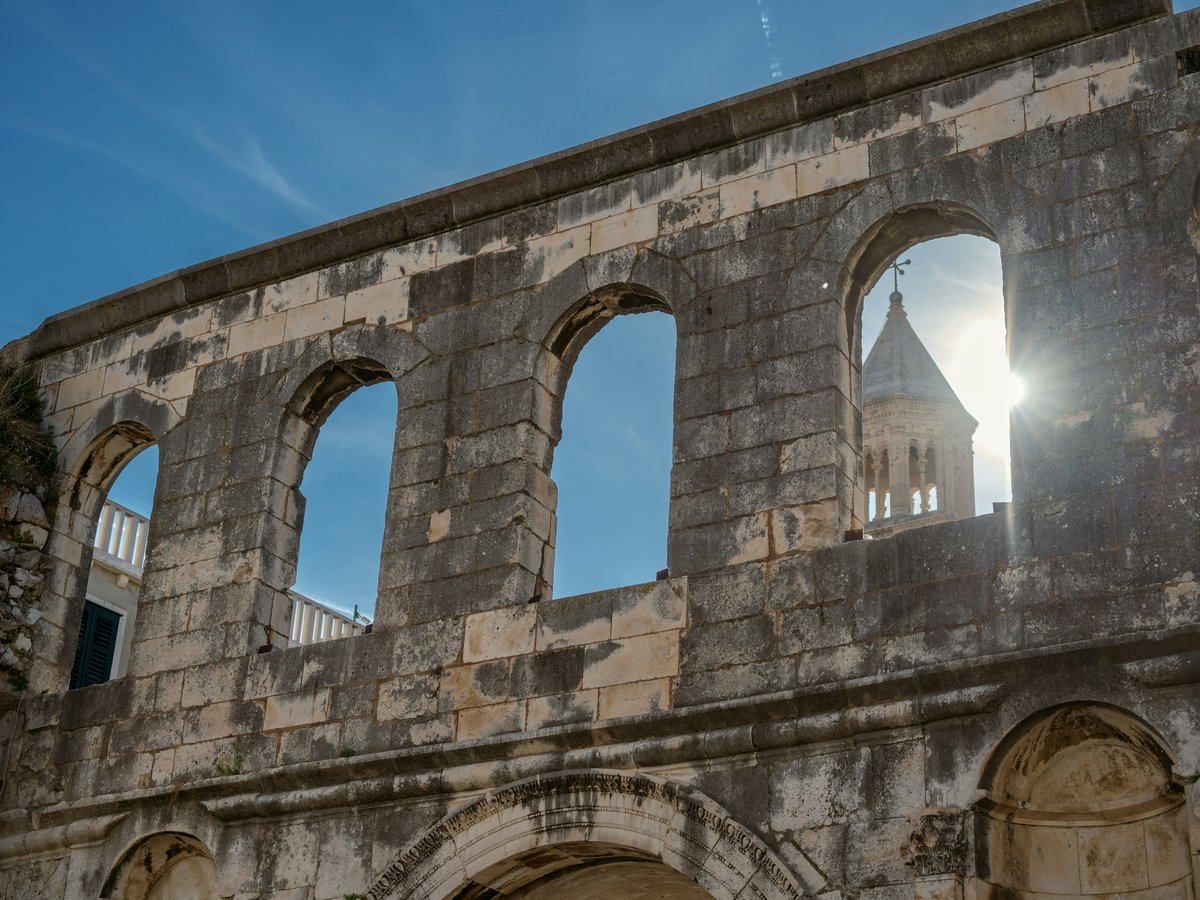
sightseeingThe 4th-century Roman palace complex, built in 293 for Emperor Diocletian, is a living neighborhood with residents, shops, and cafes operating inside its ancient walls. In January, the basement halls, Peristyle courtyard, and Temple of Jupiter can all be explored at your own pace without being funneled through tour groups.
Peak season sees 10,000+ daily visitors inside the Palace walls. January reduces that to a few hundred, making it possible to hear the acoustics of the Peristyle and photograph the basement vaults without crowds.Booking tipNo booking needed. The basement halls charge a small entry fee (around 6 EUR) and maintain winter hours, typically 9:00 to 17:00 on weekdays.
Hike Marjan hill
outdoorThe forested peninsula on Split's western edge offers trails through Aleppo pine forest, past small medieval chapels, and up to viewpoints facing the open Adriatic and the islands of Šolta, Brač, and Hvar. The main trail from Varoš to the summit takes about 45 minutes.
Cooler temperatures make the uphill walk comfortable compared to the 32°C heat of summer. Clear winter days after a bura blow deliver some of the year's sharpest visibility, sometimes exceeding 100 km.Booking tipFree and open at all times. Start from the stone steps near Vidilica viewpoint at the edge of Varoš for the most scenic approach.
Visit the ruins of ancient Salona
sightseeingSalona, 5 km northeast of Split near the town of Solin, served as the capital of the Roman province of Dalmatia with a population of roughly 60,000 at its height. The amphitheater, early Christian basilicas, and city walls spread across an open archaeological park.
The site sits almost deserted in January. Mild winter temperatures make walking the extensive grounds far more comfortable than in midsummer heat. Entrance fees are typically reduced or waived off-season.Booking tipTake bus 1 from the Riva to Solin, about a 20-minute ride. Bring a downloaded map, as on-site signage is limited.
Attend a performance at HNK Split
cultureThe Croatian National Theatre in Split, established in 1893 on Trg Gaje Bulata, hosts opera, ballet, and drama through the winter cultural season. The ornate interior of the theatre is worth seeing in its own right.
January falls in the middle of the winter program, when HNK Split runs 4-5 performances per week. The summer season shifts activity outdoors, so the theatre building itself is at its liveliest now.Booking tipTickets range from roughly 10 to 30 EUR. Book a few days ahead for weekend opera performances at the box office or online.
Walk the Varoš neighborhood
neighborhood walkVaroš is the old fishermen's quarter west of the Palace, climbing the hillside toward Marjan. Narrow stone staircases connect its streets, and drying laundry still hangs between windows. It remains primarily residential, one of the few neighborhoods inside Split's core that hasn't been fully converted to tourist accommodation.
Without summer visitors, Varoš returns fully to its residents. You'll pass locals carrying groceries up the steep lanes, hear televisions through open shutters, and sense the daily rhythm of the neighborhood in a way that high season makes impossible.Browse the morning market at Pazar
marketThe open-air green market on the eastern side of the Palace walls operates year-round. January's stalls carry winter produce from the Dalmatian hinterland and the Neretva valley. Expect root vegetables, cabbages, dried figs, walnuts, olive oil, and those peak-season tangerines.
The January market is smaller and more local than its summer counterpart, which caters partly to tourists. Prices are lower, the vendors speak Croatian rather than switching to English, and wild asparagus from the surrounding hills sometimes appears at stalls in late January.Booking tipArrive before 9:00 for the best selection. The market winds down by early afternoon.
Day trip to Trogir
day tripTrogir, a UNESCO World Heritage town 30 minutes west by bus, sits on a small island connected to the mainland by a bridge. Its cathedral, founded in 1213, features a Romanesque portal by Master Radovan considered among the finest in southeastern Europe. The 15th-century Kamerlengo Castle anchors the western end of the island.
Trogir's compact old town is almost completely tourist-free in January. The narrow limestone streets, normally packed shoulder-to-shoulder in summer, become quiet enough to hear your footsteps. Bus 37 runs from Split roughly every 20 minutes year-round.Booking tipKamerlengo Castle may have reduced winter hours or close for restoration. Check locally before making the trip specifically for the castle.
What to eat in January
In season: fruit
Neretva Valley mandarins
The tangerines from the Neretva delta, about 90 minutes southeast of Split, hit peak ripeness from December through January. You'll find them piled on stalls at Pazar market for well under 1 EUR per kilogram, still with leaves attached.
On menus now
Pašticada
Dalmatia's signature slow-braised beef stew, cooked for hours in a dried-plum and red wine sauce. Served with homemade gnocchi or njoki in most konobas. Winter is when this dish appears most often on menus, as locals consider it too heavy for summer.
Brodetto (brudet)
A fisherman's stew built from the day's mixed catch, simmered with tomatoes, onion, and vinegar, served alongside polenta. January's rougher seas tend to mean smaller, bonier fish in the pot, which gives the broth more depth.
Soparnik
A thin, unleavened pie filled with Swiss chard, onion, garlic, and olive oil, originally from the Poljica area near Split. It shows up more commonly on winter menus and at the green market, served at room temperature in rough triangular slices.
Street food peaks
Fritule
Small fried dough balls flavored with rakija, lemon zest, and raisins. A traditional holiday treat that lingers in bakeries and home kitchens through most of January. Best eaten warm from the fryer, with powdered sugar still falling off.
What to drink
Bevanda
Red wine mixed with still water, served at room temperature or slightly warm in the colder months. Split locals drink this casually with lunch year-round. In January it sometimes appears gently heated, closer to a simple mulled wine.
Regular events in January
Nova Godina (New Year's Day)Free
January 1 is a public holiday across Croatia. In Split, the Riva promenade hosts celebrations the night before, and the city is quiet on the day itself. Most shops and restaurants close for the holiday.
January 1Bogojavljenje (Epiphany)Free
On January 6, a traditional blessing-of-the-sea ceremony takes place at Bačvice beach. A priest throws a wooden cross into the Adriatic and young men swim out to retrieve it in water around 13-14°C. The crowd is almost entirely local, with families gathered on the promenade watching and cheering. Brief but lively.
January 6Sveti Ante (Feast of Saint Anthony the Abbot)Free
January 17 marks the feast of St. Anthony the Abbot, patron saint of animals. Some parishes in the Split area hold a traditional blessing of animals. The celebration is small-scale and neighborhood-level, primarily of interest for its folk traditions and the sight of locals bringing pets and farm animals to the church steps.
January 17HNK Split winter season performances
The Croatian National Theatre runs a full calendar of opera, ballet, and dramatic performances through January. The winter program tends to feature Croatian-language drama alongside Italian opera repertoire, with several performances each week.
Throughout JanuaryBest places this January
Diocletian's Palace
historical siteThe 4th-century Roman palace forms the literal core of Split's old town. January is arguably the best month to appreciate its architecture. The Peristyle courtyard, which functions as an open-air stage in summer, sits quiet enough that you can study the columns and the sphinx without a tour guide's microphone drowning out your thoughts.
GradMarjan
park and natureSplit's forested hill on the western peninsula has walking trails, a small zoo, medieval chapels, and south-facing cliff paths sheltered from the bura. On clear January days, the air after a bura event is the cleanest it gets all year.
MejePazar (Green Market)
marketThe daily open-air produce market directly east of the Palace walls. In January the stalls are dominated by local winter produce. The adjacent fish market (Ribarnica) is at its most authentic in winter, when the customers are almost entirely neighborhood regulars.
GradRadunica street
neighborhood streetA narrow, curving street on the eastern side of the old town, running outside the Palace walls through the Lučac neighborhood. One of the oldest continuously inhabited streets in Split. In winter, the family-run bakeries and small shops along here keep the rhythm of a residential neighborhood that the Riva loses in off-season.
LučacGalerija Meštrović
museumIvan Meštrović's former seaside villa, now a gallery of his sculptural work, overlooks the Adriatic on the road toward Marjan. The building itself and the sculpture garden are worth the walk. January visits are unhurried, as the galleries rarely see more than a handful of visitors on winter weekdays.
MejeSustipan
viewpoint and parkA small headland between Marjan and the city center with a historic cemetery shaded by Mediterranean pines. The benches face the harbor and the low January sun catches the old tombstones in warm afternoon light. A quiet spot favored by locals for slow walks.
Meje
Your packing checklist
Tick items off as you pack. Your progress saves in this browser.
All packed — have a great trip.
Insider tips
The marenda tradition is your friend in January. Many konobas in Varoš and Lučac serve a set midday meal between 11:00 and 14:00, typically 2-3 courses for well under 15 EUR. These places rarely advertise to tourists, so look for handwritten signs in the window or ask at your accommodation.
If the bura clears the sky, take the south-facing trail on Marjan (marked Šetalište Marjana) for the best island views. The air after a bura event delivers visibility that can exceed 100 km on a good day, all the way to the outer islands.
For groceries and supplies, the Konzum or Tommy supermarkets near Marmontova ulica are 20-30% cheaper than the small shops inside the Palace walls. Even in January, the tourist-core markup persists.
Always check Jadrolinija's website the evening before any planned island crossing. Bura-related ferry cancellations are not always announced far in advance, and the catamaran to Hvar cancels more frequently than the car ferry to Supetar on Brač.
The warmest, most sheltered walking in the city runs along the south side of Marjan, facing the open sea. When the bura is hammering the Riva and the harbor, this stretch often sits in relative calm.
Avoid these mistakes
- Assuming restaurants listed on Google Maps are open. In January, many Split eateries operate on reduced winter hours or close entirely until March. Check recent review dates, call ahead, or walk past in person before planning dinner around a specific spot.
- Booking a day trip to Hvar or Vis without checking the ferry schedule first. Winter services run 1-2 daily crossings, and bad weather can cancel them overnight. Brač, being closer at 50 minutes by car ferry, is the more reliable island option in January.
- Packing for mild Mediterranean weather. January in Split is not southern Spain. The combination of rain, wind, and nights near 4°C catches visitors off guard, especially along the exposed waterfront and the Riva.
- Walking past the Temple of Jupiter because it looks small from the outside. Tucked inside the Palace complex, it is one of the best-preserved Roman temples on the Adriatic coast. The barrel-vaulted ceiling takes 5 minutes to see and is worth the brief stop.
Practical tips for January
Most museums and galleries in Split operate on reduced winter hours, typically closing by 16:00 or 17:00. The Archaeological Museum and Galerija Meštrović are usually open but may close on Mondays. Confirm hours on the day you plan to visit. Croatia adopted the euro on January 1, 2023, so you will not need to exchange kuna. ATMs are widespread around the Riva and Marmontova ulica. Tipping at sit-down restaurants is appreciated at around 10% but not expected at cafes or bars. The main bus station (Autobusni kolodvor) sits next to the ferry terminal and runs regular services to Trogir (30 min), Omiš (45 min), and Dubrovnik (4-5 hours). Advance booking is unnecessary in January. Free street parking is easier to find in winter in the neighborhoods outside the Palace walls, though the one-way system through Manuš and Lučac can be confusing for first-time drivers. If you plan to rent a car for a day trip to Salona, Trogir, or the Cetina canyon near Omiš, book through a local agency rather than the airport desks for better January rates.
FAQ
Is January a good time to visit Split?
Honestly, January is one of Split's weakest months for tourism. It is the coldest time of year, with significant rainfall and many closures. That said, if you value uncrowded historical sites, low accommodation prices, and a genuine local atmosphere without tourist polish, January has real appeal for the right traveler. It ranks 11th out of 12 months for visiting.
What is the weather like in Split in January?
Cold, wet, and periodically windy. Highs reach about 12°C (53°F) and lows sit near 4-5°C (40°F). Rain falls on roughly 11 of 31 days, often in heavy bursts rather than all-day drizzle. The bura wind can make it feel significantly colder, particularly along the waterfront. Snow in the city is extremely rare, appearing perhaps once in 5-10 years. Bring proper layers and waterproof gear.
Is Split crowded in January?
Not at all. January is the quietest month for tourism in Split. You might share the Palace complex with a handful of other visitors on a weekday morning. Restaurants that stay open will have tables available without reservations. The Riva promenade, which becomes a wall of people in July, feels nearly deserted on January evenings.
Can you visit the Croatian islands from Split in January?
Yes, but with real limitations. Jadrolinija runs reduced winter ferry schedules, typically one to two departures daily to Brač, Hvar, and Vis. The bura wind can cancel crossings without much notice, potentially stranding you overnight. Brač is the most reliable option at 50 minutes by car ferry. On the islands themselves, expect most tourist restaurants and shops to be closed for the season.
What should I eat in Split in January?
Winter is the season for heavy, warming Dalmatian cooking. Look for pašticada (beef braised in prune and wine sauce, served with gnocchi), brodetto (mixed-fish stew with polenta), and soparnik (Swiss chard pie from the Poljica area). Neretva valley tangerines are at peak ripeness and sold cheaply at Pazar market. Fritule, small fried dough balls with rakija and lemon zest, stay on bakery shelves through most of the month.
Things to Do in Split in January
 Free cancellation
 Split & Diocletian's Palace Walking Tour - Since 2007
City tour: 1.5 hours, free cancellation.
via Viator Free cancellation
 ATV Quad Safari Tour with Picnic & Swimming from Split
Outdoor experience: 4 hours, free cancellation.
via Viator Free cancellation
 SPLIT-PRIVATE Walking Tour of Old Town & Diocletian's Palace
City tour: 2 hours, free cancellation.
via Viator Free cancellation
 2-hours Split Segway Tour
Outdoor experience: 2 hours, free cancellation.
via Viator Free cancellation
 SPLIT-PREMIUM Diocletian's Walking Tour for History Lovers+Museum
City tour: 2 hours, free cancellation.
via Viator Free cancellation
 90-min Diocletian Palace Walking Tour - Since 2007
City tour: 1.5 hours, free cancellation.
via ViatorFind a flight to Split
Live fares to Split appear here once cookies are accepted.
Last verified by automated review (v1.7.2) on . What is automated review?