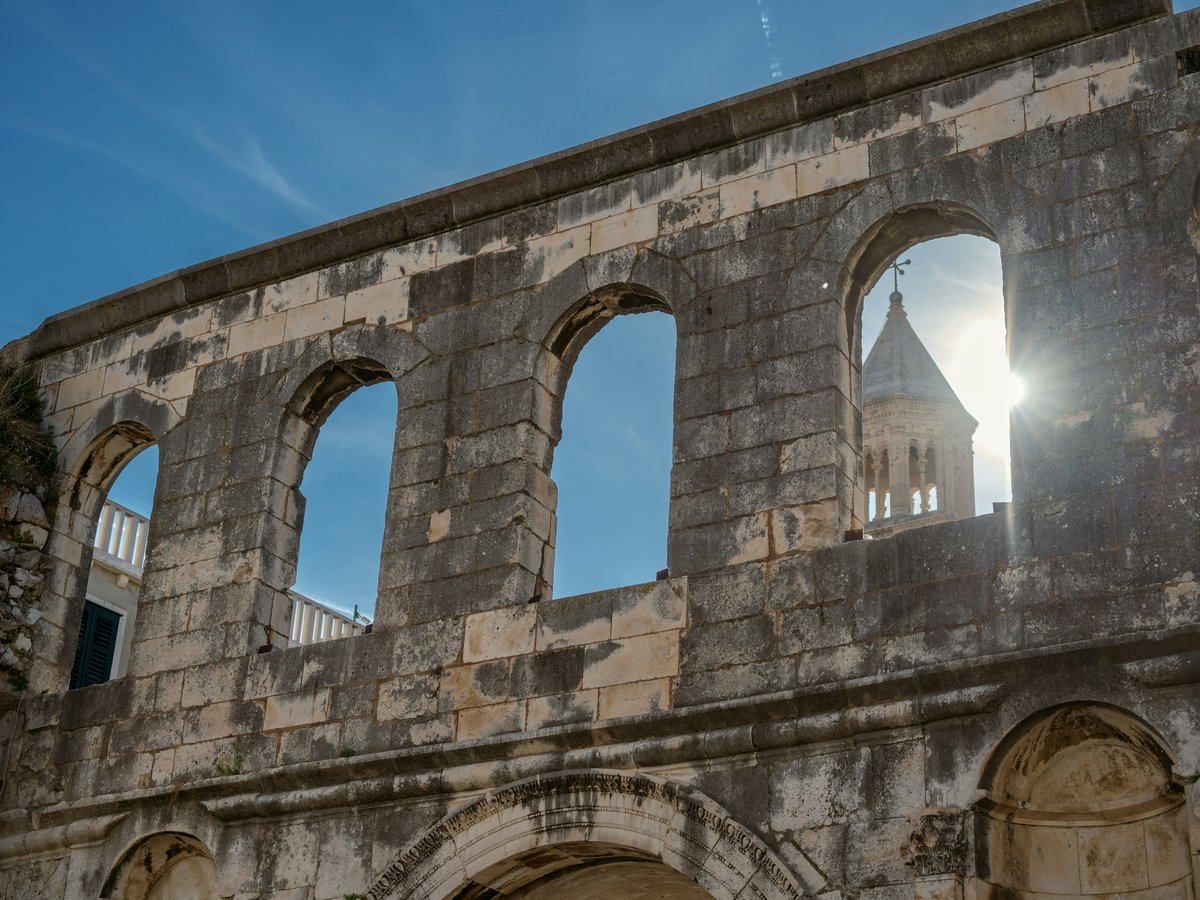
Diocletian's Palace is not a ruin you visit; it is the city centre you walk through to buy fish. Built around 305 AD as a retirement fortress for the Roman emperor, the limestone complex still forms the structural core of Split, and roughly three thousand people live inside its walls today. This is what separates Split from every other Mediterranean port city: the Roman layer is not fenced off behind a ticket booth but threaded into the ordinary life of a working Adriatic city of about 178,000 residents. You cross the Peristyle, the palace's ceremonial courtyard, to reach a café. The Cathedral of Saint Domnius, originally Diocletian's own mausoleum and one of the oldest cathedral structures still in continuous use, stands a few steps from a greengrocer. West of the palace walls, the neighbourhood locals call Varoš climbs Marjan hill in a tangle of stone staircases and drying laundry, its narrow streets largely free of the souvenir shops that colonise the palace interior every summer. Marjan itself is a pine-covered peninsula that functions as the city's park, running trail, and chapel circuit, reachable in ten minutes on foot from the Riva, the wide waterfront promenade where Split's social life concentrates each evening. East of the palace, the open-air Pazar market sells seasonal produce from the Dalmatian hinterland every morning, and beyond it the concrete crescent of Bačvice beach hosts a local obsession called picigin, a keep-the-ball-airborne game played in ankle-deep water that has its own tournament. Split also operates as the ferry hub for the central Dalmatian islands: Brač, Hvar, Vis, and Šolta all depart from the harbour that lines the south palace wall. The city keeps Central European Time, one hour ahead of London, and in late afternoon the Adriatic light turns the palace limestone the colour of honey.
Split in photos


Split right now
Answers about Split
-
Airport to city
Split Airport (SPU) is 24 km west in Kaštela. The airport shuttle bus reaches Split's main bus station in 30 minutes for €6, departing after each flight lands. Uber and Bolt cost €20-28 to central Split. Licensed metered taxis run €35-40. Avoid unlicensed drivers quoting fixed fares inside the terminal.
Read the full answer → -
Best time to visit
May, June, and September. July and August pack Diocletian's Palace with cruise-ship crowds by 10am, and hotel rates in neighborhoods like Varoš double. Late May brings 25°C days, water warm enough for Bačvice beach, and prices 40-50% below the August peak. September keeps similar warmth with noticeably thinned-out streets.
Read the full answer → -
Cost per day
Split runs about €50/day ($58) on a backpacker budget, covering a hostel dorm, bakery breakfasts, konoba lunches, and supermarket dinners. Midrange travelers spending €110/day ($127) add a private apartment and sit-down seafood. Luxury starts above €300/day ($347) at waterfront hotels. Croatia uses the euro, so no currency conversion from the eurozone.
Read the full answer → -
Cultural etiquette
Split runs on a greeting-first social code. Say "dobar dan" before any interaction in shops, konobas, or the Pazar market. Tip 10% at sit-down restaurants. Cover shoulders and knees at the Cathedral of Saint Domnius and every chapel along Marjan hill. Don't touch or lean on stonework inside Diocletian's Palace.
Read the full answer → -
Best day trips
Trogir is the strongest single-day trip from Split, 27 km west by bus #37 in 30 minutes for about 3 EUR. The 1213 cathedral and 1420 Kamerlengo Castle fill a morning, the waterfront fills an afternoon. Krilo catamarans reach Hvar Town in roughly 60 minutes. Krka National Park works if you leave by 8am. Salona's Roman ruins are 15 minutes away by local bus.
Read the full answer → -
Digital nomads
Split scores 7.2/10 for digital-nomad suitability (sourced from TTDI's editorial rubric). Fiber delivers 100-200 Mbps in Bačvice and Spinut, with direct-lease apartments from €700 a month. Monthly all-in runs about $2,100. Croatia's Digital Nomad Visa grants non-EU workers year-long tax-exempt residence. Best arrival window is October through May.
Read the full answer → -
Family-friendly
Split scores 6.8/10 for family friendliness (see the TTDI Family-Friendliness Index). The Riva waterfront promenade and shallow Bačvice beach work well with toddlers, but Diocletian's Palace has narrow Roman-era corridors that defeat any stroller. Summer temperatures above 32°C mean ruins are a morning activity. Pizza, ćevapi, and gelato keep picky eaters fed.
Read the full answer → -
Food culture
Split's food runs on the Dalmatian clock. Coffee and burek by 8am, a full lunch of pašticada or grilled fish between 1pm and 3pm, dinner after 9. The Pazar green market and Peškarija fish market set the daily rhythm. Skip the Riva waterfront restaurants and walk 5 minutes west into the Varoš quarter, where konobas grill the same morning's catch over open flame.
Read the full answer → -
Getting around
Walking covers 90% of Split. Diocletian's Palace and the Riva promenade are car-free, and Marjan hill is 15 minutes west on foot. Promet Split buses handle the suburbs and airport connection. Bolt is the dominant ridehail app, not Uber. Ferries to Brač and Hvar leave from the port beside the palace walls.
Read the full answer → -
How to get there
Split Airport (SPU) at Resnik, 24 km west of the city, handles most international flights. No nonstops from North America. Fastest connections run through Frankfurt, Munich, or Istanbul at 12-14 hours. From London, easyJet and Jet2 fly direct in 2.5 hours. Jadrolinija ferries from Ancona, Italy offer a 10-hour overnight alternative. Croatia uses the euro.
Read the full answer → -
Is it safe?
Split is safe for solo travellers, scoring 8.2 out of 10 on our solo-safety index (see the TTDI Solo-Safety Index), and violent crime against visitors is rare. The risks worth planning around are drunk summer crowds at Bačvice after 2am, pickpockets in Peristil when cruise ships are in port, overcharging by airport taxis, and midday heat on Marjan. Dial 112 for any emergency.
Read the full answer → -
Language basics
Croatian, written in the Latin alphabet with 5 extra diacritical letters (č, ć, š, ž, đ). Split's Dalmatian dialect shortens vowels and runs at a faster pace than standard Croatian. English works in the tourist core around Diocletian's Palace but fades in residential neighborhoods. 'Bok' (hi) and 'hvala' (thanks) cover most casual interactions.
Read the full answer → -
Layover guide
Split Airport sits 25 km west of Diocletian's Palace, connected by Bus 37 in about 30 minutes. Croatia joined the Schengen zone in January 2023, so intra-Schengen connections skip immigration entirely. Five hours is the honest minimum for leaving the terminal and making it to the Roman palace walls.
Read the full answer → -
Where locals go
Split's residents avoid the Diocletian's Palace crowds by default. They drink morning coffee on Trg Republike, swim at Žnjan beach 3 km east of Bačvice, play picigin in ankle-deep water by 5 pm, and eat grilled fish at konobas in Varoš and Spinut where menus still come in Croatian only.
Read the full answer → -
Must-see
Diocletian's Palace, built starting in 293 AD as a Roman emperor's retirement compound. The palace is not a museum behind ropes. It IS Split's old town, with about 3,000 residents still living inside its limestone walls. Start at the Bronze Gate on the Riva waterfront before 9am and work north to the Peristyle courtyard while the stone is still cool.
Read the full answer → -
Solo travel
Split is a strong solo destination where the compact Old Town inside Diocletian's Palace walls means you walk everywhere without needing transit. Bačvice beach and the Riva waterfront are natural gathering spots where you'll meet other travelers within hours. The apartment-rental market keeps single-occupancy rates well below the southern European average.
Read the full answer → -
This week
Split this week hits 32°C with clear skies and 35% humidity. Mornings before 11am are the comfortable walking hours, best spent at the Pazar green market or on Marjan hill. Afternoons shift to Bačvice beach for picigin. The Riva promenade fills after 8pm. Tuesday through Thursday are the calmest evenings.
Read the full answer → -
3-day itinerary
Day 1 covers Diocletian's Palace on foot, starting at the Cathedral of Saint Domnius bell tower by 8 AM and clearing the main sights before the 10 AM cruise-ship wave. Day 2 takes Marjan Hill and the western beaches. Day 3 is a 30-minute bus ride to medieval Trogir and the Roman ruins at Salona. About 22 km of walking total.
Read the full answer → -
What to avoid
Skip the Riva waterfront restaurants with photo menus charging €25 for mediocre pašticada. Insist on a metered taxi from Split Airport. Diocletian's Palace walls trap summer heat, so visit before 10am or after 5pm. Head to Marjan hill or Kašjuni beach instead of Bačvice's August crowds.
Read the full answer → -
What to pack
Rubber-soled walking shoes that grip wet limestone are the priority. Split's stone streets turn slick after rain. Pack for 30°C+ summers with swimwear, a cover-up for the Cathedral of Saint Domnius, and water shoes for Bačvice's hot pebble shore. Buy sunscreen and toiletries locally at European drugstore prices, roughly 40% below US equivalents.
Read the full answer → -
Where to stay
Stay in Varoš, the neighborhood climbing Marjan hill west of Diocletian's Palace. It puts you 2 minutes from the Roman walls and 10 from Marjan's pine trails, at €80-150 per night for a stone apartment. Bačvice beach area, 10 minutes east, runs €55-100 and suits families wanting sand and lower rates.
Read the full answer →
Deep guides for Split
Curated lists for Split
accommodation
-
Best boutique hotels
Split's accommodation spreads along a narrow coastal strip where the Roman palace quarter, the beach neighborhoods, and the Marjan peninsula hillside each attract a different kind of traveler. The old town packs the densest inventory into the smallest radius; the beach districts to the east and southeast trade walkable history for sand and lower rates; and the western peninsula offers quiet residential streets above rocky coves. Choosing where to stay is less about star ratings and more about which version of the Adriatic you want outside your window: palace walls and cathedral bells, or open water and pine shade. The neighborhoods run from the historic core outward, each with a distinct price band and a different relationship to the Riva promenade that connects them. Most visitors default to the palace quarter and pay the premium; the smarter play depends on whether you came for the ruins, the beaches, or the hills.
See the picks → -
Where to stay
Split's waterfront arcs from the palace walls west of the Riva to the gravel beaches past Žnjan, and the where-to-stay decision is a coastline decision: how close to Diocletian's Palace do you want your morning coffee? The old-town core around Matejuška and Manuš puts Roman walls and market stalls within a few minutes on foot, at prices ranging from $21 hostel bunks to palace-adjacent luxury above $385. East along the shore, Bačvice and Brodarica trade narrow stone alleys for wider streets and a calmer pace, still walkable to the Riva but with breathing room. Further southeast, Žnjan, Plaža Ježinac, and Trstenik are beach neighborhoods first, old-town neighborhoods second; you will want the local bus or a taxi for a night out near the palace. The practical split is simple: book near the walls for history and foot traffic, or book near the beaches for swim access and quiet evenings. Both sides connect along the Riva promenade and the coastal road, so nothing is truly isolated, but your morning routine picks the neighborhood for you.
See the picks →
attractions
-

Best free attractions
Split's free layer is geography, not architecture. A hill above the town at 43.5086, 16.4093, two mapped squares that function as public rooms, a peninsula where the city runs out of pavement, and a park most itineraries skip: none charge admission and none require a booking. What they require is time. This list is for the visitor who has already paid to walk inside the monuments and wants to see how Split arranges itself between its walls and its water. The five below are ranked less by fame than by what a slow walker can get from them in a morning or an evening; each earns the hour on its own terms. Free, in Split, means unmediated: no ticket window, no promoter, no queue.
See the picks → -

Best museums
Split's museums are not one museum. They are a loose federation of collections scattered from the Marjan waterfront to the ring road north of Diocletian's walls, and treating them as a single afternoon errand is how visitors miss the good ones. The city has an archaeological museum keeping national-tier Roman material; a fine-arts gallery in a civic square well outside the palace; an ethnographic collection tucked so deep into the palace substructure that finding the door is part of the visit; and a Meštrović gallery on the Marjan shore that argues, convincingly, that the twentieth century happened here too. Two of the ten entries below are in Trogir, a short coastal hop west and worth the detour on any museum-serious day. This list is ordered by editorial weight, not proximity, so read it as a map of what to prioritise rather than a walking route. Anyone visiting Split for the palace alone is under-using the city; anyone visiting the museums without a plan is over-walking it.
See the picks → -

Must-see attractions
Split's must-see list is built from stone and centuries, not from viewing decks. Diocletian's Palace, an ancient palace built for the Roman emperor Diocletian that dates from AD 293 and is part of a UNESCO World Heritage Site, anchors everything, and around it we've drawn together a cathedral, a Roman temple, and a synagogue, each on the Register of Cultural Goods of Croatia, plus a city wall that also dates from AD 293. Further out are Salona, an ancient Roman city on the Dalmatian coast, and Trogir Cathedral, a basilica dating from 1213. A theatre dating from 1893 and a cemetery dating from 1928 carry the story into the modern city. This list is for visitors who would rather read a doorway than queue for a selfie: people who walk slowly, go early, and want to know what they are standing in front of. It skips the boat parties and the novelty museums. Every entry here earns its place by being something you can only see in Split or within reach of it.
See the picks →
food
-

Best cafes
Split's cafe culture is not a scene, it is a habit. The city takes its coffee slowly, at outdoor tables that stay full from breakfast through the long Dalmatian afternoon, and the twelve rooms and terraces below are chosen for the ones locals keep returning to: the espresso counters on Narodni trg, the daytime rooms just off the Diocletian walls, the neighbourhood bars on Poljička cesta, and the beach-side terraces west of the ferry port. Some open at 06:30 and close at midnight, doubling as morning cafe, lunchtime bar, and after-dinner glass of loza. Others keep strict 08:00–20:00 hours because the room is built around a swim, not a nightcap. Skip the harbour-front chains along the Riva; the twelve here are what a local editor would recommend to a friend arriving Thursday, on a first coffee before the walk into the Palace.
See the picks → -

Best restaurants
Split eats the way a working port city eats: early, late, and without much ceremony. The dining rooms across and just outside the old town are wedged into centuries-old stonework and townhouses, and the cuisines on offer swing from strict Dalmatian regional cooking to Neapolitan pizza, Mexican tacos, and steak house cooking, a range that reflects both the summer crowd and a resident population that eats out year-round. This list favours twelve addresses that reward a visitor who wants to eat well without booking a headline dining room. A few open early for coffee and a plate; others do not fire the grill until lunch. Read each entry for what the kitchen does; the address and the hours are there so you can plan the day around a table, not the other way around.
See the picks →
Browse by traveler type
Book experiences in Split
 Free cancellation
 From Split: Krka Waterfalls, Food & Wine Tasting Tour
Day trip: 10 hours, free cancellation.
via Viator Free cancellation
 Blue Cave, Mamma Mia and Hvar, 5 Islands Speed boat Small group
Day trip: free cancellation.
via Viator Free cancellation
 Blue Lagoon & 3 Islands Cruise with Lunch, Wine & Swim from Split
Outdoor experience: 8 hours, free cancellation.
via Viator Free cancellation
 Blue Cave and Hvar Tour - 5 Islands Tour from Split and Trogir
Day trip: free cancellation.
via Viator Free cancellation
 From Split: Krka Waterfalls Tour, Boat Cruise & Swimming
Outdoor experience: 10 hours, free cancellation.
via Viator Free cancellation
 Blue Cave, Mama Mia and Hvar, 5 Island Speed boat Small group
Outdoor experience: free cancellation.
via Viator Free cancellation
 Blue Lagoon, Borkko Beach & Šolta with lunch & drinks from Split
Day trip: 8.5 hours, free cancellation.
via Viator Free cancellation
 From Split: Plitvice Lakes National Park Guided Tour
Day trip: 11 hours, free cancellation.
via Viator Free cancellation
 Blue Cave, Hvar & 5 Islands Speedboat Adventure From Split
Day trip: 10 hours, free cancellation.
via Viator Free cancellation
 Krka Waterfalls Tour from Split with Boat Ride and Swimming
Day trip: 7.5 hours, free cancellation.
via Viator Free cancellation
 Blue Lagoon & 3 Islands Small-Group Speedboat Tour
Day trip: 5.5 hours, free cancellation.
via Viator Free cancellation
 From Split: Plitvice Lakes National Park Guided Tour
Outdoor experience: 12 hours, free cancellation.
via ViatorBrowse by interest
Find a flight to Split
Live fares to Split appear here once cookies are accepted.
Last verified by automated review (v1.7.2) on . What is automated review?