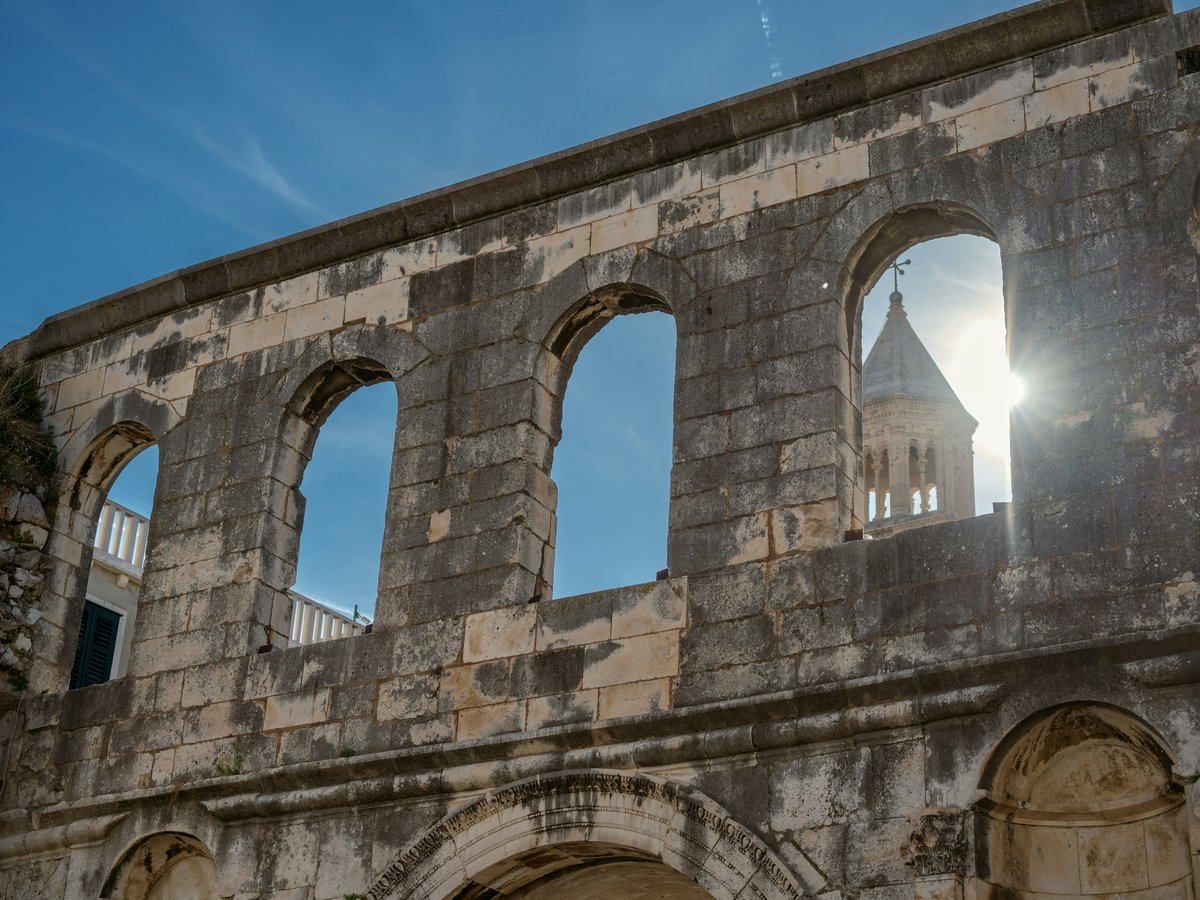
What should I pack for Split?
Rubber-soled walking shoes that grip wet limestone are the priority. Split's stone streets turn slick after rain. Pack for 30°C+ summers with swimwear, a cover-up for the Cathedral of Saint Domnius, and water shoes for Bačvice's hot pebble shore. Buy sunscreen and toiletries locally at European drugstore prices, roughly 40% below US equivalents.
Shop the packing list (15 items)Walking shoes with rubber soles that grip polished stone matter more in Split than almost any other Mediterranean port. The limestone pavers inside Diocletian's Palace, worn smooth since the structure went up in 293 AD, become slippery enough to send you down hard after a summer rain. Flat leather sandals and fashion sneakers slide on every wet surface inside the Palace walls. A hiking sandal like Chacos or trail runners with deep-lug soles are what you want. You'll also climb. The bell tower of the Cathedral of Saint Domnius has steep, narrow stone steps, and the trail up Marjan hill from the Varoš neighborhood covers roughly 178 meters of elevation over rocky switchbacks. Pack one pair of grippy walking shoes and one pair of water shoes for Split's beaches, which are almost entirely pebble and rock. Bačvice has smooth stones that reach scorching temperatures by noon in July. Without water shoes, the 15-meter walk from your towel to the waterline feels like crossing a hot griddle.
Mid-August temperatures in Split currently sit around 27.5°C with 63% humidity, and that's a mild day by local summer standards. Expect daytime highs between 28°C and 35°C from June through September, dropping to around 22°C by October. Pack 3-4 quick-dry shirts, shorts, and one light long-sleeve layer. The Cathedral of Saint Domnius requires covered shoulders and knees, and the staff turn you away without discussion or wrap-rental options at the door. That long-sleeve shirt pulls double duty on the upper deck of ferries to Brač or Hvar, where wind cuts through even in July. The bura, a cold northeast wind, can appear without warning and drop the perceived temperature by 10°C in minutes. It happens less often in summer, but a 200g packable windbreaker saves the evening. Croatia uses Type C and F plugs at 230V. If you're coming from North America, you need a plug adapter and should leave any 110V-only appliances at home. Most phone and laptop chargers accept 100-240V. Check the fine print on the power brick before buying a voltage converter you probably don't need.
Skip packing sunscreen, after-sun gel, and basic toiletries. DM Drogerie Markt on Marmontova ulica, about 200 meters west of the Palace, sells European brands like Nivea and La Roche-Posay at roughly 40% less than US airport prices. A 200ml bottle of SPF 50 runs around €8. Mosquito repellent is worth grabbing there too, since summer evenings near Marjan's pine forest bring the bugs out. Skip the umbrella entirely. A compact rain shell is more useful in Split, where summer storms blow in fast off the Adriatic, drench everything for 20 minutes, then pass. An umbrella in that coastal wind becomes an inside-out liability within seconds. One thing you won't easily find at DM is reef-safe sunscreen. The local selection tends toward conventional European formulas, so pack your own if that matters to you.
Bring a small packable daypack for island days and Marjan hikes. The Jadrolinija ferry from Split to Supetar on Brač takes 50 minutes and costs around €5 one-way. You'll want 1.5L of water, sunscreen, a quick-dry towel, and swimwear within easy reach. A packable dry bag doubles as beach storage and protects your phone during boat transfers, where spray on smaller excursion vessels is hard to avoid. A 10,000 mAh portable charger is non-negotiable. Google Maps navigation through the Palace corridors, where GPS signal bounces off stone walls, drains battery at twice the normal rate. Cash is less critical since Croatia adopted the euro in January 2023. Contactless card terminals are standard even at small konoba restaurants in Varoš and at the Pazar green market east of the Palace. At Pazar, the smell of fresh figs and dried lavender hits you before you see the stalls.
Essentials
- Rubber-soled walking shoes with deep tread (Diocletian's Palace limestone is slippery when wet) Shop
- Water shoes (Split's beaches are pebble and rock, hot enough to burn bare feet by midday) Shop
- 3-4 quick-dry shirts and shorts Shop
- One light long-sleeve layer (Cathedral dress code and ferry wind) Shop
- Light windbreaker or packable rain shell Shop
- Swimwear (you will use it daily from June through September) Shop
- Type C/F plug adapter (230V, required for North American devices) Shop
- Portable charger, 10,000 mAh minimum Shop
- Small packable daypack for ferry trips and Marjan hikes Shop
- Packable dry bag for boat excursions Shop
Seasonal extras
- June-September: wide-brim hat and UV sunglasses for 8+ hours of direct Mediterranean sun Shop
- June-September: rash guard or UV swim shirt for long beach days at Kašjuni or Bačvice Shop
- October-November: light fleece for evenings dropping to 12-15°C Shop
- December-March: warm jacket, scarf, waterproof closed shoes for 8-12°C daytime and frequent rain Shop
- April-May: layering pieces for 15-22°C days with cooler evenings Shop
Buy on arrival
- Sunscreen at DM Drogerie Markt on Marmontova ulica (200ml SPF 50 around €8, roughly 40% below US prices)
- Mosquito repellent from DM or local pharmacies (summer evenings near Marjan's pines bring bugs out)
- After-sun gel (Nivea or La Roche-Posay, widely available at DM and Müller for under €6)
- Beach towel at Pazar green market (€5-10, saves suitcase space)
- Lavender products from Hvar-sourced vendors at Pazar (lightweight, packable souvenirs)
Last verified by automated review (v1.7.2) on . What is automated review?