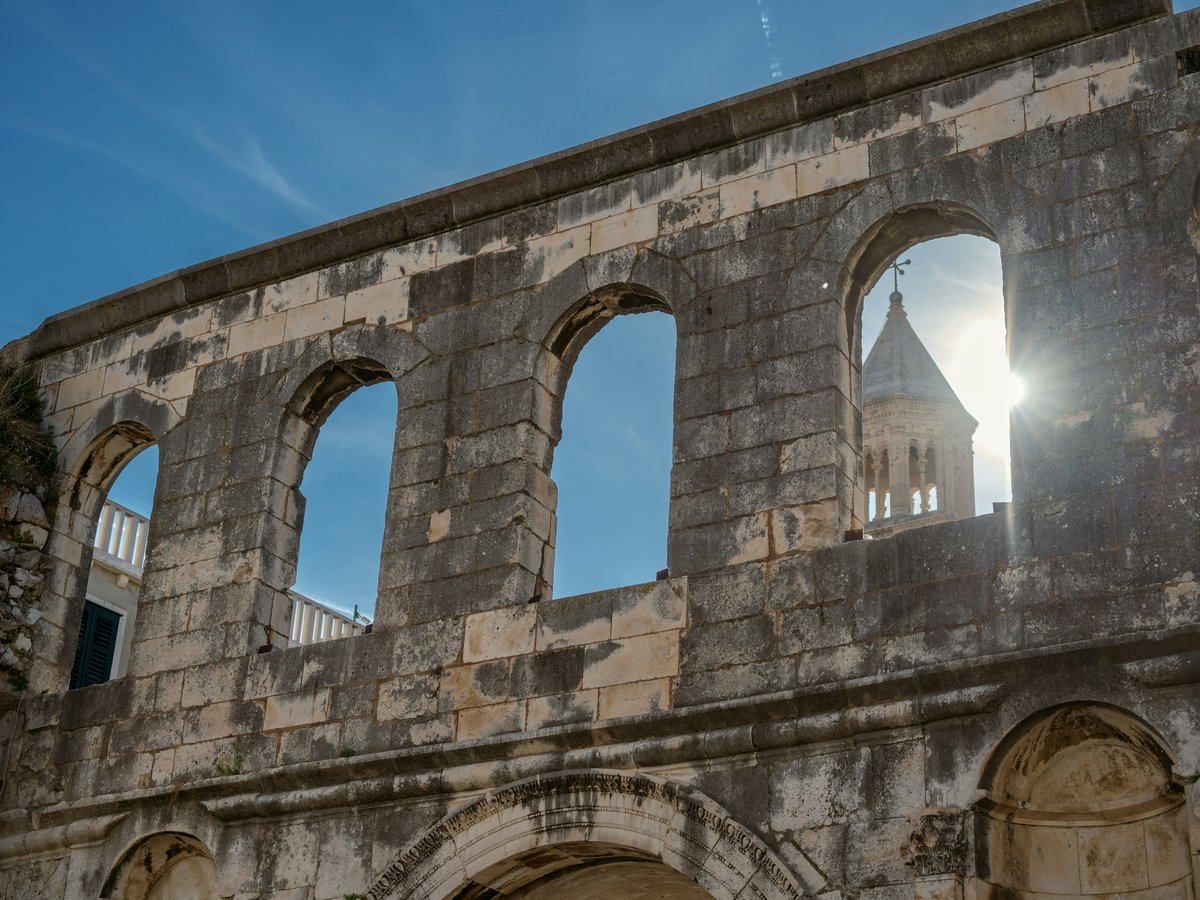
Split grew in rings around a single building. Diocletian's Palace, started in 293, still forms the innermost core, and people have been living inside its walls since at least the 7th century. The Riva waterfront promenade runs along the palace's south face, lined with palm trees and white stone benches where half the city seems to sit on summer evenings. From the Riva, neighborhoods fan outward. Varoš and Meje stretch west toward the forested slopes of Marjan hill. Lučac, Bačvice, and Firule extend east along the coast past the ferry terminal. North of the old town, Stadion Poljud has anchored the Poljud quarter since 1979, its shell-shaped concrete canopy visible from the Marjan trails above. The whole walkable center covers roughly 3 kilometers, and most visitors never need more than their feet. Croatia adopted the euro in January 2023, so all prices are in EUR, with 1 USD currently buying about 0.86 EUR. A kava at a Riva cafe runs about 1.50 EUR. Two blocks inland, the same espresso drops below 1 EUR. Mid-August days bring clear skies and temperatures around 32.4°C, with humidity near 35%, which tends to push everyone coastward by early afternoon. The palace's interior alleys empty out between 1 PM and 4 PM as a result. Worth noting, Split scores 8.2 out of 10 for solo-traveler safety (see the TTDI Solo-Safety Index), and the compact layout means you're rarely more than a 10-minute walk from a well-lit, populated street.
Neighborhoods
-
Grad (Old Town)
About 3,000 residents still live inside the old palace walls, which makes Grad less a museum and more a noisy, functioning residential quarter that also carries UNESCO World Heritage status. The Cathedral of Saint Domnius occupies what was once Diocletian's mausoleum, and its bell tower climb costs about 5 EUR for the clearest overhead view of how the original Roman grid maps onto today's streets. The Temple of Jupiter sits tucked down a narrow passage off Peristil, the courtyard that served as the palace's ceremonial center and now hosts cafe tables and summer concerts. Mornings before 9 AM smell like damp limestone and fresh coffee from the apartments above. By midday, narrow alleys trap the heat and the sound of rolling suitcases on stone fills every corridor. After 9 PM, bars along Dosud and Majstora Jurja take over, with stone-wall acoustics that carry bass and conversation well past the northern Golden Gate. Cruise-day foot traffic peaks between 10 AM and 2 PM, thinning noticeably after the last tender boats head back to the harbor.
- Best for
- First-time visitors who want to sleep inside the history, couples without small children (stone steps and zero elevators make strollers a struggle), and anyone who doesn't mind bar noise past midnight.
- Key streets
- Peristil (the central Roman courtyard), Krešimirova (the old Decumanus, the main east-west artery), Dosud (bar alley near the western wall), Rodrigina ulica (a quieter residential passage near the Golden Gate)
-
Varoš
Varoš is the old fishermen's quarter climbing the lower slopes of Marjan, west of the palace. The streets are steep, narrow, and mostly too tight for cars. Stone houses with green-shuttered windows connect via staircases that local kids use as shortcuts between levels. Laundry dries on lines strung between buildings 3 meters apart. The pace here is noticeably slower than the rest of central Split. You'll hear Radio Dalmacija drifting from open kitchen windows and domino tiles clacking from the few konobas that still cater to regulars rather than tourists. The Croatian National Theatre, founded in 1893, sits at the eastern edge where Varoš meets the old town along Trg Gaje Bulata. Head uphill and you'll reach Vidilica, the small cafe-viewpoint partway up the hill, where a cold Karlovačko runs about 3 EUR and the view extends across the harbor to the islands of Brač and Šolta.
- Best for
- Budget travelers in apartment rentals, hikers heading up Marjan, and anyone who values quiet evenings over convenience. The walk to the Riva takes about 7 minutes.
- Key streets
- Šperun (the neighborhood's main artery), Senjska ulica (staircase street climbing toward Marjan), Trg Gaje Bulata (where the theatre anchors the eastern edge)
-
Meje
Meje wraps around the western tip of Split's peninsula, below the southern cliffs of Marjan. The neighborhood feels residential and unhurried, with 1960s apartment blocks sitting alongside older stone houses. Kašjuni beach, tucked below the cliff path, is the closest Split gets to a secluded cove, reached by a set of concrete steps that takes about 5 minutes to descend. A handful of coworking spaces have opened along Šetalište Ivana Meštrovića in recent years, and the area scores 7.2 out of 10 for digital-nomad suitability (sourced from TTDI's editorial rubric). The Ivan Meštrović Gallery occupies the sculptor's own 1930s villa at the neighborhood's eastern end, with a garden of bronze figures and a terrace overlooking the sea. Café options are limited compared to Grad or Bačvice. Most residents here cook at home or walk 15 minutes east toward the waterfront.
- Best for
- Digital nomads looking for a quieter base with coworking access, swimmers who prefer rocks over sand, and visitors interested in Croatian modern art at the Meštrović Gallery.
- Key streets
- Šetalište Ivana Meštrovića (the coastal road and gallery address), the Marjan forest path starting from Sustipan cemetery, the steps down to Kašjuni beach
-
Bačvice
Bačvice centers on the shallow, sandy bay where locals have played picigin since the 1920s. The game is unique to Split. Players stand waist-deep and keep a small ball airborne with elaborate diving saves, and you can watch for free on any summer afternoon. The beach area gets crowded and loud, with music from the Bačvice beach-bar complex carrying well past midnight on weekends. Behind the beach, the streets along Tončićeva are lined with pizzerias and casual seafood places where a grilled brancin with sides runs 15 to 20 EUR. The bay sits about a 10-minute walk east of the Riva along Obala Lazareta. Split's family-friendliness score of 6.8 out of 10 (see the TTDI Family-Friendliness Index) reflects the fact that the sandy bottom suits older kids well, but nightlife noise and limited shade make the area harder for families with toddlers.
- Best for
- Groups in their 20s and 30s who want nightlife within walking distance of the beach, and families with children old enough to swim independently.
- Key streets
- Šetalište Petra Preradovića (the promenade above the bay), Tončićeva (the restaurant strip behind the beach), Prilaz braće Kaliterna (connecting Bačvice to the Riva)
-
Lučac
Lučac sits directly east of the palace walls, between the old town and the main bus and ferry terminals. It's the neighborhood most visitors walk through without realizing it has a name. Stone houses here are older but less restored than in Grad or Varoš, and apartment rents run noticeably lower. The streets behind Hrvojeva ulica have a handful of konobas that cater to construction workers and taxi drivers, which in Split usually means generous portions at prices under 10 EUR for a full plate. A few wine bars and brunch spots have appeared along the lower streets since 2022, but gentrification has been gradual. The street noise is different here than in the old town. Instead of tourist chatter, you hear Jadrolinija ferry terminal announcements and the diesel hum of the island boats warming up at their berths.
- Best for
- Budget-conscious travelers who want to be near the old town without paying old-town prices, and anyone catching early-morning ferries to Brač, Hvar, or Vis.
- Key streets
- Hrvojeva ulica (the main commercial street), Radunica (the northeastern extension with the neighborhood's oldest stone houses), Ulica Matice hrvatske
-
Firule
Firule is a residential neighborhood about 15 minutes on foot east of the old town, past Bačvice. It has its own small pebbly beach, local tennis courts, and the kind of quiet that disappears the moment you walk back toward the center. The architecture is mostly mid-century apartment buildings and family villas with overgrown gardens behind stone walls. Few tourists make the walk past Bačvice to reach Firule, and apartment rental prices here run 30 to 40 percent lower than in Grad as a result. The café-to-person ratio drops sharply compared to the neighborhoods closer to the waterfront. Firule's beach is smaller and rockier, populated by neighborhood regulars and their dogs rather than sunbed renters. A coastal path connects it back to the Bačvice bay in about 8 minutes on foot.
- Best for
- Visitors planning a stay of a week or longer who want lower apartment prices with reasonable walking access to the center.
- Key streets
- The coastal path connecting to Bačvice, Dubrovačka ulica (the main road through the neighborhood), Šetalište Marina Getaldića near the beach access
-
Žnjan
Žnjan occupies the eastern stretch of Split's coastline, about 3.5 kilometers from the old town. It has the longest continuous beach area in the city, roughly 1 kilometer of pebble shore and concrete bathing platforms. The area was redeveloped in the 2010s with changing facilities, showers, and a row of beach bars that play music at a volume noticeably lower than Bačvice. The water tends to be cleaner here because currents move east to west along this shore. Žnjan is where Split families spend their weekday summer afternoons, especially those with younger children who need the gradual entry points into the water. The walk from the old town takes about 40 minutes. A local bus covers the route in roughly 12 minutes for under 2 EUR.
- Best for
- Families with young children, anyone prioritizing beach time over sightseeing, and visitors with a car who can use the parking area at Žnjan's eastern end.
- Key streets
- Žnjansko šetalište (the beach promenade), Ulica Bruna Bušića (the road running above the beach), the coastal path connecting west toward Trstenik beach
FAQ
Where should first-time visitors stay in Split?
Grad puts you inside the palace walls, which means waking up in a building older than most European countries, but also dealing with cobblestone logistics and bar noise past midnight. Varoš might be the sweet spot for most first-timers. It's 5 to 7 minutes from the waterfront promenade on foot, significantly quieter after dark, and apartment prices run 20 to 30 percent lower than inside the palace. For a beach-forward trip, Bačvice keeps you close to both sand and nightlife at prices between the two.
How easy is it to get around Split without a car?
The core neighborhoods from Meje to Bačvice are all within a 20-minute walk of each other, and the Riva serves as the natural east-west spine connecting them. Local buses cover the eastern beaches if you want to save the longer walks. Parking in the center runs 2 to 3 EUR per hour in summer and fills by mid-morning most days, so a car is more liability than asset unless you're planning excursions to places like Salona, the ancient Roman city about 5 kilometers northeast, or to Trogir, 30 kilometers west.
How LGBTQ+ friendly is Split?
Split scores 6 out of 10 for LGBTQ+ friendliness (sourced from TTDI's editorial rubric). Croatia legalized same-sex life partnerships in 2014, and Split held its first Pride march in 2011, though early events drew counter-protests. Attitudes have shifted noticeably since then, particularly in the old town's bar scene. That said, public displays of affection between same-sex couples may still draw stares in more residential neighborhoods outside the center.
What day trips work well from Split?
Salona, the ancient Roman capital of Dalmatia, sits about 5 kilometers northeast and takes 15 minutes by car or 30 by local bus. The Hollow Church in nearby Solin, dating to around 1100, is part of that same archaeological zone. Trogir is 30 kilometers west by bus, roughly a 45-minute ride. Trogir Cathedral, whose construction began in 1213, and Kamerlengo Castle, built from 1420, are both walkable from Trogir's center. Either trip fills a half day comfortably, leaving afternoons free for the beach.
Which neighborhood has the best food scene?
The highest concentration of restaurants lines the palace's southern edge and the streets behind the waterfront in Grad, but locals tend to eat in Varoš and Lučac where prices run lower and portions come bigger. For seafood, the konobas around Šperun in Varoš serve the freshest catch. Bačvice has the strongest late-night options. Mind you, Split's restaurant scene leans heavily toward grilled fish and meat. Vegetarian visitors will find more options in the Grad restaurants that cater to an international crowd.
Last verified by automated review (v1.7.2) on . What is automated review?