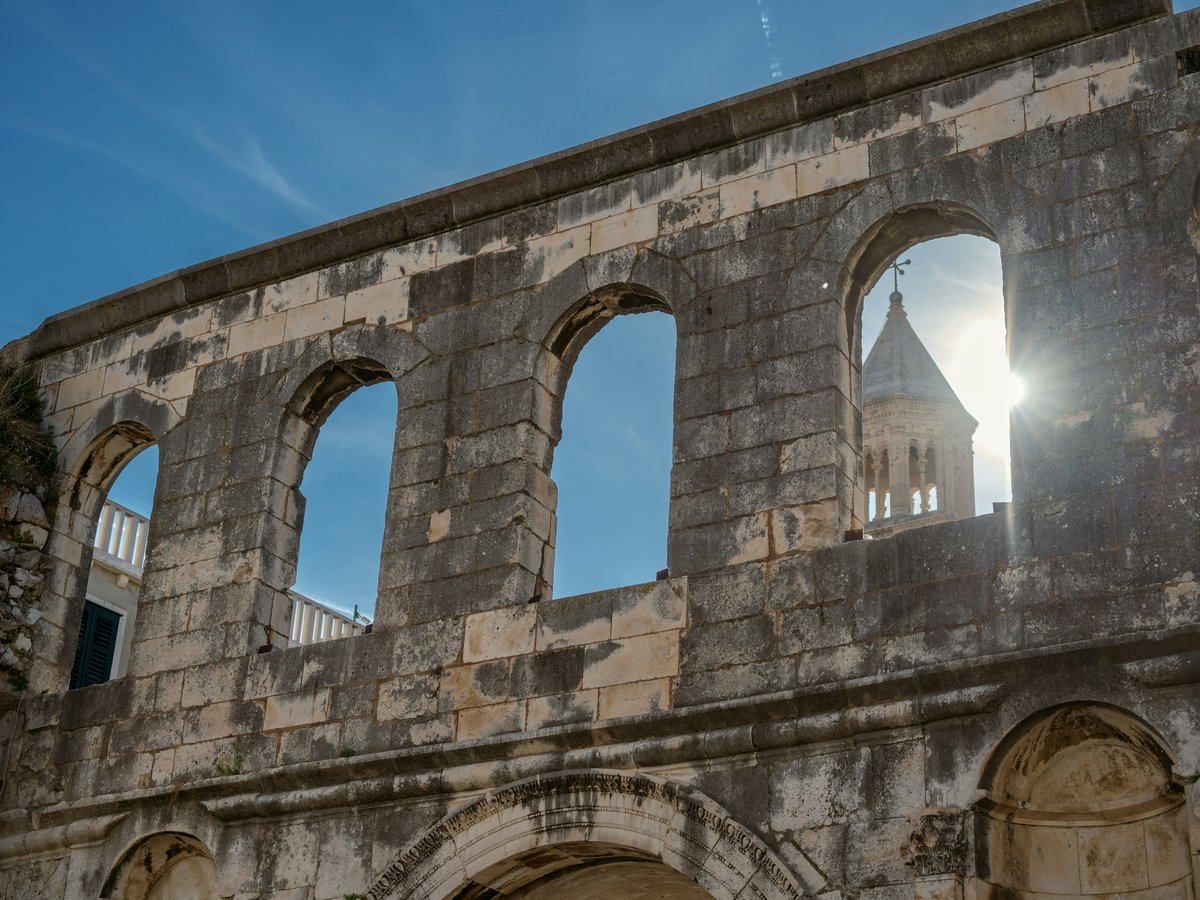
Split tends to confuse first-time visitors who expect a museum city behind a ticket counter. The core of the old town is Diocletian's Palace, a Roman complex where roughly 3,000 people currently live and work inside walls that went up more than 17 centuries ago. You walk through it the way you'd walk through any neighborhood, stepping past cafe tables wedged between ancient columns, hearing someone's TV through a window that frames a Roman arch. Marjan, the forested hill on the western peninsula, offers kilometers of shaded trails and coastal viewpoints at no cost. The city's municipal beaches line the southern shore from Bačvice east to Žnjan, all free and all within a 30-minute walk of each other. On a mid-August night, the temperature might still sit near 25.8°C well after midnight, humidity around 65%, the air mainly clear and carrying salt off the harbor. Croatia adopted the euro in January 2023, which makes price comparisons straightforward for most European visitors.
Free attractions
-
Diocletian's Palace (courtyards, Peristil, and Vestibul)
The Palace was built starting in 293 as a retirement residence for Emperor Diocletian. Today its open courtyards and limestone streets function as Split's city center. The Peristil, the original ceremonial court, is permanently open. So is the Vestibul, the domed rotunda that once served as the entrance to the imperial quarters. The acoustics in the Vestibul are worth a pause. Klapa singers sometimes perform there, their harmonies caught and amplified by the bare stone dome. No ticket, no barrier. Mind you, the Cathedral of Saint Domnius and the Temple of Jupiter, both inside the Palace, are separately ticketed attractions.
Gradlandmark -
Park šuma Marjan (Marjan Forest Park)
Marjan covers the western peninsula in Aleppo pine and Mediterranean scrub. Several marked trails loop through the park, with the main promenade running along the southern slope above the sea. The Vidilica viewpoint, roughly a 20-minute climb from the western end of the Riva, gives you a wide panorama over the old town, the harbor, and the islands of Brač, Šolta, and Čiovo. The air on the trail smells like resin and dry herbs, and you'll likely hear cicadas more than people. The summit at Telegrin reaches 178 meters above sea level.
Marjanpark -
Sustipan
A quiet park and former cemetery on the tip of the Marjan peninsula, closest to the city center. Cypress trees, stone benches, and a sea-level promenade that catches late-afternoon light. The old gravestones have weathered into something closer to sculpture than inscription. It tends to empty out by sunset, which makes it one of the calmer spots in the city. The western tip faces Kaštela Bay and the Kozjak mountain range on the far shore.
Marjanpark -
Riva (Obala Hrvatskog Narodnog Preporoda)
Split's main waterfront promenade stretches roughly 250 meters along the southern wall of the Palace. The palm-lined marble surface was redesigned in 2007 and sits at the center of daily public life. Morning coffee, evening strolls, occasional public events. The stone benches fill up fast after 6 PM in summer, but there's always room to sit on the sea wall and watch the ferries come and go from the harbor. The surface is white Brač limestone, the same stone used on the White House in Washington.
Gradpromenade -
Galerija Meštrović
The gallery occupies a villa built in the 1930s by the sculptor Ivan Meštrović himself, set in gardens overlooking the sea on the Marjan side of the city. The permanent collection holds over 190 sculptures, drawings, and pieces of furniture. Admission is currently free on the first Sunday of each month. On paying days, the garden and the exterior terrace are still worth the walk for the coastal views alone. The building sits at Šetalište Ivana Meštrovića 46, about a 15-minute walk west of the old town.
Mejemuseum -
Arheološki muzej u Splitu
Founded in 1820, this is one of the oldest museum institutions in Croatia. The collection spans Illyrian, Greek, and Roman periods, with finds from nearby Salona heavily represented. The outdoor lapidarium, a garden of stone fragments and sarcophagi from the Roman era, is accessible without entering the paid galleries. Full free admission currently applies on the first Sunday of each month, though checking ahead seems reasonable since policies shift. The building sits on Frankopanska ulica, north of the old town.
Dobrimuseum -
Matejuška
A small traditional fishing harbor tucked between the Riva and the base of Marjan. Wooden boats still tie up here, often with nets drying across the stone walls. The space is a fraction of the main harbor's size but carries the smell of diesel, rope, and sea brine that the polished waterfront doesn't. A handful of steps lead up from the waterline to a terrace where locals gather in the evenings. To be fair, it takes about 5 minutes to walk the whole harbor. It's the atmosphere, not the distance.
Veli Varošharbor -
Park Strossmayerov
A formal public garden near the Croatian National Theatre, which has stood on the adjacent block since 1893. Shaded paths, benches, a few sculptural pieces. It tends to function as a quiet midday pause for residents rather than a tourist draw, which means you'll likely have a bench to yourself during late morning hours. The park covers roughly 5,000 square meters between Trg Gaje Bulata and the theatre facade.
Gradpark
Free activities
-
Bačvice beach and picigin
Bačvice sits about 400 meters east of the old town, a shallow sandy cove that fills up by mid-morning in summer. The local sport here is picigin, a ball game played knee-deep in the water. Teams of 4 or 5 slap a small rubber ball back and forth, trying to keep it airborne. It has been played on this beach since the 1920s, and you'll spot it every day from April through October. The water at Bačvice is warm and rarely deeper than a meter at the popular swimming zone. Worth noting, there's a concrete sunbathing terrace on the eastern side with free showers.
Bačvicebeach -
Pazar (Green Market)
Split's open-air produce market operates daily on the eastern side of the Palace, outside the Silver Gate. The stalls carry seasonal Dalmatian produce. Figs and grapes in late summer, citrus through winter, lavender sachets and dried herbs year-round. The noise level peaks between 7 AM and noon. You'll hear vendors calling over each other, and the smell of ripe tomatoes and fresh basil sits heavy in the morning air. Browsing costs nothing, and the market often has free samples of cheese and olive oil if you show genuine interest.
Gradmarket -
Veli Varoš walking
The oldest residential neighborhood outside the Palace walls climbs the hillside between the old town and Marjan. Narrow stone lanes, stairways worn smooth, laundry lines overhead. This is where Split's fishermen and tradespeople have lived for centuries, and the area remains residential. The architecture is dense and low-slung, with terracotta roofs and window shutters painted in faded Mediterranean blues and greens. The walk from the Riva up through Veli Varoš to Vidilica takes about 25 minutes at an easy pace.
Veli Varošwalking -
Žnjan beach
A long pebble-and-concrete beach east of Bačvice, stretching along the coast toward the suburb of Stobreč. Žnjan tends to draw more locals than tourists, particularly families. The shallow entry and calm water make it straightforward for swimming. Free showers are available at several points along the beach. The walk from the old town takes about 35 minutes along the coastal path, passing through Trstenik on the way.
Žnjanbeach -
Kašjuni beach
A small pebble cove on the southern side of the Marjan peninsula. The approach is steep, about 150 steps down through the pine forest, which keeps it less crowded than the city-side beaches. The water tends to be clearer here, with the scent of pine resin mixing with the salt air. No permanent facilities beyond a seasonal beach bar at the bottom of the stairs.
Marjanbeach -
Ribarnica (Fish Market)
The covered fish market sits on the waterfront west of the Riva. Mornings bring fresh catch from the Adriatic. The selection changes daily, with squid, mackerel, sea bass, and sometimes tuna or swordfish laid out on ice. The atmosphere is louder and wetter than the Pazar, with ice melting on stone counters and vendors filleting fish on request. The building is a late-19th-century stone hall. Visiting is free, and a loop through takes about 10 minutes.
Gradmarket
Free events
-
Noć muzeja (Museum Night)
Late January, annually (typically last Friday)Croatia's annual Museum Night opens galleries, museums, and cultural institutions for free, typically on the last Friday of January. In Split, participating venues usually include the City Museum, the Archaeological Museum, the Gallery of Fine Arts, and several smaller private collections. The event runs from around 6 PM to 1 AM, with temporary exhibitions, performances, and guided tours organized for the evening. Attendance across Croatia has regularly reached over 500,000 visitors in a single night.
Multiple museums and galleries across Split -
Splitsko ljeto (Split Summer Festival)
Mid-July through mid-August, annuallyThe summer festival runs from mid-July through mid-August, filling the Peristil, Sustipan, and other open-air venues with opera, theatre, and classical music. While most performances are ticketed, the festival typically programs several free outdoor concerts and theatrical events on the Peristil and along the waterfront. The atmosphere on the Peristil during a live performance, with the Cathedral's bell tower lit up behind the stage, is likely the most memorable free evening the city offers.
Peristil, Sustipan, Riva, and other open-air venues -
Dani Dioklecijana (Days of Diocletian)
Late August, annuallyA historical reenactment festival held in and around the Palace, typically in late August. Performers in Roman-era costumes stage markets, processions, and gladiatorial demonstrations in the Peristil and surrounding streets. The core events are free to watch. The smell of roasting meat and the sound of live period music fill the limestone corridors for the duration. Street vendors sell food, but watching the reenactments costs nothing.
Diocletian's Palace and surrounding streets -
Peristil open-air klapa concerts
June through September, intermittent (check local listings)Throughout the summer months, the Peristil courtyard hosts intermittent free concerts, often featuring klapa groups performing traditional Dalmatian a cappella. Schedules appear on boards near the Tourist Information office on the Riva and tend to be confirmed a few days in advance. The natural acoustics of the Peristil, with its colonnade and enclosed stone surfaces, give even small vocal ensembles a presence that fills the entire square.
Peristil, Diocletian's Palace
What costs money inside Diocletian's Palace
The Palace's courtyards and streets are permanently free, but three attractions inside the walls charge separate admission. The Cathedral of Saint Domnius, originally Diocletian's mausoleum, requires a ticket that also covers the crypt and the Treasury. Climbing the bell tower costs an additional fee. The Temple of Jupiter, a small Roman temple converted into a baptistery, charges a modest entry. The Podrumi, the vaulted basement halls that mirror the floor plan of the imperial apartments above, have a ticketed entrance on the Riva side. Combined tickets covering all three sites are usually available and tend to cost less than buying individually. That said, seeing these structures from the outside, where they form the architectural fabric of the neighborhood, provides a detailed experience on its own. The Iron Gate, Golden Gate, Silver Gate, and Bronze Gate are open passages, not controlled entry points.
Free beaches along Split's coast
Croatian law guarantees free public access to the entire coastline, so every beach in Split is free to use. Beyond Bačvice, Žnjan, and Kašjuni, two smaller spots tend to stay quieter. Ovčice, a pebble cove between Bačvice and Firule, fills up slowly in the mornings and draws a more local crowd. Trstenik, further east, has concrete swimming platforms where regulars do early-morning laps before the heat sets in. All five sit within a 40-minute walk of the Palace, strung along the southern coast. Bring your own towel. Sunbed rentals at seasonal beach bars are the only fee you'll encounter, and they're entirely optional.
Planning a full zero-cost day in Split
A practical route might start at the Pazar around 8 AM, when the stalls are fully stocked and morning light hits the Palace's eastern wall at a low angle. From there, walk through the Silver Gate into the Palace, cross the Peristil, and exit through the Iron Gate on the western side. Turn right toward Veli Varoš and follow the narrow lanes uphill toward Vidilica on Marjan, a climb that takes about 30 minutes from the Palace. The viewpoint delivers a wide panorama over the harbor, coast, and islands. From there, the trail continues along the ridge or descends to Kašjuni for a swim. After the beach, circle back along the southern Marjan promenade to Sustipan, then down to the Riva for the evening atmosphere. The Ribarnica closes by early afternoon, so catch it before heading up Marjan if you want to see it in action. This loop covers roughly 7 to 8 kilometers over a full day.
FAQ
Is Diocletian's Palace free to visit?
The Palace's public streets, courtyards, the Peristil, and the Vestibul are always free to walk through, as they function as Split's living city center. Specific sites inside the Palace, including the Cathedral of Saint Domnius, the Temple of Jupiter, and the basement halls, each charge separate admission. You can spend hours in the Palace without paying for anything.
Are all beaches in Split free?
Yes. All coastal beaches in Split are free by law. From Bačvice to the Marjan coves, access and swimming cost nothing. The only expenses are optional, like renting a sunbed from a seasonal beach bar or buying drinks. Bring your own towel and sunscreen.
Is Split safe for solo travelers?
Split scores 8.2 out of 10 for solo-traveler safety (see the TTDI Solo-Safety Index). The old town and waterfront areas are well-lit and busy through late evening during summer months. Standard precautions apply near the bus and ferry terminals after dark. The city center is compact and walkable, which means most free activities sit within a short distance of populated areas.
When is the best time of year for free outdoor activities in Split?
May through October gives you warm enough weather for swimming and comfortable conditions for hiking Marjan. July and August are the hottest months, with afternoon temperatures often reaching above 30°C, which makes early morning and evening the more pleasant times for walking. The Splitsko ljeto festival programs its free outdoor performances during these peak months. Shoulder season, particularly late May and September, combines good weather with noticeably fewer visitors at the beaches and viewpoints.
How family-friendly are Split's free activities?
Split scores 6.8 out of 10 for family friendliness (see the TTDI Family-Friendliness Index). The beaches at Bačvice and Žnjan have shallow, calm water well suited for children. Marjan's lower trails are manageable with older kids. The Pazar and the Palace streets tend to hold children's attention more effectively than a conventional museum, since the entire environment is visually dense and active. Stroller access inside the Palace is limited by uneven stone surfaces and steps.
What currency does Split use, and do I need cash for free activities?
Croatia uses the euro. At current rates, 1 USD converts to roughly 0.86 EUR. Free activities by definition cost nothing, but carrying a small amount of cash is practical for public restroom fees, typically 0.50 EUR, and water from kiosks. The Pazar vendors and beach bars that border the free beaches almost all accept card payments.
Last verified by automated review (v1.7.2) on . What is automated review?