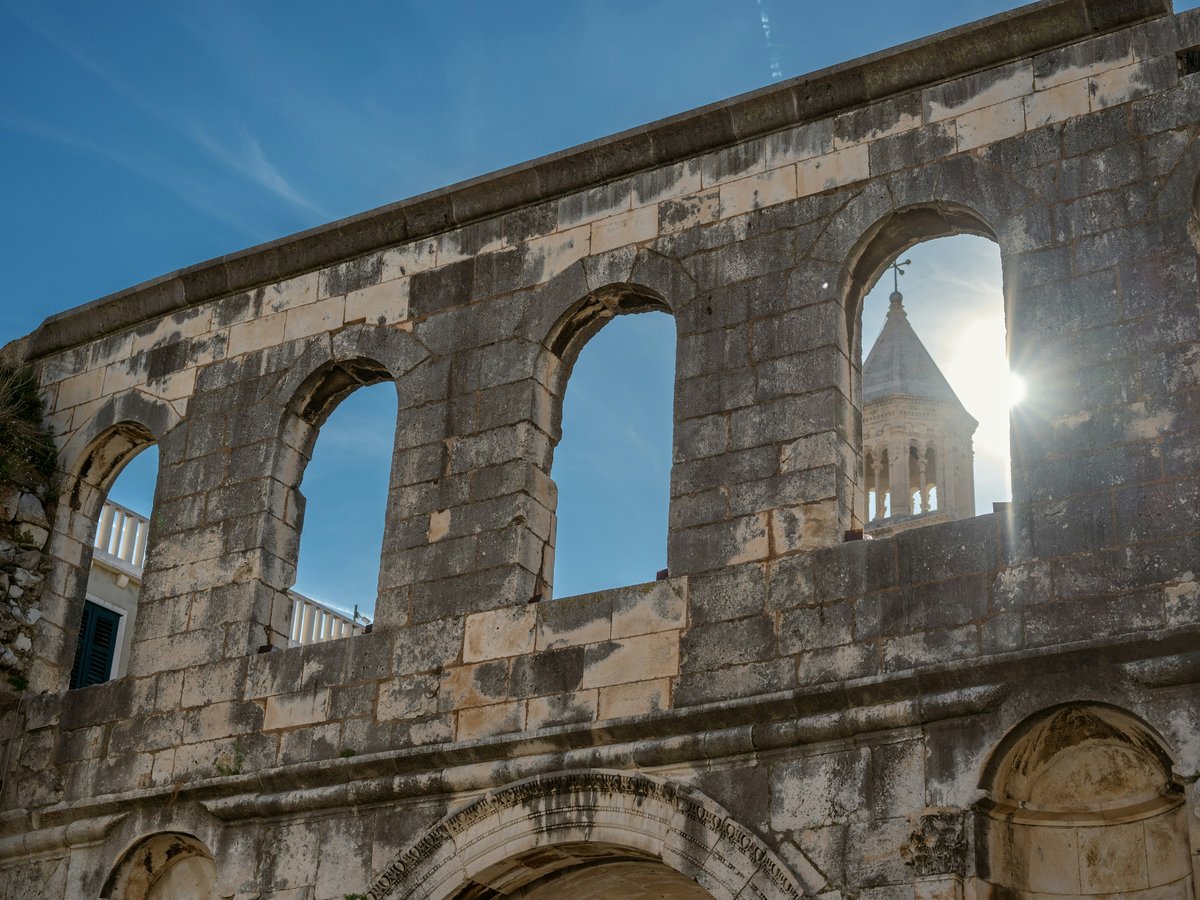
Split's must-see list is built from stone and centuries, not from viewing decks. Diocletian's Palace, an ancient palace built for the Roman emperor Diocletian that dates from AD 293 and is part of a UNESCO World Heritage Site, anchors everything, and around it we've drawn together a cathedral, a Roman temple, and a synagogue, each on the Register of Cultural Goods of Croatia, plus a city wall that also dates from AD 293. Further out are Salona, an ancient Roman city on the Dalmatian coast, and Trogir Cathedral, a basilica dating from 1213. A theatre dating from 1893 and a cemetery dating from 1928 carry the story into the modern city. This list is for visitors who would rather read a doorway than queue for a selfie: people who walk slowly, go early, and want to know what they are standing in front of. It skips the boat parties and the novelty museums. Every entry here earns its place by being something you can only see in Split or within reach of it.
-

1 Diocletian's Palace
10 Obala hrvatskog narodnog preporoda, Split, 21000An ancient palace built for the Roman emperor Diocletian, dating from AD 293 and part of a UNESCO World Heritage Site
At 10 Obala hrvatskog narodnog preporoda, in Split's 21000 postal area, Diocletian's Palace is where any honest itinerary of this city begins, an ancient palace built for the Roman emperor Diocletian that dates from AD 293 and is part of a UNESCO World Heritage Site. Skip the costumed-centurion photo stops that crowd every famous ruin; the stone needs no help from actors. Come early in the morning, and come again after dark, when the walls belong to whoever is still walking. Read the official site, diocletianspalace.org, before you go; it saves a lot of guessing on the ground.
Dates from AD 293 · Part of a UNESCO World Heritage Site
-

2 Cathedral of Saint Domnius
2 Peristil, Split, 21000A cathedral on Peristil listed on the Register of Cultural Goods of Croatia
The Cathedral of Saint Domnius stands at Peristil in Split's 21000 postal area, a cathedral in Split, Croatia listed on the Register of Cultural Goods of Croatia. If your map app argues with the square's name, drop a pin at 43.5081, 16.4403. Skip the midday group shuffle through the doors and come at opening or late in the afternoon, when you can stand still without being herded along. Look up more than you look at your phone. This building rewards the visitor who gives it quiet, unhurried attention, and punishes the one who treats it as a box to tick.
Register of Cultural Goods of Croatia
-
3 Salona
An ancient Roman city on the Dalmatian coast, in present Croatia
Set your map pin to 43.5394, 16.4831 before heading out to Salona, an ancient Roman city on the Dalmatian coast, in present Croatia. The locals know what the cruise-day crowds miss: Split's Roman story does not stop at the waterfront. Go in the cooler hours, wear proper shoes, carry water, and give it a slow half-day rather than a rushed hour. This is a place for readers of history rather than collectors of photos, so bring a little background reading, find a patch of shade, and let the scale of what Rome left on this coast sink in before you head back to town.
-
4 Croatian National Theatre in Split
Trg Gaje Bulata 1, 21000 SplitAn evening at a theatre dating from 1893
Dating from 1893, the Croatian National Theatre in Split stands at Trg Gaje Bulata 1, 21000 Split, a theatre in Split, Croatia, and the case for it is simple: a city this rich in ancient stone deserves an evening spent with its living culture too. Skip the dinner-and-folklore packages pitched along the waterfront, because a night in this house among people who came for the stage is the better ticket. Check the programme before you plan the day around it, dress one notch up from beachwear, and arrive early enough to watch the audience gather.
Dates from 1893
-
5 Temple of Jupiter, Split
Kraj sv. IvanaA Roman temple listed on the Register of Cultural Goods of Croatia
The Temple of Jupiter on Kraj sv. Ivana opens from 08:00 to 19:00 Monday to Saturday, and 12:30 to 18:30 on Sunday, a Roman temple in Split, Croatia and a listed entry on the Register of Cultural Goods of Croatia. We'd skip peak hour entirely; the Sunday window opens late, and a weekday morning gives you the space to look without elbowing. This is a place that rewards patience: study the stonework, step back, then study it again before you leave.
Register of Cultural Goods of Croatia
Hours: Mo-Sa 08:00-19:00; Su 12:30-18:30
-
6 Trogir Cathedral
10 Trg Ivana Pavla II, Trogir, 21220A Roman Catholic basilica dating from 1213, part of a UNESCO World Heritage Site
Trogir Cathedral is at 10 Trg Ivana Pavla II, Trogir, 21220, a Roman Catholic basilica dating from 1213 and part of a UNESCO World Heritage Site. The boat-and-bus day trips that give Trogir a single hour do this place no favours; the basilica alone deserves a morning. Arrive before the heat builds, let your eyes adjust inside before you decide what you are looking at, then step back out and look at the facade again. The second look is always better than the first.
Dates from 1213 · Part of a UNESCO World Heritage Site
-
7 Kamerlengo Castle
A castle dating from 1420, part of a UNESCO World Heritage Site
Kamerlengo Castle dates from 1420, a castle in Croatia and part of a UNESCO World Heritage Site. We'd put 43.5153, 16.2475 into your map rather than trusting a vague sign or a confident stranger. Skip the guided tour; a fortress this direct explains itself to anyone who walks it slowly. Go late in the day, when the stone has shed the worst of the heat, and pair it with an unhurried lunch rather than a sprint back to the bus.
Dates from 1420 · Part of a UNESCO World Heritage Site
-
8 Split Synagogue
1 Židovski prolaz, Split, 21000An orthodox synagogue listed on the Register of Cultural Goods of Croatia
Few visitors think to look for an orthodox synagogue here, which is precisely why the Split Synagogue at 1 Židovski prolaz, 21000 Split belongs on this list. Listed on the Register of Cultural Goods of Croatia, it tells a chapter of the city's story that the postcards leave out, and no souvenir lane will give you that. Check access before you go, dress modestly, and keep the visit unhurried. You will walk away reading the rest of Split a little differently.
Register of Cultural Goods of Croatia
-
9 Co-Cathedral of St. Peter, Split
Alojzija Stepinca, Split, 21000A working church in Split, away from the ancient set pieces
The Co-Cathedral of St. Peter stands on Alojzija Stepinca in Split's 21000 postal area, and the evening light there is worth planning around. If the street name doesn't land on your map, use 43.5102, 16.4564. It is a church in Split, Croatia, and people come here to worship, not to tick off a sight: this is the city's working faith rather than its ancient showpiece. Come for a service or the quiet that settles in the hour after one, keep your voice down, and give it the same attention you would give any of the stone churches that fill everyone else's photographs.
-
10 Lovrinac Cemetery
Kralja Držislava 15, 2100 SplitA cemetery dating from 1928 that shows how Split remembers
Lovrinac Cemetery at Kralja Držislava 15, 2100 Split is a cemetery in Split, Croatia dating from 1928, and it earns a place on this list because it shows how the city remembers. Skip the ghost-walk gimmicks sold to the night crowd. This is a place of mourning, and it asks to be treated as one: walk the paths slowly, read the names, leave the camera in your bag. Go in the morning, and you will come away understanding the modern city better than any museum label could teach you.
Dates from 1928
-
11 Golden Gate
11 Majstora JurjaA city wall dating from AD 293 that you still walk through
The Golden Gate at 11 Majstora Jurja is a city wall in Split, Croatia, not a museum piece. It dates from AD 293, which makes walking through it one of the oldest commutes you will ever take. The locals prefer it before breakfast, when the passage feels like theirs and the tour flags have not yet appeared. Stop in the middle, look up, run a hand along the stone, then come back after dark; the same gate reads as a different place at night.
Dates from AD 293
-
12 St Martin's Church
Kod zlatnih vrata, 21000A church listed on the Register of Cultural Goods of Croatia
St Martin's Church, listed on the Register of Cultural Goods of Croatia, sits at Kod zlatnih vrata, 21000 in Split, Croatia, and if the address leaves your map guessing, you can pin it at 43.5092, 16.4407. Grand domes and famous facades are not what this place offers; if that's the draw for you, skip it. For the visitor who wants history felt rather than photographed, though, it's worth your time. Ask before you enter, keep your group to a whisper, and stay longer than you meant to. It's the stop people tend to bring up on the way home.
Register of Cultural Goods of Croatia
Last verified by automated review (v1.7.2_fame1017d-1015-3575-20261017061412) on . What is automated review?