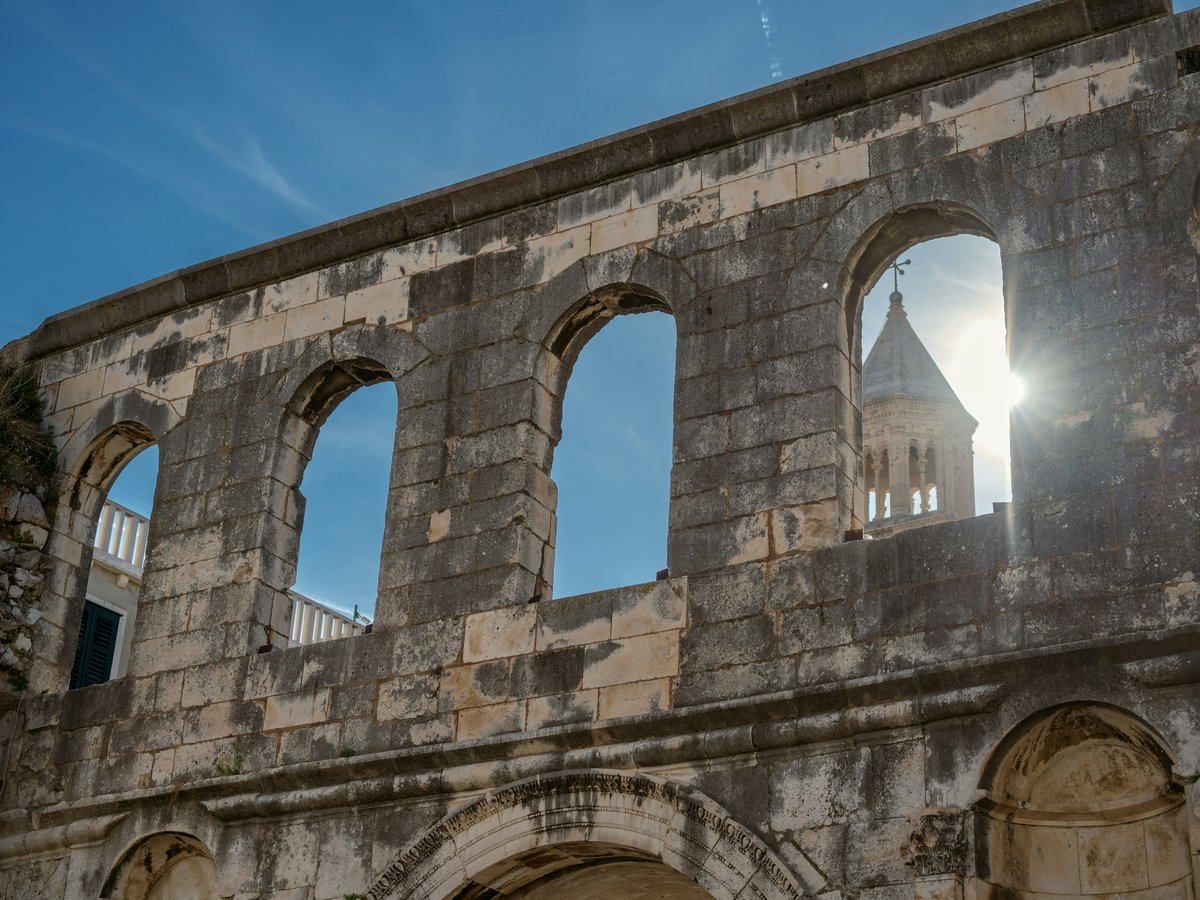
What's the must-see thing in Split?
Diocletian's Palace, built starting in 293 AD as a Roman emperor's retirement compound. The palace is not a museum behind ropes. It IS Split's old town, with about 3,000 residents still living inside its limestone walls. Start at the Bronze Gate on the Riva waterfront before 9am and work north to the Peristyle courtyard while the stone is still cool.
Diocletian's Palace covers roughly 30,000 square metres of central Split. The emperor abdicated in 305 AD and moved here to grow cabbages. That is not a metaphor. The walls still stand 15 to 26 metres high in places. Enter through the Bronze Gate on the Riva and you step from bright Adriatic sun into the basement halls, where the air drops 5 or 6 degrees and smells like wet limestone. These vaulted corridors held up the palace floors for 1,700 years before archaeologists cleared them in the mid-20th century. Walk north to the Peristyle, the open courtyard at the center of the complex. Pink-veined marble columns have held this space open since the 4th century, and the acoustics bounce conversation off the stone in a way that makes 20 people sound like 200. At 8am in August, you might have the Peristyle nearly to yourself. By noon on a day like today, 32°C with 31% humidity, the flagstones radiate heat and cruise-ship tours fill the courtyard three-deep.
The Cathedral of Saint Domnius sits on the east side of the Peristyle. It began as Diocletian's mausoleum, which likely makes it the oldest cathedral structure still serving its original liturgical purpose anywhere. The irony is hard to miss. Diocletian persecuted Christians more aggressively than any Roman emperor before him, and they turned his tomb into their church. The bell tower costs about €5 and the 183 steps up a narrow medieval staircase deliver a 360-degree view over Split's terracotta rooftops, the harbour, and the islands of Brač and Hvar in the distance. The stairs are uneven, worn smooth by centuries of feet, with no railing in some sections. Worth it. Across the Peristyle, the Temple of Jupiter still stands in its original Roman proportions. It has served as a baptistery since the early Middle Ages. The carved stone barrel vault overhead carries relief work from Diocletian's era, and the whole visit takes 10 minutes.
Marjan is the forested hill on Split's western peninsula, and it is the thing most first-time visitors skip because it does not feel 'historic' in the palace sense. That is a mistake. The 178-metre summit sits 20 minutes on foot from the Riva, and the trail climbs through Aleppo pine forest where cicadas are so loud in summer they drown out conversation. The air shifts from stone-and-coffee to pine resin within the first 100 metres of the climb. At the top, the view west toward Čiovo island and the open Adriatic is the best free vantage point in the city. Bring water. There is no shade on the final approach, and on an August afternoon the heat differential between the pine canopy and the exposed summit is stark. The small 13th-century Church of St. Nicholas near the summit path tends to be locked, but the stone terrace beside it is the spot.
Split's cruise traffic peaks between 10am and 4pm from June through September, and the palace's narrow Roman-era alleys squeeze everyone into single-file traffic. The best first-day sequence is the palace at opening, the bell tower by 9am, then the walk to Marjan while groups are still queuing at the Golden Gate for guided tours. Skip Salona on your first day. The ancient Roman capital 5 kilometres northeast in Solin covers a large open site with almost no shade, and it needs a bus ride and at least two hours to do properly. Save it for a morning on day two or three. Close your first day on the Riva promenade around 7pm, when Split's residents take their evening korzo walk. The smell of grilled fish drifts from Matejuška harbour, cold Ožujsko at one of the waterfront cafés. The korzo tends to wind down by 10pm.
The top three
Diocletian's Palace
A Roman emperor's retirement compound that became a living neighborhood. Residents still live inside the walls. The Peristyle courtyard before 9am, when it is cool and near-empty, is the single best moment you will have in Split.
Cathedral of Saint Domnius
Built as the tomb of the emperor who led Rome's most aggressive Christian persecution, then converted into their cathedral. The bell tower climb might be the best elevated view on the Dalmatian coast.
Marjan
Split's forested western hill, walkable from the waterfront in under half an hour. Pine shade, loud cicadas, and the best free panoramic vantage in the city from the summit terrace near the Church of St. Nicholas.
Verified attractions
Sourced from Wikidata and OpenStreetMap: each entry links to its authoritative page.
-
Diocletian's Palace
archaeological siteancient palace built for the Roman emperor Diocletian
View on Wikidata -
Stadion Poljud
stadiumfootball stadium in Split, Croatia
View on Wikidata -
Salona
archaeological siteancient Roman city on the Dalmatian coast, in present Croatia
View on Wikidata -
Cathedral of Saint Domnius
churchcathedral in Split, Croatia
View on Wikidata -
Croatian National Theatre in Split
theatertheatre in Split, Croatia
View on Wikidata -
Kamerlengo Castle
castlecastle in Croatia
View on Wikidata -
Trogir Cathedral
churchRoman Catholic basilica in Trogir, Croatia
View on Wikidata -
Marjan
parkhill in Split, Croatia
View on Wikidata -
Temple of Jupiter, Split
archaeological siteRoman temple in Split, Croatia
View on Wikidata -
Hollow Church
churchchurch in Solin, Croatia
View on Wikidata -
Stadion Stari plac
stadiumfootball stadium in Split
View on Wikidata -
Republic Square
plazasquare in Split, Croatia
View on Wikidata -
Archaeological Museum Split
museummuseum in Split, Croatia
View on Wikidata -
Co-Cathedral of St. Peter, Split
churchchurch in Split, Croatia
View on Wikidata -
Museum of Croatian Archaeological Monuments
museumarchaeological museum in Split, Croatia
View on Wikidata -
Split Science museum
museumzoo in Split, Croatia
View on Wikidata -
Split Synagogue
place of worshiporthodox synagogue in Split, Croatia
View on Wikidata -
Andetrium
archaeological siteRoman military town in Illyria
View on Wikidata -
Bijaći
archaeological sitevillage in Croatia
View on Wikidata -
Ćipiko Palace
palacehistorical building in Trogir, Croatia
View on Wikidata -
Golden Gate
monumentcity wall in Split, Croatia
View on Wikidata -
Museum of Fine Arts, Split
museumart museum in Split, Croatia
View on Wikidata -
St Martin's Church
churchchurch in Split, Croatia
View on Wikidata -
Stadion Hrvatski vitezovi
stadiumfootball stadium in Dugopolje, Croatia
View on Wikidata -
Tilurium
castleIllyrian fortified settlement of the Delmatae
View on Wikidata -
archbishop's palace of Split
place of worshipbuilding in Croatia
View on Wikidata -
Church of Holy Trinity
churchchurch in Split, Croatia
View on Wikidata -
Bajamonti-Dešković Palace
palacepalace in Split, Croatia
View on Wikidata -
Cambi Castle
castlecastle in Dalmatia, Croatia
View on Wikidata -
Church of Our Lady of Health
churchchurch building in Split, Croatia
View on Wikidata -
Church of Our Lady of the Island in Solin
churchView on Wikidata -
Church of the Holy Spirit
churchchurch in Split, Croatia
View on Wikidata -
Cippico Castle
castlecastle in Dalmatia, Croatia
View on Wikidata -
Crkva sv. Ivana Krstitelja (Kaštel Stari, Kaštela, Chorvatsko)
churchchurch building in Kaštela, Croatia
View on Wikidata -
Croatian Maritime Museum
museummaritime museum in Split, Croatia
View on Wikidata -
Ethnographic museum Split
museumethnographic museum in Split
View on Wikidata -
Fortress Gripe
castlefort in Split, Croatia
View on Wikidata -
Ivan Meštrović Gallery
museumgallery in Šetalište Ivana Meštrovića , Split
View on Wikidata -
Kaštilac
castleView on Wikidata -
Peristil
theatersquare in Split, Croatia
View on Wikidata
Last verified by automated review (v1.7.2) on . What is automated review?