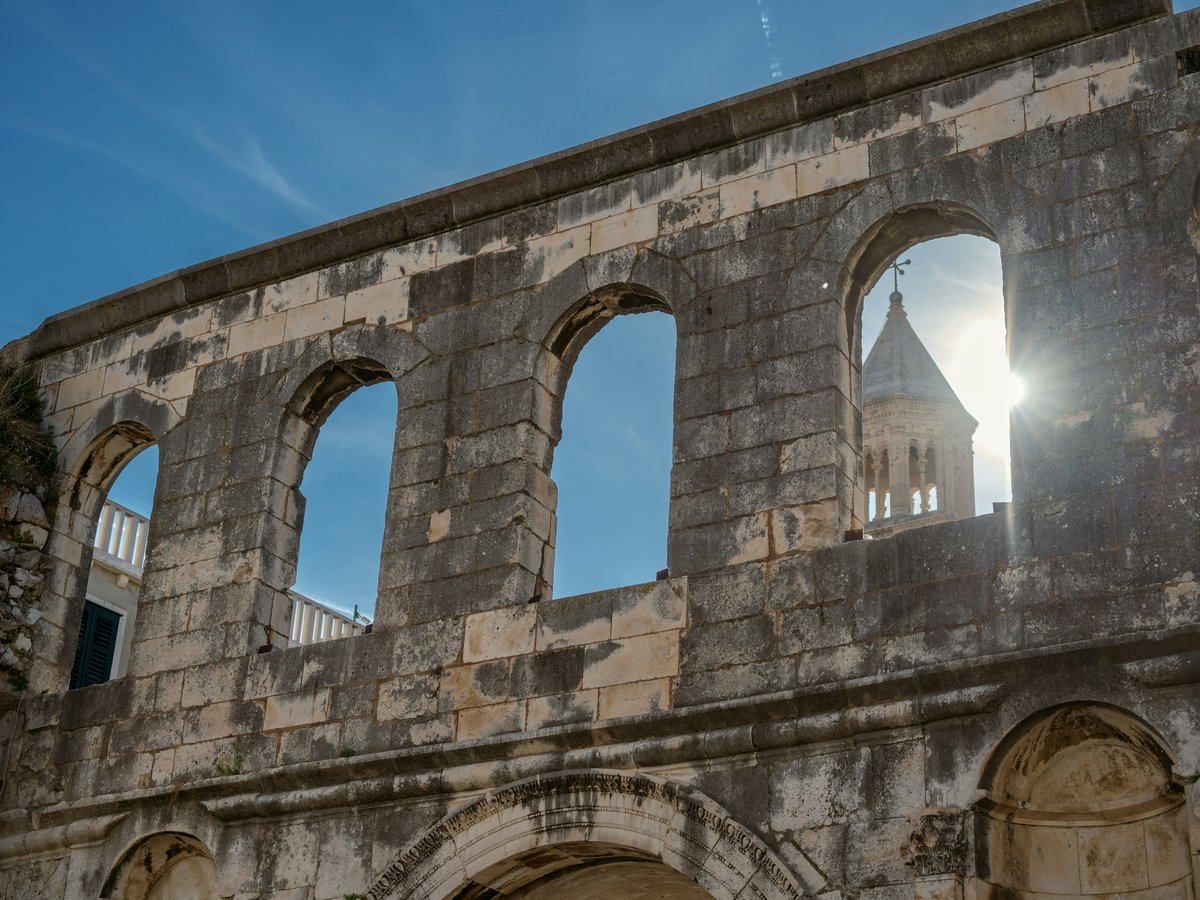
Split sits on a narrow peninsula between the Adriatic Sea and Marjan hill, with the Mosor mountain range rising to 1,339 meters directly behind the city. The Romans understood this geography when Diocletian built his retirement palace here in 293 AD. You'll feel that same pull today. The city faces southwest, which means afternoon sun hammers the Riva waterfront while the forested slopes of Marjan stay cooler by 3 to 5 degrees. To the east, the Cetina River carves a canyon through limestone karst about 25 kilometers from the city center. To the north, Kozjak ridge runs parallel to the coast at around 780 meters. This is a city where you can swim in the morning, hike above the treeline by lunch, and paddle a river canyon before dinner. Solo travelers will find it welcoming, with a safety score of 8.2/10 (see the TTDI Solo-Safety Index). That said, Split is not a polished resort. The trails are often unmarked, the rocky beaches are hard on bare feet, and the bura wind can turn a calm paddle into a serious workout with little warning.
Outdoor activities
-
Rock climbing at Marjan
The south face of Marjan has about 70 bolted sport climbing routes spread across several crags, mostly in the 15 to 25 meter range. The limestone is sharp and pocketed, with good friction when dry. Routes concentrate around grades 5a to 7a on the French scale, making it accessible for intermediate climbers. You'll find a few harder lines up to 8a if you look. The approach from Bene beach takes roughly 10 minutes on foot. Local climbers tend to gather in the late afternoon when the south face falls into shade.
- Difficulty
- Beginner to advanced (5a to 8a French scale)
- Duration
- 2 to 4 hours per session
- Best season
- October through May. Summer temperatures above 30°C make south-facing rock uncomfortably hot.
-
Cetina River canyoning
The Cetina canyon near Omiš, about 30 minutes southeast of Split, offers guided canyoning descents through a series of pools, waterfalls, and narrow gorges. The standard route covers roughly 4 kilometers and involves rappelling, jumping from ledges of 2 to 10 meters, swimming through pools, and sliding down natural chutes. Water temperature sits around 15 to 18°C even in August, so a wetsuit is standard issue from the outfitter. Several operators in Omiš run daily trips between June and September, with prices typically around 40 to 55 EUR per person including gear.
- Difficulty
- Moderate. Requires basic swimming ability but no prior canyoning experience.
- Duration
- 3 to 4 hours (full day with transport from Split)
- Best season
- June through September, when water levels are manageable and air temperatures offset the cold river.
-
Road cycling to Klis Fortress
The ride from Split's waterfront up to Klis Fortress covers about 14 kilometers one way, with roughly 360 meters of elevation gain. The route follows the D1 road through Solin, passing the ruins of ancient Salona along the way. The climb steepens in the final 3 kilometers to the fortress gates. Traffic can be heavy on the D1 during summer mornings, so an early start helps. The descent is fast and exposed to crosswinds from Kozjak ridge. You'll find water at cafes in Klis village near the top.
- Difficulty
- Moderate. The gradient reaches 8 to 10 percent in places.
- Duration
- 1.5 to 2.5 hours round trip depending on fitness
- Best season
- April through June and September through November. Mid-summer heat makes the exposed climb punishing.
-
Mountain biking on Mosor
The Mosor range behind Split has a network of forest roads and singletrack connecting villages like Sitno Gornje and Gornje Postinje at elevations between 400 and 900 meters. A popular loop starts from the village of Žrnovnica, climbs through pine and oak forest on a gravel road, and descends on rockier trails with loose limestone. Total distance for the main loop runs about 22 kilometers. Water sources are scarce above 600 meters. The terrain is technically demanding in places, with exposed rock sections and steep switchbacks.
- Difficulty
- Moderate to difficult. Rocky terrain and sustained climbs.
- Duration
- 3 to 5 hours
- Best season
- April through June and September through October. Snow can linger above 1,000 meters into April some years.
-
Stand-up paddleboarding along the Split coastline
The stretch of coast from Znjan beach west to Bene beach covers roughly 7 kilometers and passes beneath the cliffs of Marjan. Mornings tend to be glassy calm before the maestral wind picks up around noon. Rental outfits operate from Bačvice and Znjan beaches between May and October, with boards typically costing 10 to 15 EUR per hour. The water is clear enough to see the sandy bottom at 3 to 4 meters depth in most spots. Mind you, afternoon chop from ferry traffic near the harbor can catch beginners off guard.
- Difficulty
- Easy in calm conditions. Moderate when the maestral blows.
- Duration
- 1 to 3 hours
- Best season
- May through October. Mornings are consistently calmer than afternoons.
-
Via ferrata on Omiš cliffs
The via ferrata route on the Fortica fortress cliff above Omiš follows steel cables and iron rungs up a 200-meter limestone face overlooking the Cetina River mouth. The route opened in 2012 and has become one of the more popular protected climbing routes in Dalmatia. Exposure is significant in the upper sections. Several outfitters in Omiš rent harness and helmet sets for about 15 to 20 EUR if you don't carry your own. The descent follows a hiking trail back to town.
- Difficulty
- Moderate to difficult. Requires a head for heights and basic fitness.
- Duration
- 2 to 3 hours including the descent trail
- Best season
- March through June and September through November. Summer heat on the exposed rock face is intense.
Day hikes
-
Marjan Hill loop
The main loop trail circles most of the Marjan peninsula, connecting the summit at 178 meters with beaches and churches along the south coast. The path is well-maintained, mostly shaded by pine forest, and signed at major intersections. You'll cross stone steps on the steeper sections near the summit. The descent to Bene beach on the north side passes through dense forest where the temperature drops noticeably. This is Split's default after-work hike and gets busy on weekend mornings.
- Difficulty
- Easy. Elevation gain of about 178 meters total. Some uneven stone steps near the top.
- Duration
- 2 to 3 hours for the full loop
- Best season
- Year-round. Summer mornings before 9 AM avoid the worst heat.
-
Kozjak ridge traverse
Kozjak is the ridge that runs northwest from Klis, topping out at 780 meters. The hike typically starts from Klis village, reachable by bus 22 from Split in about 35 minutes. The trail climbs through low scrub and rocky terrain above the treeline, with exposure to wind on the ridge. Views extend north into the interior and south across Split and the islands. The path is marked with red and white blazes but can be faint in places where the rock is bare. Carry at least 2 liters of water per person. There is no shade on the upper ridge.
- Difficulty
- Moderate to difficult. Sustained uphill, exposed ridge, loose rock in sections.
- Duration
- 5 to 7 hours round trip from Klis
- Best season
- April through June and September through November. The ridge is dangerously exposed in summer heat and winter bura wind.
-
Mosor summit (Vickov Stup, 1,325 m)
The highest peak in the Mosor range is accessible as a long day hike from the village of Sitno Gornje, which sits at about 400 meters elevation above Split's eastern suburbs. The trail climbs through forest to alpine meadows and then bare limestone. The final approach to the summit cross involves some easy scrambling over rock. This hike demands fitness and early starts. The summit offers a 360-degree panorama across central Dalmatia, from the Biokovo range south to the islands.
- Difficulty
- Difficult. Over 900 meters of elevation gain from Sitno, exposed terrain above 1,000 meters.
- Duration
- 6 to 8 hours round trip
- Best season
- May through October. Snow can cover the upper slopes from November through March.
-
Salona to Klis historical trail
This route connects the archaeological site of ancient Salona in Solin with Klis Fortress, covering about 8 kilometers one way through a mix of farmland, olive groves, and low macchia scrub. The historical connection between the two sites goes back centuries. The trail is mostly on gravel roads and farm tracks, with a steep final approach to Klis. You'll pass through quiet countryside where the loudest sound tends to be goat bells. A bus from Klis returns you to Split.
- Difficulty
- Easy to moderate. Mostly gentle terrain with one steep section near Klis.
- Duration
- 3 to 4 hours one way
- Best season
- March through June and September through November. Wildflowers peak in April and May.
-
Perun peak from Žrnovnica
Perun (peak elevation 533 meters) sits in the foothills between Split and Omiš. The trail from the village of Žrnovnica follows a stream valley before climbing through pine forest to exposed rocky slopes. The upper trail is marked but rocky, with some loose scree. Žrnovnica is reachable by local bus from Split in about 20 minutes. The village has a couple of konobas where you can eat grilled lamb after the hike.
- Difficulty
- Moderate. About 400 meters of elevation gain on rocky terrain.
- Duration
- 3 to 4 hours round trip
- Best season
- April through June and September through November.
Water activities
-
Sea kayaking around Marjan peninsula
Guided and self-guided kayak tours follow the south coast of Marjan from Znjan or Kašjuni beach, rounding the headland to Bene beach on the north side. The route passes sea caves and small pebble coves accessible only from the water. The paddle covers about 10 kilometers for the full circumnavigation. Morning departures avoid the maestral wind that typically builds after noon. The water along the cliff base is deep and cold, a different shade of blue-green from the shallow bays. Several operators based near Bačvice charge 35 to 50 EUR per person for guided half-day trips.
- Difficulty
- Easy to moderate depending on wind. Basic paddle fitness needed for the full loop.
- Duration
- 3 to 4 hours for the full circumnavigation
- Best season
- May through October. September tends to have warm water and lighter winds than July or August.
-
Swimming at Kašjuni beach
Kašjuni is a pebble cove on the south side of Marjan, reached by a steep staircase from the road above. Pine trees overhang parts of the beach, offering natural shade that most Split beaches lack. The water is clear and deep close to shore. A small beach bar sells drinks and basic food in summer. It fills up by mid-morning in July and August, so arriving before 9 AM is worth the effort. The stones are smooth but hard on feet, so reef shoes help.
- Difficulty
- Easy. The approach staircase has about 100 steps.
- Duration
- As long as you like
- Best season
- June through September for swimming. The beach is pleasant for walking year-round.
-
Cetina River kayaking from Radmanove Mlinice
The Cetina River downstream from Radmanove Mlinice to Omiš covers about 8 to 10 kilometers of mostly calm water through a limestone canyon. The river here is slow-moving and suitable for beginners. You'll paddle past fig trees growing from the canyon walls and through sections where the gorge narrows to 20 meters. The water is fresh, cold, and green-tinted from dissolved minerals. Rental kayaks at Radmanove Mlinice typically cost 20 to 30 EUR per person including the shuttle back. River trout are visible in the shallows during quieter stretches.
- Difficulty
- Easy. Flat water with no significant rapids on this section.
- Duration
- 2 to 3 hours
- Best season
- May through October. Spring has higher water levels and slightly faster current.
-
Snorkeling at Šolta island
Šolta is the closest major island to Split, reachable by catamaran in about 30 minutes from Split harbor. The rocky coves around Maslinica on the western end have clear water with visibility often reaching 15 to 20 meters. Posidonia seagrass beds host wrasse, sea bream, and octopus. You'll need to bring your own gear or rent in Split, as rental options on Šolta are limited outside Maslinica village. The island's south-facing coves stay sheltered from the bura wind.
- Difficulty
- Easy. Calm, sheltered coves suitable for beginners.
- Duration
- Full day trip including ferry transit
- Best season
- June through September. Water temperature reaches 24 to 26°C in August.
-
Cliff jumping at Žrnovnica river pools
The Žrnovnica stream, about 12 kilometers east of Split's center, has carved small pools in the limestone where locals swim and jump from rocks of varying heights, roughly 2 to 5 meters. The water is cold even in August, typically 16 to 19°C, since it feeds from mountain springs. The pools sit in a shaded canyon and feel noticeably cooler than the coast. Check depth before jumping. The rocks are slippery when wet.
- Difficulty
- Easy to moderate. Some jumping spots require confidence and depth awareness.
- Duration
- 2 to 3 hours
- Best season
- June through September.
Parks & gardens
-
Marjan Forest Park
FreeMarjan is a 340-hectare forested hill that occupies the western end of the Split peninsula, rising to 178 meters above sea level. The park is dense with Aleppo pine, holm oak, and cypress. A network of paved and gravel paths connects viewpoints, small churches, and rocky swimming spots along the south shore. The smell of warm pine resin hangs in the air on summer afternoons. You'll hear cicadas from May onward, loud enough to drown out conversation in places. The north side of the hill stays shaded and several degrees cooler, which matters when temperatures hit the 30s.
Highlights: The first viewpoint (Vidilica) sits about a 15-minute walk from Varaš neighborhood and looks east across the old town rooftops to Mosor. The 12th-century Church of St. Nicholas is carved into the rock near the summit. Bene beach on the north shore has pine trees to the waterline.
-
Park Šuma Marjan (Marjan Botanical Garden section)
FreeOn the gentler southern slope of Marjan, a section of the park functions as a semi-wild botanical area with labeled Mediterranean plant species. It's less visited than the main trails, partly because the access path from Meje neighborhood is easy to walk past. Stone benches sit among wild rosemary and lavender. The scent is strongest in late spring, around May, when both are flowering.
Highlights: Native Mediterranean species including wild fig, strawberry tree (arbutus), and several orchid species in spring. Dry-stone wall remnants from 19th-century agricultural terraces.
-
Sustipan Park
FreeA small park and cemetery on a promontory at the southwestern tip of the old town peninsula, between the Riva and Marjan. Tall cypress trees line the paths. The park was established as a cemetery in the early 19th century and still has ornate tombstones from that era among the vegetation. It tends to be quiet even when the rest of the waterfront is packed with tourists.
Highlights: Views south across the Adriatic toward the islands of Brač and Šolta. The old cemetery headstones date from the 1820s onward. A good spot to watch ferries heading to Supetar.
-
Strošmajerova Šetnica (Strossmayer Park)
FreeA narrow green strip along the north side of the old town, between the Palace walls and the neighborhood of Radunica. Mature trees provide shade over the benches. The park follows the line of the old town's northern boundary for about 300 meters. It fills up with locals in the early evening, especially families.
Highlights: Proximity to the Golden Gate entrance of the Palace complex. The park sits at the base of the Palace's northern wall, which still stands to roughly 20 meters in places. Worth noting as a respite from the stone-paved old town, where shade is scarce.
Practical tips
- Sun protection
- Dalmatian summer sun is relentless. On a day like today, with temperatures around 32°C and clear skies, sunburn happens within 20 minutes on exposed skin. Bring SPF 50 and reapply after swimming. A wide-brim hat matters more than sunscreen on ridge hikes where shade is absent for hours. UV-protective long sleeves weigh less than the sunscreen you'd otherwise carry.
- Water supply
- Carry a minimum of 1.5 liters per person for any hike over 2 hours. On Mosor and Kozjak, there are no reliable water sources above the villages, so 2.5 to 3 liters is safer for full-day outings. Split's tap water is drinkable and cold. Fill up before you leave. Dehydration on exposed limestone trails progresses faster than you might expect at this latitude.
- Footwear and terrain
- The karst limestone in this area is sharp and unforgiving. Trail runners with good grip work for Marjan and the lower Mosor trails. Ankle-supporting boots are worth the weight on the Kozjak ridge and upper Mosor, where loose scree and exposed rock demand more stability. For beaches, reef shoes or sturdy sandals save your feet on pebble shores.
- Wind awareness
- The maestral (northwest sea breeze) typically builds between 11 AM and 1 PM in summer and dies around sunset. Plan paddling and kayaking for early morning. The bura (northeast katabatic wind) is a different animal. It arrives without much warning, especially in autumn and winter, with gusts that can reach 100 km/h on exposed ridges. If a bura warning is up, stay off Kozjak and postpone any open-water paddling.
- Trail markings
- Trails on Marjan are generally well-signed. Outside the park, Croatian mountain trails use red and white circle blazes painted on rocks and trees. On Mosor and Kozjak, blazes can be sparse above the treeline where there are no trees to paint. A GPS track downloaded beforehand helps on the upper ridges. The Croatian Mountaineering Association (HPS) maintains most marked trails, but conditions vary by season and recent weather.
- Currency and costs
- Croatia uses the euro. At the current rate of about 0.86 EUR per 1 USD, outdoor activity costs are moderate by European standards. Guided kayaking runs 35 to 50 EUR, canyoning 40 to 55 EUR, and equipment rentals (SUP, snorkel gear) 10 to 20 EUR per session. Trailhead access is free for all hikes mentioned here. Carry cash for small beach bars and village konobas that may not take cards.
FAQ
Is Split a good city for outdoor activities year-round?
Split has a Mediterranean climate with over 2,600 hours of sunshine per year. Hiking and cycling work best in spring (April through June) and autumn (September through November), when temperatures hover between 18 and 25°C. Summer is ideal for water activities but too hot for exposed ridge hikes. Winter is mild enough for Marjan walks and lower-elevation trails, though the bura wind can shut down outdoor plans for days at a time.
Can I hike Marjan hill without a guide?
Marjan is well-suited for independent hiking. The trails are marked and mostly paved or gravel. A full loop takes 2 to 3 hours at a relaxed pace. The park starts within walking distance of the old town, about 15 minutes on foot from the Riva waterfront. No permit or fee is needed.
What is the best way to reach Cetina River activities from Split?
Omiš sits about 25 kilometers southeast of Split. Bus 60 from Split's main bus station reaches Omiš in roughly 40 minutes and runs frequently through the day. Most canyoning and kayaking operators offer pickup from Split for an additional fee, typically 5 to 10 EUR. Having your own car gives flexibility for the Radmanove Mlinice put-in, which is about 10 kilometers upriver from Omiš.
Is Split safe for solo outdoor activities?
The trails around Split are generally safe for solo hikers during daylight hours. Standard precautions apply. Tell someone your route, carry a charged phone, and start early. The exposed ridges of Kozjak and upper Mosor deserve more respect. Going solo on those trails is reasonable for experienced hikers but not advisable for beginners unfamiliar with karst terrain.
Do I need to book guided outdoor activities in advance during summer?
For July and August, booking canyoning and guided kayaking 2 to 3 days ahead is advisable, especially for morning departures. Weekend slots fill fastest. SUP and basic kayak rentals at beach stands rarely need reservations. Climbing gear rental from local shops in Split is usually available same-day.
Are there family-friendly outdoor options in Split?
Split scores 6.8/10 for family friendliness (see the TTDI Family-Friendliness Index). Marjan's lower trails are stroller-accessible on the paved sections. Kašjuni and Bene beaches have calmer water than the open coast. The Cetina River kayak route from Radmanove Mlinice works for children aged 7 and up with a parent in a tandem kayak. Avoid the upper Mosor trails with young children.
Outdoor experiences in Split
 Free cancellation
 Blue Lagoon & 3 Islands Cruise with Lunch, Wine & Swim from Split
Outdoor experience: 8 hours, free cancellation.
via Viator Free cancellation
 From Split: Krka Waterfalls Tour, Boat Cruise & Swimming
Outdoor experience: 10 hours, free cancellation.
via Viator Free cancellation
 Blue Cave, Mama Mia and Hvar, 5 Island Speed boat Small group
Outdoor experience: free cancellation.
via Viator Free cancellation
 From Split: Plitvice Lakes National Park Guided Tour
Outdoor experience: 12 hours, free cancellation.
via Viator Free cancellation
 From Split: Small-Group Blue Lagoon and 3 Islands Speedboat Tour
Outdoor experience: 5 hours, free cancellation.
via Viator Free cancellation
 ATV Quad Safari Tour with Picnic & Swimming from Split
Outdoor experience: 4 hours, free cancellation.
via Viator Free cancellation
 Blue Cave & Hvar, 5 Islands Speedboat with Luxury Seats in Shade
Outdoor experience: 10.5 hours, free cancellation.
via Viator Free cancellation
 Private Blue cave, Mamma Mia and Hvar, 5 islands tour from Split
Outdoor experience: free cancellation.
via Viator Free cancellation
 Blue cave & Hvar, 5 islands speed boat tour, luxuy seats in shade
Outdoor experience: free cancellation.
via Viator Free cancellation
 2-hours Split Segway Tour
Outdoor experience: 2 hours, free cancellation.
via Viator Free cancellation
 Rafting Experience in the Canyon of the River Cetina
Outdoor experience: free cancellation.
via Viator Free cancellation
 City Bike Tour of Split
Outdoor experience: free cancellation.
via ViatorLast verified by automated review (v1.7.2) on . What is automated review?