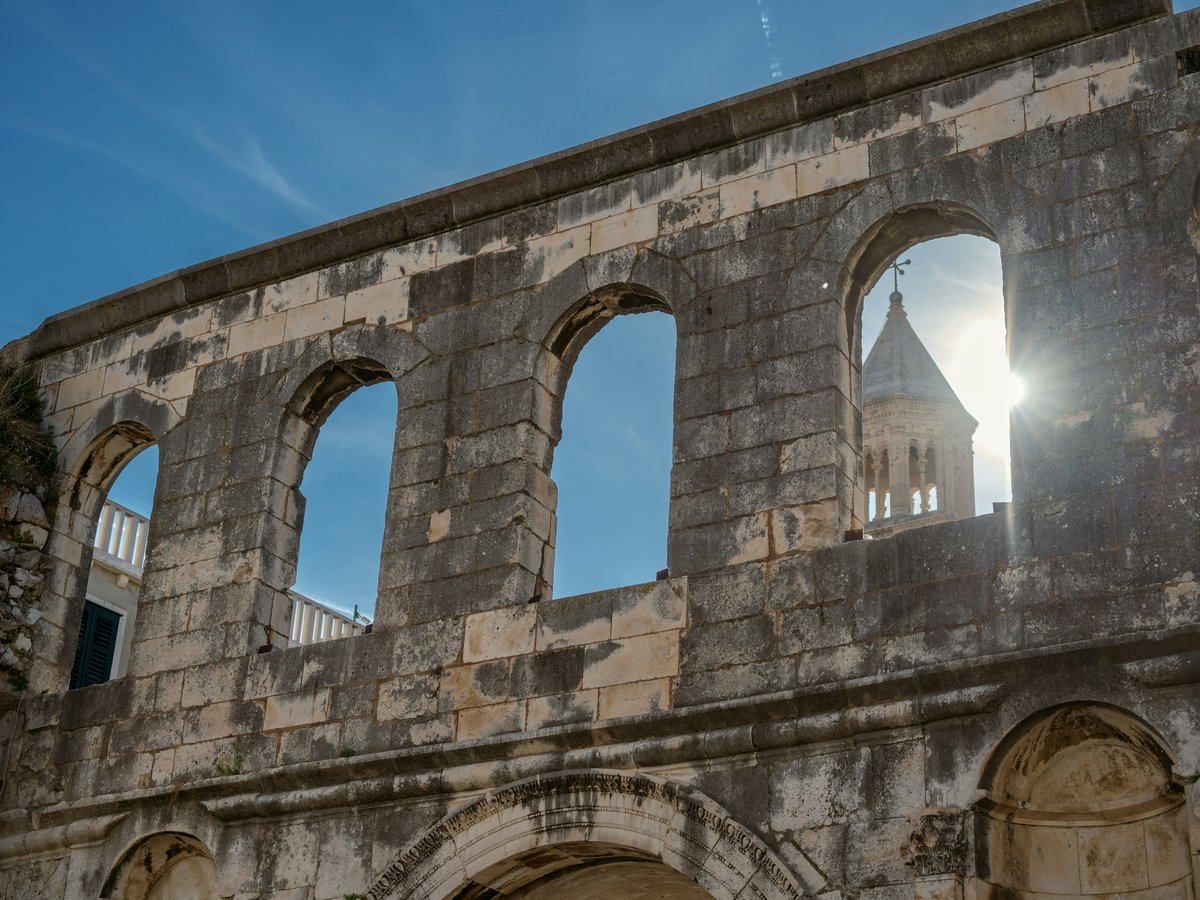
Split With Kids: What Works
Split's narrow Roman corridors and 33-degree summer heat test every family's patience, but the 6.8 family-friendliness score hides a workable sequence. Hit Diocletian's Palace before 9 AM, skip the bell tower, and let Marjan Hill and Bačvice Beach carry the rest of the day.
Published
1 Split Scores a 6.8 for Families, and That Number Is Honest
The ferry from Brač docks at Split's harbor around 7 PM, and the first thing families notice from the deck is how narrow the old town streets look from the water. Stone walls, terracotta roofs, and corridor-like alleyways thread into a structure built for a Roman emperor, not for a family of four pushing a double stroller. Split earned a family-friendliness score of 6.8 out of 10. That number is honest. A city constructed inside a 1,700-year-old palace, where the main pedestrian passages run about 2 meters wide, was never designed for wheels, small legs, or the pace of a 3-year-old who stops to touch every street cat.
The 6.8 reflects three competing realities. Bačvice Beach sits a 5-minute walk from the Riva promenade, and its sandy shallows run 30 to 40 meters out before the water reaches an adult's waist. Marjan Hill, the forested peninsula on Split's western edge, offers 3.5 kilometers of shaded trail with no entrance fee. Both lift Split's 6.8 above what the palace's narrow alleys would suggest on their own. The problem is Diocletian's Palace, the thing everyone came to see, which tends to become an obstacle course of cobblestones, staircase bottlenecks, and 33-degree July heat that turns toddler patience into a countdown timer.
This guide is not about whether to bring kids to Split. Families do, thousands of them, every summer between June and September. It is about the specific itinerary shape that survives children under 6. That amounts to a ruthless morning schedule, one beach commitment, and the willingness to treat Split's most famous landmark as a brisk walk-through rather than a half-day exploration. The 6.8 might climb toward a 7.5 if you follow the sequence in these sections. It drops to a 5 if you attempt Diocletian's Palace at noon with a cranky toddler on limestone cobbles. The difference, every time, is the 8 AM start.
The 6.8 might climb toward a 7.5 if you follow the sequence. It drops to a 5 if you attempt the palace at noon with a cranky toddler.
2 Diocletian's Palace After 10 AM Is Where Family Days Go to Die
The sound inside the Peristyle at 8 AM is mostly pigeons and a lone cellist who sometimes sets up near the Cathedral of Saint Domnius. By 10:30 on a July morning, that quiet vanishes under tour groups funneling through 3-meter-wide corridors, amplified guides echoing off stone, and the scraping noise of stroller wheels over limestone slabs laid in the 4th century. Diocletian's Palace earned its UNESCO World Heritage listing in 1979, and it remains the primary reason most visitors come to Split. It is also, for families with children under 5, the most reliable meltdown trigger on the Croatian coast.
The palace spans roughly 30,000 square meters, but the visitor experience funnels through tight passages where two adults side by side fill the available space. The substructure halls beneath the Peristyle stay notably cool, perhaps 20 degrees Celsius even in August, and kids tend to enjoy the cave-like stone rooms. That buys about 15 minutes of engaged calm. The rest of the palace circuit involves steep steps at the Iron Gate, uneven footing near the Temple of Jupiter, and the absence of meaningful shade after you exit the substructure.
The fix requires commitment. Arrive at the Bronze Gate on the southern waterfront side before 9 AM. Walk through the substructure halls first, when the vendors along the underground corridor are still arranging scarves and lavender sachets. Reach the Peristyle by 9:15 and let the kids run the open square before tour groups claim it. Skip the Cathedral bell tower if your children are under 7. The steps are narrow, sections lack railing, and the queue in July can stretch 20 minutes in full sun. To be fair, the view from the top reaches across the Brač Channel to Vidova Gora at 778 meters. Older kids might find the climb worthwhile. For families with anyone under 7, Marjan Hill offers what the palace corridors cannot, and that is space to move and air that smells like pine rather than warm stone and sunscreen.
Arrive at the Bronze Gate before 9 AM. Reach the Peristyle by 9:15. Skip the bell tower if your children are under 7.
3 Marjan Hill Is Split's Best Family Asset, and It Costs Nothing
The pine canopy on Marjan Hill's lower trails filters July sunlight into something almost comfortable. The dappled shade drops the felt temperature 5 or 6 degrees below the exposed stone of Diocletian's Palace, about a kilometer to the east. The air carries warm resin and wild rosemary. Cicadas fill what would otherwise be silence. For families with small children, Marjan is the underrated winner in Split's 6.8 family score, the asset that quietly carries the whole number.
The hill rises to 178 meters at its peak, but the family-friendly loop along the southern slope stays well below that, running about 3.5 kilometers from the Vidilica viewpoint at the eastern entrance to Bene Beach at the western base. The path is paved or packed dirt for most of that distance, wide enough for two strollers side by side on the lower sections. A 4-year-old in sandals can handle the terrain without complaint. Past the first kilometer, roots and shallow stone steps appear, and strollers become a liability.
Bene Beach sits at the trail's western end with a small café, a pebbly shore, and water that stays shallow for wading within about 10 meters of the shoreline. The crowd on a typical August Saturday runs to perhaps a third of Bačvice's numbers. That relative calm matters when you have a 2-year-old who does not share well. The tradeoff is the return walk, which runs uphill toward the Varoš neighborhood. Mind you, a taxi from Bene Beach back to the Riva currently costs roughly 8 to 10 euros and takes about 5 minutes.
The Split Zoo sits partway along Marjan's southern trail and has operated on the hill since 1924. It will not rival Barcelona or Vienna's Schönbrunn, but it holds 30 to 40 minutes of toddler attention on a hot afternoon. That is the currency a family needs at 3 PM in Split. The Institute of Oceanography nearby keeps a small aquarium collection and tends to fascinate children under 8 who are still delighted by sea urchins behind glass.
For families with small children, Marjan is the underrated winner in Split's 6.8 family score, the asset that quietly carries the whole number.
4 Bačvice Before 10 AM Is the Only Beach Timing That Works
The water at Bačvice Beach on a calm July morning feels close to bath temperature, roughly 25 degrees Celsius, and it barely covers a toddler's knees 15 meters out from shore. The sandy bottom is a genuine rarity on Croatia's predominantly pebbly Adriatic coast. No sharp rocks underfoot. No water shoes needed. A 2-year-old walks in without complaint. For families weighing Split's 6.8 family-friendliness, Bačvice is likely the single largest positive contributor to that number.
The beach sits a 5-minute walk east of the Riva promenade, past the Split ferry terminal. That proximity is both its selling point and its downfall. By 11 AM in July and August, Bačvice fills to the point where claiming 3 square meters of sand for a towel and a toddler's digging project requires real patience. The concrete terrace above the beach holds several cafés, and their speaker systems carry across the sand at volume. Not a quiet beach. Not a family-exclusive beach. Still, the shallows do something for toddlers that most Croatian beaches do not.
You might spot locals playing picigin in the ankle-deep water, a paddle-ball game without a net that has been a Split tradition since the 1920s. Kids wander into the games. The players tend to be patient about it, sometimes handing a small child the ball for a throw.
The named alternative is Kašjuni Beach, tucked below Marjan Hill on the western slope, roughly a 15-minute walk from the Vidilica trailhead. Kašjuni is pebbly, not sandy, so water shoes matter for small feet. But it holds perhaps a quarter of Bačvice's crowd on a given August morning, the pines behind the shore provide natural shade that Bačvice lacks entirely, and the water runs a degree or two cooler from the hill's runoff. Families with children over 4 who can handle pebbles should consider Kašjuni the better option. Families with toddlers who need flat, soft ground still need Bačvice, ideally before 10 AM.
5 The Family Itinerary That Works Runs 8 AM to 1 PM
Air temperatures in Split reach 33 to 35 degrees Celsius through July and August, and the stone surfaces inside Diocletian's Palace radiate stored warmth that pushes the felt temperature several degrees higher. The cobblestones feel warm through thin-soled shoes by 10 AM. Shade disappears from the Riva promenade's western end by 11. If the plan is "we'll see how it goes," the result is a red-faced child carried back to the apartment by 2 PM.
The itinerary that survives small children in Split follows a specific shape. Leave the accommodation by 8 AM, reach the Bronze Gate of Diocletian's Palace by 8:15. Walk the substructure halls and the Peristyle before tour groups arrive around 9:30. Exit through the Silver Gate on the eastern side, cross to the Green Market, where the fruit vendors are fully stocked by 9 AM and the stone-fruit selection in July is excellent. Peaches, cherries, apricots from the Dalmatian hinterland. Buy beach snacks for under 5 euros. Walk south to Bačvice Beach by 10, claim sand, and let the kids swim in the warm shallows for 90 minutes. Leave the beach by 11:30. Eat an early lunch in the Varoš neighborhood rather than on the Riva, where restaurant prices tend to run 30 to 40 percent higher for comparable food. Be indoors by 1 PM.
That sequence covers Diocletian's Palace, a local market, and a beach swim in under 5 hours. With children under 5, it is the only schedule that consistently holds together in Split's summer conditions. The afternoon belongs to the apartment pool, a nap, or shade. A gelato walk after 5 PM works well once shadows return to the old town's western alleys near the Varoš quarter. Families who attempt the palace at 2 PM in direct sun will understand viscerally why the family-friendliness score lands at 6.8 and not at 8. Split rewards the early riser every day from June through September.
Leave by 8 AM. Palace by 8:15. Beach by 10. Indoors by 1 PM. That is the only schedule that holds.
6 The Varoš Neighborhood Feeds Kids for Half the Riva Price
The smell of grilled ćevapi drifts from the narrow stone streets of Varoš, a residential quarter built into the hillside about a 10-minute walk west and uphill from the Riva promenade. That smell is the first reliable signal that you have crossed from tourist Split into something closer to the city's working rhythm. The Riva waterfront restaurants fill every seat from May through September and price accordingly. A margherita pizza on the Riva in July currently tends to cost 12 to 14 euros. A comparable pizza 400 meters uphill in Varoš drops to 7 to 9 euros. A family of four eating out over a week in Split feels that gap in the hundreds of euros.
Kid-tested foods in Split are straightforward. Ćevapi, small grilled meat sausages served in somun flatbread, appeal to most children and appear at nearly every konoba in the old town and Varoš alike. Burek, a flaky pastry filled with cheese or meat, costs 2 to 3 euros from bakeries near the Green Market and functions as Croatia's most reliable toddler snack. Palačinke, thin crepes with Nutella or jam, show up on nearly every dessert menu from the Riva to Bačvice. None of these require adventurous palates or prolonged negotiations with a 4-year-old.
For sit-down meals, the konobas in Varoš tend to be more relaxed about small children than the tourist-facing spots on the Riva, where table-turnover pressure during July and August is visible. Worth noting, the Green Market on the eastern side of the palace wall opens by 7 AM and sells seasonal fruit, fresh bread, and local cheese at neighborhood prices. A picnic from the Green Market runs roughly 10 to 12 euros for 2 adults and 2 children. Eat it on a bench in Strossmayer Park or on the Bačvice Beach terrace, and the restaurant question disappears entirely. That is arguably the most forgiving family-meal approach in Split, especially when a 3-year-old decides they are finished sitting at a table after 4 minutes.
7 The 6.8 Means Split Works as a Base, Not as a Full Week
The ferry from Split to Supetar on the island of Brač runs roughly every 2 hours during summer and takes about 50 minutes. A foot-passenger ticket tends to cost around 4 to 6 euros per adult. Supetar's town beach is pebbly and calm, backed by a shaded promenade with a few family-friendly cafés. The more photographed Zlatni Rat beach at Bol, on Brač's southern coast, sits another 40 minutes by bus from Supetar, and its gradually sloping shore handles families more gently than any beach in Split proper. This is the calculation that the 6.8 family-friendliness score quietly encodes. Split is the ferry hub. The islands it connects to are frequently the better family destination.
Klis Fortress perches on a ridgeline about 10 kilometers northeast of Split's old town and draws families with children over 6 who have energy for 90 minutes of ramparts and medieval walls. The fortress gained pop-culture visibility as a Game of Thrones filming location for Meereen, which registers with older children and means nothing to a 4-year-old. The drive from Split takes roughly 20 minutes, and the views from the upper walls stretch across the Dalmatian interior toward the Mosor range at 1,339 meters.
Split's 6.8 is the score of a city never built for families that still accommodates them when you work with its rhythms. The narrow 4th-century corridors of Diocletian's Palace, the summer heat that pins families indoors from 1 to 5 PM, the beaches that fill by mid-morning. These are fixed constraints, not problems to solve. The families who experience Split closer to a 7.5 tend to arrive with a plan. They hit Bačvice before 10 AM, walk Marjan Hill in the afternoon shade, treat the palace as a 45-minute circuit rather than a 3-hour exploration, and use the ferry terminal 200 meters from the Riva to reach Brač or Šolta when the stone radiates too much warmth. The Šolta ferry takes 30 minutes and draws a fraction of Brač's passenger volume.
Split is the ferry hub. The islands it connects to are frequently the better family destination.
Last verified by automated review (v1.7.2_onboard-split-flagship-2026-08-18) on . What is automated review?