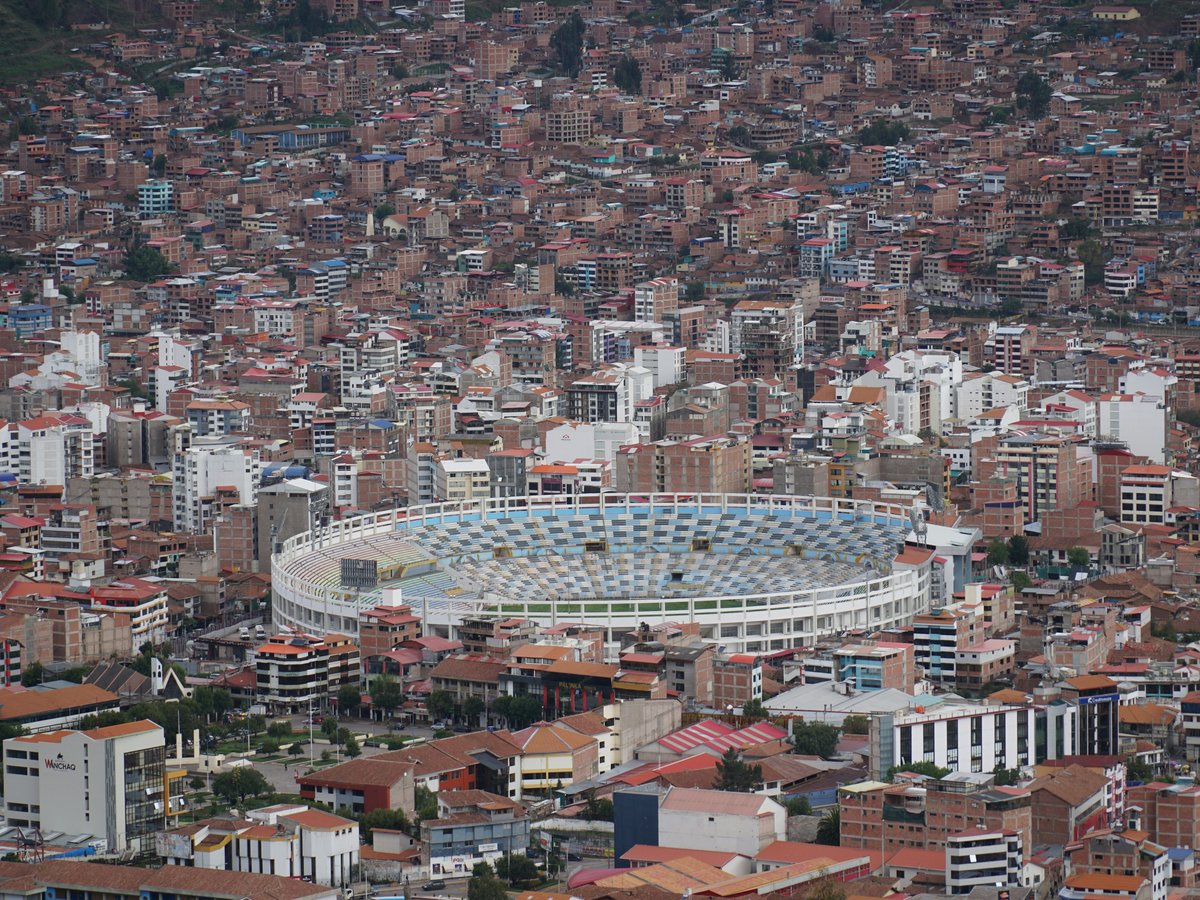
Stay in Cusco in May
91 hotels in the Trip.com pool for Cusco, from US$8 a night.
Opens Trip.com on Fri 7 May to Sun 9 May 2027; change the dates there.
May is the month Cusco dries out. After 5 months of wet-season downpours starting in November, rainfall drops to 35mm across roughly 9 days, a steep fall from January's 226mm. Daytime temperatures sit around 17.4°C (63°F), comfortable for walking the steep cobblestone streets of San Blas or the flat stretches along Avenida El Sol. Nights at 3,400 meters above sea level dip to 6.2°C (43°F) as the thinner dry-season air lets warmth drain out fast. You'll want layers.
Two celebrations anchor the month. Cruz Velacuy, the Festival of the Cross in early May, fills neighborhood plazas in San Cristóbal, Santiago, and beyond with brass bands, dance troupes, and ornately dressed crosses carried down from hilltop shrines. In some years, the Qoyllur Rit'i pilgrimage also begins in late May, drawing devotees from across the Andes to a high glacial valley for days of ritual that predates Spanish colonization. Neither event exists for tourists. Both are worth seeing.
May's trade-off against the June-August peak is straightforward. You lose the guaranteed bone-dry days of July and the spectacle of Inti Raymi on June 24. You gain Centro Histórico hotel rates that haven't reached their ceiling, Inca Trail permits that aren't sold out 6 months in advance, and clear enough mornings that the snow line on the Cordillera Vilcanota stands out from the San Cristóbal viewpoint.
Why visit in May
- Dry-season weather settling in with clearer mornings for photography at Saqsaywaman and across the Sacred Valley archaeological sites, while the surrounding hillsides still hold their wet-season green
- Hotel rates run 20-30% below June-August peaks, with better last-minute availability in San Blas guesthouses and Centro Histórico properties
- Cruz Velacuy and neighborhood patron-saint festivals bring authentic Andean celebration without the organized-tour crowds that define Inti Raymi a month later
- Trekking conditions on the Salkantay, Lares, and Inca Trail routes improve as mud from the rainy months dries and river crossings become safer, with permit availability better than peak season
Worth knowing
- Afternoon rain showers still appear, especially in the first 2 weeks, before the full dry season takes hold around mid-June
- Nighttime cold at altitude feels sharper than the numbers might suggest to anyone arriving from lower elevations. Many travelers underestimate how quickly comfortable afternoon warmth disappears after sunset
- The Qoyllur Rit'i pilgrimage, when it falls in late May, temporarily drives up transport and accommodation costs in the valleys southeast of the city
- Some tour operators and restaurants in the Centro Histórico keep reduced hours early in May before shoulder-season demand builds
Best for
Think twice if
May sits at the hinge between Cusco's wet and dry seasons. Mornings typically dawn clear and cold, with frost possible in valleys around Chinchero and Urubamba. Clouds may build through the afternoon and deliver a brief shower, though these rarely last more than 30 minutes. By late May, the pattern tilts decisively dry, previewing the June-August window. The temperature swing between day and night exceeds 11°C (20°F), a gap that catches travelers off guard. Direct sun at this altitude feels strong on exposed skin even when the air reads cool.
Seasonal caution
- Altitude sickness affects roughly 1 in 3 visitors arriving from sea level. At 3,400 meters (11,150 feet), symptoms like headache, nausea, and breathlessness typically peak 6-12 hours after arrival. Spend at least 2 full days acclimatizing before attempting anything above 4,000 meters.
- UV radiation at this elevation is roughly 60% stronger than at sea level. Sunburn can occur in under 20 minutes of direct exposure, even on overcast days. SPF 50+ sunscreen and lip protection with UV filter are medical necessities.
Year-round climate
Averages from the last 5 years.
| Month | Avg high (°C) | Avg low (°C) | Rainfall (mm) |
|---|---|---|---|
| Jan | 17 | 8 | 226 |
| Feb | 17 | 8 | 185 |
| Mar | 16 | 8 | 180 |
| Apr | 17 | 7 | 74 |
| May | 17 | 6 | 35 |
| Jun | 18 | 5 | 5 |
| Jul | 19 | 5 | 7 |
| Aug | 19 | 5 | 20 |
| Sep | 19 | 6 | 41 |
| Oct | 19 | 7 | 92 |
| Nov | 19 | 8 | 169 |
| Dec | 18 | 8 | 180 |
Holidays and festivals in May
Public holidays
- International Workers' Day(Día del Trabajo)1 May 2027
- Labour Day(Día del Trabajo)1 May 2027
Headline events
Qoyllur Rit'i
Late May to early June (moveable, tied to Corpus Christi)
The largest Andean pilgrimage, drawing an estimated 70,000-100,000 devotees to the Sinakara Valley at 4,700 meters near the Ausangate glacier. A syncretic blend of Catholic and Quechua tradition involving days of ritual dance, music, and a pre-dawn procession to the glacier's edge. UNESCO inscribed it on the Intangible Cultural Heritage list in 2011. The date shifts with the liturgical calendar, and in some years it falls entirely in June. Check dates before booking travel specifically for this event.
Best things to do in May
Inca Trail to Machu Picchu
trekkingThe classic 4-day, 43-kilometer trek from Km 82 to Machu Picchu, crossing Dead Woman's Pass at 4,215 meters and passing through cloud forest scattered with wet-season wildflowers. The trail passes Inca ruins at Runkurakay and Wiñay Wayna before reaching the Sun Gate at dawn on day 4.
Trail mud from the wet season has largely dried by May, river crossings are safer, and permit availability is easier to secure 2-3 months out than for the June-August window.Booking tipBook through a licensed operator. May weekday departures are the easiest to get. Permits are non-transferable and tied to your passport number.
Cruz Velacuy processions
culturalEach barrio in Cusco sponsors a cross dressed in elaborate textiles, flowers, and candles. Dance troupes in traditional costume accompany the crosses from hilltop shrines to neighborhood plazas. The atmosphere is more neighborhood party than organized spectacle, with food vendors and crowds of cusqueño families filling the streets. San Cristóbal, San Blas, and Santiago have some of the liveliest celebrations.
Cruz Velacuy is fixed to early May each year, marking the feast of the Finding of the Holy Cross adapted into Andean tradition. There is no other time to see it.Sunrise at Saqsaywaman
sightseeingThe Inca citadel above the city, built with limestone blocks weighing up to 125 tonnes, catches the first light across its zigzag ramparts. The site sits at 3,700 meters, a 30-minute steep walk from Plaza de Armas. The surrounding grasslands still hold their green from the rains while the stones warm in the low-angle light.
Clearer mornings than the preceding wet months, combined with far fewer tour groups than June-August, make early-morning visits genuinely peaceful. The shoulder-season quiet is the draw.Booking tipCovered by the Boleto Turístico multi-site pass. Arrive before 07:00 to beat the first organized tours.
Salkantay Trek
trekkingA 5-day alternative to the Inca Trail crossing the 4,630-meter Salkantay Pass beneath the 6,271-meter peak of Nevado Salkantay. The route drops from high-altitude grassland into subtropical cloud forest. No permit lottery required.
Snow conditions on the pass are more manageable than during the wet months, and clear days offer unobstructed views of both Salkantay and Humantay that cloud cover hides from January through March.Booking tipBook 3-4 weeks ahead with a Cusco-based operator. May departures tend to cost 10-15% less than July slots.
Coricancha in late-afternoon light
culturalThe Temple of the Sun, whose Inca foundations date to around 1201, was the most sacred site in the empire. The Spanish built Santo Domingo convent directly on top, creating a collision of Inca dry-stone masonry and colonial architecture. The remaining Inca walls, cut and fitted without mortar, are among the finest surviving examples of the technique.
Drier afternoon air and fewer overcast days let light enter the temple's niches more reliably than in the wet months. Visitor density is noticeably lighter than peak season.Booking tipEntry is separate from the Boleto Turístico. Visit between 14:00 and 16:00 for the best interior light.
Day trip to Tipón terraces
sightseeingTwelve irrigated agricultural terraces roughly 23 kilometers southeast of Cusco, featuring an Inca hydraulic system that still channels water through original stone aqueducts after more than 500 years. The site sees a fraction of the visitors who crowd the Sacred Valley circuit.
The terraces retain their wet-season green while surrounding hillsides begin turning gold. This contrast peaks in May and creates photographs that aren't possible in the uniformly dry July-August landscape.Booking tipTake a combi from Avenida de la Cultura toward Oropesa and ask for the Tipón turnoff. A taxi from there runs about 10 soles.
Andean stargazing
natureAs dry-season clarity returns, the Southern Cross and the Milky Way's galactic center become visible to the naked eye from locations beyond the city's light footprint, particularly along the road toward Chinchero.
May's clearing skies and falling humidity mark the start of Cusco's best stargazing season. Deep-sky objects invisible during the wet months reappear as cloud cover retreats.Booking tipGuided sessions at observatories near Saqsaywaman should be booked a day ahead for small groups.
What to eat in May
In season: fruit
Tuna (prickly pear)
The tail end of tuna season runs through May. The fruit of the nopal cactus grows across the dry hillsides surrounding Cusco, and the deep magenta variety appears in juices and desserts at market stalls. It stains everything it touches.
On menus now
Chairo
A hearty soup built on chuño, lamb or beef, fava beans, and wheat. Demand at market lunch counters rises as Cusco's nights get colder through May. Portions typically cost under 10 soles.
Street food peaks
Choclo con queso
Large-kernel Peruvian corn paired with fresh queso fresco, sold by street vendors near Mercado San Pedro for 3-5 soles (under 1.50 USD). The late-harvest choclo still available in May tends to be starchier and sweeter than earlier-season ears.
What to drink
Ponche cusqueño
A warm, spiced punch made from toasted grains, cinnamon, cloves, and sugar, sometimes laced with pisco. Vendors set up steaming cauldrons near Plaza de Armas as evening temperatures drop, and the drink is closely tied to Cruz Velacuy celebrations.
In markets
Chuño
The cold, dry nights that begin in May create ideal conditions for making this ancient Andean freeze-dried potato. Communities across the altiplano spread tubers on the ground to freeze overnight and sun-dry by day. Fresh chuño appears in soups and stews at market stalls in the Wanchaq district through the winter months.
Regular events in May
Cruz Velacuy (Festival of the Cross)Free
Cusco's annual Festival of the Cross, with neighborhood processions, music, and market fairs across the city's barrios. Primarily a local celebration rather than a tourist event.
May 2-3Día del Trabajo (Labour Day)Free
National public holiday. Banks, government offices, and some shops close. Main archaeological sites remain open but certain museum schedules shift. Political marches occasionally pass through Plaza de Armas in the morning.
May 1Señor de Torrechayoc (Urubamba)Free
A major religious procession in Urubamba, roughly 75 kilometers from Cusco in the Sacred Valley. Multi-day celebrations include traditional dances, market fairs, and bullfights honoring the Lord of Torrechayoc. Worth a day trip if you're already in the valley.
Mid-May (moveable, typically around May 14-16)Best places this May
Mercado San Pedro
marketCusco's central market, 2 blocks southwest of Plaza de Armas. In May, stalls display late-harvest choclo, fresh chuño, and prickly pear. The juice vendors on the upper level blend seasonal fruits for a few soles. Arrive before 09:00 to shop alongside locals rather than tour groups.
San PedroQ'inqu archaeological park
archaeological siteA carved-rock ceremonial site about 4 kilometers from the center on the road toward Saqsaywaman. Far less visited than its larger neighbor. Carved channels and stone seats sit in open grassland that transitions from green to gold through May. Covered by the multi-site tourist pass.
San Blas artisan quarter
neighborhoodThe neighborhood above Plaza de Armas, reached by steep cobblestone alleys. In May, the clearer air opens views from the San Blas plaza across the city's terracotta roofline to the mountains. Ceramic and textile workshops are less hectic than in peak months, and the artisans have more time to explain their craft.
San BlasCusco Cathedral
churchConstruction began in 1559 on the foundations of the Inca palace of Viracocha. The interior holds over 400 Cusqueña School paintings, including Marcos Zapata's Last Supper featuring a guinea pig as the central dish. Lower visitor numbers in May mean less jostling in the side chapels.
Centro HistóricoChurch of the Society of Jesus
churchCompleted in 1668 on Plaza de Armas after an earthquake leveled the original structure. The Baroque facade competes with the Cathedral for visual dominance of the main square. Interior gilt work catches afternoon light well in the drier May atmosphere.
Centro HistóricoTambomachay and Puka Pukara
archaeological siteTwo Inca sites about 8 kilometers from the city, likely used as a ceremonial bath and military checkpoint respectively. Spring water still flows through original stone channels at Tambomachay. Both are part of the 4-site circuit above Cusco. In May, water flow remains strong from the rains while the walking paths have started drying out.
San Cristóbal viewpoint
viewpointThe terrace in front of the San Cristóbal church, on the steep hillside above Plaza de Armas, offers one of the best panoramic views of the city's roofline. May mornings with clear skies reveal the full mountain backdrop. The walk up takes 15-20 minutes from the main square and doubles as acclimatization exercise.
San Cristóbal
Your packing checklist
Tick items off as you pack. Your progress saves in this browser.
All packed — have a great trip.
Insider tips
The Boleto Turístico covers 16 sites across Cusco and the Sacred Valley for 130 soles but expires 10 days after purchase. In May, when lines are shorter, you can realistically visit all 16 in that window. Buy it at the COSITUC office on Avenida El Sol, not from touts near Plaza de Armas who add a commission.
Mercado de Wanchaq, a 15-minute walk from Centro Histórico in the Wanchaq district, is where cusqueños shop for daily groceries. Prices run 30-40% below Mercado San Pedro for the same products, and the lunch counters serve better chairo because the clientele is local.
For Cruz Velacuy, head to the San Cristóbal neighborhood rather than Plaza de Armas. The hilltop crosses come down through San Cristóbal first, and the dancing in the small plaza there feels like a neighborhood gathering, not a civic performance. Arrive by 16:00 on the opening afternoon.
Colectivos to the Sacred Valley leave from the Pavitos terminal area near Mercado Cascaparo, not the main bus terminal. A shared van to Pisac costs 5-8 soles (under 2.50 USD) and takes about 45 minutes. Taxis quote 10 times that for the same trip.
Spend your first 2 days at Cusco's elevation before going higher. Walking the 4-site circuit above the city on day 2 is the best acclimatization hike. It tops out around 3,750 meters and you can bail at any point by heading downhill into town.
Avoid these mistakes
- Flying into Cusco from Lima at sea level and heading straight to the Sacred Valley or a trek on day 1. Altitude sickness hits most people 6-12 hours after arrival, and the first 48 hours should be gentle exploration on foot, not 4,000-meter passes.
- Packing based on the daytime average alone and arriving unprepared for the cold after dark. By 19:00, you need a proper warm layer. The gap between afternoon comfort and evening cold surprises nearly every first-time visitor.
- Booking the Inca Trail for July because 'that's when everyone goes' and missing the fact that May offers comparable trail conditions with fewer crowds and easier permit access at a lower price.
- Eating a heavy meal at a sit-down restaurant within hours of arriving. Digestion slows at altitude. Start with light soups and mate de coca for the first 24 hours. The market lunch counters serve at a pace your body can handle better than a full dinner.
Practical tips for May
May 1 (Día del Trabajo) is a national holiday, so banks close and ATM queues grow. Withdraw soles the day before. The local currency is the Peruvian sol (PEN), and 1 USD converts to approximately 3.38 PEN at current rates. Most restaurants and tour agencies in Centro Histórico accept cards, but market vendors, colectivos, and smaller shops deal in cash only. Bring small bills in 5 and 10 sol denominations. Tipping is not obligatory in restaurants but 10% is common in tourist-facing places. For trek guides and porters, 40-60 soles per day per group is standard. Book Inca Trail permits through a licensed operator 2-3 months ahead for May departures. Multiple airlines operate direct flights from Lima to Alejandro Velasco Astete Airport (CUZ), with a flight time of about 1 hour 15 minutes. Flights typically arrive in the morning, which means your altitude adjustment starts in midday sun. Drink water, skip alcohol for the first 24 hours, and resist the pull of the ruins above the city on day 1. Some guesthouses in San Blas sit above 3,500 meters. If altitude sensitivity is a concern, consider staying lower in Wanchaq for the first 2 nights.
FAQ
Is May a good time to visit Cusco?
May is one of the better months, ranking 4th out of 12 overall. The wet season has largely ended, skies are clearing, and the dry-season crowds that fill the city from June through August haven't arrived. You get improving weather, lower hotel prices, and better trek permit availability. The trade-off is an occasional afternoon shower in the first half of the month and cold nights that require real warm layers.
What is the weather like in Cusco in May?
Expect comfortable afternoons in the high teens Celsius (low 60s Fahrenheit) and cold nights that drop to single digits (low 40s Fahrenheit). Mornings are typically clear, with clouds building in the afternoon and occasional brief showers, particularly in early May. Humidity sits around 69%. The biggest weather surprise for most visitors is the strength of the sun at altitude, which burns exposed skin quickly even on cool or overcast days.
Is Cusco crowded in May?
Crowd levels are moderate. May is noticeably quieter than the June-August peak, when Inti Raymi and school holidays bring the highest visitor numbers of the year. You'll share the major sites with other travelers, but not in the shoulder-to-shoulder way that happens in July. Restaurants in San Blas that need reservations in peak season will likely seat you on a walk-in.
How many days do I need in Cusco in May?
Plan for at least 4 full days in the city itself, plus whatever time you allocate for treks or the Sacred Valley. The first 2 days should prioritize acclimatization with gentle walking around town. Days 3 and 4 can take on the archaeological sites, markets, and the artisan quarter in San Blas. If you're trekking the Inca Trail, add 4 days for the route itself plus a buffer day on each end.
Do I need altitude sickness medication for Cusco?
Many travelers take acetazolamide (Diamox) starting 24 hours before arrival, though you should consult your doctor first. The traditional local approach is coca tea (mate de coca), available everywhere in Cusco for a few soles per cup. The most effective prevention is slow acclimatization over 2 full days at the city's elevation before attempting anything higher. Symptoms are common but typically manageable if you take the first 48 hours easy.
Things to Do in Cusco in May

Inca Trail 4-Day Trek to Machu Picchu – Return by Vistadome Train
Outdoor experience: 4 days.
via Viator Free cancellation
 Sacred Valley Full Day Tour
Day trip: 10 hours, free cancellation.
via Viator
4-Day Inca Trail Trek to Machu Picchu & Panoramic Train
Outdoor experience: 4 days.
via Viator
Classic 5-Day Salkantay Trek to Machu Picchu: Small Group Hike
Outdoor experience: 5 days.
via Viator
2-Day Short Inca Trail to Machu Picchu – Vistadome & 4-Star Hotel
Outdoor experience: 2 days.
via Viator Free cancellation
 Excursion to Rainbow Mountain Full Day Optional Red Valley
Outdoor experience: 12 hours, free cancellation.
via ViatorFind a flight to Cusco
Live fares to Cusco appear here once cookies are accepted.
Last verified by automated review (v1.7.2) on . What is automated review?