Stay in Petra in July
52 hotels in the Trip.com pool for Petra, from US$10 a night.
Opens Trip.com on Fri 2 Jul to Sun 4 Jul 2027; change the dates there.
July in Petra is, honestly, about heat management. The average high reaches 32.2°C (90°F) and drops to around 22.4°C (72°F) at night, with effectively zero rainfall and 37% humidity. That sounds manageable on paper, but the reality of walking across open desert terrain between sandstone cliffs that radiate stored heat changes the equation. The pale rock of the Siq throws UV back at you from every angle. By noon, the climb to Ad-Deir (the Monastery) feels punishing. This is not a month for leisurely midday exploration.
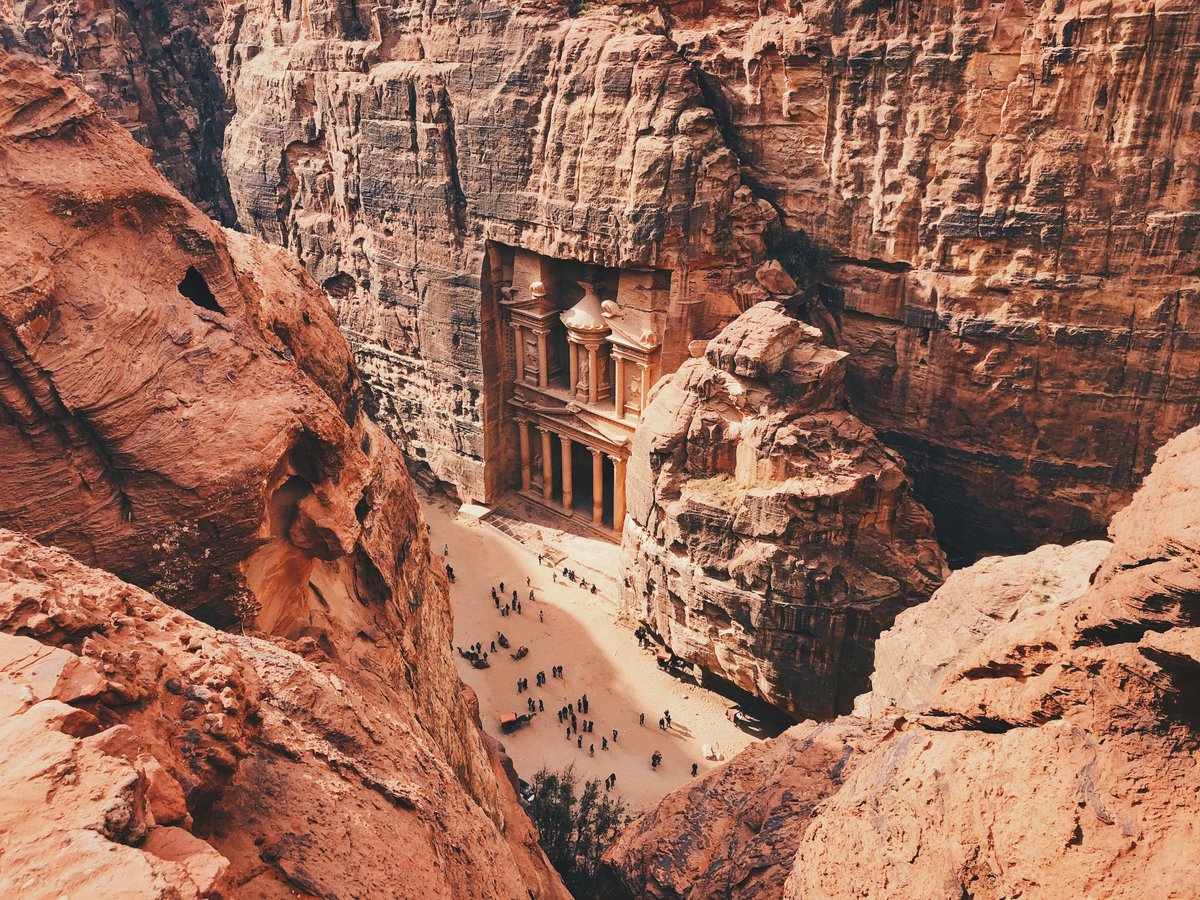
The tradeoff is real, though. July is Petra's quietest month. The tour buses that line the Visitor Centre parking lot from March through May are gone. Al-Khazneh (the Treasury) at 6:30am belongs to you and maybe a dozen other visitors, not 300. Hotels in Wadi Musa drop rates to their annual lows, and you'll find restaurant staff in the town genuinely happy to see you rather than overwhelmed. The 22°C evening air feels like a reward after the daytime heat, and Petra by Night on a summer evening is a different experience from the shivering winter version.
To be fair, most travelers would be better served visiting in April or October. But if your calendar puts you here in July, or if you actively prefer solitude over comfort, Petra still delivers. The key is restructuring your day. Enter at 6am when the gates open, retreat to air conditioning by 11am, and return for the golden hours between 4pm and sunset around 7:30pm.
Why visit in July
- Lowest crowd levels of the year. Al-Khazneh (the Treasury) and the Siq are remarkably empty before 9am, and you might have the 800-step climb to Ad-Deir entirely to yourself.
- Hotel rates in Wadi Musa drop 40-50% from spring peaks. 3-star rooms that cost 80-100 JD in April go for 40-55 JD in July.
- Evening temperatures around 22°C (72°F) make Petra by Night and sunset viewing from the Royal Tombs genuinely comfortable rather than cold.
- Zero rainfall and clear skies eliminate any risk of flash flooding in the Siq, which occasionally forces closures during the November-March wet season.
Worth knowing
- Daytime highs of 32°C (90°F) with intense desert sun limit comfortable sightseeing to roughly 6am-11am and after 4pm. The midday hours are dangerous on exposed trails like the High Place of Sacrifice.
- Several restaurants and shops along Tourism Street in Wadi Musa reduce hours or close for summer, narrowing your dining options to hotel restaurants and a handful of year-round spots.
- The Monastery (Ad-Deir) climb has almost no shade across its 800+ carved steps. In July's heat, this 45-minute ascent becomes a serious cardiovascular challenge even for fit hikers.
Best for
Think twice if
July in Petra is hot and completely dry. The desert sun is the dominant weather factor, pushing felt temperatures well above the 32.2°C average on exposed rock surfaces. Humidity sits at a relatively low 37%, which helps the body cool through sweat, but UV intensity stays extreme throughout daylight hours. Nights cool noticeably to around 22.4°C (72°F), making evenings genuinely pleasant for walking around Wadi Musa or attending Petra by Night. There is zero rainfall and essentially zero cloud cover across the entire month.
Seasonal caution
- Direct sun on exposed sandstone can push surface temperatures above 50°C (122°F) between 11am and 3pm. The unshaded climb to the Monastery and the High Place of Sacrifice trail are the highest-risk zones for heat exhaustion.
- Carry at least 3 liters (100 oz) of water per person for a full day at the site. Petra's few water vendors sometimes reduce stock by midday in summer, and there is no shade or running water on several major trails.
- UV reflection off pale sandstone causes faster sunburn than direct sun exposure at a beach. Exposed skin on hands, neck, and face burns within 20-30 minutes even with SPF 30.
Year-round climate
Averages from the last 5 years.
| Month | Avg high (°C) | Avg low (°C) | Rainfall (mm) |
|---|---|---|---|
| Jan | 14 | 7 | 33 |
| Feb | 14 | 6 | 41 |
| Mar | 18 | 9 | 37 |
| Apr | 25 | 14 | 11 |
| May | 28 | 17 | 6 |
| Jun | 31 | 21 | 0 |
| Jul | 32 | 22 | 0 |
| Aug | 33 | 23 | 0 |
| Sep | 30 | 20 | 1 |
| Oct | 25 | 17 | 4 |
| Nov | 21 | 14 | 20 |
| Dec | 16 | 9 | 35 |
Best things to do in July
Dawn exploration of the Siq and Al-Khazneh
sightseeingEnter at 6am when the gates open and walk the 1.2km Siq in cool morning shadow. The Treasury catches direct sunlight around 9am in July, creating golden light on the facade. With low summer crowds, you might share the moment with fewer than 20 other visitors.
July's combination of 6am gate opening, lowest annual crowd levels, and comfortable early morning temperatures (around 24°C at 7am) creates the best conditions for undisturbed photography at the Treasury.Booking tipNo booking needed for the site itself, but arrange a 5:30am taxi from your Wadi Musa hotel the night before. Summer shuttle schedules are unreliable.
Petra by Night
culturalA 1.5km candlelit walk through the Siq to the Treasury, where the facade is illuminated by 1,500 paper-bag lanterns. The program includes Bedouin music and tea at the Treasury plaza. The walk takes about 25 minutes each way.
Summer evening temperatures of 22°C (72°F) make the walk comfortable in light clothing, unlike the winter version where you shiver through 7°C air. July crowds are small enough that the Siq feels intimate rather than congested.Booking tipRuns Monday, Wednesday, and Thursday evenings. Tickets cost 17 JD and are available at the Visitor Centre or through your hotel. Buy on arrival day, not in advance. Summer sessions rarely sell out.
Sunset at the Royal Tombs
sightseeingThe west-facing facades of the Urn Tomb, Silk Tomb, and Corinthian Tomb catch direct sunset light. In July, the sun sets around 7:30pm, giving the sandstone a deep orange glow that lasts about 30 minutes. The amphitheater-like seating carved into the rock across the valley makes a natural viewing spot.
July's late sunset (around 7:30pm versus 4:45pm in December) extends the golden-hour window and lets you return from the Treasury area in comfortable late-afternoon temperatures rather than racing midday heat.Little Petra (Siq al-Barid) morning visit
sightseeingThis smaller Nabataean site sits 8km north of the main entrance. Its short canyon with carved dining halls, cisterns, and painted Nabataean frescoes takes 45-60 minutes to explore. The narrow siq provides more consistent shade than the main site.
When Petra's main site becomes unbearable after 11am in July, Little Petra's compact layout and natural shade cover offer a heat-friendly alternative. Free entry and almost no other visitors in summer.Booking tipFree, no ticket needed. Drive or take a taxi from Wadi Musa (about 10 minutes, 5-7 JD). Go before 10am for the best shade coverage.
Nighttime stargazing from elevated viewpoints
naturePetra's surrounding ridgelines offer exceptional dark-sky conditions. The area around Umm Sayhoun village, just outside the archaeological park boundary, provides accessible high-ground viewpoints without the need for a park entry ticket.
July's 0% cloud cover, 37% humidity, and warm 22°C nights create ideal conditions for naked-eye astronomy. The Milky Way core is near its highest position in the southern sky during July evenings in Jordan.Dana Biosphere Reserve day trip
natureThe RSCN-managed reserve sits about 50km north of Petra, with hiking trails through sandstone canyons and Mediterranean scrubland. The Rummana campsite offers guided sunset walks and night wildlife observation sessions during summer months.
The reserve's summer program at the Rummana campsite runs June through September, with guided evening hikes when desert wildlife (ibex, foxes, rock hyrax) is most active in cooler twilight hours. Dana's elevation (1,500m at the rim) provides temperatures 5-7°C cooler than Petra.Booking tipBook Rummana campsite through the RSCN website at least a week ahead. Summer spots fill faster than you might expect given the season.
Wadi Farasa trail in early morning
hikingThis partially shaded route descends from the High Place of Sacrifice through carved Nabataean tombs, the Garden Triclinium, and the Soldier's Tomb. The narrow wadi walls block direct sun for much of the path, making it one of the cooler hiking options within Petra.
The Wadi Farasa route's natural shade cover makes it one of the few trails at Petra where July's heat is manageable past 9am. The trail drops in elevation, so the return climb is the harder half. Start by 7am and finish before 10:30am.What to eat in July
In season: fruit
Teen (fresh figs)
July is peak fig season across southern Jordan. Street vendors in Wadi Musa sell bags of ripe green and purple teen for 1-2 JD, and hotel breakfast buffets feature them daily. Mid-July tends to bring the sweetest fruit.
Batteekh (watermelon)
Jordanian watermelon reaches peak sweetness in July. Roadside stalls on the highway between Wadi Musa and Aqaba sell whole melons for 2-3 JD. After a morning at Petra, cold watermelon is the best recovery food available.
On menus now
Mansaf with summer sides
Jordan's national dish of lamb in fermented dried yogurt (jameed) over rice appears on every menu year-round, but summer preparations in Wadi Musa pair it with lighter sides like cold fattoush with purslane (baqleh) and sumac-dressed tomato salads.
What to drink
Jallab
A traditional Levantine summer drink made from grape molasses, dates, and rose water, poured over crushed ice with floating pine nuts. Most restaurants and juice stands in Wadi Musa serve it through August. It tastes like cold smoky caramel.
Qamar al-Din
Chilled apricot nectar made from sheets of dried apricot leather dissolved in cold water. Originally a Ramadan staple, it serves as a popular summer cooler at restaurants across Wadi Musa. The thick, sweet-tart flavor is distinctive.
Regular events in July
Petra by Night
Candlelit walking experience through the Siq to the Treasury, with 1,500 luminaries, Bedouin music, and sweet sage tea. Runs year-round on Monday, Wednesday, and Thursday evenings at 8:30pm in summer.
Every Monday, Wednesday, and Thursday eveningJerash Festival of Culture and Arts
Jordan's largest annual cultural festival, held at the ancient Roman ruins in Jerash (about 3.5 hours north of Petra). Features Arab and international musicians, dance troupes, and theatrical performances across 10-14 days. Worth the day trip if the timing aligns.
Late July to early August (dates vary each year)RSCN Summer Night Walks at Dana Biosphere Reserve
The Royal Society for the Conservation of Nature organizes guided twilight and night walks from the Rummana campsite during summer months. The walks focus on desert wildlife observation (ibex, striped hyenas, foxes) in the cooler evening hours.
June through September, several evenings per weekBest places this July
The Siq
natural formationThe 1.2km narrow gorge that serves as Petra's main entrance stays 5-8°C cooler than open areas thanks to its 80-meter sandstone walls. In July, treat it as a cooling corridor rather than a quick transit. The carved water channels and votive niches along the walls reward slow walking. The morning light filtering down through the gap creates shifting color bands on the rock.
Main entrancePetra Museum
museumOpened in 2019, this air-conditioned museum near the Visitor Centre houses Nabataean pottery, jewelry, and architectural fragments. In July, it doubles as a critical midday cooling station. The exhibits on Nabataean hydraulic engineering feel more relevant after you have walked the water channels in the Siq.
Wadi Musa (Visitor Centre area)Al-Khazneh (The Treasury)
archaeological sitePetra's iconic carved facade is 39 meters tall and catches direct morning sun around 9am in July. The plaza in front fills with shade from the eastern cliff face before 8am, giving you a comfortable window to sit and absorb the scale. This is the one structure that earns every photograph ever taken of it.
Central PetraQasr al-Bint
archaeological siteThe only freestanding structure in Petra, this 1st-century Nabataean temple sits at the end of the Colonnaded Street. Partially shaded by the surrounding valley walls in late afternoon, it makes a good waypoint on the return walk from the Basin area. The carved stone detailing on the remaining walls is finer than it looks from a distance.
Central valleyThe Basin Restaurant area
rest areaThe open-air restaurant near the Monastery trail junction offers shade, cold drinks, and basic meals. In July, this is the furthest comfortable point for midday visitors. The nearby tap water from the ancient Nabataean spring system is still cool and drinkable.
Central PetraBeidha Neolithic Village
archaeological siteA 9,000-year-old settlement excavated 5 minutes north of Little Petra. One of the earliest permanent human communities ever found. Rarely visited even in peak season, completely deserted in July. The circular stone foundations predate Petra's Nabataean city by 8,000 years.
Near Siq al-BaridThe Byzantine Church
archaeological siteThis 5th-century church in central Petra preserves floor mosaics depicting animals, seasons, and geometric patterns. The partial reconstruction provides shade cover over the mosaic floor, making it one of the more comfortable stops in July's heat.
Central Petra
Your packing checklist
Tick items off as you pack. Your progress saves in this browser.
All packed — have a great trip.
Insider tips
The Siq stays 5-8°C cooler than exposed areas because its 80-meter walls block direct sun for most of the day. Walk it slowly and enjoy the temperature difference rather than rushing through to reach the Treasury.
The Petra Museum cafe has air conditioning and decent Arabic coffee. Make it your midday refuge between the 6am-11am and 4pm-sunset sightseeing sessions rather than sitting in the heat at the Treasury.
Ask your hotel about the back trail from Umm Sayhoun to the Monastery. This route approaches Ad-Deir from above, skipping the 800-step climb entirely. It is a rough 4WD track that some hotels can arrange access to for 20-30 JD.
Local taxi drivers in Wadi Musa charge 5-7 JD for the 10-minute ride to the Visitor Centre. Agree on a 5:30am pickup the night before. The hotel shuttles run less frequently in summer and the first one often departs too late to catch the 6am gate opening.
The small shops inside Petra (near the Treasury and along the Colonnaded Street) sell cold water and soft drinks for 2-3 JD, roughly triple the Wadi Musa price. Buying from the Bedouin tea sellers is cheaper at 1 JD per glass and puts money directly into the local community.
Avoid these mistakes
- Attempting the Monastery (Ad-Deir) climb at midday. The 800+ steps have almost no shade, and July's reflected heat off the sandstone stairs pushes felt temperature above 40°C. Go before 8am or after 5pm. Two tourists were hospitalized for heat exhaustion on this trail in recent summers.
- Carrying only one small water bottle for a full day. You need a minimum of 3 liters (100 oz) per person. Dehydration at the Monastery or High Place of Sacrifice means a difficult evacuation across uneven terrain with limited shade for the entire return.
- Trying to see all of Petra in a single July day. The heat forces a 5-hour midday break (11am to 4pm). Buy the 2-day pass (75 JD via the Jordan Pass) and split your visit into two dawn-to-midmorning sessions, covering the Treasury and central valley on day one and the Monastery plus Wadi Farasa on day two.
- Skipping the sunscreen on overcast-feeling mornings. Petra's haze diffuses the light but does not reduce UV intensity. The sandstone amplifies exposure from below. Visitors with fair skin have reported significant burns after 2-3 hours even when the sky looked grey.
Practical tips for July
Buy the Jordan Pass online before arrival. The 70 JD version covers Petra for 1 day plus the tourist visa fee (40 JD savings over buying separately). The 75 JD version gives 2 days at Petra, which is the right choice for July since the heat forces you to split your visit across mornings. The Visitor Centre opens at 6am in summer and closes at 6pm (last entry at 4pm for a 2-hour minimum). Bring your own snacks and electrolyte packets. The handful of food vendors inside the site reduce stock in low season, and the Basin Restaurant is the only reliable sit-down meal option within the park. Hotel bookings in Wadi Musa rarely need advance reservations in July, but it is worth booking 3-5 days ahead to lock in the best low-season rates. Dress modestly when walking through Wadi Musa town, as it is a conservative community. Cover shoulders and knees outside the archaeological site. If you plan to visit Jerash for the festival, budget a full day. The drive from Wadi Musa takes 3.5 hours each way via the Desert Highway, or 4 hours via the scenic Kings Highway through Madaba and Kerak.
FAQ
Is July a good time to visit Petra?
It is fair at best. The average high of 32.2°C (90°F) with intense desert sun limits comfortable sightseeing to early morning and late afternoon. That said, July offers the lowest crowds and cheapest hotel rates of the year. If you can handle the heat and restructure your day around 6am starts with a long midday break, Petra is still fully accessible. Most travelers would be better served in April, May, October, or November when temperatures sit between 18-28°C.
What is the weather like in Petra in July?
Hot, dry, and cloudless. The average high is 32.2°C (90°F) with lows of 22.4°C (72°F). Rainfall is 0mm, humidity averages 37%. The desert sun is relentless during midday, and reflected heat off sandstone surfaces can push felt temperatures above 40°C in exposed areas. Evenings cool noticeably and feel pleasant for walking. Bring far more water than you think you need.
How many days do you need for Petra in July?
Two days minimum. The 5-hour midday heat break (roughly 11am to 4pm) cuts each day to about 5-6 hours of comfortable sightseeing. Day one covers the Siq, Treasury, Street of Facades, Royal Tombs, and the Colonnaded Street. Day two tackles the Monastery climb at dawn, Wadi Farasa, and any sites you missed. The 2-day Jordan Pass costs 75 JD. A third day allows a morning at Little Petra (Siq al-Barid), which is 8km north of the main entrance and free.
Is Petra crowded in July?
No. July is Petra's quietest month. The heat keeps most tourists away, and the site feels dramatically different from the spring and autumn peaks when the Treasury plaza hosts 200-300 visitors simultaneously. In July mornings, you might share Al-Khazneh with 15-20 other people. The Monastery trail could be entirely empty. Tour bus groups, which dominate from March through May, largely disappear.
Can you do the Monastery hike in July?
Yes, but timing is critical. The 800+ stone steps to Ad-Deir have almost no shade, and midday temperatures on the exposed stairway can exceed 40°C. Start the climb before 7:30am or after 5pm. Carry at least 1.5 liters of water for the round trip (45 minutes up, 30 minutes down). There is a small cafe at the top that sells drinks, but do not rely on it as the sole water source. An alternative is the back trail from Umm Sayhoun village, which approaches from above and skips the stairs entirely. Ask your hotel about access.
Find a flight to Petra
Live fares to Petra appear here once cookies are accepted.
Last verified by automated review (v1.7.2) on . What is automated review?