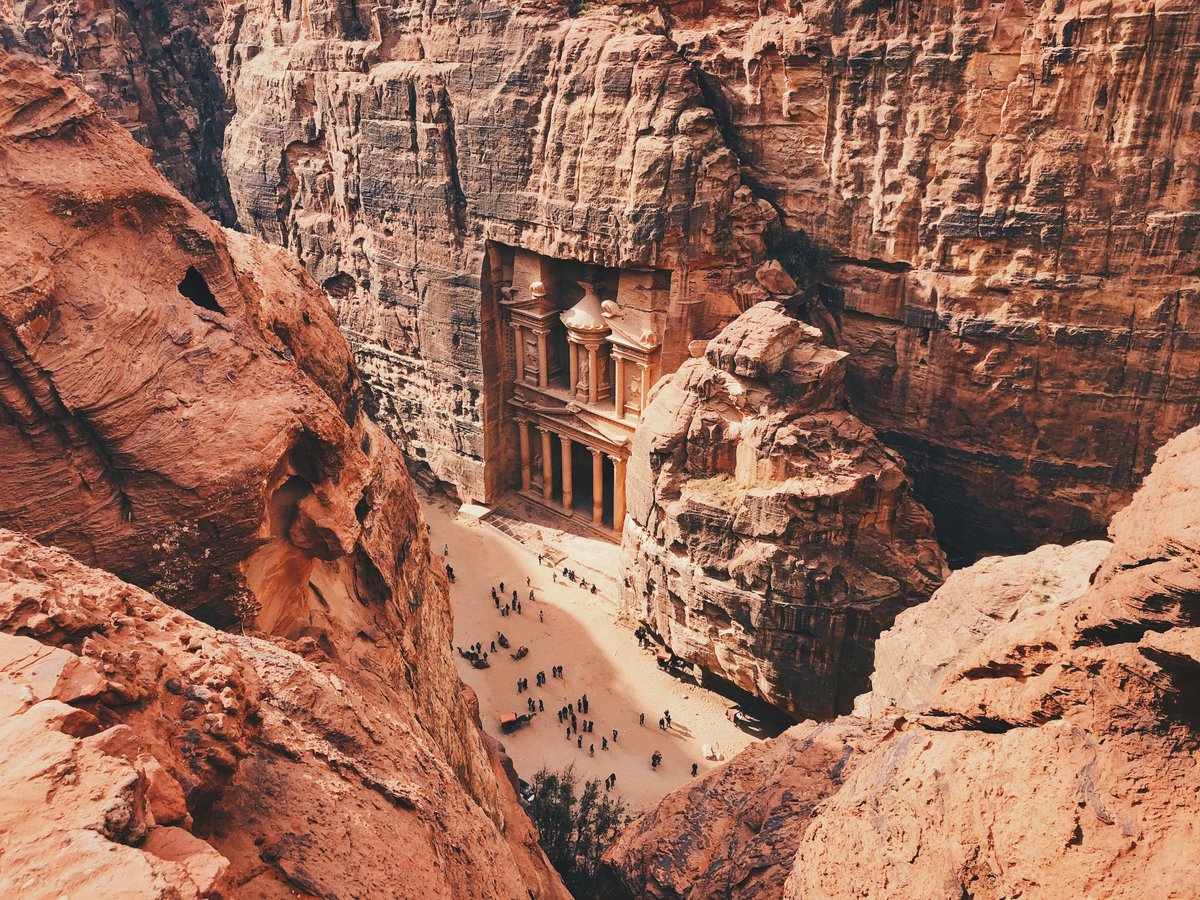
Petra sits at roughly 900 meters elevation in Jordan's Sharah Mountains, where the sandstone shifts from pale cream to deep rust depending on the hour and the angle. The town of Wadi Musa, the gateway settlement, clings to a hillside above the ancient Nabataean city. South toward Aqaba, the land drops into the Wadi Araba rift. North, the Dana Biosphere Reserve stretches across 320 square kilometers of terraced valleys. The terrain is dry, rocky, and scored by seasonal wadis that can flash-flood between November and March. You'll feel the altitude in the mornings, when temperatures in October and November might dip to 8 or 9 degrees Celsius before the sun clears the canyon walls. By midday in July, that same spot hits 36. The landscape tends to reward early risers and punish midday ambition. Most of the hiking here happens on ancient trade routes and goat paths through Nubian sandstone, which gives good grip when dry but becomes treacherous when wet. To be fair, the setting is less about manicured outdoor recreation and more about navigating a landscape that has been walked for 2,000 years with minimal alteration.
Outdoor activities
-
Horseback riding through the Siq approach
Local Bdoul Bedouin guides offer horse rides from the Petra Visitor Centre to the entrance of the Siq, a distance of about 800 meters along a wide gravel path. The ride is included in the Petra entry ticket, though a tip of 3 to 5 JD is expected. The horses know the route better than you do. Worth noting, the ride ends at the Siq entrance, not inside the narrow canyon itself. Mules and donkeys handle the steeper interior trails, but those are a separate negotiation. The path runs past the Djinn Blocks and the Obelisk Tomb, so you still see carved facades from the saddle.
- Difficulty
- Easy, suitable for beginners
- Duration
- 10 to 15 minutes one way
- Best season
- October through April, when horses and riders both cope better with the heat
-
Mountain biking from Wadi Musa to Little Petra
The road from Wadi Musa north to Siq al-Barid, known as Little Petra, covers about 9 kilometers on a paved but hilly road through dry scrubland. The elevation gain is moderate, maybe 150 meters of climbing in total. Traffic is light outside of tour bus hours, which tend to cluster between 9 and 11 in the morning. You'll pass through the village of Umm Sayhoun, where the Bdoul community was resettled in the 1980s. Bring your own bike or arrange rental through one of the adventure operators in Wadi Musa. The return trip is faster, with a net downhill trend.
- Difficulty
- Moderate, requires reasonable fitness and comfort on hilly roads
- Duration
- 1 to 2 hours round trip depending on stops
- Best season
- March through May and October through November
-
Canyoneering in Wadi Mujib
Wadi Mujib Nature Reserve sits about 130 kilometers north of Petra along the Dead Sea highway. The Siq Trail, the reserve's main wet canyon route, involves wading, scrambling, and swimming through a narrow gorge where the Mujib River has cut into basalt and sandstone. Water levels vary by season, and the trail closes from November through March due to flash flood risk. The Royal Society for the Conservation of Nature (RSCN) manages access and charges around 21 JD for entry. Expect cold water even in summer, as the canyon stays shaded most of the day. The current can be strong after rain upstream.
- Difficulty
- Moderate to strenuous, requires confidence in water and on wet rock
- Duration
- 3 to 4 hours for the Siq Trail route
- Best season
- April through October, with the trail officially open April 1 to October 31
-
Camel trekking in Wadi Rum
Wadi Rum Protected Area lies about 100 kilometers south of Petra, roughly a 1.5-hour drive. Bedouin-run camps offer camel treks ranging from 2-hour loops around Jebel Rum to full-day crossings of the desert floor. The sand here is fine and red, and the silence between the sandstone towers is genuinely disorienting after the tourist bustle of Petra. Overnight treks typically cost 50 to 80 JD per person, including a meal cooked in a zarb, an underground sand oven. The Protected Area entry fee is 5 JD, or free with a Jordan Pass.
- Difficulty
- Easy to moderate, more about endurance than technical skill
- Duration
- 2 hours to full day or overnight
- Best season
- October through April, summer daytime temperatures regularly exceed 40 degrees Celsius
-
Rock climbing at Wadi Rum
Wadi Rum has been a climbing destination since the 1980s, with routes established on Jebel Rum, Jebel Um Ishrin, and several of the smaller towers. The sandstone varies from solid to friable, so route selection matters. Established multi-pitch routes like the Sabbah's Route on Jebel Rum run 8 to 10 pitches at around French 4 to 5b. Local operators such as Bedouin Directions and Rum Stars provide guides and gear. Bolting is minimal on most classic routes, so trad gear is standard. The rock warms up fast in direct sun, which makes north-facing routes more comfortable from May onward.
- Difficulty
- Varies from French 3 scrambles to 6c sport and trad routes
- Duration
- Half day for single-pitch, full day for multi-pitch
- Best season
- October through April for multi-pitch, north-facing walls workable into May
-
Stargazing from the Petra hills
Light pollution around Wadi Musa is minimal compared to Amman, and Wadi Rum to the south has some of the darkest skies in the Middle East. From the hills above Wadi Musa, the Milky Way is clearly visible on moonless nights from about April through September. Several Wadi Rum camps run guided night-sky sessions with telescopes. In Petra itself, the Petra by Night event runs on Monday, Wednesday, and Thursday evenings, lighting the Treasury with 1,500 candles. That one is more atmosphere than astronomy, but the walk through the Siq after dark is worth the 17 JD ticket.
- Difficulty
- Easy
- Duration
- 1 to 3 hours
- Best season
- Year-round, with clearest skies from June through September
Day hikes
-
High Place of Sacrifice (Al-Madbah) trail
This route climbs from the main Petra valley floor near the Theatre up a carved staircase to a Nabataean altar platform at about 1,035 meters elevation. The ascent is roughly 200 meters of vertical gain over stepped rock. At the top, two 6-meter obelisks stand carved from the ridge itself. The descent via the Wadi Farasa route passes the Lion Fountain, the Garden Temple, and the Roman Soldier Tomb, all carved directly into the cliff face. That loop descent is more interesting than retracing your steps, though the footing on the Wadi Farasa side is rougher. Go early, before 9 a.m., when the altar platform is still in shade and the tour groups haven't arrived.
- Difficulty
- Moderate. Steep stone stairs, some exposed sections on the descent via Wadi Farasa
- Duration
- 2 to 3 hours for the loop including the Wadi Farasa descent
- Best season
- October through April, avoid midday in summer
-
Ad-Deir (Monastery) trail
The trail to Petra's Monastery climbs over 800 rock-cut steps from the basin floor near the museum. The Monastery facade stands 47 meters tall, larger than the Treasury, and the afternoon light on the western-facing stone is the best time for photographs. The steps are uneven and there is no railing, so decent footwear matters. Bedouin tea stalls operate at the top, selling sweet sage tea for about 1 to 2 JD. A further 15-minute scramble past the Monastery leads to a viewpoint over Wadi Araba, where you can see into the Negev on clear days. Mind you, the hike feels longer on the return than on the way up, because tired legs on stepped rock demand concentration.
- Difficulty
- Moderate to strenuous. The 800-plus steps are relentless but not technical
- Duration
- 2 to 4 hours round trip from the basin floor
- Best season
- March through May and October through November
-
Jabal Haroun (Aaron's Tomb)
The longest marked day hike from the Petra basin leads to Jabal Haroun at 1,350 meters, the highest point in the Petra area. The round trip covers roughly 8 kilometers from the Qasr al-Bint temple, with about 450 meters of elevation gain. A small white Ottoman-era shrine marks the traditional burial site of Aaron, the brother of Moses. The trail is exposed for most of its length, crossing open wadi beds and ridgelines with minimal shade. Carry at least 3 liters of water per person. The views from the summit take in Wadi Araba, the Dana plateau to the north, and the full spread of the Petra basin below. You need to start early, ideally by 7 a.m., to avoid the worst heat on the return.
- Difficulty
- Strenuous. Long, exposed, significant elevation gain with some route-finding on the upper slopes
- Duration
- 5 to 7 hours round trip
- Best season
- October through March, genuinely dangerous in summer heat
-
Al-Khubtha trail to Treasury viewpoint
This route climbs the Al-Khubtha ridge from near the Royal Tombs and leads to a ledge directly above the Treasury, looking straight down into the Siq opening. The trail is about 1 kilometer each way with a steep middle section. The view from the top is the reverse of the classic Siq reveal. You see the Treasury roof and the tourists below reduced to specks. The path is worn but not always obvious, and the final section involves some scrambling on smooth rock. A Bedouin family operates a small stall near the viewpoint with tea and trinkets. Best light for photography is morning, when the Treasury facade is sunlit.
- Difficulty
- Moderate. Short but steep, with some scrambling near the top
- Duration
- 1 to 2 hours round trip
- Best season
- Year-round, though summer mornings require a very early start
-
Dana to Feynan trail (from Dana Nature Reserve)
Starting from Dana village, about 50 kilometers north of Wadi Musa, this point-to-point trail drops roughly 1,000 meters over about 14 kilometers from the sandstone heights down through Wadi Dana to the copper-smelting site at Feynan. The RSCN manages the reserve and requires hikers to go with a guide, which can be arranged through the Dana Guest House for around 50 JD. The trail passes through four distinct bio-zones, from Mediterranean scrub at the top to arid Saharan conditions at the bottom. Feynan Ecolodge at the endpoint runs on solar power and candles, with no grid electricity. You can arrange a pickup from Feynan or stay the night. The descent is hard on the knees, with loose scree in the lower wadi.
- Difficulty
- Strenuous. A 1,000-meter descent over 14 kilometers on uneven terrain, guide required
- Duration
- 5 to 7 hours one way
- Best season
- March through May and October through November, closed or restricted in summer
Water activities
-
Snorkeling and diving in Aqaba
The Red Sea port of Aqaba lies about 130 kilometers south of Petra, roughly a 2-hour drive down the Wadi Araba highway. Jordan's coastline on the Gulf of Aqaba is only 27 kilometers long, but the coral reefs are still in reasonable shape compared to much of the northern Red Sea. The South Beach area and the Aqaba Marine Park have accessible reef within 20 to 50 meters of shore. Water temperatures range from about 21 degrees in February to 28 in August. A half-day dive with local operators such as Ahlan Aqaba or Seastar Watersports runs around 45 to 65 JD for two tank dives with equipment. The Japanese Garden and Cedar Pride wreck are two of the more popular dive sites. Visibility tends to reach 15 to 25 meters in calm conditions.
- Difficulty
- Easy for snorkeling, certification required for diving
- Duration
- Half day to full day from Petra including transport
- Best season
- Year-round, warmest water June through October
-
Dead Sea floating
The Dead Sea shore is about 180 kilometers north of Petra, around a 2.5-hour drive. At roughly 430 meters below sea level, it is the lowest point on Earth's surface. The salt concentration of about 34 percent makes sinking physically difficult, though the sensation is less relaxing and more disorienting than people expect. The water stings any cut or scrape, and you absolutely cannot get it in your eyes without significant pain. Public beach access points exist at Amman Beach, which charges about 20 JD entry, or the free beaches further south near Sowayma. The mud along the shore is sold in Amman pharmacies for 10 times what it costs to scoop it yourself. Water levels have been dropping about 1 meter per year, and the shoreline has retreated noticeably since the early 2000s.
- Difficulty
- Easy, though the salt concentration demands caution with eyes and open wounds
- Duration
- Full day trip from Petra including 5 hours of driving
- Best season
- March through May and September through November, summer air temperatures at the Dead Sea regularly exceed 40 degrees
-
Wadi Mujib Siq Trail (wet canyon)
The Siq Trail at Wadi Mujib Nature Reserve involves walking, wading, and at points swimming upstream through a narrow basalt canyon with the river flowing against you. The water depth varies from ankle-deep to chest-deep depending on recent rainfall and the season. The reserve is managed by the RSCN and entry costs about 21 JD. Life jackets are provided and required. The canyon walls rise 50 to 80 meters on either side, and in the narrowest sections you're moving through a gap maybe 2 meters wide with the current pushing against your legs. This is the closest thing to proper adventure water activity within day-trip range of Petra. The reserve closes November through March due to flash flood danger, and even in open season they will shut the trail after upstream rain.
- Difficulty
- Moderate to strenuous, requires comfort in moving water and on slippery rock
- Duration
- 3 to 4 hours for the trail, plus 2.5 hours driving from Petra
- Best season
- April through October, with April and May offering the strongest water flow
-
Thermal springs at Hammamat Ma'in
The Ma'in Hot Springs sit about 160 kilometers north of Petra, near the Dead Sea. Natural thermal water, heated by underground volcanic activity, falls over a series of cascades at temperatures between 40 and 63 degrees Celsius. The public pools at the base of the waterfall area are accessible for about 15 to 20 JD. The Ma'in Hot Springs Resort operates a private section with developed pools and spa facilities. The mineral content is high in sulfur, which you'll smell before you see the water. It tends to be crowded on Fridays, the Jordanian weekend. The road down to Ma'in from the plateau involves a steep descent with tight switchbacks, worth knowing if you're driving a rental.
- Difficulty
- Easy, no physical exertion required
- Duration
- Half day from Petra including 3 to 4 hours of driving
- Best season
- November through March, when the hot water feels welcome rather than excessive
Parks & gardens
-
Ain Musa (Spring of Moses)
FreeA small spring site on the eastern edge of Wadi Musa, marked by three stone domes built over the water source. Local tradition associates it with the spring that Moses struck from the rock, though geologists have a less dramatic explanation involving the local aquifer. The area around the spring has some planted trees and a modest garden. It is more of a historical curiosity than a park, but the water still flows and the shade is welcome after a morning in the Petra site. You'll find it along the main road into town, near the older residential quarter.
Highlights: Three Ottoman-era stone domes over the spring, mature olive and fig trees, views east toward Wadi Araba
-
The Petra Garden (inside Petra Archaeological Park)
Archaeologists from Brown University excavated a large Nabataean garden complex between the Great Temple and the Colonnaded Street, revealing what appears to have been a 2,000-year-old ornamental garden with an island pavilion, open-air pool, and terraced planting beds. The site is still partially excavated, and you can see the outlines of the ancient irrigation channels cut into the bedrock. It currently sits open to the air without fencing, so you walk through it on the main path between the theatre and the Colonnaded Street. The contrast between this deliberate green space and the surrounding desert terrain says something about Nabataean engineering ambition.
Highlights: Excavated Nabataean pool structure, visible ancient irrigation channels, interpretive panels from the Brown University dig
-
Wadi Musa town gardens and viewpoints
FreeWadi Musa is a small town, and it lacks a formal municipal park in the Western sense. That said, the hillside terraces along the main road have olive groves and scattered community garden plots, particularly in the older neighborhoods above the Visitor Centre. The rooftop terraces of several budget hotels double as informal gardens with jasmine and bougainvillea. For the best vantage point, the area around the Crowne Plaza hotel at the upper end of town offers a wide view west over the valley toward the Sharah range. The sunset from here tends to be better than the one from inside the site, where the canyon walls block the low sun early.
Highlights: Hillside olive terraces, sunset viewpoint near the upper town, seasonal wildflowers on the slopes in March and April
Practical tips
- Footwear and gear
- Hiking boots with ankle support are non-negotiable for Petra's trails. The rock-cut steps are smooth and uneven, and the sandstone becomes slick when wet. Trail running shoes work for the main basin paths but not for the High Place descent via Wadi Farasa or the Jabal Haroun route. Trekking poles help on the Ad-Deir steps and the Dana-Feynan descent. A 20-liter daypack, headlamp, and basic first aid kit cover most situations. For Wadi Mujib, bring shoes you don't mind getting soaked, old trainers or water sandals with heel straps.
- Sun protection and heat management
- UV exposure in southern Jordan is intense year-round, with the elevation at Petra adding to the burn risk. Wear SPF 50 sunscreen and reapply every 2 hours, more often if you're sweating. A wide-brimmed hat and lightweight long sleeves will do more than sunscreen alone. In summer months from June through August, start hiking by 6 or 7 a.m. and plan to be back in shade by noon. Heatstroke is a real risk on the Jabal Haroun and Dana-Feynan trails, where shade is minimal and rescue access is slow.
- Water and hydration
- Carry a minimum of 2 liters per person for a half-day in the Petra basin, 3 liters for longer routes like Jabal Haroun or Ad-Deir. The Bedouin tea stalls inside Petra sell bottled water for 1 to 2 JD, which is a useful backup but not a primary water plan. Tap water in Wadi Musa hotels is generally safe but tastes mineral-heavy. Buy large bottles from the supermarkets on the main road for around 0.35 JD per 1.5 liters. For the Dana-Feynan hike, your guide will advise on water quantity, but 3 liters per person is a reasonable baseline.
- Trail conditions and flash flood risk
- Many of Petra's trails are ancient routes without modern markings or railings. The Al-Khubtha and High Place trails have exposed sections with significant drops. After rain, avoid the Siq and any narrow wadi, as flash floods can arrive with little warning even when the rain falls kilometers upstream. In December 2022, the Petra site was closed due to flash flooding. Check conditions at the Visitor Centre each morning during winter months. Wadi Muthlim, the alternative entrance route, is closed whenever there is any rainfall forecast.
- Petra entry tickets and timing
- A 1-day Petra ticket costs 50 JD, 2-day is 55 JD, and 3-day is 60 JD. The Jordan Pass, starting at 70 JD, includes Petra entry and the Jordan visa fee, which makes it better value for most visitors. The site opens at 6 a.m. in summer and 6:30 a.m. in winter. Gates close at 6 p.m. in summer and 4 p.m. in winter, though you won't be forced out immediately. The first 2 hours after opening are the quietest, with tour groups typically arriving between 9 and 10 a.m. Hire a licensed local guide at the Visitor Centre for about 50 JD for a half-day if you want route context and historical narrative.
- Seasonal planning
- The sweet spot for outdoor activity around Petra is October through November and March through May. Daytime highs in these windows sit around 20 to 28 degrees Celsius. December through February brings cooler temperatures, sometimes dropping to near freezing at night, with occasional rain and rare snow. Summer from June through August sees daytime highs of 33 to 38 degrees, which limits hiking to early mornings. Ramadan dates shift annually and can affect restaurant hours and local guide availability, so check the calendar before booking.
FAQ
How many days do I need for outdoor activities around Petra?
Two full days inside the Petra archaeological site covers the main trails, including the Treasury, High Place of Sacrifice loop, and the Monastery. A third day lets you attempt Jabal Haroun or explore Little Petra. Adding Wadi Rum, Wadi Mujib, or Aqaba requires at least one additional day each. A week in the region gives you time for the Dana-Feynan hike as well. Most visitors end up wishing they had booked one more day than they did.
Can I hike Petra's trails without a guide?
The main trails inside the Petra basin, including the Siq, Treasury, High Place of Sacrifice, Monastery, and Al-Khubtha viewpoint, are all hikeable without a guide. They are not always well-marked, but foot traffic and the terrain generally keep you on track. For Jabal Haroun, a guide is recommended because the upper route is not always obvious. The Dana-Feynan trail requires an RSCN guide by regulation. Inside Petra, local Bedouin guides offer their services along the trails and tend to know shortcuts and viewpoints that are not on standard maps.
Is Petra safe for solo hikers?
The main Petra site is well-trafficked during opening hours and solo hiking on the primary trails is common. For longer routes like Jabal Haroun or Wadi Muthlim, solo hiking carries more risk due to isolation, heat exposure, and flash flood potential. Tell your hotel your planned route and expected return time. Mobile phone reception is patchy inside the canyons but generally available on the ridgelines. The Petra site has a small medical clinic near the museum area, and tourist police patrol the main trails.
What is the best time of day to start hiking in Petra?
Enter at opening, 6 a.m. in summer and 6:30 a.m. in winter. The Siq is cool and shaded in early morning, and you'll reach the Treasury before the first tour buses unload. The High Place of Sacrifice trail is best done first thing, when the altar platform is still in shadow. For the Monastery, afternoon light on the west-facing facade is better for photographs, so some hikers save it for after lunch. In summer months, plan to be back in Wadi Musa or in shade by 1 p.m.
Do I need special permits for any hikes near Petra?
All trails inside the Petra Archaeological Park are covered by the standard entry ticket, with no additional permits needed. Dana Biosphere Reserve charges a separate entry fee of about 10 JD and requires a guide for the Dana-Feynan trail. Wadi Mujib Nature Reserve charges about 21 JD. Wadi Rum Protected Area charges 5 JD entry, or it is free with a Jordan Pass. No trails in the area currently require advance booking, though Dana and Wadi Mujib guides should be arranged at least a day ahead during peak season in October and April.
Where can I refill water bottles inside the Petra site?
There are no public water fountains inside the Petra site as of 2024. Bedouin stalls along the main basin path and near the Monastery sell bottled water for 1 to 2 JD per bottle. The Basin Restaurant, located near the Colonnaded Street about 2 kilometers from the entrance, has tap water and sold drinks. Your most reliable plan is to carry enough water from Wadi Musa and treat the stalls as a backup. The Visitor Centre at the entrance has a small shop with water and snacks at lower prices than inside the site.
Last verified by automated review (v1.7.2) on . What is automated review?