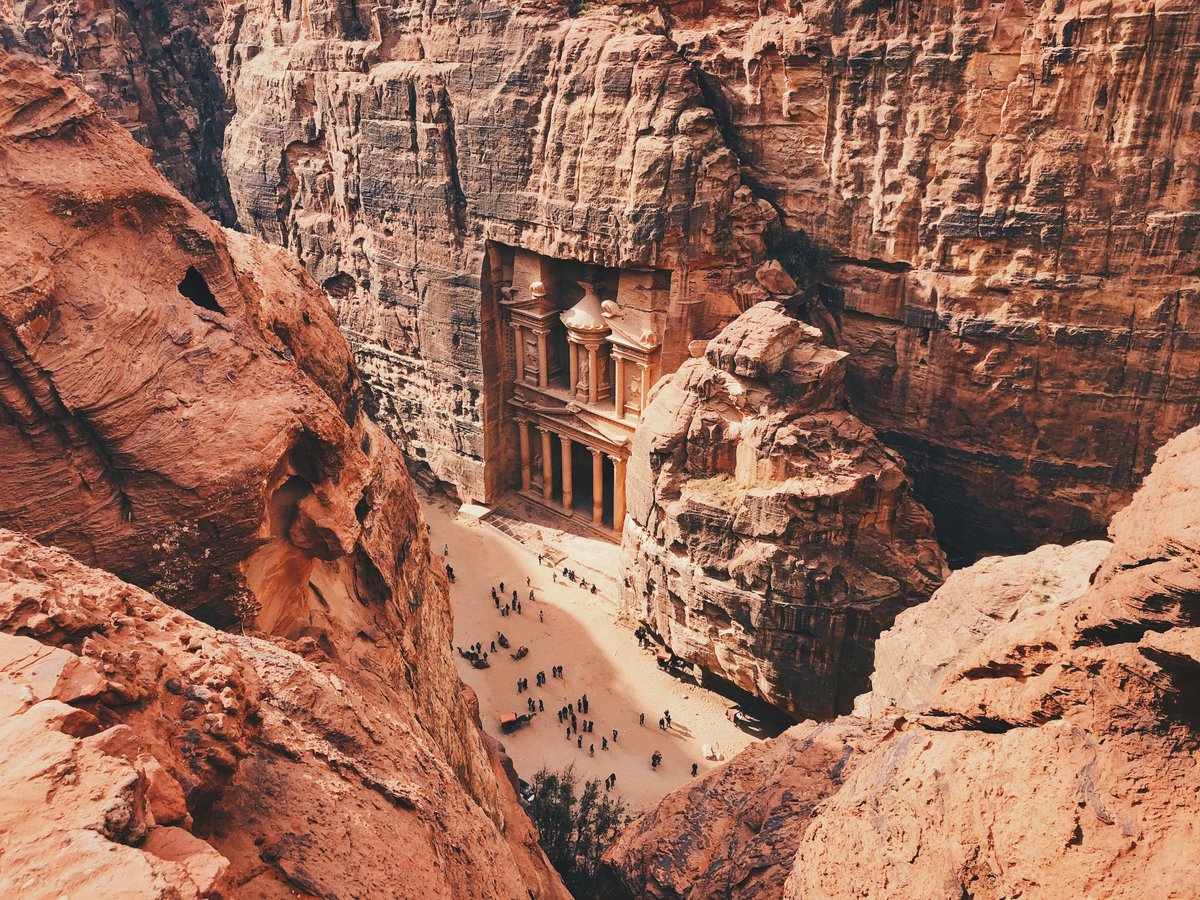
Petra doesn't exist as a standalone city. The town you'll sleep in is Wadi Musa, a settlement of around 35,000 people that stretches along a single main road descending roughly 200 meters in elevation toward the Petra Visitor Centre at its lowest point. Think of it as a 3-kilometer ribbon of concrete and sandstone draped over a hillside. Upper Wadi Musa sits near the old Moses' Spring shrine at about 1,200 meters above sea level. The middle section holds the commercial core. The lower end clusters around the Petra gate, where the Mövenpick Resort and the Petra Guest House sit within a 2-minute walk of the ticket office. A second settlement, Umm Sayhoun, lies over the ridge to the north, closer to Little Petra. The whole thing is compact enough that a taxi from the top of town to the Petra entrance runs about 3 JD and takes 5 minutes. Most visitors never leave the lower third of the main road, which is a shame, because the upper town is where Wadi Musa still feels like a Jordanian hill town rather than a tourism corridor.
Neighborhoods
-
Lower Wadi Musa / Petra Gate
This is the 200-meter radius around the Petra Visitor Centre, and it feels like it. Hotels here tend toward 4 and 5 stars, souvenir shops line both sides of Tourism Street, and the foot traffic is almost entirely visitors in hiking boots. The architecture is newer, blockier, built for capacity rather than character. Still, the sheer convenience is hard to argue with. You roll out of bed at the Mövenpick and you're scanning your ticket 90 seconds later. The Petra Guest House, originally a government rest house from the 1960s, sits on the opposite side of the entrance road. At night the area gets quiet fast. By 9pm most restaurants have thinned out and the street feels oddly empty for a place that was shoulder-to-shoulder at 7am.
- Best for
- Visitors with limited mobility, anyone doing a single full day at Petra who wants to maximize time inside the site, families with young children who need the shortest possible walk back to a hotel
- Key streets
- Tourism Street runs the final 300 meters downhill to the Visitor Centre. The Mövenpick sits on the left as you face the gate, Petra Guest House on the right. A small cluster of restaurants and shops lines the road on both sides, including the Silk Road Restaurant about 150 meters uphill from the entrance.
-
Central Wadi Musa
The commercial spine of the town, roughly 1 kilometer uphill from the Petra entrance. This is where locals shop. You'll find the post office, a branch of the Housing Bank, a handful of phone shops, the Al-Arabi Restaurant, and grocery stores selling water and trail snacks at roughly half the price of the tourist shops near the gate. Buildings here are 3 to 5 stories of pale limestone-clad concrete, tight together, with ground-floor shops and residences above. The pace is slower than the lower gate area during tourist season, but there's more genuine street life. Men sit outside small cafes drinking tea well into the evening. You'll hear Arabic pop music from passing cars rather than the multilingual chatter of tour groups. Budget and mid-range hotels cluster here, including places like the Cleopetra Hotel, which sits at a bend in the main road with decent views west toward the valley.
- Best for
- Budget-conscious travelers staying 2 or more nights, anyone who prefers a less tourist-oriented atmosphere, solo travelers looking for cheaper restaurants where locals eat
- Key streets
- The main road through town (sometimes called King's Highway or simply the Wadi Musa main street) is the central artery. The commercial strip runs for about 500 meters through this section. A small roundabout near the mosque marks the rough center. Side streets branch off steeply uphill to residential areas.
-
Upper Wadi Musa / Ain Musa
The highest part of town, where the road from the Desert Highway first enters Wadi Musa. This is where the bus station sits, handling JETT and minibus connections to Amman (about 3.5 hours) and Aqaba (about 2 hours). The area around Ain Musa, the small domed shrine marking the spring where Moses supposedly struck the rock, still has an older feel. A few Ottoman-era stone buildings survive between newer construction. The streets are steeper here, and in winter the temperature can drop noticeably below the lower town. Fewer tourists wander up this far, and the accommodation options tend toward simple guesthouses and budget rooms. The views west from the upper road, looking out over the Wadi Araba valley toward the distant Negev, are better than anything you'll see from the lower town.
- Best for
- Backpackers, travelers arriving late by bus who want to sleep near the station, anyone who values quiet and doesn't mind a 15-minute downhill walk or a 3 JD taxi to the Petra gate each morning
- Key streets
- The main road enters from the east near the bus station. Ain Musa sits in a small enclosed area about 200 meters south along the road. The residential streets branching uphill from here are narrow and steep, some still unpaved at the edges.
-
Umm Sayhoun
A separate settlement about 7 kilometers north of Wadi Musa's center, originally built in the 1980s to rehouse the Bdoul Bedouin tribe who had been living inside the Petra archaeological site itself. The village sits on the ridge above Petra, and some residents still run the tea stands and souvenir stalls inside the site near the Monastery and the High Place of Sacrifice. The architecture is modest, mostly low government-built houses with some newer additions. A few guesthouses have opened in recent years, catering to travelers who want proximity to Little Petra (Siq al-Barid), which lies about 3 kilometers further north. The area is quieter and more remote than Wadi Musa proper. The feeling is distinctly rural. Goats wander between houses. The sound of wind is more prominent than traffic.
- Best for
- Travelers visiting Little Petra, hikers planning the back-trail approach into Petra via the Monastery trail, anyone seeking a genuinely local Bedouin-community experience rather than a hotel zone
- Key streets
- The single access road connects Umm Sayhoun to the main highway. A dirt track continues north toward Siq al-Barid (Little Petra). The village itself has a small central area with a few shops, but no real commercial strip to speak of.
-
Taybeh
A small agricultural village about 8 kilometers south of Wadi Musa, Taybeh sits lower in the valley and feels distinctly separate from the Petra tourism economy. Olive groves and small terraced plots surround the settlement. A handful of eco-lodges and community-tourism projects have appeared here in recent years, partly supported by NGO funding. The pace is genuinely slow. You might see a tractor on the road more often than a tourist bus. The Dana Nature Reserve lies further south along the King's Highway, and some travelers use Taybeh as a base for exploring both Petra and Dana without relocating. The architecture is older village stone in the core, with newer concrete additions at the edges.
- Best for
- Travelers with a rental car who want a base between Petra and Dana Nature Reserve, visitors interested in agricultural tourism and community projects, anyone who finds Wadi Musa's tourist infrastructure off-putting
- Key streets
- The village has one main road connecting it to the King's Highway. A few unpaved tracks lead to olive groves and viewpoints over Wadi Araba. There is no street-grid or commercial area in any conventional sense.
FAQ
Is it worth staying more than one night near Petra?
Two nights is the practical minimum if you want to see both the main Petra site and Little Petra without exhausting yourself. A single day inside Petra typically covers the Siq, the Treasury, the Street of Facades, and the Royal Tombs, but the Monastery (Ad Deir) adds a steep 800-step climb that takes 45 minutes each way. Most people who try to do everything in one day end up skipping the Monastery or dragging themselves through it at 4pm on destroyed legs. A second day lets you start early for the High Place of Sacrifice trail or explore the less-visited Wadi Farasa route. Petra by Night, held on Monday, Wednesday, and Thursday evenings, is another reason to have a second night. It starts at 8:30pm and costs 17 JD.
Should I stay near the Petra gate or further up in Wadi Musa?
Staying near the gate (lower Wadi Musa) saves you a 15-to-20-minute walk or a 3 JD taxi each morning, and that matters more than you'd think after 8 hours of walking inside the site. That said, hotels near the gate charge a significant premium. A room at the Mövenpick currently runs 150-250 JD per night depending on season, while comparable comfort in central Wadi Musa might cost 40-70 JD. If you're staying 3 or more nights and have a reasonable fitness level, the savings from a mid-town hotel easily cover daily taxis both ways with money left over for better meals.
How do I get from Wadi Musa to Little Petra (Siq al-Barid)?
Little Petra is about 9 kilometers north of central Wadi Musa. There is no public bus service on that route. A taxi costs 7-10 JD one way, and drivers will usually wait for you if you negotiate a round trip (expect 15-20 JD with 1 to 2 hours of waiting time). Some hotels arrange shared transport for groups of 4 or more, which brings the per-person cost down to about 3-5 JD. If you have a rental car, the road is paved and well-signed. The site itself is free to enter and rarely crowded before 10am. Budget about 1 to 2 hours for the visit.
What is the best time of year to visit Petra?
March through May and September through November are the most comfortable months, with daytime temperatures around 20-25°C. Summer (June to August) regularly hits 35°C and the exposed rock inside the site radiates heat back at you, making midday walks genuinely unpleasant. December through February can be cold, especially at Wadi Musa's elevation of 1,000-plus meters. Nighttime temperatures drop to 2-5°C in January, and occasional snowfall is not unheard of. Spring wildflowers appear inside the site in late March and early April, which adds something the autumn months don't have. Peak tourist season aligns roughly with European school holidays in April, October, and late December.
Are there ATMs and pharmacies in Wadi Musa?
Central Wadi Musa has 3 or 4 ATMs along the main road, including branches of Arab Bank and Housing Bank for Trade and Finance. They accept Visa and Mastercard. Pharmacies are clustered in the same central stretch, typically open until 9 or 10pm. The lower tourist area near the Petra gate has fewer services of this kind. Stock up on any medications or cash in the central part of town rather than assuming you'll find what you need near your hotel if you're staying in the gate area or in Umm Sayhoun.
Last verified by automated review (v1.7.2) on . What is automated review?