Stay in Petra in October
52 hotels in the Trip.com pool for Petra, from US$10 a night.
Opens Trip.com on Fri 1 Oct to Sun 3 Oct 2027; change the dates there.
October is when Petra becomes walkable again. The summer heat that pushes daytime temperatures past 33°C (91°F) in August has finally eased, and you'll find highs around 25°C (78°F) with lows near 17°C (62°F). The air in the Siq feels almost cool in early morning, carrying the mineral smell of sandstone that's been baking for four months. This is likely the single best weather window alongside April, and tour operators know it.
The trade-off is crowds. October marks the start of Petra's high season, and the trail from the Visitor Centre to Al-Khazneh fills noticeably after 9am. Group tours from Amman and Aqaba arrive in waves between 10am and noon. That said, the site covers 264 square kilometres, and most visitors never leave the main Treasury-to-Basin corridor. Head toward Ad-Deir or the High Place of Sacrifice trail and you might have entire stretches of carved rock to yourself.
Rainfall sits at roughly 4mm for the whole month, spread across maybe 2 days. Humidity holds around 52%, which feels dry compared to coastal Aqaba. The light in October has a particular quality in Wadi Musa. Late afternoon turns the sandstone facades from salmon pink to deep copper, and the shadows in the Royal Tombs grow long enough to photograph the interiors without a flash. Worth noting, this is also when the Bedouin families in Umm Sayhoun start their olive harvest, and you'll occasionally catch the grassy scent of fresh-pressed oil drifting across the plateau.
Why visit in October
- Daytime temperatures around 25°C (78°F) make the 8km walk to the Monastery trail comfortable rather than punishing, with mornings in the Siq dropping to a pleasant 17-18°C.
- Rainfall averages only 4mm across 2 days in October, giving you near-certain dry conditions for the exposed High Place of Sacrifice climb and the scramble to the Monastery viewpoint.
- The low-angle October sun lights up the sandstone facades of the Royal Tombs and Al-Khazneh with deeper colour than the harsh overhead summer light, and the golden hour starts around 4:30pm.
- Little Petra (Siq al-Barid), 9km north of the main site, tends to be quieter than the main basin even in high season, and the 20-minute Painted House trail is especially pleasant in mild October air.
- The olive harvest begins across the Dana Nature Reserve and the hills around Taybeh village in October, adding a cultural layer to the landscape that you won't see in spring.
Worth knowing
- High-season pricing kicks in hard. Expect to pay 30-50% more for hotels in Wadi Musa compared to June or July rates, and the better properties along Tourism Street fill weeks in advance.
- The main Treasury trail between 10am and 2pm can feel congested with large tour groups arriving from Aqaba cruise ships and Amman day trips. The Siq narrows to 2 metres in places, and passing a 40-person group in that slot is slow going.
- Petra by Night sells out more frequently in October than in quieter months, and the Monday-Wednesday-Thursday schedule means you need to plan around specific nights.
- Flash flood risk, while statistically low with only 4mm of rain, remains a genuine safety concern in the Siq. Jordan's RSCN occasionally closes the canyon entrance after upstream rainfall that never reaches Wadi Musa itself.
Best for
Think twice if
October in Petra feels like a perfect autumn day in a dry mountain climate. Mornings start cool enough for a light layer at 16.9°C (62°F), warming to a comfortable 25.4°C (78°F) by early afternoon. Humidity sits around 52%, which feels noticeably drier than coastal cities. Rainfall is minimal at 4mm across roughly 2 days, typically arriving as brief afternoon showers that dry within an hour on the sandstone. The wind picks up occasionally in the exposed areas above the basin, especially on the Monastery trail and the High Place of Sacrifice plateau. Evenings cool quickly after sunset, and by 8pm you'll want a jacket if you're attending Petra by Night.
Seasonal caution
- Flash floods in the Siq remain possible even with October's low 4mm average rainfall. The Siq drains a large upstream catchment, and rain falling kilometres away in the hills above Wadi Musa can send a wall of water through the 1.2km canyon with little warning. The Petra Development and Tourism Region Authority (PDTRA) closes the Siq entrance when upstream sensors detect rising water levels. Check with your hotel or the Visitor Centre each morning.
Year-round climate
Averages from the last 5 years.
| Month | Avg high (°C) | Avg low (°C) | Rainfall (mm) |
|---|---|---|---|
| Jan | 14 | 7 | 33 |
| Feb | 14 | 6 | 41 |
| Mar | 18 | 9 | 37 |
| Apr | 25 | 14 | 11 |
| May | 28 | 17 | 6 |
| Jun | 31 | 21 | 0 |
| Jul | 32 | 22 | 0 |
| Aug | 33 | 23 | 0 |
| Sep | 30 | 20 | 1 |
| Oct | 25 | 17 | 4 |
| Nov | 21 | 14 | 20 |
| Dec | 16 | 9 | 35 |
Best things to do in October
Hike the Ad-Deir (Monastery) trail at dawn
hikingThe 850-step climb from the basin to Ad-Deir gains roughly 200 metres of elevation over 2.5km. The Monastery facade stands 47 metres tall, larger than the Treasury, and in October's morning light the sandstone glows orange-gold. You'll pass Nabataean rock-cut tombs and a small Bedouin tea stall halfway up. The viewpoint beyond the Monastery looks west toward Wadi Araba and, on clear October mornings, across to the Negev.
October's 25°C highs make this steep climb feasible without the heat exhaustion risk of summer. In August, this trail is dangerous after 9am.Booking tipNo booking needed. Enter the site at 6am when the gates open and head directly to the Monastery trail to avoid the tour groups that arrive at the basin by 10am.
Petra by Night at Al-Khazneh
culturalThe walk through the Siq by candlelight takes about 25 minutes, with 1,500 paper bag luminarias lining the canyon floor. The experience ends in front of the Treasury, lit by hundreds of candles, with a Bedouin musician playing the rababa (a single-stringed instrument). The sound echoes off the canyon walls. The whole event runs about 2 hours, starting at 8:30pm.
October nights around 17°C are comfortable for sitting on the ground in front of the Treasury for 45 minutes. In winter, the cold sandstone is genuinely unpleasant. In summer, you're still sweating at 9pm.Booking tipRuns Monday, Wednesday, and Thursday only. Tickets sell out in October. Book through your hotel or the Visitor Centre at least 3-4 days ahead. The price is 17 JD on top of your daytime entry ticket.
Scramble to the High Place of Sacrifice (Al-Madbah)
hikingThis alternative trail branches off the main Siq-to-Treasury path and climbs steeply to a Nabataean sacrificial platform at 1,035 metres elevation. The carved altar channels and offering basins are still visible in the rock. The 360-degree view from the top takes in the Treasury below, the Wadi Araba valley, and the Royal Tombs across the basin. The descent via Wadi Farasa passes the Lion Fountain and the Garden Tomb.
The exposed summit has no shade. In summer, the rock surface temperature can exceed 50°C. October's 25°C air temperature and lower sun angle make the 45-minute climb and the time spent at the top safe and comfortable.Booking tipNo booking required. Start by 7am to have the summit to yourself. The round trip via Wadi Farasa takes 2.5-3 hours.
Explore Little Petra (Siq al-Barid)
sightseeingThis smaller Nabataean site 9km north of the main entrance was likely a trading suburb and caravan stop. The short siq opens into a series of carved dining halls (triclinia) with painted ceiling frescoes from the 1st century AD. The Painted House, with its vine scrolls and cupids still visible on the ceiling, is the highlight. The whole site takes 1-2 hours and has no entry fee.
October light penetrates deeper into the narrow siq than summer's overhead sun, making the Painted House frescoes easier to see and photograph without artificial light. The site also serves as a good warm-up or cool-down day between intensive Petra days.Booking tipFree entry, no booking needed. Go in early morning when tour buses haven't arrived. Combine with a visit to the nearby Neolithic village of Al-Beidha, a 10-minute walk north.
Walk the Colonnaded Street to Qasr al-Bint
sightseeingThe main Roman-era street runs 600 metres from the theatre district to Qasr al-Bint, the only freestanding structure in Petra that wasn't carved from rock. The Nabataeans built this temple around 30 BC, and its 23-metre walls are still standing. The walk passes the Great Temple excavation, the Byzantine Church with its 6th-century mosaic floors, and the Temple of the Winged Lions.
October's moderate heat lets you spend time examining the Great Temple's excavated columns and the Byzantine Church mosaics without rushing for shade. The afternoon light on Qasr al-Bint's south face is particularly warm in October, when the sun sits lower than in summer months.Booking tipIncluded in the general Petra entry ticket. The Byzantine Church mosaics are covered by a protective shelter. Visit between 2pm and 4pm when most groups have headed back toward the Treasury.
Photograph the Royal Tombs at golden hour
photographyThe cluster of monumental facades carved into Jabal al-Khubtha, including the Urn Tomb, the Silk Tomb, the Corinthian Tomb, and the Palace Tomb, faces west. In October, the late afternoon sun hits these facades directly between 3:30pm and 5pm, turning them from pale sandstone to deep rose-gold. The Urn Tomb's interior, later converted into a Byzantine church in 446 AD, has a 17-metre-high vaulted ceiling that catches the last light.
October's sun angle creates longer, more dramatic shadows across the carved details than the near-vertical summer sun. The air tends to be clearer than spring, when occasional dust from the Wadi Araba can soften the light.Booking tipNo booking needed. Reach the Royal Tombs area by 3pm to secure a position on the rocks opposite. The climb up to the Urn Tomb takes 10 minutes via rock-cut stairs.
Day trip to Dana Nature Reserve
natureDana sits 50km north of Wadi Musa along the King's Highway and drops from 1,500 metres on the plateau rim to below sea level in Wadi Araba. The reserve covers 308 square kilometres of sandstone canyons and dry forest. The Rummana campsite trail (2.5 hours, 8km) passes through juniper woodland and offers views across the rift valley. The old stone village of Dana, perched on the canyon edge, has a small guesthouse run by the Royal Society for the Conservation of Nature (RSCN).
October marks the start of Dana's hiking season after the summer closure of several trails. The ibex and rock hyrax are more active in cooler weather, and the Rummana trail typically reopens in early October.Booking tipBook the RSCN guesthouse or campsite at least a week ahead in October. The Wadi Dana trail (14km, full day) requires a guide, bookable through the RSCN.
What to eat in October
In season: fruit
Rumman (pomegranate)
October is peak pomegranate season across Jordan's Rift Valley and the hills around Taybeh. You'll find them at roadside stalls along the King's Highway, split open to show the deep crimson seeds. Fresh-squeezed pomegranate juice appears at vendors near the Petra Visitor Centre for 1-2 JD a glass. The fruit tends to be sweeter and less tannic than what you'd find in supermarkets outside the region.
On menus now
Zarb (Bedouin underground barbecue)
October's cooler evenings make this the ideal month for zarb, where lamb, chicken, rice, and root vegetables slow-cook for 3-4 hours in a sand-covered underground pit. Several camps in Wadi Musa and along the road to Little Petra prepare it for groups. The meat takes on a smoky, tender quality from the sealed heat, and the rice absorbs the rendered fat. The experience is partly the meal, partly watching the Bedouin cook unearth the buried pot at sunset.
Mansaf
Jordan's national dish of lamb cooked in fermented dried yoghurt (jameed) over rice is served year-round, but the cooler October temperatures make the rich, tangy broth more appealing. The jameed gives the sauce a sour, almost cheese-like depth. Restaurants in Wadi Musa typically serve it as a Friday lunch special, and portions tend to be generous enough for two.
What to drink
Maramiyyeh (wild sage tea)
The sage that grows across the sandstone hills around Petra is at its most aromatic in early autumn. Bedouin tea stalls inside the site, particularly near the Basin area and along the trail to Ad-Deir, brew it fresh. The flavour is sharper and more resinous than dried sage, with a slightly camphor-like warmth that pairs with the cooler October evenings.
In markets
Zeitoun makhlouta (fresh-pressed olive oil with za'atar)
The olive harvest begins across southern Jordan in October, and freshly pressed oil from the first pressing has a peppery, almost grassy bite that fades within weeks. Dip warm bread into a plate of new-season oil mixed with za'atar and you'll understand why Jordanians treat the first press as a seasonal event. Restaurants in Wadi Musa sometimes note the new oil on their menus.
Regular events in October
Petra by Night
Candlelit walk through the Siq to Al-Khazneh, with Bedouin music and tea. Runs year-round but October's comfortable 17°C evenings make it one of the best months to attend. Held Monday, Wednesday, and Thursday at 8:30pm. Costs 17 JD per person.
Every Monday, Wednesday, and Thursday throughout OctoberQitaf al-Zaytoun (olive harvest season)Free
The annual olive harvest begins across southern Jordan in October. Villages near Petra, particularly Taybeh and the settlements along the King's Highway, hold community pressing days. Some guesthouses in the Wadi Musa area arrange visits to local presses where you can watch the first cold-press and taste the new season's oil.
Mid-October through NovemberJordan Trail autumn season openingFree
The 650km Jordan Trail from Um Qais to Aqaba reopens its southern sections for guided and self-guided trekking in October after the summer heat closure. The Dana-to-Petra segment (4 days, 73km) is one of the most popular stretches, ending with a back-door entry into Petra through the Wadi Araba approach.
Season opens early OctoberBest places this October
The Petra Museum
museumOpened in 2019 near the Visitor Centre, this modern museum displays 280 artefacts from the Nabataean period through the Roman annexation in 106 AD. The climate-controlled galleries are a welcome midday retreat when October sun heats the basin. The hydraulic engineering exhibit explains how the Nabataeans channelled water through 200km of channels and cisterns in a desert that receives under 100mm of rain annually.
Wadi MusaThe High Place of Sacrifice (Al-Madbah) summit
viewpointAt 1,035 metres, this exposed Nabataean ritual platform offers the widest panorama in the Petra basin. Two 6-metre obelisks carved from the living rock mark the approach. The carved channels that directed sacrificial blood are still visible. In October, the summit catches a persistent breeze that makes the 45-minute climb worthwhile for the cooling effect alone.
Central Petra basinWadi Farasa
trailThis quieter descent route from the High Place passes the Renaissance Tomb, the Lion Fountain (a carved spout shaped like a lion's head, now dry), the Garden Tomb with its carved portico, and the Roman Soldier Tomb complex with its elaborate triclinium. In October, you might have this entire wadi to yourself before 10am, and the morning light catches the carved details at their best.
Southern PetraJabal al-Khubtha viewpoint (Treasury from above)
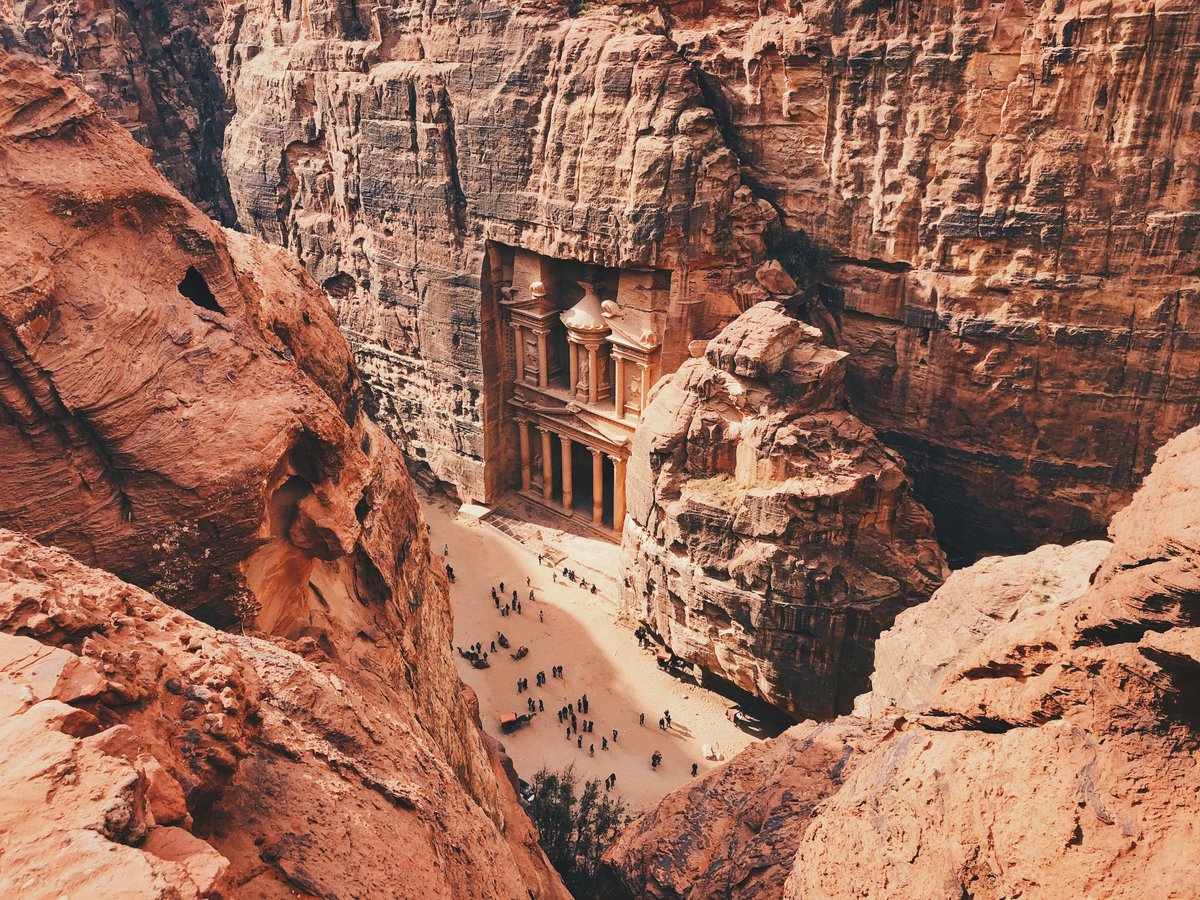
viewpointA 45-minute trail from the Royal Tombs area leads to the cliff edge directly above Al-Khazneh. The Treasury looks different from above. You see its full scale against the canyon floor, and in October's late afternoon light the facade takes on colours invisible from ground level. The trail is steep but manageable in October conditions.
Eastern cliffsLittle Petra (Siq al-Barid) and the Painted House
archaeological siteThis free-entry Nabataean trading suburb 9km north of the main site features carved banquet halls with 1st-century painted ceilings. The Painted House biclinium preserves vine scrolls, cupids, and birds in pigments that are still visible after 2,000 years. October light reaches the ceiling better than the overhead summer sun. The nearby Neolithic settlement of Al-Beidha, dating to 7000 BC, is a 10-minute walk north.
Siq al-BaridThe Byzantine Church mosaics
archaeological siteDiscovered in 1993 within the Petra basin, this 6th-century church preserves geometric and animal mosaic floors under a modern protective shelter. The mosaics depict native and exotic animals, seasons, and ocean life. It sits between the Colonnaded Street and the Temple of the Winged Lions, and most tour groups walk past it. Worth 30 minutes of your time in the quiet midday period.
Central Petra basinDana village overlook
villageThe stone village of Dana clings to the edge of the Wadi Dana canyon, 50km north of Petra along the King's Highway. The RSCN guesthouse terrace looks straight down into the rift valley, and on clear October mornings the visibility extends to the Negev. The village itself has stone houses dating to the 15th century, some now converted to simple lodgings. The October olive harvest gives the village a particular atmosphere of activity.
Dana Nature Reserve
Your packing checklist
Tick items off as you pack. Your progress saves in this browser.
All packed — have a great trip.
Insider tips
Enter at 6am when the gates open and walk straight past Al-Khazneh to the Monastery trail. By 6:30am, you'll be climbing the stairs in cool shade while the tour groups, which start arriving at 9:30am, are still on their hotel breakfast buffets. You can see the Monastery in near-solitude, then visit the Treasury on your way back out when the midday crowds have thinned after 2pm.
Buy a 2-day or 3-day pass even if you think 1 day is enough. The price difference between a 1-day (50 JD) and 2-day (55 JD) ticket is only 5 JD. Petra has over 800 carved structures, and one day covers the main Treasury-Basin-Monastery corridor at best. The second day lets you explore Wadi Farasa, the Royal Tombs interiors, and the Jabal al-Khubtha viewpoint without rushing.
The Bedouin tea stalls inside the site, particularly the one halfway up the Monastery stairs and another near the Basin, serve sage tea (maramiyyeh) brewed with fresh herbs for 1-2 JD. This is a better experience than any cafe in Wadi Musa. Sit for 15 minutes, catch your breath, and let the tour groups pass.
If you're driving, fill up your fuel tank in Wadi Musa. The next reliable petrol station heading south toward Wadi Rum is in Rashidiyya, about 60km away. October's cooler temperatures also mean you can comfortably do the 2-hour drive to Wadi Rum for a sunset, then drive back after dark.
Skip the horse ride from the gate to the Siq entrance that's included in your ticket. It's a 600-metre walk on flat ground that takes 10 minutes. The horses often look poorly treated, and tipping pressure from the handlers can be persistent. Walk it.
Avoid these mistakes
- Only allocating 1 day for Petra. The main Treasury-to-Basin route takes 3-4 hours, but the High Place, the Monastery, Wadi Farasa, and the Royal Tombs each need 2-3 hours. Most visitors who spend only 1 day leave saying they missed half the site. October's comfortable temperatures make multi-day visits physically easy. Plan for at least 2 days.
- Starting the Monastery trail after 10am in October. While it's not the health risk it would be in August, the 850 steps become crowded with descending hikers by late morning, and the narrow sections create bottlenecks. The round trip takes 2.5-3 hours. Start early or go after 2:30pm when the groups have turned back.
- Packing too little water because the October temperature looks mild at 25°C. The 16km round-trip walk, the elevation changes, and the dry 52% humidity mean you'll lose more fluid than the air temperature suggests. Bring at least 2 litres per day and refill at the Basin restaurant if needed.
- Ignoring flash flood protocols for the Siq. October's 4mm average rainfall feels negligible, but the Siq's catchment area extends into hills you cannot see from the canyon floor. If the Visitor Centre posts a flood warning or the sky darkens to the north, take it seriously. The 2022 November flood swept through with only 15 minutes of upstream rain.
Practical tips for October
Book Wadi Musa accommodation at least 2-3 weeks before your October visit, particularly if you want properties near the Visitor Centre along Tourism Street. The town has roughly 70 hotels ranging from 25 JD budget guesthouses to 150+ JD properties, but mid-range options (50-80 JD) fill fastest in October. The Petra Visitor Centre opens at 6am in October (summer hours, switching to 6:30am in November), and the last entry is at 4pm with the site closing at 6pm. Petra by Night runs Monday, Wednesday, and Thursday at 8:30pm and costs 17 JD. Book this through your hotel reception or the Visitor Centre booth. If you're arriving from Amman, the drive is 3 hours via the Desert Highway or 4-5 hours via the King's Highway, which passes through Madaba, Kerak, and Dana. JETT bus runs a daily service from Amman's Abdali station to Wadi Musa, departing at 6:30am, for around 11 JD one way. The return bus leaves Wadi Musa at the same time. Taxis from Aqaba (130km south) cost 40-50 JD and take about 2 hours. Jordan's currency is the dinar (JD), pegged at 0.71 JD to 1 USD. Most Wadi Musa hotels and the Visitor Centre accept credit cards, but Bedouin stalls inside the site are cash only. ATMs are available in Wadi Musa town centre. Dress modestly in Wadi Musa outside the site, as it's a conservative town. Inside Petra itself, hiking clothes are fine. October is also Daylight Saving Time transition month in Jordan. The clocks typically fall back one hour in late October, which can shift sunset and site closing times. Check the exact date with your hotel upon arrival.
FAQ
Is October a good time to visit Petra?
October is one of the 2 best months to visit Petra, alongside April. Daytime highs around 25°C (78°F) make the long walks and steep climbs comfortable, rainfall is minimal at 4mm, and the lower sun angle creates better light on the carved facades than the harsh summer overhead sun. The trade-off is that October marks the start of high season, so expect bigger crowds on the main Treasury trail between 10am and 2pm, and higher hotel prices in Wadi Musa. If the crowds concern you, an early 6am start avoids the worst of it.
What is the weather like in Petra in October?
Expect highs around 25.4°C (78°F) and lows around 16.9°C (62°F). Humidity sits at approximately 52%. Rainfall is minimal, averaging 4mm across about 2 rainy days for the whole month. Mornings in the Siq feel cool and pleasant. Afternoons in the exposed basin area and on the Monastery plateau are warm but not oppressive. Evenings cool noticeably after sunset, so bring a light layer for Petra by Night. Wind can pick up on the exposed summit of the High Place of Sacrifice.
Is Petra crowded in October?
Yes, noticeably. October is the start of the autumn high season, and visitor numbers rise sharply compared to the quiet summer months (June through August see fewer visitors because of 30°C+ heat). The main Siq-to-Treasury corridor gets congested between 10am and 2pm with large tour groups from Aqaba and Amman. That said, the site covers 264 square kilometres, and trails like Wadi Farasa, the High Place descent, and the back areas beyond the Monastery remain relatively quiet even in peak season. Entering at 6am gives you 3-4 hours of relative calm.
How many days do I need for Petra in October?
Two days minimum, three if you want to explore thoroughly. A single day covers the Treasury, the Colonnaded Street, and either the Monastery or the High Place, but not both. With 2 days, you can see all the major sites at a comfortable pace, including the Royal Tombs, Wadi Farasa, and the Byzantine Church. A third day allows for the Jabal al-Khubtha viewpoint above the Treasury, a visit to Little Petra (9km north, free entry), and time to revisit favourite spots at different times of day for photography. October's mild weather makes multiple full days physically feasible.
Is there a flash flood risk in Petra in October?
The statistical risk is low, with only 4mm average rainfall in October. But flash flooding in the Siq is a real, documented hazard that occurs regardless of the monthly average. The 1.2km canyon drains a large upstream catchment, and rainfall in the hills above Wadi Musa, which you cannot see or hear from inside the canyon, can send water through the Siq. The PDTRA has installed upstream sensors and will close the Siq entrance when levels rise. Check at the Visitor Centre each morning and take any warnings seriously. The risk is highest after November, but October is not zero.
Find a flight to Petra
Live fares to Petra appear here once cookies are accepted.
Last verified by automated review (v1.7.2) on . What is automated review?