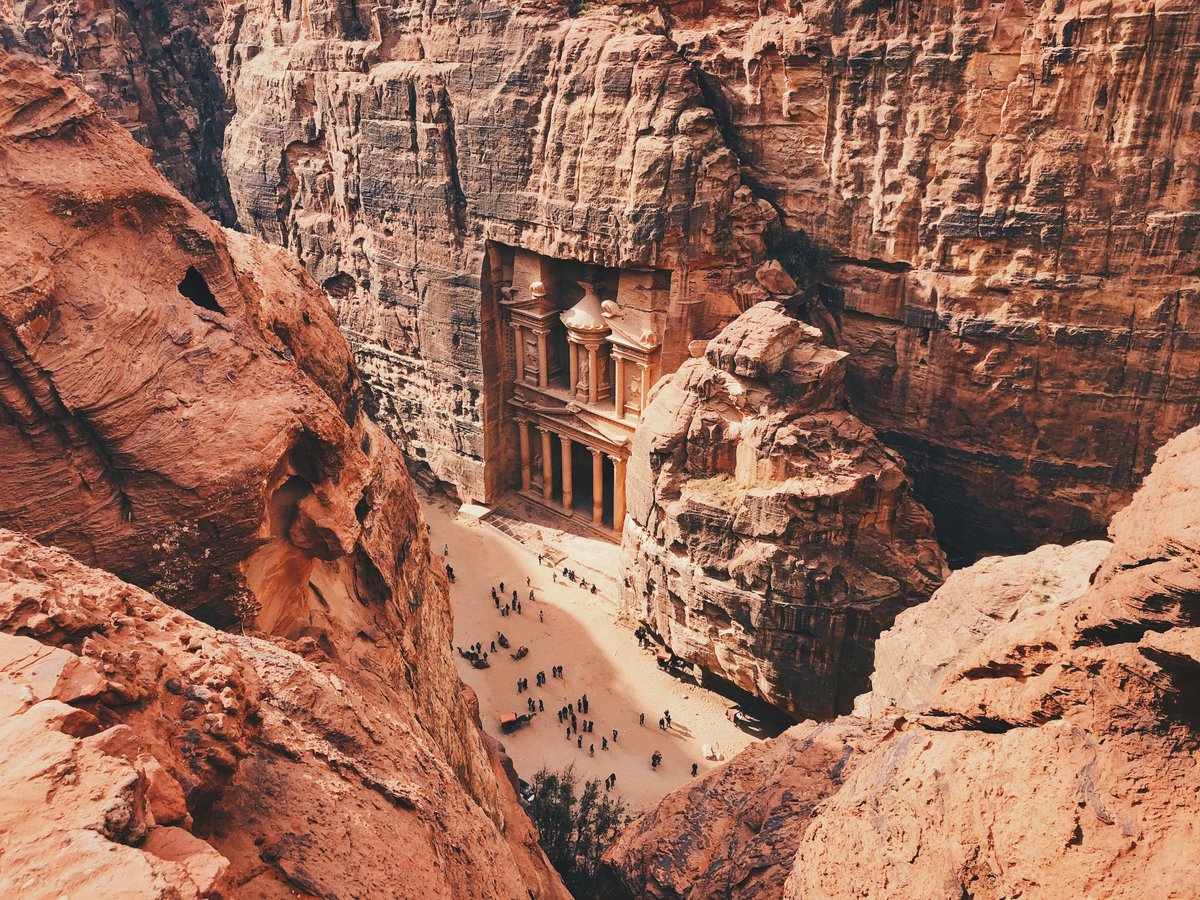
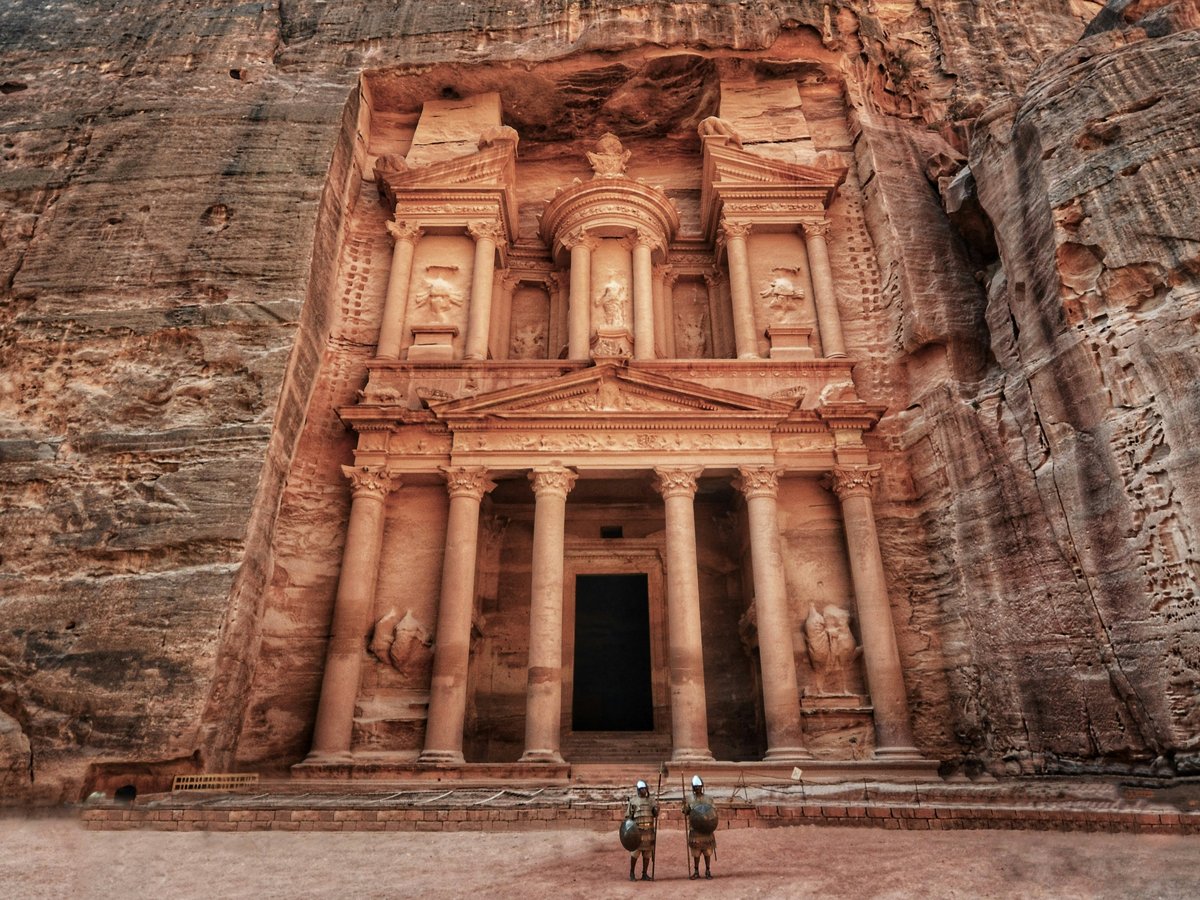
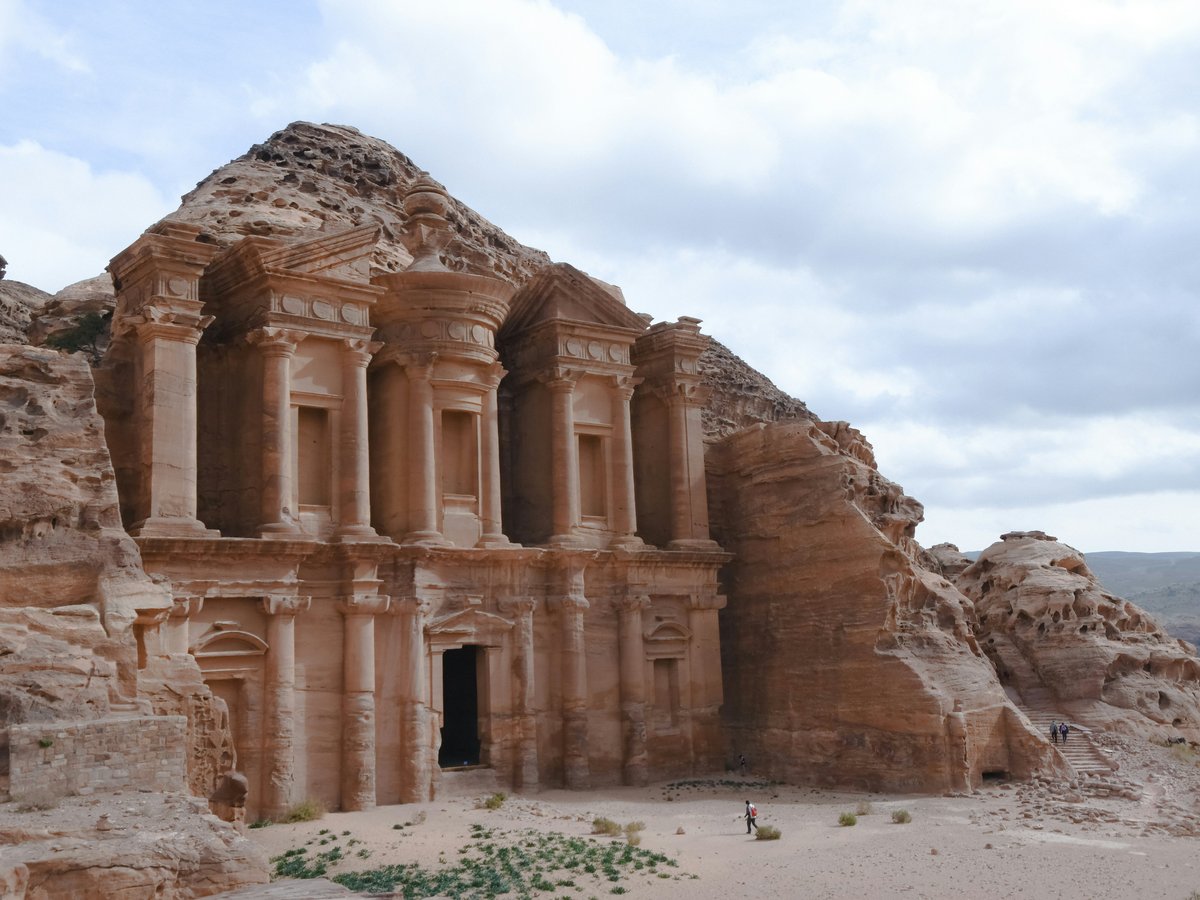
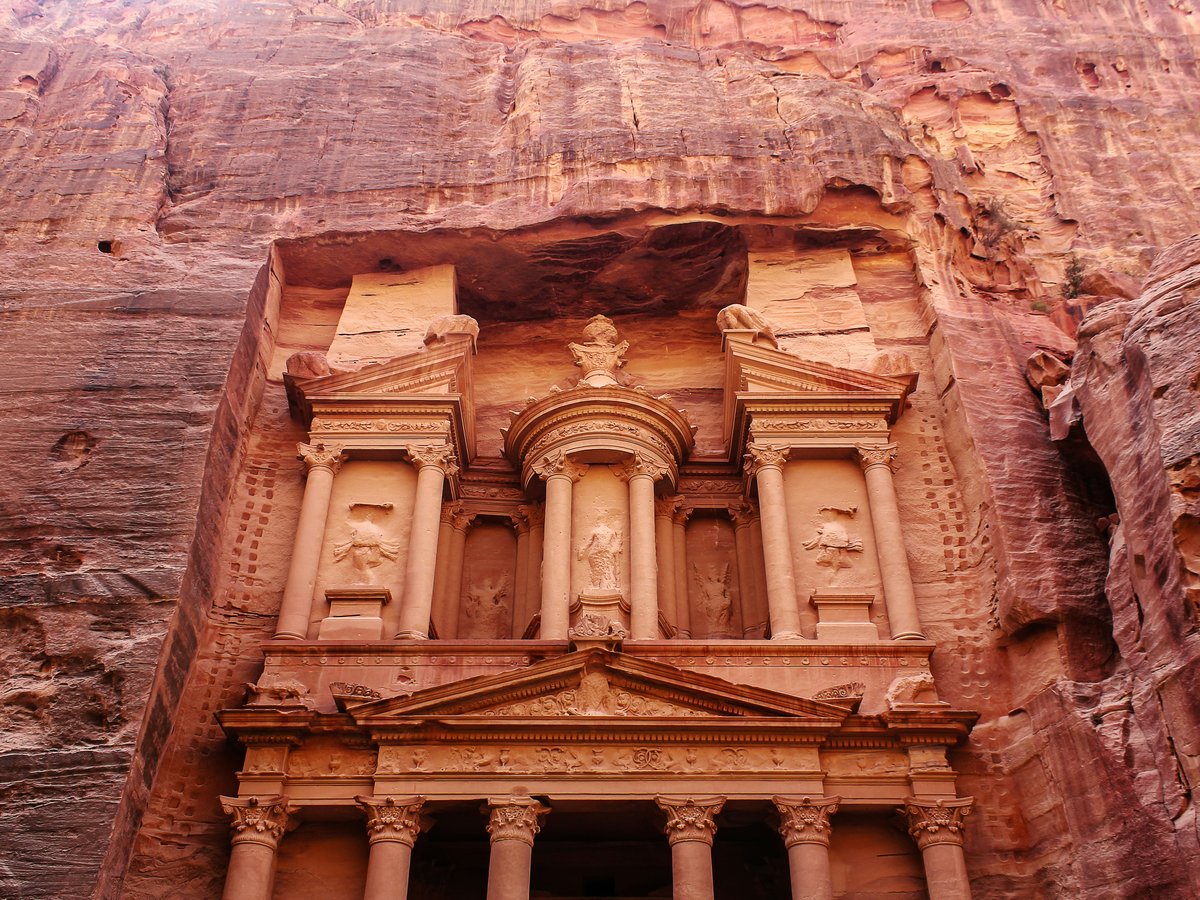
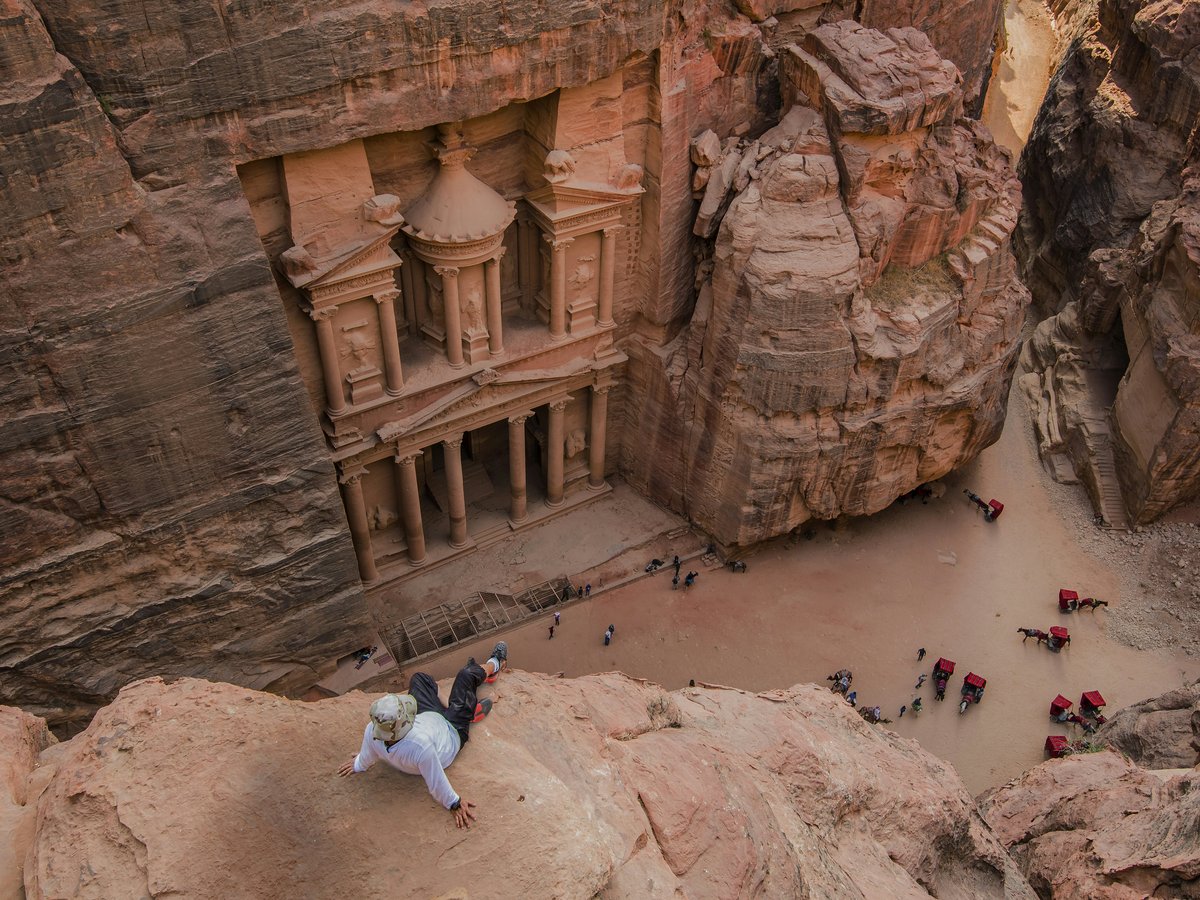
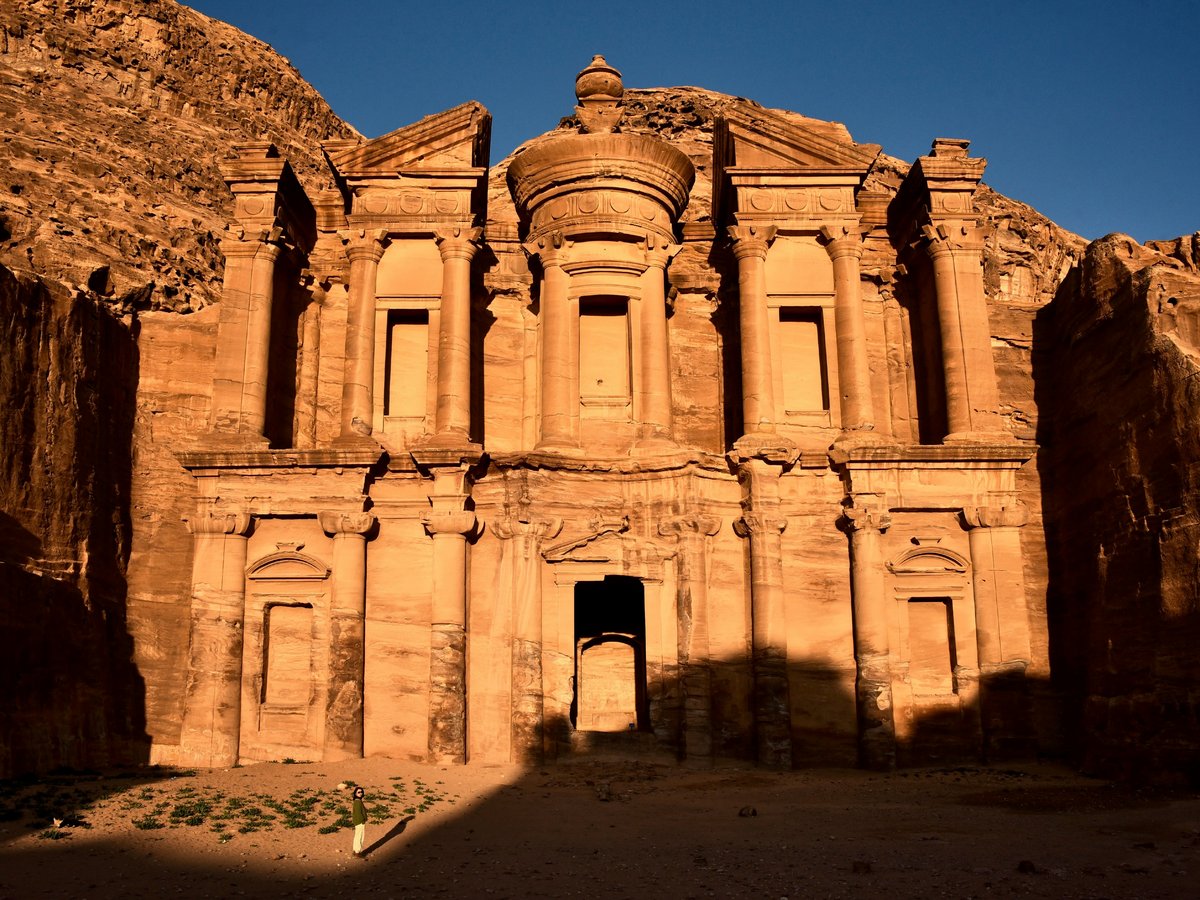
Petra is carved into the rose-red sandstone cliffs of southern Jordan's Sharah Mountains, a city that existed for centuries before the Romans arrived and that still surprises visitors who think they know it from photographs. The Nabataeans, Arab traders who controlled the incense routes between Arabia and the Mediterranean, chose this narrow canyon system around the fourth century BCE not for its beauty but for its defensibility and its access to water. They engineered channels, cisterns, and dams into the rock to sustain a population that may have reached thirty thousand at its peak, roughly the size of the modern town of Wadi Musa that now serves as its gateway. Most visitors enter through the Siq, a kilometre-long slot canyon where the walls rise forty metres overhead and the light shifts from amber to violet depending on the hour, until the Treasury facade appears in a vertical sliver that widens with each step. But the Treasury is the opening act. Beyond it, the Street of Facades gives way to the Roman-era colonnaded road, the Royal Tombs cut high into Jabal al-Khubtha, and the Monastery, a forty-five-minute climb up eight hundred rock-cut steps that most guided tours skip because of the heat. The town of Wadi Musa itself sits at roughly a thousand metres elevation, which means winter mornings can be genuinely cold and summer afternoons punishing; experienced visitors arrive at the gate before seven and leave the interior by early afternoon. In the evenings, the restaurants along the main road through Wadi Musa fill with returning hikers eating mansaf and drinking sweet tea, and on certain nights the Siq is lit with hundreds of candles for Petra by Night, a spectacle that works best when you ignore the crowds and look up at the stars visible between the canyon walls.
Petra in photos
Petra right now
Answers about Petra
-
Airport to city
Petra has no airport. Most visitors fly into Queen Alia International Airport (AMM) in Amman, 235 km north, then drive 3 hours south to Wadi Musa via the Desert Highway. Pre-book a private transfer through your hotel for 70-90 JOD ($99-127). Budget travelers take the JETT bus from Amman's Abdali station for 11 JOD ($15.50).
Read the full answer → -
Best time to visit
March through May and October through mid-November, when daytime highs near Al Khazneh reach 20-28°C. Summer temperatures hit 38°C with zero shade in the basin. Winter brings flash-flood risk in the Siq and sunsets before 5pm. Spring morning light on the Treasury facade falls best between 9am and 11am.
Read the full answer → -
Cost per day
Budget travelers spend about $50/day in Petra with a hostel dorm in Wadi Musa, local street food, and Jordan Pass entry amortized over 2 days. The Jordan Pass at 75 JOD ($106) includes your visa waiver and 2 days of Petra access. Standalone tickets cost 50 JOD ($70) per day. Midrange runs $140/day, luxury $300+.
Read the full answer → -
Cultural etiquette
Jordan is conservative and Muslim-majority. Cover your shoulders and knees in Wadi Musa town. At Petra's archaeological site, dress is more relaxed because of the heat, but Bedouin families there still appreciate modesty. Greet everyone with "as-salamu alaykum," accept offered tea, use your right hand, and never photograph Bedouin women without asking.
Read the full answer → -
Best day trips
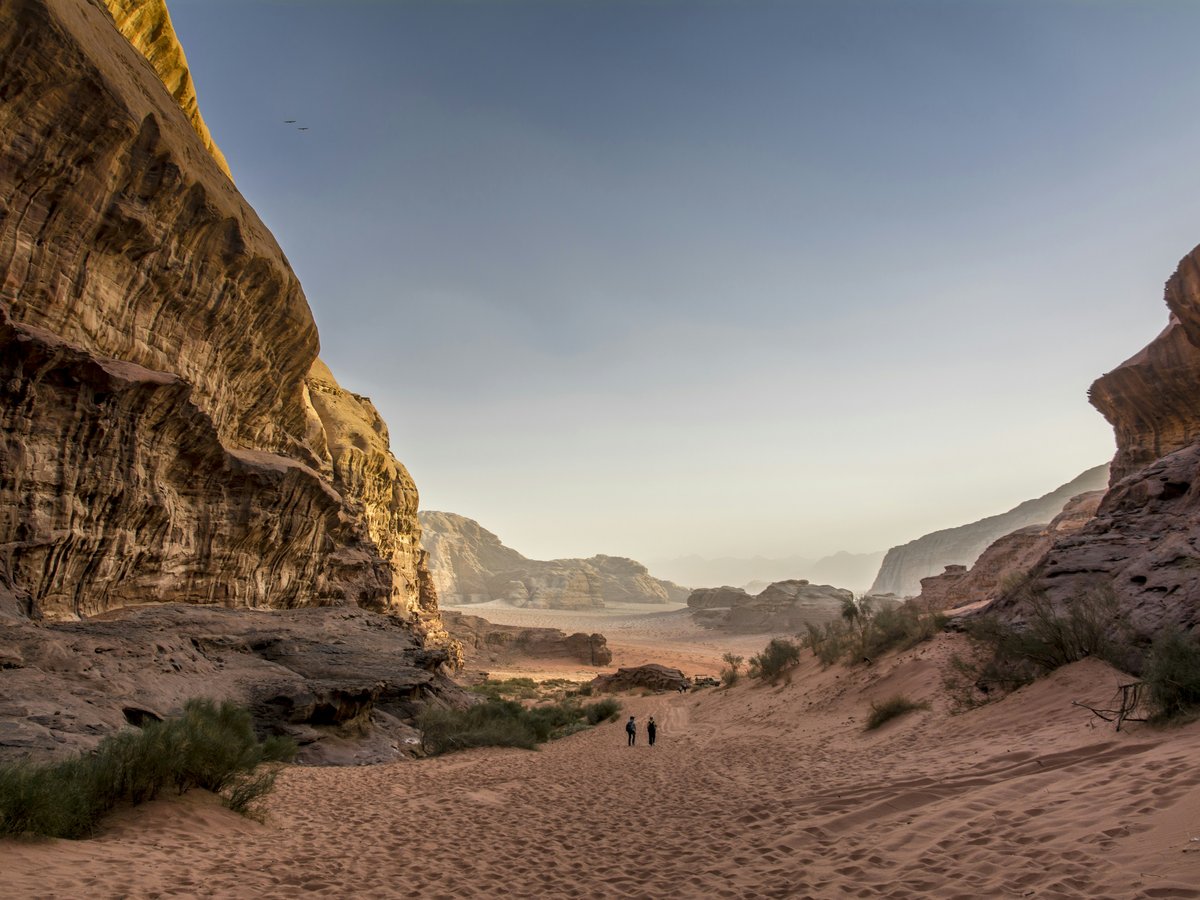
Little Petra sits 9 km north of Wadi Musa and costs nothing to enter. Wadi Rum is the full-day option at 100 km south, with jeep tours from 35 JD per person. Dana Nature Reserve works for couples who want a quieter morning hike without the Petra crowds. Shobak Castle, 25 km north, needs only 2 hours and feels like having the Crusades to yourselves.
Read the full answer → -
Digital nomads
Petra is a poor base for nomads. Wadi Musa, the adjacent town of 35,000, has unreliable 5-15 Mbps DSL, zero dedicated coworking spaces, and no expat infrastructure. Monthly costs run $700-1,000 all-in, but bandwidth frustration cancels out the savings. Base yourself in Amman (50-Mbps fibre, real coworking at 75 JOD/month) and take the 3-hour JETT bus for Petra weekends.
Read the full answer → -
Family-friendly
Petra is a mixed proposition for families. Kids 5 and older handle the 1.2 km Siq walk and respond well to the Treasury reveal. Children under 4 face real problems. No stroller access anywhere in the site. Summer heat above 35°C limits visits to mornings only. Little Petra works better for toddlers, and it's free.
Read the full answer → -
Food culture
Petra's food culture is Bedouin at its core, centered on Wadi Musa's small restaurant scene. Mansaf (lamb in fermented-yogurt sauce over rice) is the defining meal. Zarb, meat and vegetables slow-cooked underground in sand-covered pits, appears at Bedouin camps near the site. Most dining runs 3-8 JOD per plate. Bring snacks into the archaeological park, where options are limited to overpriced stalls.
Read the full answer → -
Getting around
Your feet do all the work in Petra. The archaeological park has no vehicles, no shuttles, no golf carts. From the Visitor Centre to Al Khazneh through the Siq is 1.5 km on sand and gravel. To Ad Deir add 3 km and 800 rock-cut steps. Bring trail shoes, not sandals. Horses and donkeys operate inside the park for 5-25 JOD.
Read the full answer → -
How to get there
Petra has no airport. Fly into Queen Alia International (AMM) in Amman, 235 km north, or King Hussein International (AQJ) in Aqaba, 130 km south. From Amman, the JETT bus runs daily to Wadi Musa (Petra's entrance town) for 11 JOD, about 3.5 hours on the Desert Highway. From Aqaba, it's a 2-hour drive.
Read the full answer → -
Is it safe?
Petra is safe for solo visitors, and TTDI scores it 7.8/10 for solo safety (see the TTDI Solo-Safety Index). Violent crime against tourists in Wadi Musa is rare. The real risks are heat on the climb to Ad Deir, flash floods in the Siq, pushy donkey handlers, and Bedouin men who target solo women. In an emergency, dial 911.
Read the full answer → -
Language basics
Arabic, Jordanian dialect, with a Bedouin inflection strong among the B'doul tribe working inside the Petra Archaeological Park. English proficiency across the site sits around 5/10. Licensed guides speak fluent English, but Siq stallholders and tea vendors near Ad Deir rely on memorized sales phrases. Download Google Translate's Arabic pack before entering. Cell signal dies past Al Khazneh.
Read the full answer → -
Layover guide
Petra sits 130 km from King Hussein International Airport in Aqaba, roughly two hours by taxi. With immigration, the drive both ways, and a return security buffer, you need a minimum 10-hour layover to walk the Siq and reach Al Khazneh. From Amman's Queen Alia, the 3.5-hour drive makes it borderline at 12 hours. Check the Jordan Pass for combined visa and entry savings.
Read the full answer → -
LGBTQ-friendly
Petra is 3.5/10 for LGBTQ+ friendliness (sourced from TTDI's editorial rubric). Jordan does not criminalize same-sex conduct, but offers no partnership recognition or discrimination protections. Wadi Musa, the gateway town, is socially conservative. Same-sex couples can book double rooms at international hotels without trouble, but keep affection private.
Read the full answer → -
Where locals go
Wadi Musa locals gather away from the Petra entrance road, mostly in the upper town center near the Shaheed roundabout. Evening shisha cafes along the main street fill after 8pm with off-duty guides and shopkeepers. Friday mornings shift the town's gravity to the mosque district. The Bdoul Bedouin community at Umm Sayhoun, 2km north, runs on a different rhythm entirely.
Read the full answer → -
Must-see
Al Khazneh, the Treasury, cut from living sandstone by the Nabataeans around the 1st century AD. Petra's park covers 264 square kilometres with over 800 carved monuments, but this single facade is what visitors travel to see. Buy the 55 JOD two-day pass. One day is not enough.
Read the full answer → -
Solo travel
Petra scores 7.8 out of 10 for solo safety. The site is safe, the logistics are simple, and Wadi Musa's single-street layout takes 20 minutes to learn, but the trade-off is thin social infrastructure: most visitors stay 2-3 nights, so hostel crowds turn over fast. Petra by Night (17 JOD, 3 evenings a week) is the most reliable built-in social moment.
Read the full answer → -
This week
Petra runs on an early-morning rhythm right now. The Siq opens at 6am, and the first 90 minutes before tour buses arrive are the coolest and quietest. Petra by Night lights 1,500 candles along the path to Al Khazneh on Monday, Wednesday, and Thursday evenings at 8:30pm. Plan your week around dawn starts and long midday breaks.
Read the full answer → -
3-day itinerary
Day 1 covers the Siq, Al Khazneh, and the main basin trail to Qasr al-Bint. Day 2 climbs 850 steps to Ad Deir and crosses the High Place of Sacrifice at 1,035 metres. Day 3 heads north to Little Petra and the 9,500-year-old settlement at Beidha. Buy the 80 JOD Jordan Pass and start each morning by 6 AM to beat the June heat.
Read the full answer → -
What to avoid
Skip the Petra day trip from Amman or Eilat, the donkey ride up the 800 steps to Ad Deir, and the Siq between 9am and noon. Buy the Jordan Pass before you fly, be at the gate when it opens at 6am, carry three litres of water, and leave the Siq the moment rain clouds build over Wadi Musa.
Read the full answer → -
What to pack
Sturdy closed-toe hiking shoes with ankle support, a wide-brimmed hat, and at least 3 liters of water capacity per person. Petra's sandstone trails run 8 to 12 km in a full day, with summer temperatures reaching 38°C and almost no shade past Al Khazneh. Lightweight long pants for sun protection and local dress standards. SPF 50+ sunscreen and high-SPF lip balm.
Read the full answer → -
Where to stay
Stay in lower Wadi Musa, within 10 minutes' walk of the Petra Visitor Centre. The Mövenpick Resort sits directly opposite the entrance. Mid-range hotels like Petra Guest House cluster within 800 metres. Budget $40-80 for a guesthouse, $120-250 near the gate. Upper Wadi Musa saves $20-30 per night but adds a steep 2km uphill walk or 3 JD taxi.
Read the full answer →
Deep guides for Petra
-
Petra With Kids: What Works
Petra scores 4.8 for families, but only if you turn around at the Basin Restaurant by noon. Here is the itinerary that survives small children, the marquee sight that is a meltdown trap, and the under-rated site that wins the day.
Read the guide → -
Best Time to Visit Petra, by Season
Petra's sandstone runs from February's 6.3°C overnight lows to August's 32.7°C highs. This month-by-month breakdown, built from 5-year daily weather observations, names the single best window for budget travellers, photographers, hikers, and first-timers visiting the ancient Nabataean city.
Read the guide →
Curated lists for Petra
accommodation
-
Best boutique hotels
Petra's accommodation runs along a single road that drops from the hilltop ridge to the Siq entrance, and the neighborhood you choose determines whether you walk to the treasury gate or ride a shuttle. Al-Madras clusters at the bottom of that road, pressed against the visitor center and the start of the canyon trail; Amaun sits higher on the ridge above Wadi Musa's center, where the elevation buys a cooler evening and a pool deck with a valley view. Budget beds are scarce in both zones, so the real choice is between a gate-side room that saves you a morning taxi and a hilltop room that trades proximity for resort-style space. Neither area has nightlife worth naming; Petra shuts down early, and the restaurants that matter line the downhill stretch of Tourism Street between the two clusters. Pick Al-Madras if your priority is the first group into the Siq at dawn, Amaun if you want the bigger room and do not mind the ten-minute drive.
See the picks → -
Best hostels
Petra's accommodation clusters in a single town rather than spreading across competing districts. Wadi Moussa is the gateway settlement, built on a hillside that descends toward the visitor center and the mouth of the Siq. There is no resort corridor, no waterfront promenade, no reason to taxi between neighborhoods. The beds line the main road and the lanes branching off it, all within walking range of the ticket gate. Properties run to family-run guesthouses and small hotels rather than international chains, and nightly rates reflect a town shaped by backpackers and archaeological day-trippers, not package tourists. Choosing where to sleep is less about picking a district and more about picking a spot on the slope: higher up the hill means a steeper walk home but wider rooftop views across the valley; lower means a shorter morning walk to the park entrance. That simplicity suits the hostel traveler. The town is compact, the competition between properties keeps prices honest, and the real decision is how early you want to reach the Treasury before the tour buses arrive.
See the picks → -
Where to stay
Petra's hotels line a single road that drops from Wadi Moussa down to the visitor center at the mouth of the Siq. The decision is straightforward: how close to the gate do you want to sleep? Properties nearest the entrance charge more and put you steps from the ticket office, which matters when you plan to enter at dawn while the canyon light is at its best. Hotels farther uphill in the town center cost less and sit closer to local restaurants, shops, and the minibus connections to Aqaba and Amman. There is no metro, no tram, and no reliable sidewalk for long stretches of the main road; taxis and hotel shuttles fill the gap. Three neighborhoods split the inventory. Al-Madras clusters right at the Petra gate, Amaun sits on the ridge above, and Wadi Moussa spreads through the commercial heart of town where budget beds and local eateries concentrate. The distance between all three is short by car, so the real question is not access to the ruins but whether you want to wake up in a tourist corridor or a Jordanian hill town.
See the picks →
Browse by traveler type
Browse by interest
Find a flight to Petra
Live fares to Petra appear here once cookies are accepted.
Last verified by automated review (v1.7.2) on . What is automated review?