Petra With Kids: What Works
Petra scores 4.8 for families, but only if you turn around at the Basin Restaurant by noon. Here is the itinerary that survives small children, the marquee sight that is a meltdown trap, and the under-rated site that wins the day.
Published
1 Petra Earns a 4.8 Family Score, but Only If You Know Where to Stop
The air drops 10 degrees the moment you step into the Siq. Your 4-year-old will notice before you do, pressing a palm against sandstone that has been cool and smooth for 2,000 years. Petra scores 4.8 out of 5 for family-friendliness in our verified index, a number that might surprise anyone who pictures the site as an all-day desert march. The 4.8 holds. But it measures the site's potential, not the median tourist experience.
Most families visiting Petra make the same mistake. They arrive at the Visitor Centre around 10 AM, push through the 1.2-kilometre Siq to the Treasury, take a photo, and then attempt the full 8-kilometre route to the Monastery. By 1 PM they are carrying a screaming child back through 40-degree heat with no shade and no water refill until the gate.
The itinerary that earns the 4.8 is a different shape entirely. It starts at the Visitor Centre at 6 AM, before the tour buses from Amman arrive around 8. It treats the Siq as the main event for small children, not a corridor to rush through. It includes the Treasury and the Street of Facades, spends real time at the Royal Tombs, and turns around at the Basin Restaurant by 11 AM. Total walking distance for that shape is roughly 4 kilometres each way from the main gate.
For children under 5, those 4 kilometres are a full day. For children 8 and older, the Monastery becomes possible, but only with the 6 AM start and proper hiking shoes. Petra is a UNESCO World Heritage Site covering 264 square kilometres, but the family-usable zone is about 2 kilometres of the main path between the Siq and the Basin.
2 The Siq's 1.2-Kilometre Canyon Is the Best Part of Petra for Children Under 6
The Siq's walls close in slowly. By the time you are 200 metres past the entrance dam, sandstone towers 80 metres above your head and the sky is a thin ribbon of blue. Your child will run a hand along the rock face and feel where centuries of water have polished the grain from rough to silk-smooth. This is Petra's single best family experience, and most visitors treat it as a hallway to rush through.
The Siq runs 1.2 kilometres from the entrance dam to the Treasury. The path is flat, paved in most stretches, and wide enough for a lightweight stroller in the dry season from November through March. During the wetter months of December through February, flash-flood risk can close the canyon on some days. The Visitor Centre posts conditions each morning by 6 AM.
For children, the Siq works because it is a contained, shaded corridor with constant visual change. Nabataean water channels carved into both walls run for the entire 1.2-kilometre length. A carved camel relief appears about 800 metres in. A set of votive niches, likely for small deity figures, sits near the final curve before the Treasury reveal. The temperature inside the canyon stays around 25 degrees in April and October, even when the open plateau outside hits 35.
The runner-up entry point is the back trail from Little Petra through Wadi al-Mudhlim, which bypasses the Siq and emerges near the Monastery. That route covers about 4 kilometres of unshaded scrambling with uneven rock and no guardrails. It is excellent for fit teenagers over 14. It is the wrong entrance for anyone under 10. The Siq is the right choice for families because the canyon walls keep children contained on the path for the full 1.2-kilometre length.
3 The Treasury Is a 30-Second Photo Op, Not a 3-Hour Family Destination
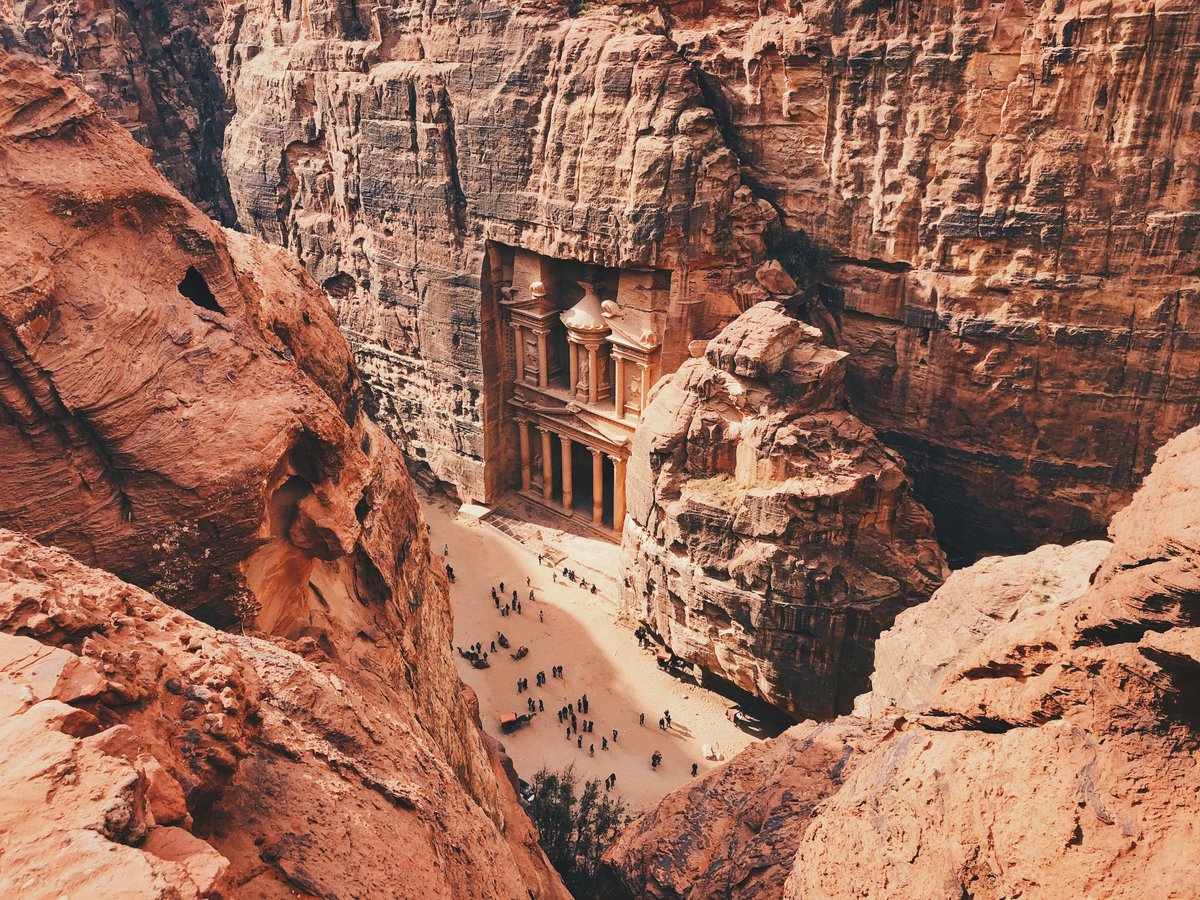
You round the final bend of the Siq and Al-Khazneh appears framed in rock, pink-gold in the morning light. Al-Khazneh's scale hits you at once. The facade stands 40 metres tall, carved directly into the cliff face during the 1st century BC, likely under Nabataean King Aretas IV. Every phone in the plaza comes out. The photos take about 90 seconds. Then what?
This is the meltdown trap for families who have built the entire day around it. Al-Khazneh has no interior rooms open to visitors. The Jordanian Department of Antiquities closed public access decades ago. There is no shade in the viewing plaza before 9 AM. Tour groups from Wadi Musa hotels start filling the space by 8:30. Camel handlers and souvenir sellers crowd the area, and for a 3-year-old at hip level, the experience is noise, dust, and a forest of adult legs.
The move for families is to arrive before 7 AM, when the plaza is nearly empty. Take 10 minutes. Sit on the rocks to the left of the facade, where a small overhang provides shade. Let your child count the Corinthian columns. There are 6 across the upper register, 4 on the lower. Then walk south.
That said, skip Petra by Night if your children are under 10. The evening show runs 3 nights a week and involves walking the 1.2-kilometre Siq by candlelight to Al-Khazneh, where a Bedouin musician plays in front of the facade. Tickets cost 17 JOD per person. In practice, that means walking 1.2 kilometres in the dark with a toddler, sitting on cold ground for 30 minutes, and walking 1.2 kilometres back. Al-Khazneh at 6:45 AM in daylight, with pink light on the facade and an empty plaza, is the better version of the same experience.
The Street of Facades begins 200 metres south of the Treasury. Forty-four tomb facades line the rock wall in a row, each at a different scale. Several have low entrances that children can peer into. The Royal Tombs sit another 300 metres beyond, across the wadi floor. The Urn Tomb has a cavernous interior chamber roughly 17 by 18 metres, with a natural echo that carries a child's voice from wall to wall.
Al-Khazneh has no interior rooms open to visitors. For a 3-year-old at hip level in that crowd, the experience is noise, dust, and a forest of adult legs.
4 Turn Around at the Basin Restaurant and You Have Had the Best Day in Petra
The smell of grilled chicken and cumin drifts up the path about 50 metres before the Basin Restaurant comes into view. The building sits at the low point of Petra's central valley, roughly 2 kilometres south of the Treasury and about 4 kilometres from the Visitor Centre gate. The structure is a converted Nabataean-era ruin, currently operated as a restaurant by the Crowne Plaza Petra group. It is the only sit-down meal option inside the archaeological park.
For families with children under 8, the Basin is the turn-around point. This is the itinerary shape that delivers the 4.8 family-friendliness score. You walk from the gate through the 1.2-kilometre Siq, past the Treasury, down the Street of Facades, past the Royal Tombs, along the Colonnaded Street, and arrive at the Basin by late morning. Total distance is about 4 kilometres from the gate, with gentle elevation loss of maybe 100 metres over the full route. The return is the same 4 kilometres, now slightly uphill, in rising heat.
Lunch at the Basin is a buffet. The price has tended to run around 15 to 18 JOD per person, roughly 21 to 25 USD. The food is standard Jordanian hotel fare. Hummus, tabbouleh, grilled meats, rice with pine nuts. The Basin is not destination dining. It is the right place to sit for 45 minutes, refill water bottles, and let a tired 4-year-old eat something warm before the walk back.
The alternative is to carry your own food to the shaded area near Qasr al-Bint, about 200 metres past the Basin. That Nabataean temple dates to the 1st century BC and the surrounding ground is flat, uncrowded after 11 AM, with a long view toward the Wadi Araba escarpment. Qasr al-Bint is also the fork where the trail to Ad-Deir begins, which is precisely why smart families turn around here. Families who leave the Basin by noon are back at the Visitor Centre gate by 2 PM.
5 Ad-Deir's 800 Steps Are the Meltdown Trap Nobody Warns About
The steps begin at the fork behind Qasr al-Bint and they do not stop. Ad-Deir, Petra's Monastery, is the site's second-most-photographed facade, about 47 metres tall and arguably more striking than the Treasury because you can walk right up to its base. The catch for families is the 800 hand-cut rock steps between the valley floor and the plateau where Ad-Deir sits at roughly 1,000 metres elevation.
The climb takes a fit adult about 45 minutes. For a 5-year-old, expect 90 minutes up and 60 down, with multiple breaks. There is no shade for roughly the first 300 steps. The path narrows in places to less than a metre, with a drop-off on one side. Donkey handlers at the base offer rides up for 10 to 15 JOD, but the animals navigate the same narrow steps. A child on a donkey on an exposed switchback is a risk calculation every parent should make deliberately, not at the trailhead under pressure from a persistent handler.
To be fair, Ad-Deir is magnificent when you arrive. The facade is wider than Al-Khazneh at about 50 metres across. A small cafe on the plateau sells mint tea for 2 to 3 JOD with a view across Wadi Araba toward the Negev Desert. On a clear morning you can see roughly 30 kilometres west to the Israeli border. For children 10 and older who are comfortable with sustained climbing, Ad-Deir is Petra's genuine highlight.
For families with children under 8, Ad-Deir is the meltdown trap. The 800 steps are non-negotiable. You cannot stroller them, shortcut them, or avoid them. A child who is finished at step 400 still faces 400 steps down on tired legs. The alternative is Little Petra, 9 kilometres north of the main entrance, where the same Nabataean architecture meets you at ground level with no stairs and no entry fee.
A child who is finished at step 400 still faces 400 steps down on tired legs.
6 Little Petra Is the Under-Rated Win for Families with Children Under 8
The painted ceiling appears in fragments above you. Blue, red, ochre. Cupids and grapevines still visible after 2,000 years on the rock surface of the Painted Biclinium inside Siq al-Barid. Your child will spot the colors before you do, because the ceiling sits only about 3 metres high and small eyes tend to look up rather than straight ahead.
Siq al-Barid, known as Little Petra, sits 9 kilometres north of the main Petra Visitor Centre, off the road toward the village of Beidha. Entry is free. There are no ticket gates, no tour groups before 10 AM, and no camel handlers working the path. The site is a miniature version of the main Siq, roughly 350 metres long, with Nabataean facades carved into both walls and several accessible cave rooms along the route.
For families, Little Petra succeeds where the main site struggles. Total walking distance is under 1 kilometre round trip. The narrow canyon provides shade for most of its length. The facades and rooms are at a child's scale, with low entrances into small chambers that feel like discovery rather than spectacle. The Painted Biclinium sits about 300 metres in and holds the best-preserved Nabataean wall painting in the region. The room is small enough that a 4-year-old can see the ceiling without being lifted.
Worth noting, the Beidha Neolithic village sits about 600 metres from the Little Petra car park. The settlement dates to roughly 7000 BC, making it one of the oldest known farming communities in the Levant. Low stone foundations are visible at ground level and the site is entirely open, with no stairs and no barriers. Children can walk through the 9,000-year-old structures freely.
The other family site in Petra's orbit is the Petra Museum, located beside the main Visitor Centre. The museum opened in 2019, covers 1,800 square metres of exhibition space, and displays Nabataean and Roman-period artifacts in a modern, air-conditioned building. It works well for children over 6, with interactive timeline exhibits covering roughly 10,000 years of regional history. Entry is included in the standard Petra ticket. Combined, Little Petra and the Petra Museum fill a 4-hour morning without a single staircase or a single extra entry fee beyond the main Petra ticket.
The room is small enough that a 4-year-old can see the ceiling without being lifted.
7 The Jordan Pass and the 6 AM Start Are the Two Moves That Change Everything
The ticket window at the Visitor Centre opens at 6 AM from April through October and 6:30 AM from November through March. At 6:05 on a May morning, you will see maybe 20 other people in the entire entrance plaza. By 8:30, the first tour buses from Amman have arrived and the Siq entrance is a queue.
The 6 AM start is the single highest-impact logistics move for families at Petra. It buys you 2 to 3 hours of cool air. April mornings in Petra sit around 18 degrees Celsius. You get an uncrowded Siq. Your children walk the 1.2 kilometres to the Treasury in shade, at their own pace, with time to touch the walls and examine the water channels. Families who arrive at 10 AM walk the same 1.2 kilometres in heat, in crowds, and in a hurry.
The second move is the Jordan Pass, purchased online before arriving in the country. A 1-day Petra gate ticket costs 50 JOD per adult, about 70 USD. The Jordan Pass bundles Petra entry with the 40 JOD tourist visa waiver and admission to more than 40 other sites across the country. The 1-day Petra tier starts around 70 JOD. The 2-day Petra tier runs around 75 JOD.
For families, the 2-day tier changes the trip. It lets you split Petra across 2 mornings. Day 1 covers the Siq to the Basin Restaurant. Day 2 revisits the Royal Tombs and the Street of Facades at a slower pace, with detours your children choose. Two half-days in cool morning air are kinder to small children than one long push through the afternoon heat. Children under 12 enter Petra free with a paying adult.
Mind you, the Jordan Pass must be purchased before arriving in Jordan. It serves as the visa waiver at Queen Alia International Airport in Amman. A family of 2 adults saves roughly 120 JOD with the 2-day Jordan Pass compared to buying 2 separate day tickets at the gate and paying the 40 JOD visa fees independently.
Last verified by automated review (v1.7.0_onboard-petra-flagship-2026-07-25) on . What is automated review?