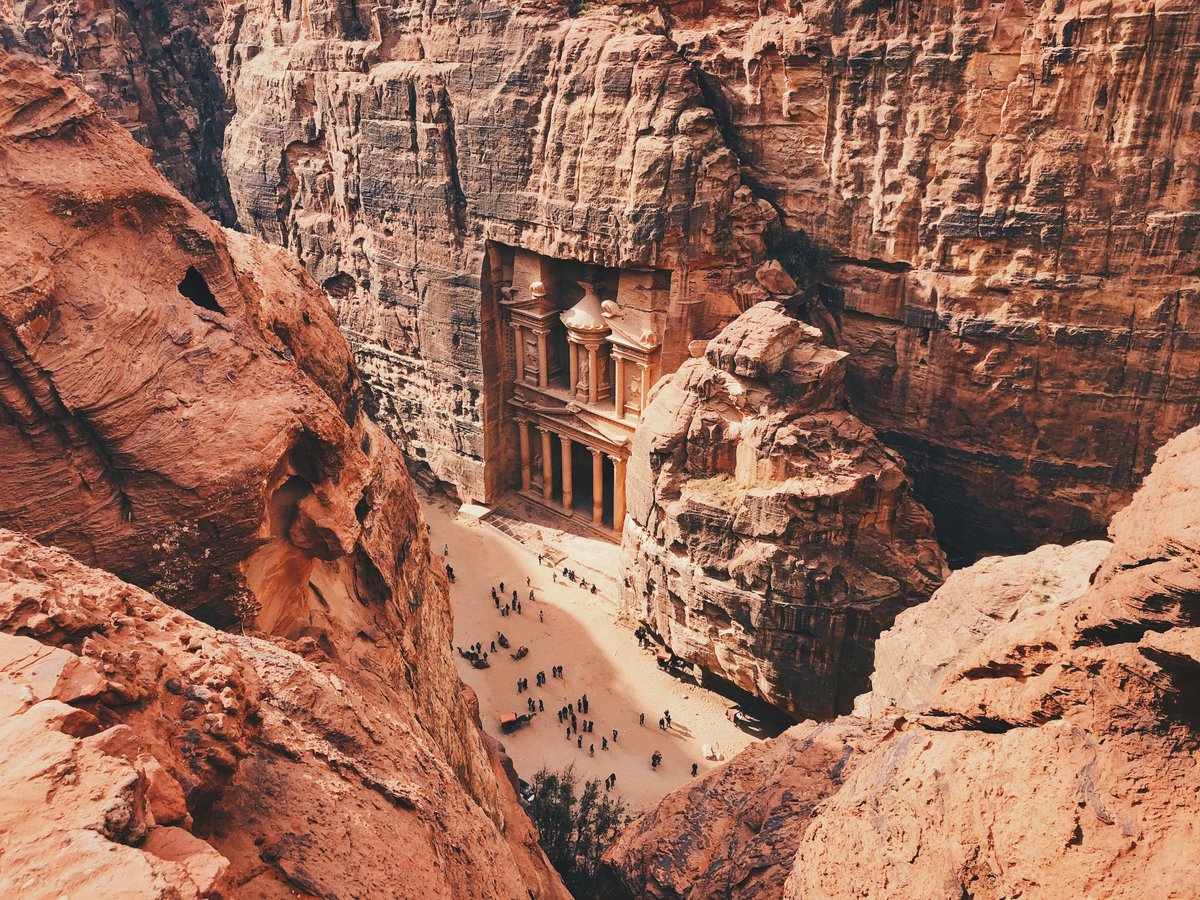
What should I pack for Petra?
Sturdy closed-toe hiking shoes with ankle support, a wide-brimmed hat, and at least 3 liters of water capacity per person. Petra's sandstone trails run 8 to 12 km in a full day, with summer temperatures reaching 38°C and almost no shade past Al Khazneh. Lightweight long pants for sun protection and local dress standards. SPF 50+ sunscreen and high-SPF lip balm.
Shop the packing list (19 items)Trail shoes or hiking boots with thick soles and ankle support. This is the single most important item. The 1.2 km walk through the Siq has uneven cobblestones worn smooth by flash floods, and the 800-step climb to Ad Deir will shred lightweight sneakers in a single visit. Sandstone is abrasive when dry, gritty underfoot, and slick after rain (uncommon in June, but possible in March and November). Expect 15,000 to 25,000 steps on a full day covering 8 to 12 km. Flip-flops are a mistake you'll feel by the second hour. Closed-toe, broken-in, grippy rubber soles.
On June 25, Petra recorded 22.6°C at 8 AM with 31% humidity. By noon it will likely reach 36 to 38°C, and humidity tends to stay below 30%. The Siq keeps you in shade until about 9:30 AM, but beyond Al Khazneh the site opens into exposed valleys where heat reflects off pale sandstone and bakes your skin from two directions at once. A wide-brimmed hat matters more than sunglasses here, though bring both. SPF 50+ sunscreen needs reapplication every 90 minutes because you'll sweat it off on the climbs. A lightweight UV-protective long-sleeve shirt beats short sleeves plus sunscreen in practice. The heat is dry, not humid, so you might not notice dehydration until you feel dizzy on the Ad Deir steps.
Carry at least 3 liters of water per person. A hydration bladder with a drinking tube works better than bottles because you'll want both hands free on the Ad Deir staircase. Bedouin vendors sell water and sweet sage tea along the main trail for 1 to 3 JOD per bottle, compared to 0.25 JOD at shops on Tourism Street in Wadi Musa. The markup is steep but the tea is worth trying. It's brewed over wood coals with a smoky, herbal sweetness that tastes better after 4 km of walking than anything you packed. The Basin Restaurant near Qasr al-Bint, about 3 km from the Visitor Centre, serves a buffet lunch for around 15 JOD. It's the only sit-down option inside the site.
Jordan is conservative by regional standards. Cover shoulders and knees, which also happens to be the smart call for sun protection across 8 km of exposed desert. Lightweight long pants in breathable fabric, cotton or merino t-shirts with sleeves. Women may want a light scarf for visiting mosques in Wadi Musa or later in Amman. After sunset, desert temperatures drop to 15 to 18°C even in June, so a packable fleece earns its weight. Jordan uses 230V with Type C, F, and G outlets. US travelers need a universal adapter. A portable charger is non-negotiable. Between GPS navigation, camera use, and the Jordan Pass QR code on your phone, expect your battery to hit 20% by early afternoon.
Skip packing bottled water, a keffiyeh, and excessive toiletries. The checkered red-and-white keffiyeh that Bedouin guides wear is the best sun protection for your neck and face, and vendors in Wadi Musa sell them for 2 to 3 JOD. Pharmacies on Tourism Street carry sunscreen for 3 to 5 JOD. The Visitor Centre shop has site maps for 1 JOD. Don't bother with a rain jacket from June through September. One thing that's hard to find locally is high-SPF lip balm. The dry heat cracks your lips within the first few hours, and Wadi Musa shops tend to stock low-SPF options at best.
Essentials
- Trail shoes or hiking boots with thick rubber soles and ankle support (broken in before the trip) Shop
- Wide-brimmed hat that won't blow off in canyon wind Shop
- SPF 50+ sunscreen, at least 100 ml for a full day Shop
- High-SPF lip balm (hard to find in Wadi Musa) Shop
- 3-liter hydration bladder or multiple water bottles Shop
- Lightweight UV-protective long-sleeve shirt Shop
- Breathable long pants (linen or quick-dry synthetic) Shop
- Portable phone charger, 10,000 mAh minimum Shop
- Universal power adapter for Jordan's 230V Type C/F/G outlets Shop
- UV-blocking sunglasses with a retention strap Shop
- Energy bars, dried fruit, or trail mix for the 8 to 12 km route Shop
- Packable fleece or light jacket for post-sunset temperatures of 15 to 18°C Shop
- Light scarf for mosque visits and additional sun protection Shop
Seasonal extras
- June to September: electrolyte tablets or powder (dry heat masks dehydration at 36 to 38°C) Shop
- June to September: cooling towel to drape over your neck past the Treasury Shop
- November to March: rain shell jacket (flash floods occur in the Siq, and rain makes the sandstone slick) Shop
- November to March: thermal base layer for early mornings at 3 to 5°C Shop
- March to April: antihistamines if you're pollen-sensitive (spring wildflowers bloom across Wadi Araba) Shop
- December to February: fleece-lined pants or thermals for Petra by Night sessions starting at 8:30 PM Shop
Buy on arrival
- Keffiyeh (red-and-white headscarf) from Wadi Musa vendors, 2 to 3 JOD
- Bottled water from Tourism Street shops, 0.25 JOD per 1.5L versus 1 to 3 JOD inside the site
- Sunscreen from Wadi Musa pharmacies, 3 to 5 JOD
- Site map from the Visitor Centre, 1 JOD
- Jordan Pass purchased online before arrival, 70 to 80 JOD depending on duration (covers Petra entry and visa fee)
- SIM card from Zain or Orange at Queen Alia airport, about 10 JOD for a tourist data plan
Last verified by automated review (v1.7.2) on . What is automated review?