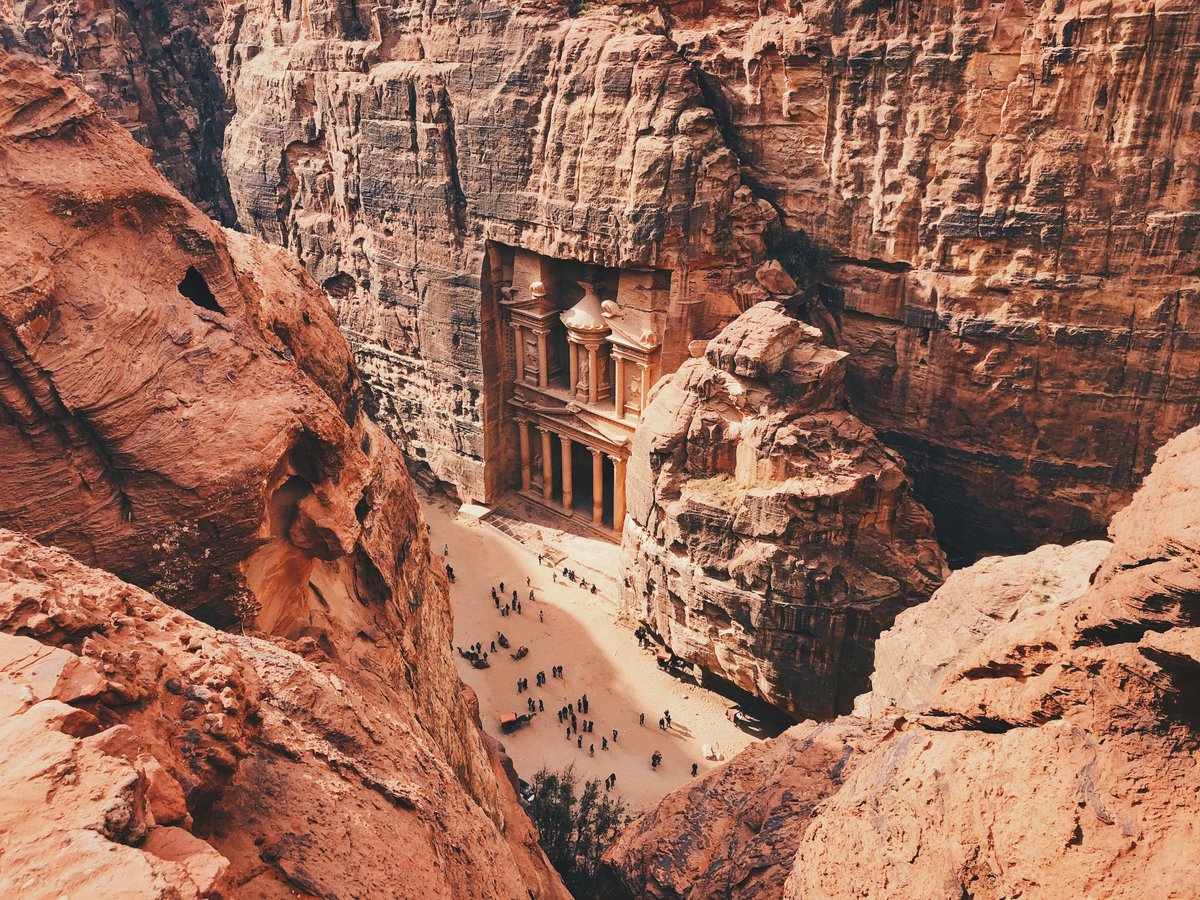
What's the must-see thing in Petra?
Al Khazneh, the Treasury, cut from living sandstone by the Nabataeans around the 1st century AD. Petra's park covers 264 square kilometres with over 800 carved monuments, but this single facade is what visitors travel to see. Buy the 55 JOD two-day pass. One day is not enough.
Swiss explorer Johann Ludwig Burckhardt became the first European to see Al Khazneh in 1812, after disguising himself as a pilgrim to pass through the Siq. The name comes from a Bedouin legend. A pharaoh supposedly hid gold inside the stone urn crowning the upper pediment. You can still see pockmarks where locals shot at the urn trying to crack it open. Up close, the sandstone holds chisel marks at shoulder height, rough and chalky under your fingertips after nearly 2,000 years. The interior is plainer than you'd expect. Two unadorned chambers cut into the rock, the air cool and faintly mineral. Excavations in 2003 uncovered tombs beneath the plaza floor, pushing the burial use back further than scholars had assumed. In late June the morning temperature sits around 23°C, a comfortable window before the exposed areas climb toward 38°C by midday. Get there early and you'll have 30 to 40 minutes before the first Amman tour buses pull into Wadi Musa, a 3-hour drive south.
The Siq formed along a natural geological fault, not by water erosion as many visitors assume. The Nabataeans widened the split and engineered it into a grand entrance. Before you enter, look for the Djinn Blocks, three squat carved monuments that likely served as memorials. The Obelisk Tomb sits above them with four pyramidal pillars. Inside the gorge the Nabataeans built a dam and tunnel system at the mouth to divert flash floods around the passage. Those floods still happen during winter storms. Fragments of the original terracotta water pipes sit in the Petra Museum near the visitor centre. Underfoot you'll find sections of Roman paving, some stones still fitted tight after two millennia. Horse-drawn carriages rattle past every few minutes at about 20 JOD return, kicking up fine dust that catches slanted light between the cliff faces. It takes about 20 minutes at a comfortable pace. The niches carved into the walls held small votive figures, most now eroded to faint outlines in the stone.
Ad Deir likely served as a Nabataean temple or biclinium, a ceremonial dining hall. Crusaders who sheltered inside centuries later carved crosses on the walls and gave it the name that stuck. The climb passes the Lion Triclinium, a small tomb with eroded lion-headed water spouts flanking its entrance. Several painted burial chambers sit along the path, and most hikers walk straight past them. Donkeys are available for the ascent at roughly 10 JOD negotiated at the basin, though the final stretch of steps is too narrow for them. The carved interior is a single massive room, dim and echoing. A niche at the back wall once held a deity block, a plain stone representing Dushara, the chief Nabataean god. Past the facade, a trail continues 10 minutes to a separate viewpoint. The rift valley drops away below, and on clear days you can trace the old trade route toward Aqaba on the Red Sea coast. The wind at the summit is strong and constant, warm even in spring. Mind you, there are no railings at the cliff edges.
A single-day ticket costs 50 JOD, about $70 USD. Two days is 55 JOD and three days 60 JOD. That pricing makes multi-day passes nearly free after the first day, and a single day forces a choice between the main Treasury trail and Ad Deir. You won't do both comfortably in peak summer heat. The visitor centre in Wadi Musa opens at 6am from April through October and at 6:30am November through March. Bring at least 2 litres of water per person. The Basin Restaurant inside the site, near the Qasr al-Bint temple, serves a lunch buffet for about 15 JOD. The food is adequate, not memorable, but there's no real alternative inside the park. To be fair, the Qasr al-Bint itself dates to roughly 30 BC. It tends to get overlooked because it sits behind the colonnaded street. It's the only freestanding Nabataean structure still standing in Petra, built from quarried blocks rather than carved from the cliff.
The top three
Al Khazneh (The Treasury)
39.1-metre Nabataean tomb facade carved around 100 AD. Arrive at 6am when the Siq's copper light hits the sandstone and the plaza holds fewer than 50 people. By 9am you're competing with thousands of visitors for a clear sightline.
Ad Deir (The Monastery)
Larger than the Treasury at 47 by 48.3 metres, reached by 800 rock-cut steps that thin the crowd to under 20 people. The 45-minute climb rewards with a nearly private plateau, Bedouin sage tea for 2 JOD, and direct afternoon light on the facade.
The Siq
The 1.2km entrance gorge is an attraction in its own right. Walls rise 80 metres, Nabataean water channels line both sides, and the temperature drops 5-8°C from the open desert. The final bend reveals the Treasury through a 2-metre-wide slot of light.
Verified attractions
Sourced from Wikidata and OpenStreetMap: each entry links to its authoritative page.
-
Petra
archaeological siteancient rock-cut historical city in Jordan
View on Wikidata -
Al Khazneh
archaeological siteThe Treasury
View on Wikidata -
Ad Deir
monumentbuilding carved out of rock in Petra, Jordan
View on Wikidata -
Siq
monumentmain entrance to city of Petra
View on Wikidata -
Tomb of Aaron
monumentsupposed burial place of Aaron, the brother of Moses
View on Wikidata -
Beidha
archaeological sitearchaeological site in Jordan
View on Wikidata -
Basta
archaeological sitePrehistoric archaeological site in Jordan
View on Wikidata -
Little Petra
archaeological sitearchaeological site in Jordan
View on Wikidata -
Qasr al-Bint
monumentTemple in Petra, Jordan
View on Wikidata -
Ba'ja
archaeological siteBa'ja is the modern name of a neolithic settlement in the Ba'ja-Massif about 14 km North of Petra in Jordan.
View on Wikidata -
Great Temple
place of worshiptemple in Jordan
View on Wikidata -
Temple of the Winged Lions
place of worshiptemple complex located in Petra, Jordan
View on Wikidata -
church of Petra
churchchurch building in Petra, Jordan
View on Wikidata -
Palace Tomb (Petra)
monumenttomb in Jordan
View on Wikidata -
Petra Theatre
archaeological siteAncient theatre in Petra, Jordan
View on Wikidata -
Tomb of the Roman Soldier
monumenttomb in Petra
View on Wikidata -
Old Petra Museum
museumcultural museum in Petra, Jordan
View on Wikidata -
Urn Tomb (Petra)
monumentView on Wikidata -
Ridge Church
churchruined church in Petra, Jordan
View on Wikidata
Last verified by automated review (v1.7.2) on . What is automated review?