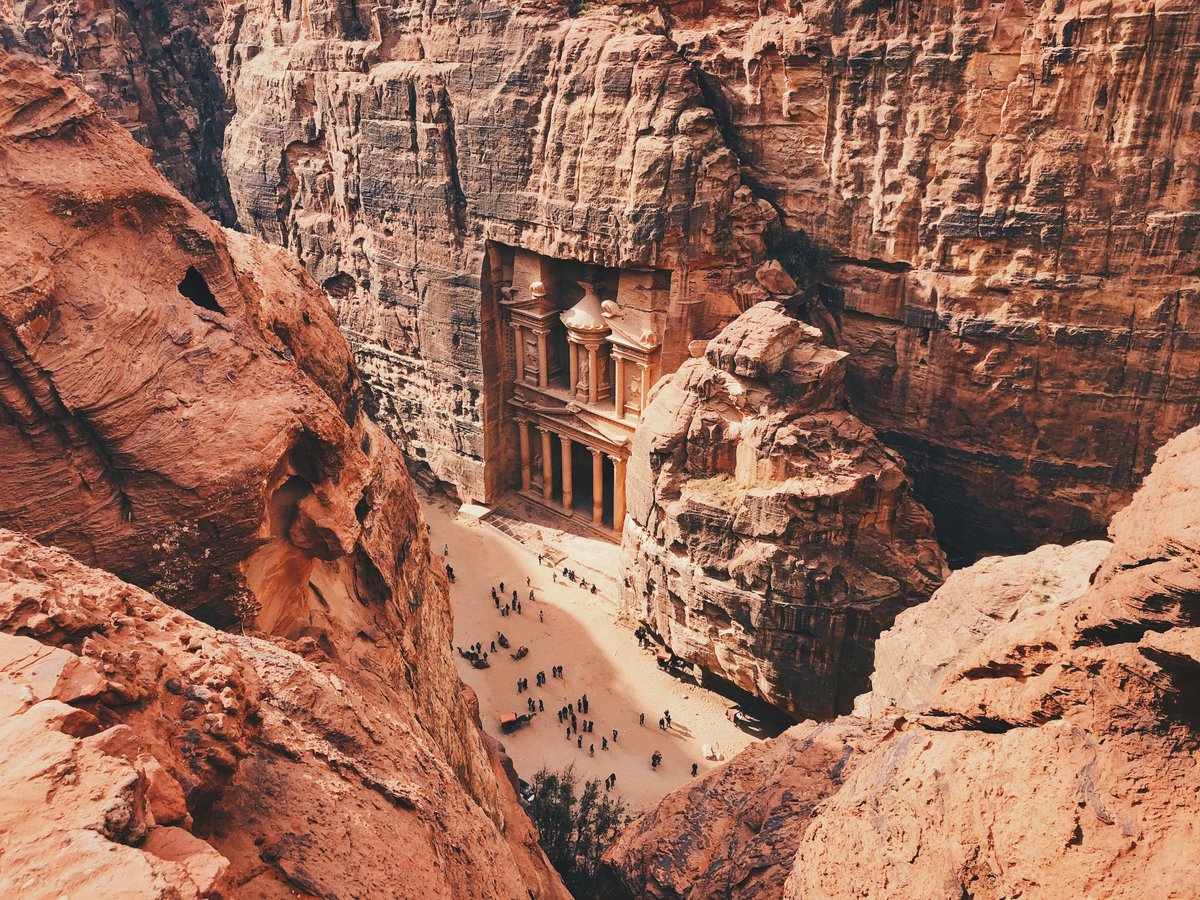
Petra is not a shopping city in any conventional sense. It is a small desert town called Wadi Musa built to serve one of the world's most visited archaeological sites, and the shopping reflects that singular purpose. You'll find Bedouin handicrafts, Nabataean-inspired pottery, and those distinctive sand bottles that have become synonymous with southern Jordan. Most of the commerce happens along a few hundred meters of road near the site entrance or inside the archaeological park itself, where Bedouin vendors set up stalls between 2,000-year-old tombs. The B'doul tribe, who were relocated from their cave dwellings inside Petra in 1985 to the nearby village of Umm Sayhoun, still run many of the stalls along the paths to the Monastery and the High Place of Sacrifice. Their work tends to carry more authenticity than the mass-produced goods near the visitor center. Wadi Musa's main commercial street has a handful of shops catering to locals, and those are worth a look if you want to see prices without the tourist markup. Mind you, this is not Amman's downtown or Madaba's mosaic workshops. Shopping here is small-scale and personal, often conducted over sweet tea with a vendor who might also offer to guide you through a back canyon the next morning.
Shopping districts
-
Wadi Musa Main Street (Tourism Street)
mid-range to high (tourist pricing)The road running downhill from the upper hotels toward the Petra Visitor Centre is lined with souvenir shops, small grocery stores, and a few restaurants. This is where the bulk of tourist-oriented commerce happens outside the archaeological site. Shops here sell sand bottles, keffiyehs, Dead Sea products, and Nabataean replica ceramics. Prices tend to start high because the owners know most visitors walk this stretch at least twice during their stay. The closer you get to the visitor center, the more concentrated and tourist-focused the shops become. A few of the upper-street shops stock genuinely good Bedouin silver, though you'll need to ask and browse rather than grab from the front display. The street gets quieter after 9 PM even during peak season.
Best for: Convenient one-stop browsing for souvenirs, Dead Sea products, and packaged Jordanian sweets
-
Petra Archaeological Park Vendor Stalls
budget to mid-rangeInside the site itself, Bedouin families operate stalls at key rest points along the walking routes. The largest cluster sits near the Basin Restaurant area between the Colonnaded Street and the path to the Monastery. Smaller setups appear along the 800-step climb to Ad-Deir and at the High Place of Sacrifice overlook. These vendors are predominantly from the B'doul and Layathneh tribes. The goods tend toward handmade jewelry, small carved stone animals, woven bracelets, and those ubiquitous sand bottles. Prices here can be more negotiable than in town, particularly late in the day when vendors are packing up. You might find a grandmother selling simple silver rings she made herself for a few dinars, sitting in the shade of a Nabataean tomb facade. That said, the selection is narrower than the shops in Wadi Musa.
Best for: Handmade Bedouin jewelry, small carved stone souvenirs, and buying directly from the artisan families
-
Wadi Musa Town Center (Local Commercial Area)
budget (local pricing)About 2 kilometers uphill from the visitor center, the older part of Wadi Musa has a small commercial district where residents shop. There's a cluster of grocery stores, a pharmacy or two, mobile phone shops, and a few places selling household goods. This is not a tourist zone, and you won't find sand bottles here. What you will find are fair prices on Jordanian staples like za'atar spice blends, olive oil, Arabic coffee with cardamom, and local honey. The supermarket near the mosque stocks a reasonable selection. Locals tend to be surprised and friendly when visitors wander up here. It's a 20-minute walk uphill from the visitor center, or a 2 JD taxi ride.
Best for: Jordanian food products at local prices, seeing everyday life away from the tourist corridor
-
Visitor Centre Complex
mid-range to high (fixed prices)The Petra Visitor Centre, renovated with support from USAID and UNESCO, has a small gift shop and a few adjacent stalls that open when the site does at 6 AM in summer. The gift shop stocks higher-quality items than most of the street vendors, including hardcover books on Nabataean archaeology, reproduction maps, and licensed Petra merchandise. Prices are fixed here, no bargaining. The quality control tends to be better, and you'll find items like Irina Khader's illustrated guides and academic publications on Petra's water systems that aren't available in the street shops. A postal counter sometimes operates nearby for sending postcards, though its hours seem unpredictable.
Best for: Books on Nabataean history, quality photography prints, and licensed Petra souvenirs
Markets
-
Bedouin Handicraft Stalls at the Basin
artisanThe Basin area, roughly midway through the archaeological site near the old Nabataean city center, has the densest concentration of Bedouin vendor stalls inside Petra. Maybe 15 to 20 small setups operate here on busy days. Women from the B'doul community sell hand-braided bracelets, beaded necklaces, and small woven items. Several vendors specialize in carved sandstone animals, taking advantage of Petra's naturally multicolored rock. The atmosphere is relaxed, shaded by tarps and ancient cliff faces. Vendors here have been selling to tourists since the 1960s, and many speak passable English, German, or French. It functions like a small artisan market, though there's no formal organization. You'll smell coffee brewing from the adjacent rest area, and the carved rock walls behind the stalls shift from rose to amber depending on the hour.
Daily during site hours, approximately 6 AM to 5 PM in summer, 6 AM to 4 PM in winter
-
Monastery Trail Vendors
artisanThe 800-step climb to Ad-Deir, Petra's Monastery, passes several Bedouin stalls positioned at natural rest points on the switchbacks. These are smaller operations, often run by a single person with a blanket of goods spread on the rock. Bottled water, fresh mint tea, simple jewelry, and small stone carvings are the main offerings. The tea stall near the top has become something of a local institution. The vendor there has been serving hikers sweet tea with sage for years, and the view from that spot across the canyon is arguably worth more than anything you'd buy. Prices are marginally higher here than at the Basin, which seems fair given someone carried the inventory up 800 steps.
Daily during site hours, weather permitting
-
Friday Morning Produce Gathering in Wadi Musa
foodWadi Musa doesn't have a formal produce market building, but on Friday mornings, a few local farmers and sellers set up near the town center area with seasonal vegetables, herbs, and fruit. It is small. Maybe 5 or 6 sellers on a good week. During spring you might find fresh almonds still in their fuzzy green shells, and in autumn there are pomegranates and figs from the Wadi Araba valley below. Local women sometimes sell dried herbs, including wild sage from the hills around Petra. This is not a tourist attraction, and you likely won't see another visitor there. Worth a walk if you're staying in a self-catering apartment and want to cook with local produce.
Friday mornings, roughly 7 AM to noon
-
Little Petra (Siq al-Barid) Vendor Area
artisanAbout 9 kilometers north of the main Petra site, Little Petra has a small cluster of Bedouin stalls near the entrance to the Siq al-Barid canyon. The Ammarin tribe operates several of these, and you'll occasionally find genuinely old Bedouin textiles and traditional woven saddlebags here alongside newer tourist items. The setting is quieter than the main site, with far fewer visitors. Some of the Ammarin Bedouin Camp cooperative's handmade goods are available here too, including woven rugs and goat-hair tent fabric. Fewer tourists means less pressure to buy, and the conversation tends to linger longer. You might end up sitting for 20 minutes hearing about the carved Nabataean dining rooms inside the canyon before anyone mentions prices.
Daily, roughly 8 AM to sunset, though vendor presence varies with tourist flow
Souvenirs worth bringing home
The sand bottles are Petra's signature souvenir, and they deserve their reputation. Local artisans layer naturally colored sandstone powder, crushed from the multicolored rock formations around the site, into glass bottles to create landscapes, camels, and geometric patterns. The craft has been practiced in this region for at least 3 generations. A small bottle takes about 10 minutes to make, a large detailed one can take over an hour. Watch for the difference between genuinely local sand (which has a subtle, earthy palette of pinks, oranges, yellows, and creams) and imported dyed sand used in cheaper versions. Bedouin silver jewelry is another worthwhile find. The older pieces, if you can locate them, feature heavy silver with turquoise or coral settings and distinctly geometric tribal patterns. B'doul women still make simpler beaded and braided pieces by hand. Nabataean-replica pottery, particularly the thin eggshell-ware style that the Nabataeans were known for around the 1st century CE, is produced by a few local potters. Bags of the local za'atar blend from Wadi Musa's shops taste noticeably different from supermarket versions in Amman, heavier on the wild thyme that grows in the surrounding hills. Olive oil soap, particularly from northern Jordan's Ajloun region, appears in many shops and makes a compact gift. Skip the mass-produced Dead Sea mud products unless you genuinely want them. They're available everywhere in Jordan, not specific to Petra, and the packaging tends to promise more than the contents deliver. A hand-carved sandstone camel, the kind where you can still see the chisel marks and the natural color banding of the rock, feels more honest as a keepsake than anything in shrink wrap.
Practical tips
- Bargaining
- Bargaining is expected in the Bedouin stalls and most Wadi Musa tourist shops. A reasonable opening offer is about 50 to 60 percent of the first asking price, and you'll likely meet somewhere around 70 percent. The visitor center gift shop and hotel shops have fixed prices. Inside the archaeological site, vendors tend to be more flexible late in the afternoon when foot traffic drops. If a vendor offers you tea, accept it. It is hospitality, not a sales obligation, and walking away after tea is completely acceptable. Aggressive bargaining over very small amounts, say less than 1 JD, is considered poor form.
- Currency and Payment
- The Jordanian dinar (JOD) is the local currency, and cash is still king in Petra's smaller shops and Bedouin stalls. Many tourist-facing shops on the main street now accept Visa and Mastercard, but expect a minimum purchase of 5 to 10 JD for card transactions. Inside the archaeological site, vendors deal in cash only. There are 2 or 3 ATMs in Wadi Musa near the main street, though they occasionally run dry during peak season. US dollars and euros are sometimes accepted in tourist shops, but the exchange rate will not be in your favor. Bring enough dinars for a day of browsing before entering the site.
- Opening Hours
- Wadi Musa's tourist shops typically open around 8 AM and close by 9 or 10 PM during high season, from March through May and September through November. In the slower summer months and deep winter, some shops close earlier or don't open at all on slow days. Friday is the Islamic day of rest, and a few shops close or open late. Inside the archaeological park, vendor stalls operate during site hours, which shift seasonally. The local grocery stores in the upper town keep later hours than the souvenir shops, some staying open until 11 PM.
- Tax Refunds
- Jordan has a 16 percent sales tax, and a tax refund scheme exists for tourists at Queen Alia International Airport in Amman. In practice, very few Petra shops participate in the refund program, and the minimum purchase threshold and paperwork requirements make it impractical for typical souvenir purchases. If you're buying something substantial, ask the shop whether they can provide a tax refund invoice. The refund desk at the airport is in the departure hall after passport control. Keep receipts organized, but realistically, the hassle-to-savings ratio for small purchases is not worth it.
- Shipping and Packing
- Sand bottles are fragile. If you buy one, ask the vendor to seal the opening with wax or glue, which most will do automatically. Wrap bottles in clothing in the center of your luggage rather than near the edges. For larger items like pottery or rugs, a few of the more established shops on Wadi Musa's main street offer shipping, though delivery times to Europe or North America can run 4 to 8 weeks. Jordan Post operates a small office in Wadi Musa where you can send parcels, but bring your own packing materials.
- Avoiding Mass-Produced Imports
- A fair amount of what's sold as local handicraft in Wadi Musa is manufactured elsewhere. Chinese-made keffiyehs, Pakistani-made decorative daggers, and Egyptian-made papyrus bookmarks all appear in Petra's shops. Look for signs of handwork, like uneven stitching, asymmetrical patterns, or natural stone coloring. If every item on a shelf looks identical, it likely came from a factory. The Noor Al Hussein Foundation's Jordan River Designs label, when you spot it, indicates fair-trade Jordanian-made goods. Buying directly from Bedouin women inside the site is the most reliable way to get something genuinely made by local hands.
FAQ
Can I buy things inside the Petra archaeological site?
Yes. Bedouin families from the B'doul and Layathneh tribes operate stalls at several points inside the site, particularly around the Basin area and along the trail to the Monastery. They sell handmade jewelry, carved stone animals, woven bracelets, sand bottles, and drinks. Cash only. The vendors have operated inside the park for decades under agreements with the Petra Development and Tourism Region Authority.
Are the colored sand bottles worth buying, or are they a tourist trap?
The handmade ones are worth it. The craft has real local roots in southern Jordan, and a well-made bottle using naturally colored Petra sandstone is a genuinely skillful piece of work. Watch the artisan make it if possible, since the process itself is impressive. Avoid the very cheapest pre-made bottles, which sometimes use dyed sand and lack the subtle natural color variations. A small handmade bottle might cost 3 to 5 JD, while a larger detailed piece could reach 15 to 25 JD depending on complexity.
Is it safe to buy old Bedouin jewelry and antiques in Petra?
Genuinely old Bedouin silver pieces do circulate in Petra's shops and stalls, though they've become harder to find as demand has risen. Jordan does not currently restrict the export of Bedouin jewelry. Be cautious of items described as Nabataean or Roman antiquities, since exporting genuine archaeological artifacts from Jordan is illegal under the Antiquities Law, and most supposed ancient coins or pottery fragments offered to tourists are reproductions anyway. For Bedouin silver, feel the weight and look for natural patina rather than uniform polish.
What are the best hours to shop inside the Petra site?
Late afternoon, roughly after 3 PM, tends to be the best time. Most day-trippers from Amman and Aqaba are heading back by then, foot traffic drops, and vendors become more relaxed and willing to negotiate. The light inside the canyon also shifts to warmer tones in the afternoon, which makes the browsing itself more pleasant. Early morning, when the site opens at 6 AM, is quiet too, but most vendors are still setting up before 8 AM.
Should I shop in Petra or wait until Amman or the Dead Sea?
For sand bottles and Bedouin handicrafts, Petra is the better place to buy. The selection is stronger, the connection to the artisan community is more direct, and prices are comparable to or sometimes lower than Amman's tourist shops in the downtown souk. For Dead Sea products, you'll find a wider and cheaper selection at the Dead Sea resort shops or the factory outlets along the Dead Sea highway. For general Jordanian crafts, Amman's Rainbow Street area and the Wild Jordan Center offer curated selections at fixed prices, which some visitors prefer to bargaining.
Last verified by automated review (v1.7.2) on . What is automated review?