Stay in Petra in November
52 hotels in the Trip.com pool for Petra, from US$10 a night.
Opens Trip.com on Fri 6 Nov to Sun 8 Nov 2026; change the dates there.
November is likely the second-best month to visit Petra, and it comes down to temperature. Daytime highs settle around 21°C (70°F), which means you can spend 6 or 7 hours walking the sandstone canyons between the Siq and Ad-Deir without the heat exhaustion that makes summer visits genuinely dangerous. Nights drop to about 13.5°C (56°F), cool enough that you'll feel the chill walking back through the Siq after a Petra by Night session on a Wednesday evening. The summer crowds from the Gulf states have left, and the European spring-break rush is still 4 months away. That said, November is not a secret. Experienced operators and repeat visitors know this window, and you'll share the Al-Khazneh viewpoint with plenty of others between 9am and noon.
The rain risk is real but manageable. Petra typically sees about 20mm across 4 rainy days in November, which sounds mild until you remember that desert rain falls fast and the Wadi Musa drainage system funnels water directly through the Siq. Flash flood warnings close the narrow canyon a few times each autumn, sometimes with only 30 minutes notice. The Jordanian tourism police tend to err on the side of caution, which means you might lose half a day to a closure. Build at least one buffer day into your itinerary. The olive harvest is underway in the hills around Tafileh Governorate, and you'll find fresh-pressed oil at roadside stalls along the King's Highway. The landscape has shifted from summer brown to something closer to golden, with patches of green returning where the first rains have reached the soil.
Why visit in November
- Temperatures around 21°C (70°F) allow full-day exploration of the 60+ sq km site without heat risk, unlike the 33°C (91°F) highs that make August walks through the open basin near Qasr al-Bint dangerous
- Rainfall averages only 20mm across the month, giving you roughly 26 dry days to work with, compared to February's 41mm
- The olive harvest in the Tafileh and Wadi Musa hills adds a food dimension that spring visitors miss entirely. Fresh zayt zeitoun appears at family stalls within hours of pressing
- Petra by Night sessions on Monday, Wednesday, and Thursday evenings feel genuinely atmospheric at 14°C (57°F), unlike the stifling July version where the Siq radiates stored heat
- Shorter queues at the Petra Museum near the main entrance, and easier access to the Ad-Deir trail, which gets congested in the March-April peak
Worth knowing
- Flash flood risk in the Siq and Wadi Farasa is a real safety concern. November's rain tends to arrive in short, intense bursts, and the 2022 Siq flooding that went viral was a November event
- Hotel rates in Wadi Musa run high because operators know this is prime season. Expect to pay 30-50% above Jordan's annual average for 4-star properties like the Movenpick near the gate
- Sunset comes early, around 4:45pm, cutting your usable daylight in the site to roughly 8 hours if you enter at the 6am opening. The Monastery trail alone takes 3-4 hours round trip
- Some days carry a biting wind off the Sharah Mountains that makes the exposed High Place of Sacrifice trail feel colder than the 21°C reading suggests
Best for
Think twice if
November in Petra feels like a crisp Mediterranean autumn. Mornings start cool, around 13.5°C (56°F), with a noticeable chill in the Siq where the narrow walls block sunlight until mid-morning. By noon the site warms to around 21°C (70°F), comfortable in a t-shirt if you are moving. You might catch a faint smell of woodsmoke drifting from Umm Sayhoun village on still mornings. The 4 rainy days tend to cluster, often arriving as 2-day systems that drop most of the month's 20mm in concentrated bursts. Humidity sits at a comfortable 55%, low enough that sweat dries quickly on the uphill sections. Wind picks up in the open basin around Qasr al-Bint most afternoons.
Seasonal caution
- Flash flooding in the Siq and lower wadis is the primary safety risk. November rain often falls as short, intense storms, and runoff from the Sharah Mountains can reach the Siq within 30 minutes. The 2022 November flooding forced emergency evacuations. Always check with the Petra Development and Tourism Region Authority office near the main gate before entering, and exit the Siq immediately if you hear rushing water or see sudden muddying of standing pools
- Wind chill on exposed trails. The High Place of Sacrifice and the Ad-Deir viewpoint sit above 1,000m elevation. When the Sharah wind picks up, perceived temperatures can drop to 8°C (46°F) even when the basin floor reads 18°C (64°F). Hypothermia risk exists for underdressed hikers caught on these trails at sunset
Year-round climate
Averages from the last 5 years.
| Month | Avg high (°C) | Avg low (°C) | Rainfall (mm) |
|---|---|---|---|
| Jan | 14 | 7 | 33 |
| Feb | 14 | 6 | 41 |
| Mar | 18 | 9 | 37 |
| Apr | 25 | 14 | 11 |
| May | 28 | 17 | 6 |
| Jun | 31 | 21 | 0 |
| Jul | 32 | 22 | 0 |
| Aug | 33 | 23 | 0 |
| Sep | 30 | 20 | 1 |
| Oct | 25 | 17 | 4 |
| Nov | 21 | 14 | 20 |
| Dec | 16 | 9 | 35 |
Best things to do in November
Full-day Siq to Ad-Deir traverse
hikingStart at the main gate at 6am, walk the 1.2km Siq corridor to Al-Khazneh (the Treasury), continue through the basin past the Colonnaded Street and Qasr al-Bint temple, then climb the 850-step trail to Ad-Deir (the Monastery). The full route covers roughly 12km round trip with about 400m of elevation gain. November's 21°C highs make this feasible as a single outing without the dehydration risk of summer months.
At 21°C with low humidity, the exposed 850-step climb to Ad-Deir is demanding but safe. In July or August, this same climb sends several visitors per week to the Wadi Musa clinic with heat exhaustion.Booking tipEnter at the 6am opening to reach Ad-Deir by 9am, before tour groups arrive from Aqaba and Amman. The Monastery viewpoint gets crowded between 10am and 2pm.
Petra by Night
culturalThe walk through the candlelit Siq to Al-Khazneh runs on Monday, Wednesday, and Thursday evenings, starting at 8:30pm. About 1,500 paper bag luminaries line the 1.2km path, and the Treasury facade is lit by candles at its base. A Bedouin musician typically plays rababa (a single-string instrument) in the Treasury plaza. The whole event lasts roughly 2 hours.
November evening temperatures around 14°C (57°F) are cool enough for comfortable walking but not bitterly cold. The July version, by contrast, traps you in radiated heat between the Siq walls, which still hold the day's 40°C warmth.Booking tipTickets are sold separately from day passes. Buy at the visitor center before 7pm on the day of the session, as they sometimes cap numbers.
High Place of Sacrifice summit hike
hikingThe trail starts near the Theatre and climbs about 170m to a Nabataean sacrificial altar platform at roughly 1,035m elevation. The summit gives 360-degree views over the Petra basin, Wadi Araba to the west, and the Sharah range to the east. Two carved obelisks mark the approach. The round trip takes about 90 minutes at a moderate pace.
November's lower sun angle creates dramatic side-lighting across the basin in the early morning. The trail is fully exposed, so summer attempts involve direct sun for the entire climb. November's 21°C and occasional breeze make the ascent comfortable.Booking tipGo before 8am to catch the sunrise light on the basin and avoid the midday tour-group traffic. The descent via the Wadi Farasa route passes the Lion Fountain and the Garden Temple.
Jordan Trail segment from Dana to Petra
trekkingThe 4-day, 73km trekking route from Dana Nature Reserve to Petra crosses the Sharah highlands, drops through Wadi Feynan, and enters Petra from the back (Little Petra) entrance. The terrain ranges from sandstone canyons to Bedouin grazing plateaus above 1,400m. You'll need a guide for the route, and most operators run fixed-departure groups in October and November.
November temperatures in the 15-21°C range are ideal for multi-day trekking with a loaded pack. Water sources along the route are more reliable after the autumn rains begin. By January, the Sharah highlands can drop below freezing at night.Booking tipBook with a licensed Jordan Trail operator at least 4 weeks ahead. November departures fill first because the conditions are well-known among experienced trekkers.
Little Petra (Siq al-Barid) morning visit
culturalThis smaller Nabataean site sits 9km north of the main Petra entrance and takes about 90 minutes to explore. The carved dining rooms (tricliniums) still show traces of 2,000-year-old painted plaster ceilings. The site sees a fraction of the main Petra traffic. A narrow siq leads to a series of carved facades, cisterns, and chambers used as a trading suburb of the main city.
November mornings at Little Petra are quiet, with few visitors before 10am. The site has no shade structures, so the mild November temperatures make the open-air exploration comfortable. The painted Biclinium ceiling is best viewed in morning light when the sun enters the chamber directly.Booking tipNo separate ticket is needed. Drive or take a taxi from Wadi Musa. Combine with the backdoor trail into the main Petra site if you have a valid multi-day pass.
Wadi Rum day trip from Petra
day tripThe 110km drive south from Wadi Musa to Wadi Rum village takes about 90 minutes. November's clear skies and moderate temperatures make a full day in the desert comfortable. A typical 4x4 tour covers Lawrence's Spring, Khazali Canyon with its Thamudic inscriptions, the red sand dunes near Um Ishrin, and the natural rock bridges. The sandstone formations glow deep orange in the late afternoon light.
November daytime temperatures in Wadi Rum sit around 22-24°C, warm enough for comfortable exploring but cool enough that the 4x4 doesn't feel like a furnace. The summer months routinely hit 38°C on the open sand. Clear November skies also mean reliable stargazing if you stay overnight at a Bedouin camp.Booking tipBook a Wadi Rum tour operator separately from your Petra visit. Most Wadi Musa hotels can arrange transport and a day tour, but booking directly with a Wadi Rum camp often gets better value.
What to eat in November
On menus now
Musakhan
This Palestinian-Jordanian dish of roasted chicken over taboon bread, drenched in fresh olive oil and layered with caramelized onions and sumac, peaks when the new oil arrives. November musakhan in Wadi Musa restaurants tastes sharply different from the version made with last year's oil. The bread itself tends to be slightly charred from the taboon oven, with a smoky chew that flatbread from a regular oven can't replicate.
Mansaf
Jordan's national dish appears year-round, but November wedding season in the Bdul Bedouin communities around Petra means more mansaf feasts than usual. The lamb is slow-cooked in fermented dried yogurt (jameed) from Karak, served over a mound of rice. You'll smell the tangy, slightly sour jameed broth from across any gathering. Some Wadi Musa restaurants serve a version on Fridays that gets close to the communal original.
What to drink
Fresh pomegranate juice
Pomegranate harvest runs through November in the Jordan Valley and the warmer wadis near the Dead Sea. Street vendors in Wadi Musa town center press them to order, the deep red juice tart enough to make you wince on the first sip. A glass after a full day on the trails is one of those small November pleasures.
In markets
Zayt zeitoun (fresh-pressed olive oil)
The olive harvest peaks across Tafileh Governorate in November. Families in Wadi Musa and the surrounding villages press their crop at small stone mills, and you can buy single-estate oil still cloudy with sediment, with a peppery bite that fades within weeks of pressing. Look for roadside stalls along the King's Highway between Tafileh and Wadi Musa.
Regular events in November
Olive pressing season in Tafileh villagesFree
Family-run stone mills across Tafileh Governorate press the autumn olive harvest throughout November. Some mills welcome visitors to watch the pressing process and taste the fresh oil. The villages of Dana and Busayra along the King's Highway are particularly active.
Throughout NovemberBedouin wedding season
November's mild weather and post-harvest timing make it a popular month for Bdul Bedouin weddings in the communities around Petra. You might hear music and celebration from Umm Sayhoun village in the evenings. The communal mansaf feasts that accompany these events are a central tradition.
Weekends throughout NovemberBest places this November
Al-Khazneh (The Treasury)
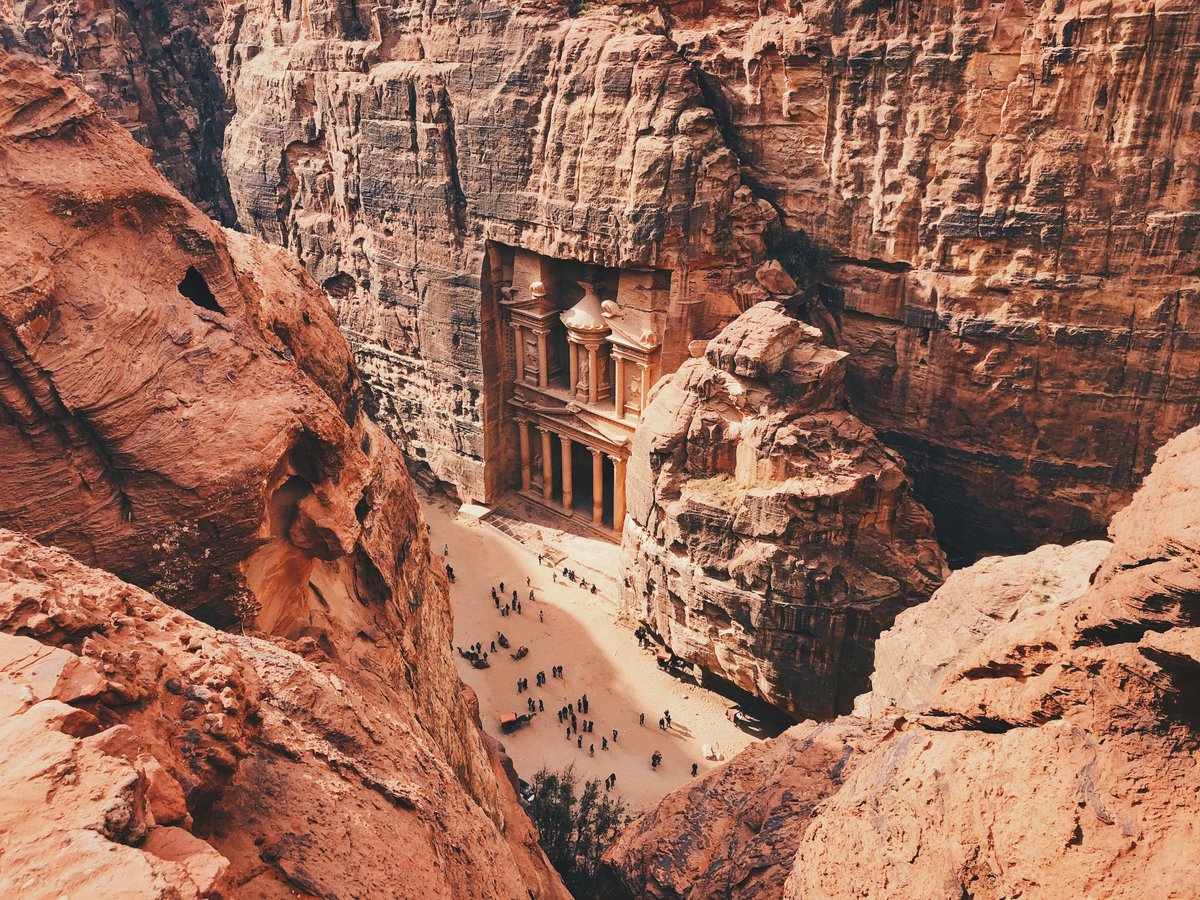
archaeological sitePetra's iconic 40m-tall carved facade, built as a royal tomb in the 1st century BC. November's low-angle morning sun hits the facade directly around 9:30-10am, warming the sandstone to a deep salmon pink. The narrow Siq frames it dramatically on approach. Arrive before 8am or after 3pm to see it without dense crowds.
Central PetraAd-Deir (The Monastery)
archaeological siteA 47m-wide carved facade reached by climbing 850 rock-cut steps from the basin floor. Larger than the Treasury but less visited because of the climb. The November afternoon sun lights the facade with warm side-light around 2-3pm. A small Bedouin tea stall near the viewpoint sells sage tea.
Northwest PetraRoyal Tombs ridge
archaeological siteA row of 4 monumental tomb facades carved into the eastern cliff face of the main basin. The Urn Tomb, Silk Tomb, Corinthian Tomb, and Palace Tomb are best viewed in the late afternoon when the setting sun turns the sandstone deep orange. The Urn Tomb interior was later converted into a Byzantine church, and you can still see the arched windows.
East cliff, central PetraPetra Museum
museumOpened in 2019, this modern museum near the main entrance holds over 280 artifacts from the Nabataean period, including pottery, coins, jewelry, and carved stone. It provides context for the site that the ruins alone cannot convey. The Nabataean hydraulic engineering exhibit explains the water channels you'll notice carved into the Siq walls.
Visitor center complexLittle Petra (Siq al-Barid)
archaeological siteA compact Nabataean trading suburb 9km north of the main site. The painted Biclinium ceiling, with its 2,000-year-old vine and cherub frescoes, is one of the best-preserved Nabataean painted surfaces in existence. The narrow siq and carved facades echo the main site at a fraction of the scale and crowd level.
North of Wadi MusaDana Nature Reserve
nature reserveJordan's largest nature reserve stretches from the Sharah highlands at 1,500m down to the Wadi Araba rift valley floor at 50m below sea level. November is one of the best months for the Rummana to Feynan trail, a 14km descent through sandstone gorges. The reserve is home to Nubian ibex, and you might spot them on the rocky slopes in the early morning.
50km north of Petra via King's HighwayWadi Musa town center
townThe small town that serves as Petra's gateway has a handful of local restaurants, a few grocery shops, and a central mosque. The main street runs downhill toward the Petra visitor center. November evenings are cool enough for a post-site walk through town, and the pomegranate juice vendors set up along the main road during harvest season.
Wadi Musa
Your packing checklist
Tick items off as you pack. Your progress saves in this browser.
All packed — have a great trip.
Insider tips
The Treasury facade catches direct sunlight between roughly 9:30am and 11am in November, when the sun clears the eastern Siq walls. Photographers who arrive at 6am and wait near the Siq exit get the best light without the midday crowds. By noon the facade is in shadow again.
The back trail from Little Petra into the main site via the Monastery trail lets you approach Ad-Deir from above, reversing the usual direction. You descend the 850 steps instead of climbing them. This route requires a valid multi-day Petra pass but avoids the main gate entirely.
Bedouin tea stalls inside the site sell sage tea (maramiyya) brewed over charcoal. The one near the Ad-Deir viewpoint is a good rest stop after the climb. Mind you, prices inside the site run higher than in Wadi Musa town.
The Wadi Farasa descent route from the High Place of Sacrifice passes the Lion Fountain, the Garden Temple, and the Roman Soldier Tomb. Most guided tours skip it because it adds 45 minutes. It is quieter and more varied than the main staircase descent.
If the Siq closes for flood risk, the trail from the Petra Museum area up to the Royal Tombs ridge still tends to be accessible. You can spend a productive 3-4 hours on the eastern cliff face trails without needing Siq access.
Avoid these mistakes
- Planning only 1 day for Petra. The site covers over 60 sq km, and a single day realistically lets you see the Siq, Treasury, and basin floor. The Monastery, High Place of Sacrifice, Royal Tombs, and Wadi Farasa route need a second day at minimum. November's early 4:45pm sunset makes this even more important.
- Ignoring flash flood warnings. The 2022 November Siq flooding showed how fast water can rise. Some visitors try to wait out closures inside the site, but the Jordanian tourism police evacuate the canyon for good reason. If the Siq closes, use the time for Little Petra or the Petra Museum instead of waiting at the gate.
- Wearing sandals or fashion sneakers. The basin floor paths are manageable in light shoes, but any trail beyond the main route involves uneven rock, loose gravel, and carved steps worn smooth over 2,000 years. Ankle injuries are the most common medical issue at the site clinic.
- Skipping the Petra Museum. It opened in 2019 and provides context that the ruins alone cannot. The Nabataean hydraulic engineering section explains the water channels visible in the Siq walls. Most visitors walk right past it on the way to the gate.
- Underestimating water needs. The Bedouin stalls sell drinks but they are irregularly spaced, and the 850-step Monastery climb has no water source. November's mild temperatures can be deceptive. You still lose moisture on steep climbs at low humidity.
Practical tips for November
November daylight runs from about 6:15am to 4:45pm, giving roughly 10.5 hours of light. The Petra site gate opens at 6am and closes at 4pm in winter months, though you can remain inside until sunset if you entered before closing. Multi-day passes offer better per-day value than single-day tickets. Check the Petra Development and Tourism Region Authority for current pricing, as fees have been adjusted several times in recent years. The visitor center near the main gate posts daily weather and flood-risk updates each morning. Wadi Musa has a small number of ATMs, but they sometimes run dry on weekends, so carry cash from Amman or Aqaba. The King's Highway route from Amman to Petra (about 4 hours) passes through Madaba, Kerak Castle, and the Dana Nature Reserve viewpoint, and is a far more scenic drive than the Desert Highway (3 hours).
FAQ
Is November a good time to visit Petra?
November is likely the second-best month after October. Daytime highs around 21°C (70°F) allow full-day exploration without heat risk, and the 4 rainy days are manageable with planning. The main trade-off is that experienced travelers know this window, so expect high season crowds at the Treasury between 9am and noon.
How many days do I need for Petra in November?
Two days is the practical minimum. Day 1 covers the Siq, Treasury, basin floor, Colonnaded Street, and Qasr al-Bint. Day 2 adds the Ad-Deir climb (3-4 hours round trip) and the High Place of Sacrifice. Three days lets you add the Wadi Farasa route, Royal Tombs ridge, and Little Petra without rushing. November's 4:45pm sunset shortens your daily window.
What should I wear to visit Petra in November?
Layering works best. A breathable base for midday walking in 21°C, a fleece for the 13°C mornings and Siq shade, and a windproof shell for exposed ridge trails where gusts can drop the perceived temperature to 8-10°C. Sturdy hiking shoes with ankle support are important for the uneven rock-cut steps on the Monastery and High Place trails.
Is Petra safe during November rain?
The site itself is safe in light rain, but the Siq becomes dangerous when flash floods are possible. The Petra authorities close the Siq canyon when heavy rain is forecast, sometimes with only 30 minutes notice. The 2022 November flooding demonstrated how quickly water can rise. Build a buffer day into your itinerary so a closure does not eliminate your visit entirely.
Can I visit Wadi Rum and Petra in the same trip in November?
Yes, and November is one of the best months for this combination. Wadi Rum sits 110km south of Petra, about 90 minutes by car. November temperatures in the desert run around 22-24°C during the day, comfortable for 4x4 tours and short hikes. Most travelers spend 2-3 days at Petra, then 1-2 nights at a Wadi Rum camp. Clear November skies make the desert stargazing particularly good.
Find a flight to Petra
Live fares to Petra appear here once cookies are accepted.
Last verified by automated review (v1.7.2) on . What is automated review?