Stay in Petra in September
52 hotels in the Trip.com pool for Petra, from US$10 a night.
Opens Trip.com on Fri 3 Sep to Sun 5 Sep 2027; change the dates there.
September in Petra marks the turning point. After 3 months where afternoon temperatures at the site regularly topped 32°C (90°F), the average high drops to 29.5°C (85°F) and mornings settle around 20°C (68°F). That shift sounds modest on paper, but inside the Siq's narrow sandstone corridor, where trapped heat radiates off 80-meter walls, the difference between August and September is the difference between endurance and enjoyment.
You'll still want to start walking by 6:30 AM, when the Visitor Centre gates open and the Siq fills with cool blue shadow. By noon the exposed climb to Ad-Deir can feel punishing. But late afternoons become genuinely pleasant, with golden light hitting the Treasury facade around 4 PM and temperatures dropping into the mid-20s (mid-70s°F). Rainfall in September averages 1mm total. You might not see a single cloud for your entire trip.
This is shoulder season on the cusp of Petra's busiest period, October through November. Hotel rates in Wadi Musa tend to sit 20-30% below their October peaks, tour groups haven't arrived in force yet, and you can photograph Al-Khazneh without 40 other visitors in your frame. The Jordanian school year starts in September, so domestic tourism drops off too. If you can handle warm afternoons and commit to early mornings, September offers a version of Petra that the peak-season crowds never get to see.
Why visit in September
- Crowd levels at Petra sit well below the October-November peak, which means you can linger at the Treasury or the Royal Tombs without jostling for photos
- Hotel rates in Wadi Musa run 20-30% lower than peak season, with guesthouses that charge 80-100 JOD per night in November currently asking 55-75 JOD
- The 29.5°C (85°F) average high is a meaningful drop from August's 33°C (91°F), and by late afternoon the exposed trail sections become comfortable rather than draining
- Virtually zero rain. September averages 1mm total, so you won't lose a hiking day to weather, and the Siq's flash-flood risk is negligible
- The low-angle September sun hits the rose-red sandstone at longer angles than summer, creating deeper shadows and richer color on the facade carvings, particularly at the Urn Tomb and the Palace Tomb between 3 PM and 5 PM
Worth knowing
- Midday temperatures still push past 30°C (86°F) on exposed sections like the 800-step climb to the Monastery, making the 11 AM to 2 PM window tough for extended hiking
- Some tour operators and adventure outfits in Wadi Musa remain on reduced summer schedules through mid-September, so multi-day treks to Jabal Haroun may require booking 2 weeks ahead
- The 48% humidity is low by global standards, but the dry desert air can dehydrate you faster than you realize. Visitors from humid climates sometimes underestimate how much water they need on a 12 km round-trip day
- Petra by Night runs only 3 evenings per week, and the smaller September crowds can ironically make it feel less atmospheric than in peak months when 300-400 candles illuminate the full Siq path
Best for
Think twice if
September in Petra is dry, warm, and sunny with virtually no rain. Mornings start around 20°C (68°F), which feels cool enough for the sandstone canyon of the Siq. By midday the temperature climbs to 29-30°C (85-86°F) in the open. Humidity sits around 48%, which is comfortable but deceptive. The desert air wicks moisture from your skin without visible sweat, so you can dehydrate before you feel thirsty. Evenings cool quickly once the sun drops behind the western ridge, sometimes falling 10°C within an hour. You'll likely want a light layer for dinner in Wadi Musa.
Seasonal caution
- UV index at Petra's 900-meter (2,950 ft) elevation is typically 8-9 in September, rated 'very high' by WHO standards. Sunburn can develop within 20 minutes of unprotected exposure on the exposed plateau sections near the High Place of Sacrifice
- Dehydration risk is elevated because the 48% humidity and persistent breeze mask fluid loss. Plan for 3-4 liters (0.8-1 gallon) of water per person for a full day at the site. The only reliable water refill inside Petra is at the Basin Restaurant near Qasr al-Bint
Year-round climate
Averages from the last 5 years.
| Month | Avg high (°C) | Avg low (°C) | Rainfall (mm) |
|---|---|---|---|
| Jan | 14 | 7 | 33 |
| Feb | 14 | 6 | 41 |
| Mar | 18 | 9 | 37 |
| Apr | 25 | 14 | 11 |
| May | 28 | 17 | 6 |
| Jun | 31 | 21 | 0 |
| Jul | 32 | 22 | 0 |
| Aug | 33 | 23 | 0 |
| Sep | 30 | 20 | 1 |
| Oct | 25 | 17 | 4 |
| Nov | 21 | 14 | 20 |
| Dec | 16 | 9 | 35 |
Headline events
Mawlid an-Nabi (Prophet's Birthday)
Early September 2026 (12 Rabi al-Awwal, shifts ~11 days earlier each Gregorian year)
Jordan marks the Prophet Muhammad's birthday as a national public holiday. Banks, government offices, and some shops in Wadi Musa close for the day. The atmosphere is quiet and respectful rather than festive, with some families making sweets and distributing food. Petra itself remains open to visitors, and you'll likely encounter fewer Jordanian day-trippers at the site.
Best things to do in September
Sunrise hike through the Siq to the Treasury
hikingEnter the site when gates open at 6:30 AM and walk the 1.2 km Siq corridor as the first light creeps down the canyon walls. In September the sun angle sends a warm beam onto Al-Khazneh's upper facade by around 7:15 AM, while the lower half stays in cool shadow. The temperature in the Siq at this hour sits around 20-22°C (68-72°F). With low September crowds, you might have the Treasury plaza to yourself for 10-15 minutes.
Summer's extreme heat made this dawn window the only option. In September it's still the best strategy, but the payoff is better because the light angle creates a half-lit, half-shadowed Treasury that's gone by October when the sun sits lower.Booking tipNo booking needed. Arrive at the Visitor Centre by 6:15 AM. The ticket office opens at 6:00 AM.
Late afternoon climb to the Monastery (Ad-Deir)
hikingThe 800-step trail from the Basin Restaurant to Ad-Deir gains about 200 meters (650 ft) of elevation through a series of switchbacks carved into the rock. Starting at 3:30 PM in September, you climb as the worst heat fades and reach the Monastery around 4:15 PM. The west-facing facade catches direct golden light until about 5:30 PM. A small Bedouin tea stall at the top sells sage tea for 2-3 JOD, and you can sit on the rocks opposite the facade as the sandstone shifts from rose to amber.
In July and August the trail is dangerously hot until 5 PM, leaving no time to enjoy the top before closing. September's lower temperatures open a full 2-hour afternoon window. By October tour groups reclaim this time slot.Booking tipEnsure your Petra ticket covers the full day. The site currently closes at 6 PM in September, giving you enough time if you start by 3:30 PM.
Petra by Night candlelit walk
cultural1,500 paper-bag luminaries line the floor of the Siq and the plaza before Al-Khazneh. The 2 km walk takes about 25 minutes at a contemplative pace. A Bedouin musician plays rababa (a single-stringed instrument) in front of the Treasury while tea is served. The September night air sits around 22-24°C (72-75°F), warm enough for a t-shirt. The smaller September audience, sometimes under 100 people versus 300+ in peak season, makes the experience more intimate.
Low September attendance means you're less likely to be stuck behind a slow-moving group in the narrow Siq, and the candlelit plaza feels calmer. October crowds change the dynamic significantly.Booking tipRuns Monday, Wednesday, and Thursday evenings, starting at 8:30 PM. Buy tickets at the Visitor Centre by late afternoon. They can sell out even in low season because capacity is capped.
Day trip to Little Petra (Siq al-Barid)
sightseeingA 15-minute drive north of Wadi Musa, Little Petra is a smaller Nabataean site with carved dining chambers, cisterns, and a painted ceiling in the Painted House that still shows remnants of 2,000-year-old frescoes. The short siq here is about 350 meters long and requires no entry fee. In September the site rarely has more than 10-15 visitors at any given time. The carved facades catch morning light well, and the slot canyon stays cool until midday.
The combination of free entry, zero crowds, and comfortable morning temperatures makes September the sweet spot for Little Petra. In peak season, tour buses arrive by 9 AM.Booking tipNo booking needed. Free entry. Drive or arrange a taxi from Wadi Musa for 5-7 JOD each way.
High Place of Sacrifice (Al-Madbah) at dawn
hikingThis alternative to the main Siq route branches off about 600 meters into the canyon and climbs steeply to a Nabataean altar platform at 1,035 meters (3,395 ft) elevation. The 360-degree panorama from the top covers the entire Petra basin, Wadi Araba, and on clear September mornings the mountains of the Negev across the border. The climb takes 30-45 minutes and the trail is well-marked with Nabataean rock-cut steps.
September's dry, clear air gives visibility that the hazier winter months can't match. Starting at 6:30 AM, you reach the summit before the heat builds. In peak season this trail gets congested with guided groups after 8 AM.Booking tipCovered by your Petra entry ticket. Bring a headlamp if you start before sunrise. The descent via Wadi Farasa passes the Lion Fountain and the Garden Tomb.
Wadi Rum overnight desert camp
adventureThe 90-minute drive south from Wadi Musa to Wadi Rum drops you into a different landscape entirely. September nights in the desert are warm enough, around 18-20°C (64-68°F), to sleep comfortably under the stars without winter-grade gear. Many camps set up mattresses on the sand outside the tents. The Milky Way is clearly visible in September's moonless windows, and the sandstone formations hold the day's warmth well into the evening.
Summer nights in Wadi Rum can stay above 25°C (77°F), making tents stuffy. Winter nights drop below 5°C (41°F). September hits the narrow band where outdoor sleeping is genuinely comfortable.Booking tipBook your camp at least a week ahead. Check the lunar calendar and aim for a night within 5 days of the new moon for the best stargazing. Most camps include a zarb dinner and a 4x4 tour.
Trail from the Treasury to the Royal Tombs via the Street of Facades
sightseeingThis 2 km walk follows the ancient processional route past dozens of carved tomb facades, through the Theatre (seats 4,000), and along the base of the cliff face to the cluster of monumental Royal Tombs. The Urn Tomb, the Silk Tomb, the Corinthian Tomb, and the Palace Tomb each catch afternoon light differently. In September you can take this walk around 3 PM without the crowds that pack the path in October and November.
The low visitor count in September means you can enter the Urn Tomb's interior chamber (converted to a Byzantine church in 446 AD) and study the arched interior alone. In peak season there's a steady queue.Booking tipCovered by Petra entry ticket. The Royal Tombs are about 1.5 km from the main entrance, so factor in 30 minutes of walking each way.
What to eat in September
In season: fruit
Fresh figs (teen)
September is peak fig season in the highlands around Wadi Musa and Taybeh. Roadside vendors sell them by the kilo for 1-2 JOD. The local black figs are smaller and sweeter than the green Turkish variety, with a honeyed interior that tends to split open when fully ripe. You'll find them at breakfast spreads in most Wadi Musa guesthouses.
Grapes (enab)
The Shoubak and Tafilah highlands harvest table grapes through September. Local varieties lean toward small, seeded, intensely sweet clusters rather than the watery supermarket type. Several Wadi Musa restaurants serve them alongside white cheese and fresh bread as a meze starter.
On menus now
Mansaf
Jordan's national dish is available year-round, but the dried fermented yogurt (jameed) produced in the spring and summer months around Tafilah and Karak tends to be freshest in September. The lamb is slow-cooked in rehydrated jameed sauce and served over a mound of rice and paper-thin shrak bread.
Zarb (Bedouin underground barbecue)
Several camps near Little Petra and in Wadi Rum cook zarb, a method where lamb, chicken, and root vegetables are buried in sand over hot coals for 3-4 hours. The meat comes out fall-apart tender with a faint smoky sweetness. September evenings are warm enough to eat outdoors at the Bedouin camps near Beidha without needing heavy blankets.
What to drink
Pomegranate juice (aseer rumman)
Early pomegranates from the Jordan Valley start appearing in September. Street-side juice vendors in Wadi Musa press them to order for around 1.5 JOD a glass. The September fruit tends to be slightly tart, not yet reaching the deep sweetness of the October-November harvest, but it's cold and refreshing after a day at the site.
Regular events in September
Petra by Night
Candlelit walk through the Siq to Al-Khazneh, with Bedouin music and tea. Runs year-round but September's smaller crowds make it feel more personal than the peak-season version.
Every Monday, Wednesday, and Thursday evening at 8:30 PMJordanian school year openingFree
Public and private schools across Jordan resume in early September. Wadi Musa becomes noticeably quieter as local families shift to the school routine, and domestic tourism to Petra drops. Some family-oriented restaurants adjust their hours.
First week of SeptemberOlive harvest season opening in Dana Nature Reserve
The villages around Dana Nature Reserve, about 50 km north of Petra on the King's Highway, begin their olive harvest in late September. Some guesthouses in Dana Village offer half-day olive-picking experiences with local families. The RSCN Dana Guesthouse can arrange visits.
Late September through NovemberBest places this September
Al-Khazneh (The Treasury)
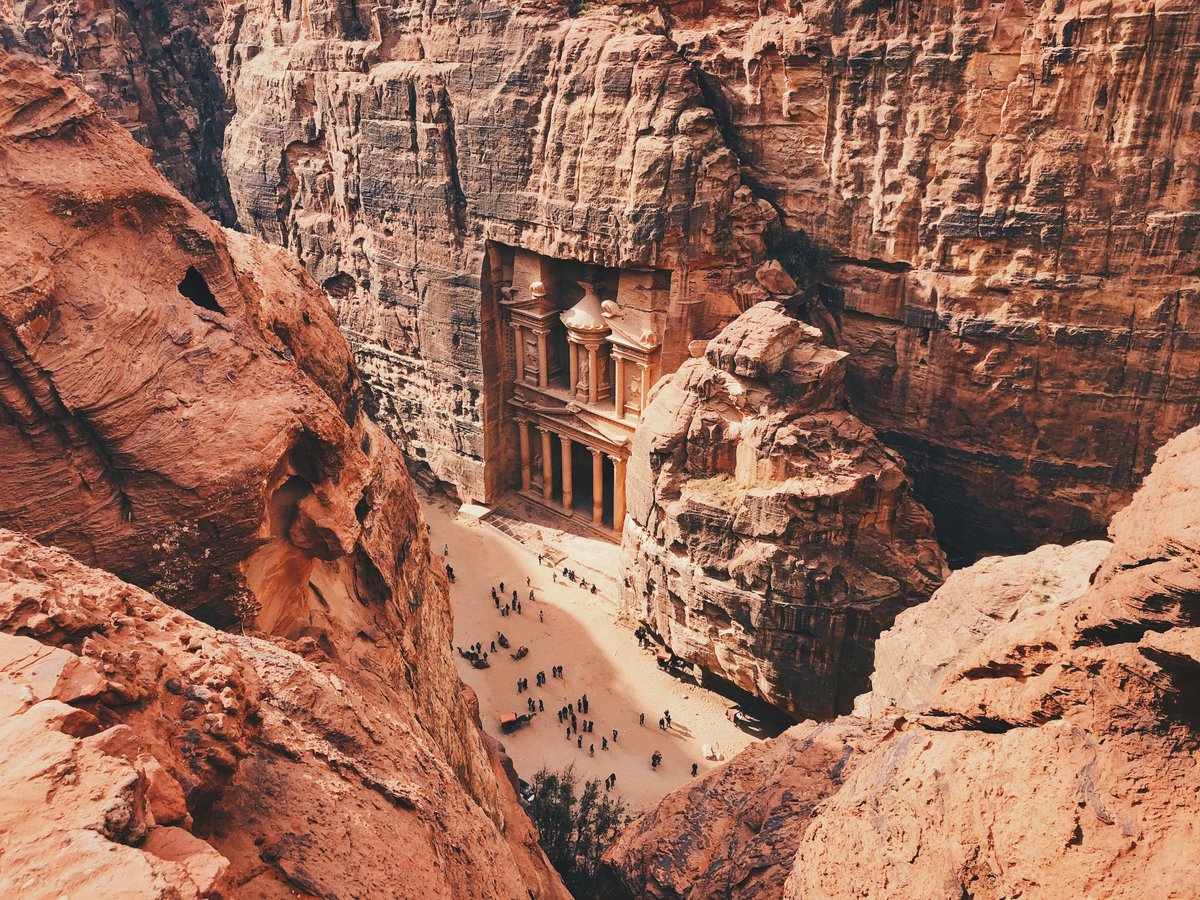
archaeological sitePetra's most photographed monument. The 40-meter-tall Hellenistic facade was likely built in the 1st century BC under King Aretas IV. In September the plaza in front of the Treasury is often empty before 7:30 AM. The sandstone shifts between pink, orange, and amber depending on the light angle. Morning visitors get cool shadow in the Siq and a partially sunlit facade. Afternoon visitors around 4 PM get full golden-hour illumination.
Central PetraThe Siq
natural formationThe 1.2 km narrow gorge that serves as the main entrance to Petra. Walls rise to 80 meters (260 ft) in places, keeping the corridor shaded and cool even in September. Look for the remnants of the Nabataean water channel carved into the left wall, and the worn camel caravansary niches at about the halfway point. The temperature inside the Siq typically runs 4-5°C below the open plateau.
Petra entranceQasr al-Bint
archaeological siteThe only freestanding building in Petra that still retains most of its walls. This 1st-century BC temple sits at the end of the Colonnaded Street and tends to be overlooked by visitors heading straight for the Monastery. In September you might have the surrounding plaza entirely to yourself at midday. The Basin Restaurant nearby is the only sit-down food option inside Petra.
Central Petra basinWadi Farasa trail and the Lion Fountain
hiking trailA quieter descent route from the High Place of Sacrifice that passes the Garden Tomb, the Roman Soldier Tomb, and a small carved lion fountain that once channeled water from a Nabataean aqueduct. The trail is mostly shaded by canyon walls in the morning, making it a cooler alternative to the main path. September foot traffic on this trail is likely under 30 visitors per day.
Western PetraLittle Petra (Siq al-Barid)
archaeological siteA smaller Nabataean suburb about 9 km north of the Petra Visitor Centre, near the Neolithic settlement of Beidha. The Painted House at the far end of the siq still has visible Hellenistic-era frescoes of vines, birds, and cupids on its ceiling. Free entry, no crowds in September. The narrow canyon stays cool until about 11 AM.
BeidhaDana Nature Reserve
nature reserveA 50 km drive north on the King's Highway from Wadi Musa brings you to Jordan's largest nature reserve, covering 320 sq km from sandstone cliffs to the Wadi Araba rift valley floor. September temperatures at Dana Village (about 1,500 m elevation) sit around 24-26°C (75-79°F), cooler than Petra. The RSCN operates a cliff-edge guesthouse with views across the canyon. Ibex sightings are common at dawn.
Dana VillageUmm Sayhoun viewpoint
viewpointThe Bedouin village of Umm Sayhoun sits on the ridge above Petra, and several informal viewpoints along the road offer panoramic looks down into the site. September's clear skies and low haze make this a good sunset spot. A few Bedouin families in the village sell handmade jewelry and tea.
Umm Sayhoun
Your packing checklist
Tick items off as you pack. Your progress saves in this browser.
All packed — have a great trip.
Insider tips
The ticket office opens at 6:00 AM but the site gate doesn't open until 6:30 AM. Buy your Jordan Pass online before arriving and you skip the ticket queue entirely, which matters because the first 15 minutes in the Siq before any tour groups arrive is the most atmospheric part of the day.
Most visitors walk straight through the Siq to the Treasury and continue to the Monastery. The quietest part of the site in September is the area around Qasr al-Bint and the Colonnaded Street at midday, when almost everyone is either at Ad-Deir or has left the site for lunch. You'll have the Great Temple excavation to yourself.
Taxi drivers in Wadi Musa will quote 15-20 JOD for the trip to Little Petra. The actual local rate is 5-7 JOD each way. Agree on the price and confirm it includes waiting time before you get in. Several Wadi Musa hotels will arrange a driver at the lower rate.
If you're staying more than 2 days, consider the back entrance to Petra via Umm Sayhoun. It drops you near the Royal Tombs and lets you explore the site in reverse, hitting the Monastery first thing in the morning while main-entrance visitors are still in the Siq. Not every ticket type allows this, so confirm at the Visitor Centre.
The water at Wadi Musa guesthouses is safe to drink from the tap, though it has a mineral taste from the local aquifer. Fill your bottles at the hotel rather than buying plastic bottles. The tap water in Amman is also drinkable.
Avoid these mistakes
- Attempting the full Treasury-to-Monastery round trip at midday. The 12 km route involves at least 4 hours of walking with significant elevation gain, and September's 30°C (86°F) peak turns the exposed sections into a dehydration risk. Split the site across 2 days, or do the Siq and Treasury at dawn and the Monastery climb after 3:30 PM.
- Underestimating water needs because the air feels dry and comfortable. At 48% humidity, you lose fluid through evaporation faster than in tropical heat. Visitors regularly show up at the Basin Restaurant midday with headaches and dizziness after carrying only 1 liter from the entrance.
- Booking only 1 day at Petra to save on the 50 JOD daily entry fee. The Jordan Pass bundles the visa fee (40 JOD) with Petra entry, and the 3-day Petra option adds only 5 JOD over the 1-day version. A single day forces you to rush past 90% of the site, and in September's heat you physically cannot cover everything before the midday slowdown.
- Wearing sandals or fashion sneakers for the Monastery climb. The 800 rock-cut steps are uneven, sandy, and occasionally loose. In September the stone heats up through the day, and the descent is harder on ankles than the climb. At least 2-3 visitors per week in peak season need medical attention for ankle injuries on this trail.
Practical tips for September
The Jordan Pass is the most cost-effective entry method for Petra and should be purchased online before arriving in Jordan. It covers your tourist visa (40 JOD), Petra entry for 1, 2, or 3 days, and access to 40+ other sites across Jordan including Jerash and Wadi Rum. The 3-day Petra Sights pass costs 75 JOD total. September hours at Petra are currently 6:00 AM to 6:00 PM (gate opens at 6:30 AM). Petra by Night tickets cost 17 JOD and are sold separately from daytime entry. Book at the Visitor Centre by late afternoon on your chosen evening. Wadi Musa has ATMs (Cairo Amman Bank and Arab Bank both have machines near the town center), but some Bedouin vendors inside Petra accept only cash in Jordanian dinars. The closest hospital is the Queen Rania Al-Abdullah Hospital in Wadi Musa, about 3 km from the Visitor Centre. A handful of Bedouin stalls inside the site sell water and snacks at 2-3x Wadi Musa prices. Dress modestly in town, covering shoulders and knees, though at the archaeological site itself the dress code is relaxed. JETT bus runs a daily Amman-to-Wadi Musa service (about 4 hours, 12 JOD one way) departing from Amman's 7th Circle station at 6:30 AM. September temperatures make renting a car worthwhile for side trips to Dana Nature Reserve and the King's Highway.
FAQ
Is September a good time to visit Petra?
September is a good time to visit, though not the absolute best. It ranks about 5th out of 12 months. The heat has dropped noticeably from the summer peak, with average highs of 29.5°C (85°F) compared to August's 33°C (91°F). Crowds are low and hotel prices sit 20-30% below the October-November peak. The main tradeoff is that midday hours on exposed trails are still warm enough to slow you down. If you have flexibility, October (25°C highs, similar dryness, slightly more visitors) is the more comfortable choice. But September rewards early risers with emptier trails, better hotel rates, and a quality of light that's hard to beat.
What is the weather like in Petra in September?
September in Petra is hot and bone-dry. The average high reaches 29.5°C (85°F) and the average low drops to 20.1°C (68°F). Rainfall averages 1mm for the entire month, with zero rainy days typical. Humidity sits at a comfortable 48%. The temperature swings through the day are sharp. Early mornings in the Siq feel pleasant, around 20-22°C (68-72°F), but by midday exposed areas like the plateau near the High Place hit 30°C+ (86°F+). Evenings cool quickly after sunset. Pack for layers rather than a single weight of clothing.
Is Petra crowded in September?
No. September has some of the lowest visitor numbers of the year. The summer heat keeps most tourists away, and the October-November peak season hasn't started yet. You can expect to share the Treasury plaza with perhaps 10-20 other visitors at any given time in the morning, compared to 100+ in November. The Monastery trail is quiet. Tour buses are sparse. Petra by Night, capped at a few hundred visitors, might draw under 100 people. If avoiding crowds is a priority, September and June are likely your best options, with September being the more comfortable of the two.
How many days do I need for Petra in September?
Two days minimum, three if you want to include Little Petra and the less-visited trails. September's midday heat cuts your effective hiking window to roughly 6:30 AM to 11:30 AM and 3:00 PM to 6:00 PM, which means you cover less ground per day than you would in October or November. A realistic 2-day split would put the Siq, Treasury, Royal Tombs, and Colonnaded Street on day 1, then the Monastery and High Place of Sacrifice on day 2. The 3-day Jordan Pass option costs only 5 JOD more than the 1-day pass, so there's little financial reason to rush.
Can you visit Petra and Wadi Rum in the same September trip?
Yes, and September is a particularly good month for combining both. Wadi Rum sits about 90 minutes south of Wadi Musa by car. September nights in the desert are warm enough (18-20°C / 64-68°F) for comfortable outdoor sleeping without winter gear, but not as stifling as July-August nights. A common itinerary spends 2-3 days at Petra, drives to Wadi Rum for an overnight desert camp with a jeep tour, then returns to Aqaba or Amman. Book your Wadi Rum camp at least a week ahead since the better-reviewed camps like those near Rum Village operate with limited September staff.
Find a flight to Petra
Live fares to Petra appear here once cookies are accepted.
Last verified by automated review (v1.7.2) on . What is automated review?