Stay in Petra in May
52 hotels in the Trip.com pool for Petra, from US$10 a night.
Opens Trip.com on Fri 7 May to Sun 9 May 2027; change the dates there.
May in Petra is warm, dry, and reliably sunny. Daytime highs average 27.5°C (82°F) with humidity around 37%, which means the heat feels direct but not oppressive. The sandstone radiates warmth under your palms by mid-morning, and the air inside the Siq carries a faint mineral coolness that fades the moment you step into the open basin beyond the Treasury. Overnight lows drop to 17°C (63°F), comfortable enough to walk back through the canyon after Petra by Night without needing more than a light layer. Rainfall registers at a negligible 6mm for the whole month, and the risk of flash floods through the Siq, which occasionally close the trail during the wetter months of January through March, drops to almost zero.
This is the quiet pivot between Petra's spring peak and its summer lull. The Easter and Passover crowds from April have thinned, and the European tour groups that dominate from October through March are mostly gone. You'll still share the trail with other visitors, but you might wait 5 minutes for a clear shot at Al-Khazneh instead of 20. At the Royal Tombs across the valley, you could have 10 minutes alone with the carved facades. The spring wildflowers above Wadi Musa are finished by mid-May, but oleander still blooms pink along the wadi bed near the Colonnaded Street, and the stronger May sun turns Nabataean sandstone a deeper red-orange than it shows in winter.
One date worth noting. Jordan celebrates Independence Day on May 25, and the long weekend draws domestic visitors to Petra from Amman, Irbid, and Aqaba. Hotels in Wadi Musa tend to fill up around that date, and you'll hear more Arabic than English on the trails. If you are flexible on timing, the first two weeks of May typically offer the best balance of weather, thin crowds, and hotel availability.
Why visit in May
- Nearly zero rainfall at 6mm for the month means dependable sunshine and virtually no risk of the flash floods that have historically closed the Siq during the wetter months of January through March.
- Morning temperatures around 17-20°C (63-68°F) make the 800-step climb to Ad-Deir comfortable before 10am, a window that shrinks dramatically once June arrives and highs reach 31°C.
- Crowds thin measurably from the Easter and Passover peak in April, so the Royal Tombs, the High Place of Sacrifice, and the back trails see fewer tour groups and more individual travelers.
- Petra by Night operates under reliably clear, dry skies in May, without the winter cloud cover that can wash out the candlelit view of Al-Khazneh on January or February evenings.
Worth knowing
- Afternoon temperatures can push past 30°C (86°F) on exposed stretches like the climb to the High Place of Sacrifice, and shade is scarce outside the Siq and a few narrow side canyons.
- The spring wildflower season that carpets the hillsides above Wadi Musa and along the trails to Jabal Haroun from March through early April is mostly finished by mid-May.
- Jordan's Independence Day on May 25 creates a domestic travel surge, and hotels in Wadi Musa around that date fill quickly with limited last-minute options.
Best for
Think twice if
May brings warm, dry conditions to Petra with near-constant sunshine and negligible rainfall. Mornings start cool at around 17°C (63°F), warming steadily through the day to an average high of 27.5°C (82°F) by early afternoon. Humidity hovers at 37%, low enough that sweat evaporates quickly but high enough to avoid the parching dryness of deep summer. The occasional hot day can touch 32-33°C, though these are the exception rather than the rule. Winds are generally light, with the occasional afternoon gust carrying fine desert dust through the open sections of the site.
Seasonal caution
- UV index in southern Jordan reaches 9-10+ in May. The sandstone canyon walls reflect sunlight, increasing effective UV exposure. Sunburn can happen within 30 minutes on exposed skin, even on overcast days.
- Dehydration risk is real at 37% humidity. Sweat evaporates before you feel wet, which masks how much fluid you are losing. Plan for 3-4 liters of water per full day inside the site.
Year-round climate
Averages from the last 5 years.
| Month | Avg high (°C) | Avg low (°C) | Rainfall (mm) |
|---|---|---|---|
| Jan | 14 | 7 | 33 |
| Feb | 14 | 6 | 41 |
| Mar | 18 | 9 | 37 |
| Apr | 25 | 14 | 11 |
| May | 28 | 17 | 6 |
| Jun | 31 | 21 | 0 |
| Jul | 32 | 22 | 0 |
| Aug | 33 | 23 | 0 |
| Sep | 30 | 20 | 1 |
| Oct | 25 | 17 | 4 |
| Nov | 21 | 14 | 20 |
| Dec | 16 | 9 | 35 |
Best things to do in May
Dawn walk through the Siq to Al-Khazneh
sightseeingThe 1.2km walk through the narrow Siq canyon opens into the Treasury facade at sunrise. In May, the gates open at 6am, and the first light hits Al-Khazneh within 30-40 minutes. The canyon walls still hold overnight coolness, the sandstone glows in warm tones, and you might share the view with only a handful of other early risers.
May sunrise at roughly 5:30am means the 6am gate opening catches near-perfect soft light on the Treasury. Summer months have earlier sunrises that outpace the gate time, and winter mornings start colder at 7°C.Booking tipNo booking needed, but arrive at the visitor center by 5:45am. The walk from Wadi Musa town center takes about 10 minutes.
Morning climb to Ad-Deir (The Monastery)
hikingThe 800+ rock-cut steps from the valley floor to Ad-Deir take 40-60 minutes depending on your pace. The Monastery itself is larger than the Treasury at 47 meters wide by 48 meters tall, and the viewing platform opposite catches full morning sun. The trail passes Bedouin tea stalls and a handful of small tombs carved into the cliff face.
Morning temperatures of 17-20°C in May make the climb genuinely comfortable. By June, the same hike in 31°C heat with no shade becomes a serious exertion. Aim to reach the top by 9am.Booking tipNo booking needed. Start the climb no later than 7:30am in May to finish before the heat builds.
Petra by Night
culturalThe walk through the Siq by candlelight ends at the Treasury, where roughly 1,500 paper-bag luminaries line the canyon floor. A Bedouin musician plays the rababa (a single-string instrument) and the sound echoes off the sandstone walls. The whole experience takes about 2 hours.
May's dry, cloudless skies mean the candles are never rained out, and the 17°C evening temperature makes the outdoor seating comfortable without the winter chill that sends visitors back early.Booking tipRuns Monday, Wednesday, and Thursday evenings. Buy tickets at the visitor center in Wadi Musa by late afternoon, as sessions can sell out during busy weeks.
Wadi Muthlim alternate entrance route
hikingThis narrow side canyon enters Petra from the north, bypassing the Siq entirely. The route involves some light scrambling over boulders and wading through shallow water pools. It emerges near the Painted House and joins the main trail before the Treasury. A local guide is recommended.
May's near-zero rainfall makes this flash-flood-prone canyon safe to enter. During the wetter months of January through March, the route is sometimes closed entirely after storms.Booking tipHire a guide through the Petra visitor center or your hotel in Wadi Musa. This route is not officially signposted and should not be attempted alone or after rain.
Siq al-Barid (Little Petra) at sunset
sightseeingThis smaller Nabataean site 9km north of Petra has carved dining halls, cisterns, and the painted Biclinium ceiling, one of the only surviving examples of Nabataean fresco painting. The site is free to enter and rarely crowded. The short canyon catches late-afternoon light beautifully.
May's thinner crowds mean you can photograph the Biclinium painted ceiling without waiting for other groups to clear. Sunset at around 6:45pm gives comfortable temperatures for the 15-minute walk through the canyon.Booking tipNo booking needed. Drive or take a taxi from Wadi Musa. Open during daylight hours with no ticket required.
High Place of Sacrifice at golden hour
hikingThe trail from the main valley climbs 170 meters to a Nabataean altar platform with 360-degree views over Petra, Wadi Araba, and the distant hills toward the Israeli border. The carved drainage channels for sacrificial blood are still visible in the rock. The descent via the Wadi Farasa trail passes the Lion Fountain and the Garden Temple.
May sunset around 6:45pm gives comfortable late-afternoon temperatures for the 45-minute ascent, and the dry, clear air provides sharp visibility to the horizon. Summer heat makes the exposed climb unpleasant after noon.Booking tipStart the climb around 4:30pm in May. Bring a headlamp for the descent if you stay for full sunset.
Wadi Rum overnight desert camp
adventureThe desert landscape of Wadi Rum lies 110km south of Petra and pairs naturally with a Petra visit. Overnight camps range from basic Bedouin tent setups to transparent bubble tents under the stars. The silence of the desert at night is striking after the daytime activity of the archaeological site.
May nighttime lows around 15-17°C are warm enough to sleep comfortably in a tent without the 35°C daytime heat that makes June-August camping exhausting. Stargazing clarity is excellent with virtually zero rainfall and low humidity.Booking tipBook Wadi Rum camps at least 1 week ahead in May, especially for weekend dates. Many camps include dinner (zarb) and a 4x4 desert tour.
Dana Nature Reserve day hike
natureDana sits about 50km north of Petra and protects a deep sandstone valley that drops from 1,500 meters at the village rim to 50 meters below sea level at Feynan. The Wadi Dana trail (14km, 5-6 hours) is one of Jordan's finest day hikes, passing through four distinct biozones with Nubian ibex sightings common along the upper cliffs.
Late spring means migratory birds pass through Dana, and the reserve's higher elevation keeps wildflowers blooming 2-3 weeks longer than the lower Petra basin. May temperatures at the 1,500m rim start around 15°C, ideal for a long hike.Booking tipThe Wadi Dana trail requires a guide, bookable through the RSCN (Royal Society for the Conservation of Nature) visitor center at Dana Village. Book 3-4 days ahead in May.
What to eat in May
In season: fruit
Mishmish (apricots)
Late May marks the start of Jordan's apricot harvest. Roadside stalls in Wadi Musa sell bags of small, intensely flavored apricots that taste nothing like the pale imports in European supermarkets. The Jordan Valley is one of the oldest apricot-growing regions in the world.
Akidinia (loquats)
These small orange-yellow fruits reach peak season in May across Jordan. The flavor sits somewhere between apricot and pear, with a slight tartness. Look for them at the Friday produce stands in Wadi Musa.
Tout (mulberries)
Dark purple and intensely sweet, mulberries appear at roadside stalls and small shops in Wadi Musa throughout May. They stain everything they touch. Worth it.
On menus now
Zarb (Bedouin underground barbecue)
Lamb or chicken slow-cooked for 3-4 hours in a pit buried under sand and coals. The meat comes out falling-apart tender with a faint smoky char. May's comfortable camping temperatures make this easier to find at Wadi Rum Bedouin camps, and some Wadi Musa restaurants offer their own version.
What to drink
Maramiyyeh (wild sage tea)
Bedouin tea stalls inside Petra brew this from sage picked in the surrounding hills. The spring harvest in May tends to produce the most aromatic leaves. The scent hits you before you see the stall. A couple of dinars per glass, poured from a blackened kettle over an open fire near the Royal Tombs.
Regular events in May
Jordan Independence DayFree
Jordan's national holiday marks the country's independence from the British Mandate in 1946. Domestic tourism rises sharply around this date, with Jordanian families visiting Petra, Aqaba, and the Dead Sea. Expect busier trails and fuller hotels in Wadi Musa.
May 25International Workers' DayFree
A public holiday in Jordan. Government offices and some shops in Wadi Musa close, but Petra itself remains open at normal hours. A quieter day overall if you are already at the site.
May 1Petra by Night
The candlelit walk through the Siq to the Treasury runs year-round on Monday, Wednesday, and Thursday evenings. Separate ticket required, purchased at the Wadi Musa visitor center. Each session starts at 8:30pm and lasts about 2 hours.
Every Monday, Wednesday, and Thursday eveningBest places this May
The Siq
canyonThe 1.2km narrow canyon entrance to Petra stays cooler than the open valley in May. The walls rise 80 meters on either side, and the shifting light creates constantly changing color bands on the sandstone. In May's dry conditions, you can walk the full length without worrying about the flash-flood risk that sometimes closes it in winter.
Main entranceAl-Khazneh (The Treasury)
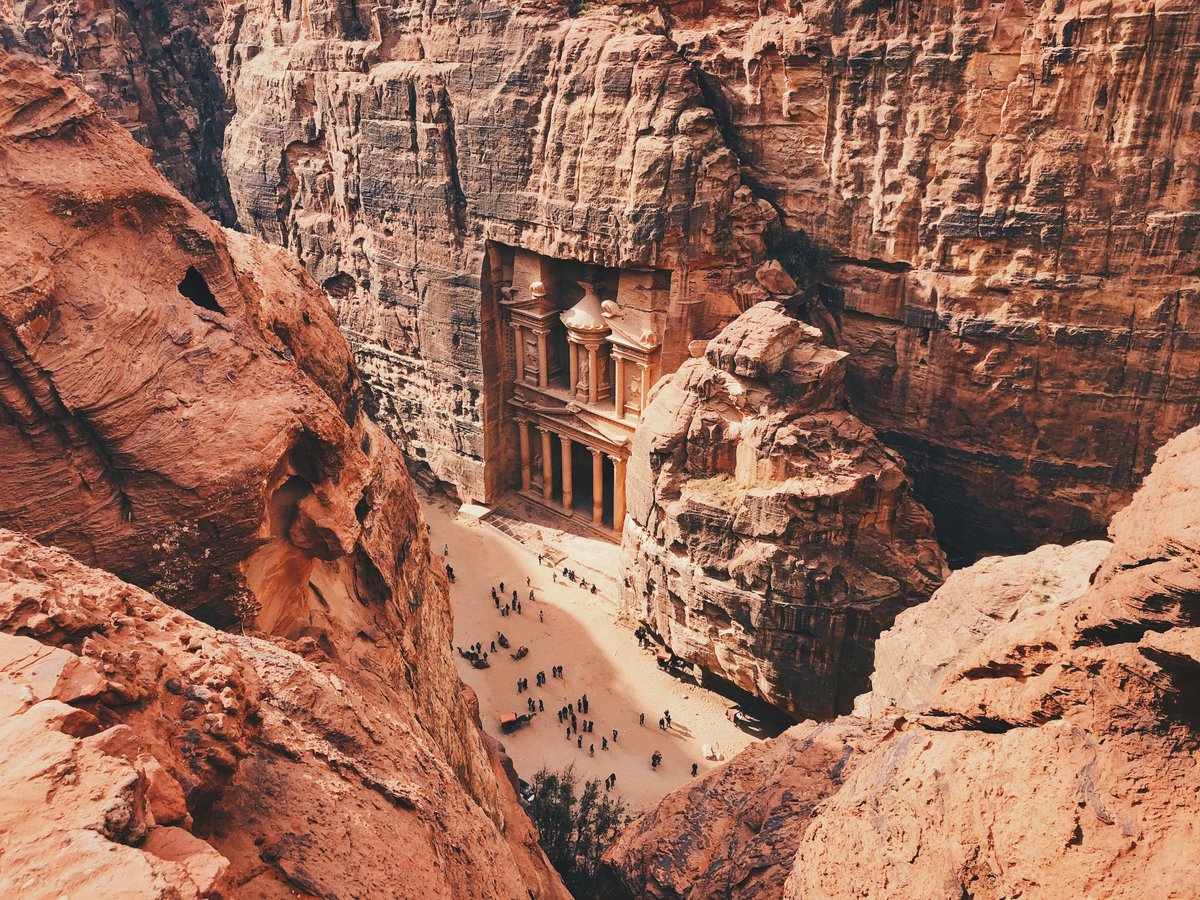
monumentPetra's most photographed monument at 40 meters tall. In May, the Treasury catches direct morning sunlight between roughly 9am and 11am, which turns the facade from shadow-gray to warm gold in minutes. Afternoon light is softer and less dramatic. The viewing area across from the facade has more breathing room in May than during the March-April peak.
Central PetraThe Royal Tombs
monumentThe Urn Tomb, Silk Tomb, Corinthian Tomb, and Palace Tomb line the eastern cliff face across the main valley. They catch late-afternoon light in May and feel significantly less crowded than Al-Khazneh. The Urn Tomb's upper chamber, converted to a Byzantine church in 446 AD, still has visible arched windows framing views over the Colonnaded Street.
Eastern cliff faceThe Colonnaded Street and Qasr al-Bint
archaeological siteThe main Roman-era street runs through Petra's ancient city center. Qasr al-Bint, the only freestanding building in Petra, sits at its western end. Oleander blooms pink along the wadi bed here in May. The Basin Restaurant nearby is one of the few shaded lunch spots inside the site.
Central valleyAd-Deir (The Monastery)
monumentLarger than the Treasury at 47 by 48 meters. The 800-step trail is best tackled in May's cool mornings. The viewing platform opposite Ad-Deir has a Bedouin-run tea stall where you can sit in the shade and take in the facade. The trail beyond the main viewpoint continues to a second lookout over Wadi Araba that fewer than 1 in 10 visitors reach.
Upper PetraSiq al-Barid (Little Petra)
archaeological siteA smaller Nabataean settlement 9km north of the main site, near the village of Al-Bayda. Free to enter, rarely crowded, and home to the painted Biclinium with surviving Nabataean frescoes on the ceiling. The short canyon catches excellent late-afternoon light in May.
Al-BaydaThe High Place of Sacrifice (Al-Madbah)
viewpointA Nabataean altar platform 170 meters above the valley floor with panoramic views in every direction. The sacrificial channels and basins are still carved into the rock. Clear May skies give visibility all the way to Wadi Araba. The descent via Wadi Farasa passes the Lion Fountain, a rock-carved water spout in the shape of a lion's head.
Central ridge
Your packing checklist
Tick items off as you pack. Your progress saves in this browser.
All packed — have a great trip.
Insider tips
Enter at 6am and walk straight past the Treasury without stopping. Most visitors freeze at Al-Khazneh for 30+ minutes, which means the trail to Ad-Deir and the High Place is nearly empty for the first hour. Circle back to photograph the Treasury after 4pm when the tour buses have departed for Aqaba and Amman.
The trail past the Monastery viewpoint continues beyond the obvious stopping point to a second lookout about 15 minutes further, with views over Wadi Araba and the hills toward the Israeli border. Fewer than 1 in 10 visitors walk past the main platform, and the silence is noticeable.
Bedouin families run tea stalls at several points inside the site. The sage tea (maramiyyeh) near the Royal Tombs costs a couple of dinars, and the Bedouin hosts often share stories about growing up inside Petra before the relocation to Umm Sayhoun village in the 1980s. These conversations tend to be more memorable than the monuments.
Ask at your Wadi Musa hotel about the back route to Ad-Deir through Umm Sayhoun. It approaches the Monastery from above, saving the 800-step climb from the valley floor. The walk takes about 45 minutes on a dirt trail, and you'll need a local guide to find the path.
Avoid these mistakes
- Arriving after 10am and attempting the Monastery trail in peak heat. The 800 rock-cut steps have zero shade, and May afternoons on the exposed upper trail can feel 5-8°C warmer than the valley floor. Start at 6am, reach Ad-Deir by 8am, and save the shaded Siq and lower valley for the afternoon.
- Carrying only a 500ml water bottle. With 2 refill points inside a 264-square-kilometer site and May temperatures around 28°C in dry air, you will drink 3-4 liters in a full day. Running out of water on the trail to Jabal Haroun or the High Place, where shade is scarce, is genuinely dangerous.
- Booking only 1 day. The 2-day pass costs only a few dinars more than a single day, and the site is far too large to cover meaningfully in one visit. A single day typically means you see the Siq, the Treasury, and maybe the Monastery before exhaustion forces you back. The Royal Tombs, the High Place, Little Petra, and the Wadi Farasa trail all deserve time.
- Failing to book a Wadi Musa hotel for the Independence Day weekend around May 25. Domestic visitors from Amman and other cities fill the town, and last-minute availability is scarce. If your dates overlap, reserve at least 3 weeks ahead.
Practical tips for May
Buy your Petra pass at the visitor center in Wadi Musa, and strongly consider the 2-day option. May conditions favor splitting your visit across two cool mornings rather than grinding through a full day of afternoon heat. Start each day at the 6am gate opening and plan to be back in town by early afternoon. The Jordan Pass bundles Petra entry with the Jordan visa fee and access to 40+ other sites across the country, so calculate your full Jordan itinerary before deciding. Modest dress is appreciated but not strictly enforced at the archaeological site. Petra's last entry is around 4pm in May, and the site closes at sunset. Bring Jordanian dinars for Bedouin stalls inside, as almost none accept cards. Taxis from Wadi Musa to Little Petra cost roughly 10-15 JD round trip. If you are flying into Jordan for Petra specifically, Aqaba's King Hussein International Airport is about 130km south and closer than Amman's Queen Alia International Airport at 230km north. Many Wadi Musa hotels arrange transfers from either airport.
FAQ
Is May a good time to visit Petra?
May is one of the better months for Petra, likely ranking around third out of twelve behind October and April. Temperatures average 27.5°C (82°F) during the day and 17°C (63°F) at night, with almost no rain. The main trade-off is that afternoons can feel warm on exposed trails, so you'll want to start early. Crowds are lighter than the March-April peak, and hotel rates sit below spring highs. The wildflower season is over, but the dry, clear conditions are excellent for hiking and photography.
What is the weather like in Petra in May?
Expect warm, dry days with average highs of 27.5°C (82°F) and lows of 17°C (63°F). Rainfall is negligible at about 6mm for the whole month, and humidity sits around 37%. Mornings feel genuinely pleasant, but exposed areas like the climb to the Monastery or the High Place can feel several degrees warmer than the shade by midday. Pack sun protection and bring more water than you think you need.
Is Petra crowded in May?
Less crowded than the March-April spring peak and the October-November autumn peak, but still busier than the summer months of June through August when the heat keeps many visitors away. You'll share the site with tour groups from Aqaba and Amman, but you can find quiet moments at the Royal Tombs and on the longer trails. The Independence Day weekend around May 25 brings more domestic visitors than a typical May week.
How many days do I need for Petra?
Two days minimum, ideally three. The 2-day pass costs only a few dinars more than a single day and is one of the best values in Jordan. Day one covers the Siq, the Treasury, the Colonnaded Street, and Ad-Deir. Day two takes the High Place of Sacrifice, the Wadi Farasa descent, and the Royal Tombs at a pace that lets you absorb what you are seeing. A third day allows a trip to Little Petra at Siq al-Barid and the Wadi Muthlim alternate canyon entrance.
Is it too hot to visit Petra in May?
Not if you plan around the heat. The average high of 27.5°C (82°F) is warm but far from the 32-33°C of July and August. The key is starting at the 6am gate opening and doing your hardest hiking before 10am. By early afternoon, exposed climbs can feel 5-8°C warmer than shaded areas, so save the Siq and lower valley for the hot hours. Carry 3+ liters of water and wear sun protection. May heat is manageable with timing; summer heat is not.
Find a flight to Petra
Live fares to Petra appear here once cookies are accepted.
Last verified by automated review (v1.7.2) on . What is automated review?