Stay in Petra in April
52 hotels in the Trip.com pool for Petra, from US$10 a night.
Opens Trip.com on Fri 2 Apr to Sun 4 Apr 2027; change the dates there.
April is one of the two best months to visit Petra, and you should know that upfront. Daytime temperatures reach about 24.6°C (76°F) and settle to a comfortable 14.3°C (58°F) after dark, which means you can walk the full 8 km from the Visitors Centre to Ad-Deir without the punishing heat that empties the trails by June. Rainfall drops to roughly 11mm for the entire month, spread across about 2 rainy days. The winter storms that periodically close the Siq have largely passed. Wildflowers still cover the sandstone slopes above the Royal Tombs, fed by the heavier rains of February and March. You'll smell wild sage on the breeze if you take the Wadi Farasa route down from the High Place of Sacrifice.
That said, you won't be alone. April sits squarely in Petra's peak season, and the site draws its heaviest visitor numbers between late March and early May. The Siq can feel more like a queue than a canyon walk between 9:00 and 11:00 AM, when tour groups from Amman (3 hours north) and Aqaba (2 hours south) arrive in waves. Hotels in Wadi Musa tend to charge their highest rates now, and the better-reviewed properties near the Elji entrance area book up 3 to 4 weeks in advance. Easter week compounds things further. Western Easter falls on April 5 and Orthodox Easter on April 12, drawing European and Middle Eastern visitors in an already-busy month.
April gives you roughly 13 hours of daylight at Petra, with sunrise near 5:50 AM and sunset around 6:50 PM. The low-angle morning light turns the sandstone at Al-Khazneh its deepest rose-gold, and the same thing happens at the Royal Tombs in late afternoon. Humidity sits at about 39%, keeping the air dry and the walking easy. October is the only month that truly rivals April, and even then, October misses the wildflower season on the Sharah Mountains.
Why visit in April
- Temperatures average 24.6°C (76°F), warm enough for all-day exploration but well below the dangerous 31-33°C highs of June through September
- Rainfall drops to 11mm from winter averages of 33-41mm, keeping trails dry and reducing flash flood closures of the Siq
- Wildflowers bloom across the sandstone hills above the Royal Tombs and along the Wadi Farasa descent trail, adding unexpected color to the red rock landscape
- Daylight lasts roughly 13 hours (5:50 AM to 6:50 PM), giving 2-3 more hours inside the site than winter's shorter days
- The Jordan Trail thru-hike season brings a welcome social energy to Wadi Musa guesthouses, and hikers share current trail conditions for routes to Dana Nature Reserve
Worth knowing
- Peak season tour groups fill the Siq between 9:00 and 11:00 AM, and the narrow 3-meter-wide canyon can feel congested with 200+ people walking in both directions
- Hotel rates in Wadi Musa reach their annual high, with properties near the site entrance typically charging 40-60% more than their July or August prices
- Easter week (early to mid-April) adds European and Middle Eastern visitors on top of the standard spring crowd, particularly at Al-Khazneh
- Wind can carry fine sand through the open areas around Qasr al-Bint and the Colonnaded Street on gusty afternoons, stinging exposed skin and coating camera lenses
Best for
Think twice if
April brings warm, dry weather to Petra with clear skies most days. Mornings start cool in the shaded Siq, where the narrow walls can make air feel 3-4°C lower than the surrounding plateau at 900 m elevation. By midday the sun is direct and strong, though it rarely feels oppressive the way summer months do. You'll notice the air is dry at 39% humidity. Evenings cool quickly after sunset, and the temperature drop catches people off guard if they're attending Petra by Night at 8:30 PM. Wind picks up on some afternoons in the open areas near Qasr al-Bint, carrying fine grit that you'll feel on your skin and taste if you don't cover your mouth. Rain is unlikely but possible. When it comes, it tends to arrive as a brief, sharp shower rather than an all-day drizzle.
Seasonal caution
- Flash floods remain a genuine risk in the Siq even in April's dry conditions. A sudden thunderstorm over the Sharah Mountains can send water rushing through the 1.2 km canyon within minutes, even when skies are clear at the site entrance. The Petra authorities close the Siq when rain is forecast. Check with the Visitors Centre before entering if you see clouds building to the east.
Year-round climate
Averages from the last 5 years.
| Month | Avg high (°C) | Avg low (°C) | Rainfall (mm) |
|---|---|---|---|
| Jan | 14 | 7 | 33 |
| Feb | 14 | 6 | 41 |
| Mar | 18 | 9 | 37 |
| Apr | 25 | 14 | 11 |
| May | 28 | 17 | 6 |
| Jun | 31 | 21 | 0 |
| Jul | 32 | 22 | 0 |
| Aug | 33 | 23 | 0 |
| Sep | 30 | 20 | 1 |
| Oct | 25 | 17 | 4 |
| Nov | 21 | 14 | 20 |
| Dec | 16 | 9 | 35 |
Best things to do in April
Sunrise walk through the Siq to Al-Khazneh
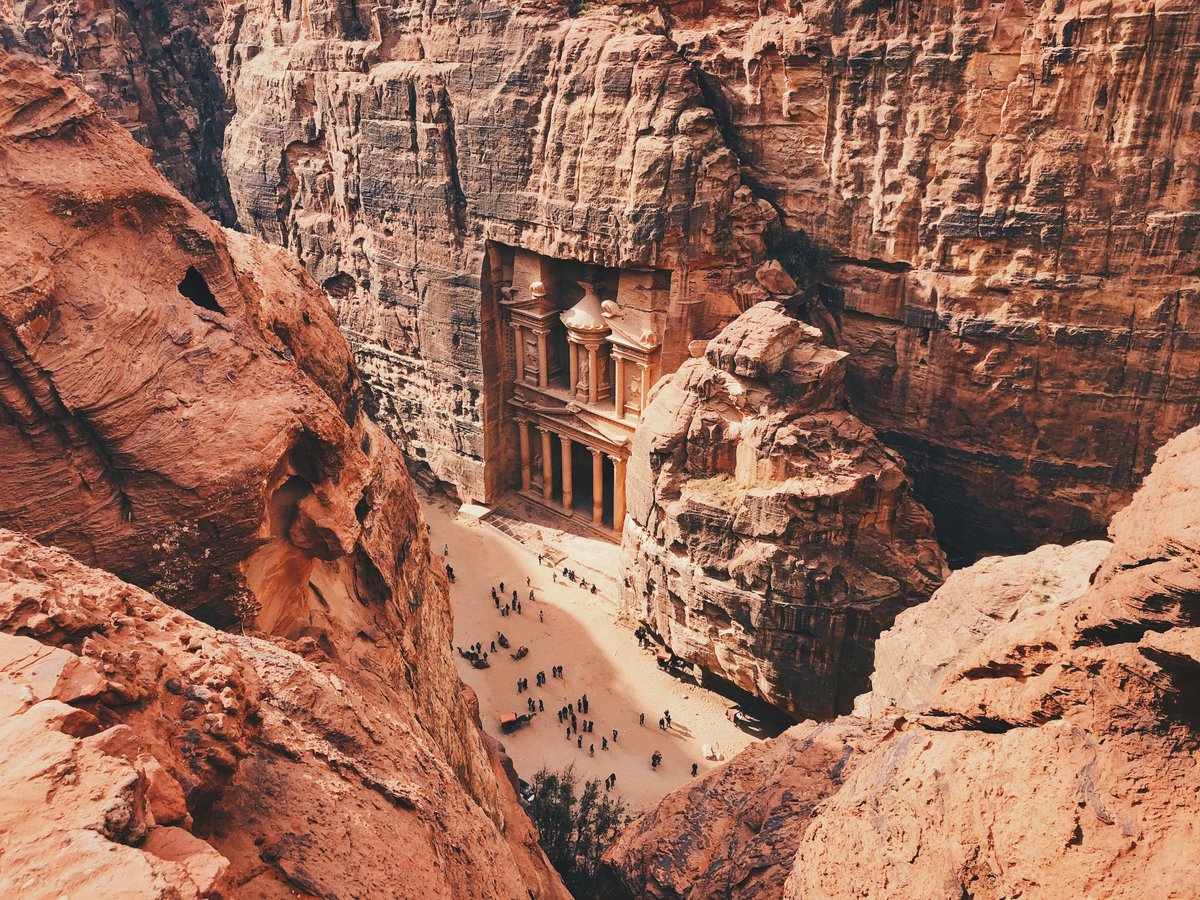
sightseeingEnter the site at 6:00 AM when the gates open and walk the 1.2 km Siq in near-silence. The canyon walls rise 80 meters on both sides, and in early morning the only sounds are your footsteps and the occasional bird call echoing off the sandstone. You'll reach the Treasury by 6:20 AM, often with fewer than 10 other people there. The east-facing facade catches the first direct sunlight and glows a deep orange-pink.
April sunrise at 5:50 AM means the 6:00 AM gate opening gives you the Treasury in full early light. In winter, sunrise is after 6:30 AM and the facade stays in shadow during the first hour.Booking tipNo booking needed, but arrive at the Visitors Centre by 5:45 AM to be first through the gate.
Full-day Petra circuit from the Siq to Ad-Deir
hikingThe main trail covers roughly 8 km one way from the entrance to the Monastery, passing the Siq, Al-Khazneh, the Street of Facades, the Royal Tombs, the Colonnaded Street, Qasr al-Bint, and finally the 800 steps up to Ad-Deir. With stops for photos and tea, it takes 6-8 hours. The sandstone changes color through the day, from pink in morning to amber at midday to deep red in late afternoon.
April's 24.6°C highs make the full 15 km circuit (including return) manageable. In summer, highs above 32°C make this route genuinely dangerous past midday without shade.Booking tipBuy the 2-day pass. The price difference from the 1-day pass is only 5 JOD, and you cannot do this circuit and the High Place of Sacrifice route in a single day without rushing.
High Place of Sacrifice via Wadi Farasa descent
hikingClimb the carved Nabataean stairway to Al-Madbah, the High Place of Sacrifice, at 1,035 m elevation. The summit gives a 360-degree view across Petra and into Wadi Araba. Descend via the Wadi Farasa route past the Lion Fountain, the Garden Tomb, and the Roman Soldier Tomb. The carved facades along this trail are less visited than the main route and the silence is striking.
Spring wildflowers line the Wadi Farasa descent in April, including red anemones and yellow daisies between the rock-cut facades. Clear April skies give visibility to the Negev across the Wadi Araba valley.Booking tipStart this route by 7:00 AM to reach the summit before the sun heats the exposed rock. Carry at least 1.5 liters of water. There are no vendors on the Wadi Farasa descent.
Climb the 800 steps to Ad-Deir (the Monastery)
sightseeingThe Monastery is Petra's largest carved facade at 47 meters wide and 48.3 meters tall, bigger than the Treasury. The 800 rock-cut steps take 30-45 minutes to climb. At the top, a Bedouin-run tea stall sells hot drinks with a view across the canyon. The scale of Ad-Deir only hits you when you see a person standing in the 8-meter-high doorway.
April's comfortable temperatures make the 800-step climb manageable. In July and August, when highs reach 32-33°C, the exposed stairway becomes an endurance test and the site sees heat-related medical incidents.Booking tipGo early or after 3:00 PM. The steps are fully exposed to sun between 10:00 AM and 2:00 PM.
Petra by Night
culturalA 2-hour candlelit walk through the Siq to the Treasury, held Monday, Wednesday, and Thursday evenings starting at 8:30 PM. Over 1,500 candles in paper bags line the Siq floor and fill the plaza in front of Al-Khazneh. A Bedouin musician plays the rebab (a single-stringed instrument) and the sound carries through the canyon. The smell of candle wax mixes with cool night air and desert stone.
April evenings sit around 14°C, mild enough to enjoy the 2-hour walk without the shivering that comes with winter nights below 7°C. Clear spring skies show stars above the Siq's narrow opening.Booking tipBuy tickets at the Visitors Centre by midday. April's peak season means the event reaches its 300-person capacity regularly. Arrive by 8:15 PM to walk near the front of the group.
Day trip to Little Petra (Siq al-Barid)
sightseeingA miniature version of Petra located 9 km north of the main site, near the village of Beidha. The narrow siq opens into carved chambers, including one with a rare surviving Nabataean painted ceiling. The site is free to enter and rarely crowded. Spring grasses and wildflowers grow around the entrance, and the smaller scale lets you touch and examine the chisel marks on the sandstone walls up close.
Spring greenery around the Siq al-Barid entrance provides a striking contrast with the sandstone that is absent in the brown, dry summer months. April's moderate crowds at the main site make the 20-minute drive worthwhile for a quieter half-day.Booking tipNo booking needed. Combine with a morning visit to the Neolithic village at Beidha, a 10-minute walk from Little Petra's entrance.
Dana Nature Reserve hiking
natureJordan's largest nature reserve, about 90 minutes north of Petra by car. The reserve drops from 1,500 m on the Rift Valley edge down to 50 m below sea level. Trails range from 2-hour loops to multi-day treks. The Rummana campsite sits on a ridge with views across the canyon. You'll hear Tristram's starlings calling from the cliffs and smell wild thyme on the rocky slopes.
Spring wildflowers and migratory birds peak at Dana in April. The Wadi Dana trail is at its best when spring water still flows in the lower sections, which typically dries up by late May.Booking tipBook the Rummana campsite through the Royal Society for the Conservation of Nature (RSCN) at least 2 weeks ahead for April weekends.
Wadi Rum desert excursion
adventureThe sandstone desert of Wadi Rum sits 110 km south of Petra, about a 90-minute drive. Bedouin-guided 4x4 tours cover the main rock bridges, Lawrence's Spring, and Khazali Canyon inscriptions. Overnight stays in desert camps range from basic Bedouin tents to climate-controlled domes. The silence at night is nearly total, broken only by wind across sand.
April temperatures in Wadi Rum hover around 25°C during the day and 12°C at night, comfortable for both daytime 4x4 tours and overnight camping without the summer heat that makes midday in the open desert dangerous.Booking tipBook a Bedouin-run camp at least 2 weeks ahead for April. A 1-night, 2-day package combining a sunset 4x4 tour with an overnight stay and sunrise jeep ride is the standard format.
What to eat in April
In season: fruit
Loz akhdar (green almonds)
Fresh green almonds eaten raw with coarse salt, available at Wadi Musa market stalls through April before the shells harden in May. The flavor is tart, grassy, and slightly milky. Locals crack them open with their teeth.
On menus now
Mansaf with spring lamb
Jordan's national dish reaches its best form in spring when young lamb is at its tenderest. The fermented jameed yogurt sauce is poured over rice and lamb, and the dish is eaten communally with the right hand. Restaurants in the Elji area of Wadi Musa serve it daily, but spring lamb has a milder, sweeter flavor than the rest of the year.
What to drink
Bedouin sage and mint tea
The wild sage (maramiyyeh) and mint that grow on the hills around Um Sayhoun and Taybeh put out their strongest spring growth in April. Bedouin tea stalls inside Petra brew fresh-picked herbs into sweet black tea. The sage adds an earthy, slightly medicinal warmth you won't get from dried versions.
In markets
Freekeh
Fire-roasted green wheat harvested across Jordan's northern highlands in April and May. The grain has a smoky, nutty flavor and appears in soups and alongside lamb at Wadi Musa restaurants during spring harvest weeks.
Akkoub (gundelia)
A thorny wild thistle foraged from the hills around Petra and the Sharah Mountains in March and April. Locals peel the stems and cook them with lamb, eggs, and olive oil. The prep is labor-intensive, which is why you'll only find it fresh in spring at family-run restaurants in Wadi Musa.
Regular events in April
Petra by Night
Candlelit walk through the Siq to the Treasury with traditional Bedouin music. Over 1,500 candles line the canyon floor and the plaza before Al-Khazneh. Runs year-round but April's mild evenings and peak-season visitor numbers make it most atmospheric.
Every Monday, Wednesday, and Thursday at 8:30 PMEaster celebrations in Wadi MusaFree
Jordan's Christian community marks both Western Easter (April 5) and Orthodox Easter (April 12) with church services and family gatherings. The town of Wadi Musa sees increased visitors from European and Middle Eastern Christian pilgrim groups traveling between Amman, Mount Nebo, and Petra.
April 5 (Western) and April 12 (Orthodox) in 2026Jordan Trail thru-hike seasonFree
The Jordan Trail Association's annual organized thru-hike of the 650 km trail from Um Qais to Aqaba passes through Petra in April. The Dana-to-Petra section is one of the trail's signature segments, covering 4 days through sandstone canyons and Bedouin settlements. Guesthouses in Wadi Musa fill with thru-hikers resupplying and resting.
Thru-hikers typically reach Petra in mid to late AprilBest places this April
Al-Khazneh (The Treasury)
archaeological sitePetra's 39-meter-tall carved facade is best viewed between 6:00 and 7:30 AM in April, when the east-facing sandstone catches direct sunrise light and the plaza holds fewer than 20 visitors. By 9:30 AM, the light has moved and tour groups fill the space. Return in late afternoon when the facade falls into soft shadow and the crowds thin again.
Central PetraAd-Deir (The Monastery)
archaeological siteLarger than the Treasury at 47 meters wide, and reached by 800 rock-cut steps from the Basin. In April, the comfortable climbing temperature and long daylight hours mean you can visit either at dawn or in late afternoon. The Bedouin tea stall at the summit offers the best-positioned seat in all of Petra, looking straight at the facade.
Western PetraWadi Farasa and the Garden Tomb
trail and archaeological siteThe descent route from the High Place of Sacrifice passes through a narrow side canyon with carved Nabataean facades that most visitors miss entirely. In April, red anemones grow between the rocks and the Garden Tomb's carved interior stays cool even at midday. The Lion Fountain carved into the rock wall still shows traces of the water channel that once fed it.
Southern PetraThe Royal Tombs
archaeological siteA row of monumental carved facades on the east cliff face, including the Urn Tomb, the Silk Tomb, and the Palace Tomb. Late afternoon light in April hits these east-facing facades directly, turning the sandstone bands of pink, orange, and yellow into their most dramatic colors. The Urn Tomb's interior was converted to a Byzantine church in 446 CE and still shows remnants of the arched windows.
Central PetraLittle Petra (Siq al-Barid)
archaeological siteA 9 km drive north of the main site, near the village of Beidha. The painted Nabataean ceiling in the Painted House is one of the few surviving examples of Nabataean art. In April, wild grasses and small flowers grow around the siq entrance, and the smaller site feels intimate after the scale of the main park. Free entry.
BeidhaQasr al-Bint
archaeological siteThe only freestanding building in Petra, a Nabataean temple from the 1st century BCE. It stands at the far end of the Colonnaded Street and marks the point where most casual visitors turn around. In April, the oleander bushes along the wadi floor near Qasr al-Bint begin showing pink and white flowers. The surrounding open area is one of the quieter spots in the site.
Western PetraThe High Place of Sacrifice (Al-Madbah)
viewpointA Nabataean altar platform at 1,035 m elevation with carved channels where offerings were made. The summit offers the widest panoramic view in Petra, looking across the site to the east and into Wadi Araba to the west. In April, clear skies with 39% humidity give visibility that the winter haze often blocks. The carved stairway up from the main trail takes about 25 minutes.
Southern PetraWadi Musa town center
townThe gateway town's main street runs uphill from the Petra Visitors Centre through the Elji area and into the newer upper town. In April evenings, restaurants set tables outside as temperatures drop to a pleasant 14-15°C. The town has a different energy in spring than summer, when heat empties the streets by early afternoon. The Friday morning produce market in central Wadi Musa sells spring vegetables and the fresh green almonds that are only available for a few weeks.
Wadi Musa
Your packing checklist
Tick items off as you pack. Your progress saves in this browser.
All packed — have a great trip.
Insider tips
Enter at 6:00 AM and walk straight to Ad-Deir first, not the Treasury. Most tour groups begin at Al-Khazneh and don't reach the Monastery until early afternoon. You'll have Ad-Deir nearly to yourself before 9:00 AM. Save the Treasury for your return walk when the afternoon light warms the facade and the morning tour buses have left.
The 1-day Petra pass is 50 JOD, but the 2-day pass is 55 JOD and the 3-day is 60 JOD. The price jump is so small that the 2-day pass is almost always the better choice. You cannot do the main site, the High Place of Sacrifice route, and Little Petra in a single day without rushing past half of what you came to see.
Skip the horse ride through the Siq. The horses move too fast to appreciate the 80-meter-high walls, and the narrow canyon path forces walkers to press against the rock when horses pass. Walking the Siq takes about 20 minutes at an easy pace, and you'll notice carved niches, Nabataean inscriptions, and the remains of the terracotta water pipe system that you'd miss entirely from horseback.
Ask at your hotel in Wadi Musa about Bedouin guides from Um Sayhoun who lead routes above Ad-Deir to a viewpoint looking down onto the Monastery facade from above. These paths are not on the main trail map and the perspective is unlike anything from the ground. Guides typically meet you at the top of the Monastery steps.
The Bedouin-run tea stalls inside Petra, particularly the one at the Monastery summit and those along the Street of Facades, serve sweet sage and mint tea brewed with spring-picked herbs. These are some of the most atmospheric places to sit in the entire site. Bring your own lunch to save money, but buy the tea.
Avoid these mistakes
- Trying to see all of Petra in a single day. The main trail from the Visitors Centre to Ad-Deir covers 8 km one way. Add the High Place of Sacrifice and Wadi Farasa route, and you're looking at 15+ km over uneven terrain. Even in April's moderate heat, fatigue and dehydration hit hard after noon if you started at 6:00 AM. Buy the 2-day pass and split the site into two mornings.
- Booking a midday walking tour. Even in April, temperatures reach 24-25°C by noon with direct sun and little shade on the main trail between the Royal Tombs and the Basin. The experienced local guides start at 6:00 AM and finish by 1:00 PM for a reason.
- Ignoring flash flood warnings because the sky looks clear overhead. The Siq can flood within minutes after a storm over the Sharah Mountains to the east, even when conditions at the site entrance seem fine. The Petra authorities close the Siq when rain is forecast. Check at the Visitors Centre before entering if you see clouds building, and never linger in the narrow canyon if you hear distant thunder.
- Spending all your time photographing the Treasury and missing the rest of the site. Al-Khazneh is magnificent but accounts for roughly 5% of what Petra offers. The Monastery is equally impressive with a fraction of the crowd. The Royal Tombs, the Byzantine Church mosaics, the Wadi Farasa route, and the views from Al-Madbah are each worth an hour or more.
Practical tips for April
Book Petra entrance tickets online through the Jordan Pass website at least a week ahead in April. The Jordan Pass bundles Petra entry with the Jordan visa fee, which saves the separate visa cost if you're entering through Queen Alia International Airport in Amman. Hotels in Wadi Musa fill during Easter week, particularly the properties in the Elji area closest to the site entrance. Reserve 3-4 weeks ahead for Easter dates (April 5 and 12 in 2026). The site opens at 6:00 AM and closes at 6:00 PM in April. Petra by Night tickets are sold separately from the day pass and should be purchased at the Visitors Centre by midday, as April evenings regularly reach the 300-person capacity. Modest clothing is appreciated in Wadi Musa town, particularly near the mosque by the main roundabout, though the archaeological site itself has no dress code. ATMs are in central Wadi Musa, about 1 km uphill from the Visitors Centre. Most Bedouin vendors inside the site accept cash only. Friday is the weekly rest day in Jordan, and some restaurants in Wadi Musa close during midday prayers. If you're driving from Amman, the King's Highway route (5 hours) passes Madaba, Mount Nebo, and Kerak Castle, and is far more scenic than the 3-hour Desert Highway.
FAQ
Is April a good time to visit Petra?
April is one of the two best months for Petra, alongside October. Temperatures average a comfortable 24.6°C (76°F) during the day with only about 11mm of rain all month. The winter wildflowers are still visible on the surrounding hills, and daylight lasts roughly 13 hours. The main trade-off is crowds. April is peak tourist season, so the Siq and Treasury area get busy between 9:00 and 11:00 AM. Arriving at the 6:00 AM gate opening avoids the worst congestion.
What is the weather like in Petra in April?
Warm and dry. Average highs reach 24.6°C (76°F) and lows drop to about 14.3°C (58°F) at night. Rainfall averages 11mm across roughly 2 rainy days, which is a sharp drop from March's 37mm. Humidity sits at 39%. Mornings can feel cool in the shaded Siq, and evenings require a layer. The sun is strong at Petra's 900 m elevation despite the moderate air temperature. Wind is possible on some afternoons.
Is Petra crowded in April?
Yes. April falls in peak season and visitor numbers are among the highest of the year. The Siq and the plaza at Al-Khazneh are busiest between 9:00 and 11:00 AM when tour groups from Amman and Aqaba arrive. Easter week (April 5 and 12 in 2026) adds further volume. The most effective strategy is to enter at the 6:00 AM opening and walk directly to Ad-Deir, returning to the Treasury after 3:00 PM when day-trip groups have departed.
How many days do I need for Petra?
At least 2 days, ideally 3. Day one can cover the Siq, the Treasury, the Royal Tombs, and the climb to Ad-Deir. Day two works well for the High Place of Sacrifice, the Wadi Farasa descent, and the Colonnaded Street area. A third day lets you visit Little Petra (Siq al-Barid), 9 km north, and revisit the main site at a slower pace. The 2-day pass is only 5 JOD more than the 1-day pass, making it the better value in nearly every case.
What should I pack for Petra in April?
Sturdy hiking boots with ankle support are essential for the uneven, gravel-covered trails. Layer for a 10°C temperature swing between early morning (14°C) and midday (25°C). Bring SPF 50+ sunscreen, a hat with chin strap, and at least 2 liters of water capacity since refill points inside the site are limited to the Basin area. A packable rain jacket covers the unlikely but possible spring shower. A fleece or light jacket is necessary for evenings and Petra by Night.
Find a flight to Petra
Live fares to Petra appear here once cookies are accepted.
Last verified by automated review (v1.7.2) on . What is automated review?