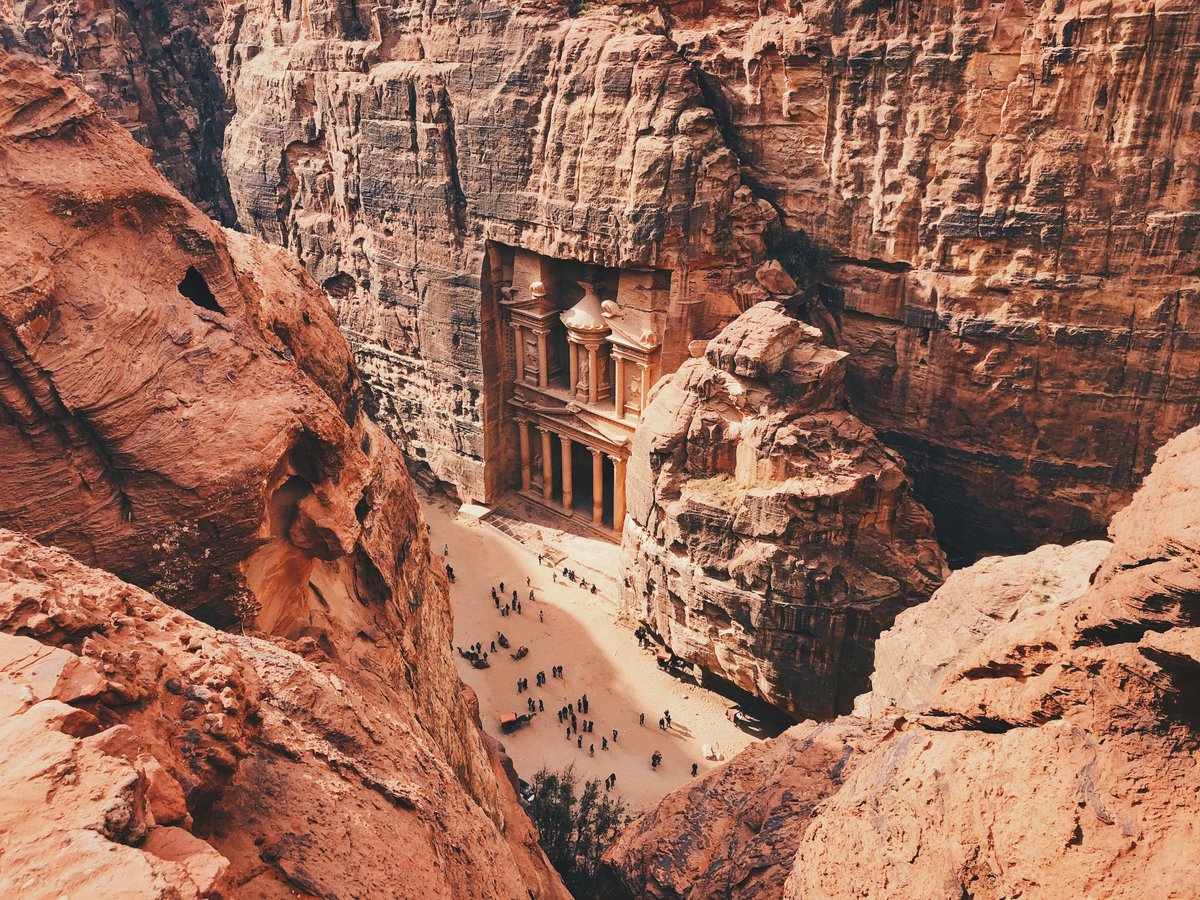
Best Time to Visit Petra, by Season
Petra's sandstone runs from February's 6.3°C overnight lows to August's 32.7°C highs. This month-by-month breakdown, built from 5-year daily weather observations, names the single best window for budget travellers, photographers, hikers, and first-timers visiting the ancient Nabataean city.
Published
1 June Through August Will Cook You. Petra Hits 32.7°C and the Siq Offers Zero Shade
The smell inside the Siq hits first. Hot sandstone has a dry, mineral scent that intensifies as temperatures climb, and by August in Petra that scent fills the narrow canyon like an oven left on overnight. The average high for August reaches 32.7°C. Overnight lows settle at 23.2°C. At that overnight temperature the rock never fully cools. You press your palm to Petra's canyon wall after dark and feel stored heat radiating back.
July runs close behind at 32.2°C for the average high, with lows of 22.4°C. The temperature gap between midday and midnight is under 10 degrees. June opens the summer stretch at a 30.9°C average high and 20.7°C lows. That 30°C line is where walks on exposed trails like the Monastery approach stop being recreational.
To be fair, summer does thin the crowds at Petra. Fewer tour buses line the road into Wadi Musa, and hotel availability opens when the heat drives casual visitors elsewhere. The trade for Wadi Musa's lower summer rates is severe. You need to enter Petra at first light to get meaningful time on foot before noon. The High Place of Sacrifice trail runs along an exposed ridgeline that is effectively impassable by midday in July, when the 32.2°C average is the mean, not the peak.
Mind you, there is a pattern in Petra's summer data worth reading. June at 30.9°C is hot. July at 32.2°C is hotter. August at 32.7°C is the year's thermal ceiling. The real problem at Petra is the overnight lows. August's 23.2°C and July's 22.4°C overnight mean you never get the desert cooling cycle that makes Middle Eastern heat tolerable. Compare that to October, when the high drops to 25.4°C and the low falls to 16.9°C. That 8.5-degree daily swing sits in a livable range. In August the swing is 9.5 degrees but anchored too high to help.
If your dates are locked to summer, pick June over July or August. June's 30.9°C high stays below the worst, and the 20.7°C lows offer marginally better sleeping conditions than July's 22.4°C or August's 23.2°C.
2 March and April Own Petra's Best Weather. 18°C Mornings and Wildflowers in the Valleys
The light in Petra changes in March. Winter's flat grey yields to angled morning sun that strikes the Treasury facade around 9 AM and turns it the saturated copper-red the postcards promise. The average high climbs to 18.0°C. Lows sit at 9.2°C. That roughly 9-degree daily range is comfortable for all-day walking, and Petra's sandstone feels cool beneath your fingers until late morning.
April pushes warmer, with the average high reaching 24.6°C and lows of 14.3°C. That range is still comfortable for hiking Petra's trails, though the midday hours on exposed paths begin to carry real warmth. The Treasury plaza sits in direct sun from mid-morning and warms noticeably by early afternoon. You might walk the Siq twice in April, once at opening and once in late afternoon when the light turns golden and the temperature starts dropping from 24.6°C toward the 14.3°C overnight.
March and April differ enough to choose between. March at 18.0°C offers cooler, more forgiving conditions for ambitious routes. The climb to the Monastery is comfortable through midday in March's 18.0°C average. April at 24.6°C is warmer, and the afternoon sun on exposed paths like the High Place of Sacrifice trail starts to bite. That said, April's 14.3°C lows are mild enough that early mornings feel pleasant rather than cold, while March's 9.2°C lows mean a proper jacket at dawn.
For first-time visitors, April tends to be the better pick. The 24.6°C highs are warm enough that Petra feels inviting rather than austere, and the 14.3°C overnight lows keep evenings comfortable in Wadi Musa. For hikers who plan to cover Petra's back trails all day, March's 18.0°C ceiling gives more thermal headroom. Compare either month to February's average high of 13.5°C and low of 6.3°C, and the improvement is sharp. February to March is a 4.5-degree jump in highs and a 2.9-degree rise in lows.
March at 18.0°C is for hikers who want all-day range. April at 24.6°C is for everyone else.
3 October and November Mirror Spring Without Spring's Crowds
Sound carries differently in Petra when the crowds thin. In late October you can stand at the Street of Facades and hear your own footsteps echo off the tomb fronts. Try that in April. The average high for October is 25.4°C. Lows settle at 16.9°C. The temperature profile sits close to April's 24.6°C high and 14.3°C low, but the feel is different. Autumn light angles lower and catches Petra's carved details in sharper relief.
November cools further. The average high drops to 21.0°C, the low to 13.5°C. November's 21.0°C to 13.5°C range produces Petra's strongest walking weather outside March. The Monastery climb, which can tire you in April's 24.6°C afternoons, feels almost effortless on a November morning starting near the 13.5°C low. The air is dry. Petra's sandstone is cool underfoot.
The gap between October and November is worth reading. October's 25.4°C high still carries real warmth through midday, and exposed sections of the Royal Tombs trail heat up by early afternoon. November's 21.0°C high rarely feels hot at any hour. If you prefer shirtsleeves and don't mind warmth, October mirrors April at 24.6°C. If you want to walk hard all day without managing heat, November mirrors March at 18.0°C.
Worth noting, autumn brings shorter days than spring at Petra. You might lose usable light compared to April, which means earlier starts matter. The trade-off is fewer tour groups and lower accommodation rates in Wadi Musa. November tends to draw particularly thin crowds, as the month falls between Europe's autumn-holiday period and the December bump.
For photographers, October is likely the strongest single month at Petra. The 25.4°C average high keeps haze low, the 16.9°C overnight low prevents lens condensation at dawn, and the autumn light gives warmer tones than March's slightly blue-shifted winter holdover. November at 21.0°C is equally good for shooting, but the shorter light window narrows the chances for late-afternoon sun on the Treasury facade.
4 December Through February Is Cold, Cheap, and Surprisingly Photogenic
There is a particular silence in Petra on a January morning when the temperature sits near 7.1°C and your breath clouds in the Siq. The sandstone takes on a bluer cast in winter light. Carved details sharpen under low-angle sun, and the site feels emptied of performance. January's average high reaches only 13.9°C. The low drops to 7.1°C. February is the coldest month by average, with a 13.5°C high and 6.3°C low.
December splits the difference. Its average high of 15.6°C and low of 9.0°C sit noticeably above January and February but well below November's 21.0°C. The drop from November to December is 5.4 degrees in the highs, enough to shift from comfortable shirtsleeves to proper layers at Petra.
Petra's winter cold is manageable with preparation. Even February's 6.3°C low, the year's coldest average overnight reading, rarely dips to freezing. You want a warm base layer and a windproof shell for morning walks through the Siq, where shade persists until mid-morning and the narrow walls channel cool drafts. By midday, January's 13.9°C and December's 15.6°C feel pleasant in direct sun. The Royal Tombs face east and catch warmth early.
Petra operates at a fraction of its April visitor volume between January and February. Accommodation in Wadi Musa tends to reach its lowest rates when the combination of 13.9°C and 13.5°C highs and short daylight discourages the package-tour circuit. Budget travellers who tolerate layering in the 6.3°C to 13.9°C range will find the best value window of the year.
That said, winter at Petra carries risks. Rain, though infrequent, can cause flash flooding in the Siq. Occasional closures happen between December and February. The short December-to-February days compress your visiting window. For photographers, though, the low winter sun creates dramatic shadows across the carved facades. The Treasury at 9 AM in January, with the sun barely clearing the canyon walls and the air near the 7.1°C low, produces a light quality that summer's overhead glare cannot match. February's 13.5°C average high and 6.3°C low are the price of that light.
February's 6.3°C overnight low and January's 7.1°C are the price of having the Treasury to yourself.
5 May Is the Last Comfortable Month. 27.5°C Means Morning-Only Hiking
You feel May's shift in the Treasury plaza around 11 AM. The stone underfoot turns warm, the shade line retreats, and the air at Petra takes on a thickness that April did not carry. May's average high reaches 27.5°C, a 2.9-degree jump from April's 24.6°C. The lows climb to 17.2°C, nearly 3 degrees above April's 14.3°C. This is the month where Petra starts to feel genuinely hot.
The early morning remains good. At 8 AM the Siq is still cool, the temperature likely sitting near the overnight low of 17.2°C. The walk from the Siq to the Treasury is pleasant at that temperature. By late morning the exposed areas heat past comfortable, and the climb to the Monastery on its unshaded ridge becomes a serious physical effort. May at Petra is a mornings-first month. Plan the most ambitious trail for the first 3 to 4 hours after the gate opens, and spend the afternoon back in Wadi Musa.
How does May compare to its neighbours? April at 24.6°C is 2.9 degrees cooler in the highs and a full 2.9 degrees lower overnight at 14.3°C versus May's 17.2°C. That gap translates to roughly one extra hour of comfortable walking in the morning and a cooler night's sleep. June at 30.9°C sits 3.4 degrees above May, and its 20.7°C lows push the overnight temperature into the range where rooms in Wadi Musa stay stuffy until dawn.
May is the pick for travellers who missed the April window and want to avoid summer entirely. The 27.5°C highs are manageable with an early start. The 17.2°C lows still allow a reasonable night's rest. The margin is thin, though, only 3.4 degrees below June's 30.9°C threshold. Compare May's 27.5°C to October's 25.4°C, and October runs 2.1 degrees cooler with lower humidity. If your schedule offers any choice between May and October at Petra, October is the stronger month. May's 27.5°C ceiling and 17.2°C floor still sit well below June's 30.9°C and 20.7°C, the boundary where Petra stops being comfortable on foot.
6 September Is a False Start. 29.5°C Says Summer Is Not Done at Petra
The evening light on Petra's Royal Tombs in September looks like autumn. The angle is lower, the colour richer, and you might convince yourself the worst heat has broken. Then you check September's numbers. The average high sits at 29.5°C, with lows of 20.1°C. That high is only 3.2 degrees below August's 32.7°C. Summer has not released September.
The overnight reading tells a more interesting story. September's 20.1°C low, compared to August's 23.2°C, represents a 3.1-degree drop. That is the first notable cooling shift since May's 17.2°C lows gave way to June's 20.7°C. The 3.1-degree nighttime difference matters more than it sounds. August nights in Wadi Musa can feel airless. September nights begin to carry a breeze.
Petra's daytime temperatures in September remain hard. A 29.5°C average high means exposed walks along the Street of Facades, the High Place of Sacrifice trail, and the Monastery approach still need careful timing. The pre-10 AM window is workable. Temperatures at 7 AM might sit near the 20.1°C overnight low. By noon you are approaching the 29.5°C ceiling, and reflected heat off Petra's sandstone walls adds perceived degrees the thermometer does not capture.
September's calendar position is awkward. Too hot to count as autumn at Petra, cool enough to feel distinctly better than August's 32.7°C. Compare September's 29.5°C to October's 25.4°C. That 4.1-degree drop in highs, combined with October's 16.9°C lows versus September's 20.1°C, makes October a different experience entirely. If you can shift a trip by even two weeks from late September into early October, the comfort gain at Petra is immediate.
Who should consider September? Budget travellers who find October's rates climbing back up might get better value in September, accepting tolerable discomfort for the savings. Petra is quieter in September than in April. The evenings, when temperatures fall from 29.5°C toward the 20.1°C low, open a pleasant window for walking the site in softer light. September at 29.5°C is Petra's compromise month. October at 25.4°C, four weeks later, is a genuinely good one.
7 The Verdict. One Best Window for Every Kind of Petra Traveller
Stand at the Treasury in early April, around 8 AM, and the temperature sits near the overnight low of 14.3°C. Petra's sandstone glows. Morning light cuts through the Siq and paints the facade in slow stages. By midday the average high of 24.6°C makes the sun warm on your shoulders but not oppressive. That day, that light, that temperature is the single best combination Petra offers.
For first-time visitors, early to mid-April is the answer. April's 24.6°C average high and 14.3°C low give comfortable full-day access to Petra. The Treasury, the Monastery, the Royal Tombs, and the back trails are all walkable without heat management. The window is roughly the first three weeks of April, before temperatures start trending toward May's 27.5°C.
For budget travellers, January and February are the clear pick. January's 13.9°C high and 7.1°C low, and February's 13.5°C high and 6.3°C low, keep casual visitors away and push accommodation rates in Wadi Musa to their annual floor. The 6.3°C to 13.9°C range requires layers but stays well above freezing at Petra. The trade is solitude and lower rates for a few extra clothing decisions.
For hikers and back-trail explorers, March is strongest. The 18.0°C average high and 9.2°C low give the widest thermal comfort range for sustained physical effort on Petra's exposed routes. You can walk from dawn to late afternoon without overheating or over-layering.
For photographers, October narrowly beats March. October's 25.4°C average high keeps the air clear over Petra, the 16.9°C low prevents dawn condensation, and the autumn light rakes across the carved surfaces with a warmth that March's cooler-toned sky does not match. November at 21.0°C and 13.5°C is the runner-up, with slightly shorter light windows but equally photogenic conditions at Petra.
For travellers locked into summer, early June is the least punishing window. June's 30.9°C average high and 20.7°C lows sit meaningfully below July's 32.2°C and 22.4°C, and well below August's peak of 32.7°C and 23.2°C. Start at dawn. Finish by 11 AM. Accept the constraints. April's 24.6°C and October's 25.4°C remain the benchmarks every other month at Petra falls short of.
April at 24.6°C and October at 25.4°C bracket Petra's optimal range. Every other month is a trade-off.
Last verified by automated review (v1.7.0_onboard-petra-flagship-2026-07-25) on . What is automated review?