Stay in Ubud in March
9 hotels in the Trip.com pool for Ubud, from US$18 a night.
Opens Trip.com on Fri 5 Mar to Sun 7 Mar 2027; change the dates there.
March in Ubud is defined by Nyepi, the Balinese Day of Silence, which typically falls in mid-to-late March and shuts the entire island down. Ngurah Rai International Airport closes from 6 AM, no vehicles drive anywhere from Denpasar to Tegallalang, and every shop and restaurant stays shuttered. Hotels across Ubud require guests to remain on-site with curtains drawn and lights dimmed. The ceremony shifts annually with the Saka lunar calendar, so confirm the exact date before booking any flights in or out of Bali that month.
Outside the Nyepi window, March weather is wet but not relentless. Afternoon downpours arrive on roughly 26 out of 31 days, dropping about 246mm (9.7 inches) of rain across the month. Daytime highs reach around 29.5°C (85°F) and overnight lows settle near 22.4°C (72°F), with humidity holding at a thick 86%. That said, this is noticeably drier than January's 348mm or February's 304mm. Mornings in Ubud tend to stay clear until 1 or 2 PM, and the rain typically arrives in sharp bursts rather than all-day drizzle.
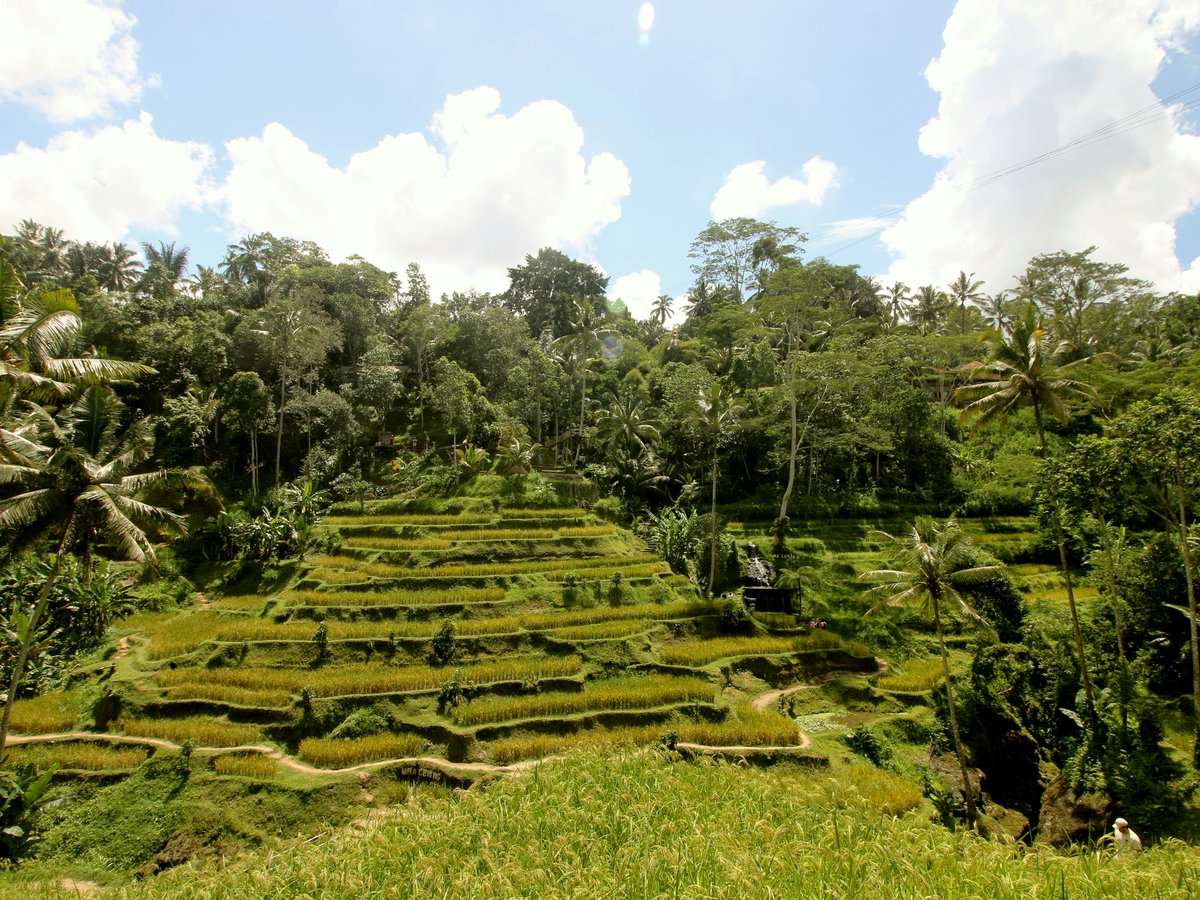
Rice terraces around Campuhan and Tegallalang reach peak green after months of accumulated water, and the Ayung River runs high through the gorge below Sayan. Ogoh-Ogoh parades fill the streets of central Ubud the night before Nyepi, with enormous demon figures carried by groups of young Balinese men as percussion echoes between stone walls and shop fronts. Accommodation rates in Penestanan and along Jalan Monkey Forest drop well below the July and August peak. Peliatan and Nyuhkuning see the fewest visitors of any Ubud neighborhood, and the coworking cafes have open seats that August would find fully claimed.
Why visit in March
- Nyepi and the surrounding ceremonies give March a cultural depth that no dry-season month can match, with visible preparations across every banjar in the Ubud area for the full week before the Day of Silence.
- Guesthouse rates in Nyuhkuning and homestays along Jalan Kajeng typically run 30-40% below August prices, making March one of the cheapest months to stay in Ubud.
- Crowd levels drop well below the June through September peak, meaning shorter waits at popular sites and the ability to walk the Campuhan Ridge without navigating around tour groups.
- The landscape reaches its most saturated green after three consecutive months of heavy rain, and rivers and waterfalls across the Gianyar regency run at full volume.
Worth knowing
- Afternoon rain arrives on most March days and occasionally lingers into the evening, compressing outdoor time at exposed sites like Goa Gajah and the rice terraces to morning windows.
- The persistent humidity makes moderate walks strenuous. The 300-step descent to Gunung Kawi's riverside shrines leaves most visitors drenched in sweat before any rain starts.
- Nyepi's enforced stillness can feel confining if your accommodation lacks a pool, spa, or stocked library. Even well-appointed properties in Sayan and Kedewatan can feel small after 12 or 15 restless hours.
Best for
Think twice if
March sits at the tail of Bali's wet season, with the heaviest months now behind you. Mornings in Ubud typically dawn clear with warm sunlight, then clouds mass over the central highlands by early afternoon and release in sharp downpours that drum on tiled roofs for anywhere from 20 minutes to 2 hours. The air between showers feels thick and warm, carrying the smell of wet earth and frangipani from the gardens along Jalan Suweta. Evenings cool enough to sit comfortably on an open terrace in Peliatan or Kedewatan without air conditioning. By the final week of March, you might notice the intervals between showers growing longer as April's drier pattern approaches.
Seasonal caution
- Monthly rainfall exceeds 200mm, with downpours heavy enough to cause temporary flash flooding on low-lying roads between Ubud and the southern coast. The stretch through Gianyar town toward Denpasar is particularly prone to standing water after sustained afternoon rain.
Year-round climate
Averages from the last 5 years.
| Month | Avg high (°C) | Avg low (°C) | Rainfall (mm) |
|---|---|---|---|
| Jan | 29 | 23 | 348 |
| Feb | 29 | 23 | 304 |
| Mar | 30 | 22 | 246 |
| Apr | 29 | 22 | 151 |
| May | 29 | 22 | 136 |
| Jun | 28 | 22 | 90 |
| Jul | 27 | 21 | 135 |
| Aug | 27 | 21 | 114 |
| Sep | 28 | 21 | 130 |
| Oct | 29 | 22 | 135 |
| Nov | 29 | 22 | 286 |
| Dec | 29 | 23 | 283 |
Holidays and festivals in March
Public holidays
- Good Friday(Wafat Isa Almasih)26 March 2027
- Easter Sunday(Paskah)28 March 2027
Headline events
Nyepi (Balinese Day of Silence)
Mid-to-late March (varies annually by Saka calendar; fell on March 29 in 2025)
The Balinese Hindu New Year observed across the entire island of Bali. All activity ceases for a full day and night. The airport closes, no vehicles move, all businesses shut, and visitors must stay within their accommodation grounds with lights off and noise minimized. Pecalang, traditional community security, patrol the streets to enforce the stillness, and compliance extends to all visitors regardless of nationality or religion.
Best things to do in March
White-water rafting on the Ayung River
adventureRafting operators launch from points near Kedewatan and Payangan, running 10-12 km (6-7 miles) of the Ayung through a gorge lined with carved rock faces, side waterfalls, and dense tropical vegetation. Expect Class II to III rapids, suitable for beginners with a guide.
Wet-season water levels push the Ayung to peak flow, producing the strongest rapids and tallest side-waterfalls of the year. Operators note that March runs are noticeably more dynamic than the same stretch in August or September.Booking tipBook 2-3 days ahead. Morning departures starting around 8 AM usually finish before afternoon rain.
Dawn walk on the Campuhan Ridge
natureA 2 km (1.2 mile) paved path along a narrow ridge between two river valleys, starting near the junction in Campuhan. The walk passes through tall alang-alang grass with panoramic views of palm-covered hills on both sides.
March mornings are typically clear with dramatic cloud formations building over the central highlands, creating photographic conditions that flat blue dry-season skies lack. The grass along the ridge stands at full height from months of rain.Booking tipNo booking needed. Arrive before 7 AM to beat both the heat and other walkers.
Balinese cooking class
foodSeveral schools in the Ubud area run half-day programs that begin with a guided visit to Pasar Ubud for ingredients, followed by preparation of 5-8 traditional dishes including babi guling and various sambals in an open-air kitchen setting.
Afternoon rain makes indoor activities appealing, and March's lower tourist numbers mean smaller class sizes with more hands-on time from instructors. The Nyepi-period spike in ceremonial cooking adds seasonal context to the dishes you prepare.Booking tipMorning sessions that start with the market visit tend to fill even in low season. Book at least a day ahead for these slots.
Tirta Empul Temple during Melasti week
culturalThe water temple near Tampaksiring, about 15 km (9 miles) north of central Ubud, draws worshippers for ritual purification in its spring-fed pools. The temple dates to 962 AD during the Warmadewa dynasty.
Melasti ceremonies in the days before Nyepi bring processions and heightened ritual activity to water temples across Bali. Tirta Empul sees ceremonial decoration and devotional energy that the site lacks during ordinary tourist visits.Booking tipArrive before 9 AM to experience the temple before tour groups. Bring your own sarong to avoid the entrance rental queue.
Explore the Sacred Monkey Forest Sanctuary in the rain
natureA 12.5-hectare (31-acre) nature reserve in southern Ubud housing over 1,200 long-tailed macaques and three Hindu temples. Moss-covered stone carvings and a dense banyan canopy create a distinct atmosphere unlike any other site in the area.
Rain deepens the greens across the temple carvings and forest canopy, and tour groups tend to skip the forest on wet afternoons. The paths are quieter in March than at any point from June through October.Waterfall circuit in the Gianyar highlands
natureSeveral waterfalls within 30-45 minutes of Ubud, including Tegenungan, Kanto Lampo, and Tibumana, are accessible by scooter or hired driver. Each involves a descent of 100-300 steps through lush forest terrain.
Wet-season volume pushes these falls to their most impressive flow of the year. Tegenungan, often reduced to a narrow stream by September, runs as a wide curtain in March. Fewer tourists mean the pools beneath are less crowded.Booking tipNo booking needed. Go between 8 and 10 AM when the light reaches the water and before afternoon rain makes the steps slippery.
Morning yoga in Ubud's studios
wellnessUbud has one of the highest concentrations of yoga studios in Southeast Asia, with established spaces in Penestanan and along Jalan Hanoman offering daily drop-in classes from Vinyasa to Yin and restorative styles.
Lower visitor numbers mean smaller class sizes at popular studios. The 7-8 AM class schedule aligns with March's clear-morning window, and the warm, humid air loosens muscles faster than dry-season air-conditioned sessions.Booking tipDrop-in works at most studios. Popular teachers fill up by the day before, so check schedules the evening ahead.
What to eat in March
In season: fruit
Mangosteen
Peak season runs December through April in Bali, and March sits right in the sweet spot. Crack open the dark purple rind and the white segments inside are intensely sweet with a citrus-tart finish. Vendors at Pasar Ubud sell them by the kilogram at a fraction of export prices.
Salak (Balinese snake fruit)
Bali grows its own variety with a drier, crunchier texture and a honey-sweet finish compared to Javanese salak. The scaly brown skin peels easily to reveal pale, firm flesh. Wet-season harvests keep supply steady and prices low through March.
Durian
Early Balinese durian season begins in February and builds through April. March fruit tends to be smaller than peak-season specimens, but roadside stalls around the Gianyar market start stocking local varieties by mid-month. The smell is polarizing, the flavor is custard-rich.
Street food peaks
Sate lilit
Minced pork, chicken, or fish mixed with grated coconut, lime leaves, and shallots, then pressed around lemongrass sticks and grilled over coconut husk embers. Ceremonial cooking before Nyepi means more neighborhood grills fire up across the Ubud area in March than in quieter months, and the smoky, aromatic skewers appear at warungs in greater variety.
What to drink
Jamu
Traditional herbal tonics made from fresh turmeric, ginger, tamarind, and other roots, mixed with palm sugar and lime. The cooling tamarind-based versions feel particularly welcome in March's heavy air. Morning jamu sellers circulate through neighborhoods with glass bottles in hand-carried wooden racks.
Festival food
Lawar
A ceremonial Balinese dish of finely chopped meat, grated coconut, vegetables, and spice paste, traditionally prepared for temple ceremonies and community feasts. Production rises across Ubud's banjars during the Nyepi preparation period, making it more widely available at warungs near temples than in other months.
Regular events in March
Ogoh-Ogoh Parade (Pengerupukan)Free
The night before Nyepi, enormous papier-mâché demon figures, some reaching 5 meters (16 feet) tall, are paraded through Ubud's streets by teams of young men from each banjar. Intersections near Puri Saren Agung become performance stages where teams spin and shake their Ogoh-Ogoh to loud gamelan accompaniment. The atmosphere is festive, chaotic, and unlike anything else in the Balinese calendar.
Night before Nyepi (typically mid-to-late March)Melasti Purification CeremonyFree
Three to four days before Nyepi, Hindu communities process to water sources for ritual purification. In the Ubud area, processions head to nearby springs and rivers, or travel south to beaches near Sanur and Keramas. Village temple artifacts are ceremonially bathed, and participants dress in full white temple attire. You'll hear each procession approaching from blocks away, a wall of chanting and percussion moving through the streets.
3-4 days before Nyepi (mid-March)Best places this March
Museum Puri Lukisan
museumUbud's oldest art museum, founded in 1956, housing Balinese painting and woodcarving from the 1930s onward across four pavilions set in a water garden. March's frequent afternoon rain makes this an ideal midday retreat, and smaller wet-season crowds mean you can stand in front of the I Gusti Nyoman Lempad works without competing for space.
Central UbudPenglipuran Village
culturalA traditional Balinese village about 45 minutes north of Ubud in the Bangli regency, known for its uniform bamboo-gate architecture and pedestrian-only main street stretching roughly 800 meters (half a mile). March's lower visitor count lets you walk the avenue without the shoulder-to-shoulder density of dry season. The surrounding bamboo forest stays lush through the wet months.
BangliGoa Gajah (Elephant Cave)
historicalA 9th-century archaeological site about 6 km (4 miles) southeast of central Ubud, featuring a carved cave entrance, bathing fountain, and surrounding rock-hewn temple remains. The moss and lichen on the carved rock face reach their thickest growth in March, and the bathing pools overflow with spring water fed by elevated wet-season groundwater.
BeduluNeka Art Museum
museumA museum on Jalan Raya Sanggingan displaying Balinese art from traditional Kamasan style through the Ubud school of the 1930s to contemporary works. Seven separate buildings house the collection across a hillside garden. With enough depth to fill 2-3 hours, it serves as a rewarding refuge during the afternoon storms.
SangginganPura Gunung Lebah
templeAn 8th-century temple at the confluence of two rivers at the base of the Campuhan valley, marking the traditional starting point of the ridge walk. In March, the rivers below the temple run high and brown with sediment, and the sound of rushing water fills the air around the grounds. Arrive before 7 AM to have the temple largely to yourself.
CampuhanPasar Ubud (Ubud Market)
marketThe central market opposite the palace on Jalan Raya Ubud. The morning section sells local produce, spices, and canang sari temple offerings to Balinese families before 9 AM. In March, the wet-season fruit selection reaches its widest variety. The tourist handicraft stalls that take over by late morning see noticeably fewer shoppers than during the dry-season peak.
Central Ubud
Your packing checklist
Tick items off as you pack. Your progress saves in this browser.
All packed — have a great trip.
Insider tips
For the Ogoh-Ogoh parade, skip the main intersection near Puri Saren Agung where every tourist clusters. Head to smaller banjar junctions in Peliatan or along the quieter southern roads near Nyuhkuning, where the demon figures are built with equal craft but the crowd is entirely local families and the atmosphere feels more genuine.
When a Melasti procession passes near your guesthouse, you'll hear the chanting and percussion approaching from blocks away. Step outside and watch respectfully from the road's edge, but don't walk into the procession or push a camera into participants' faces. The people in white temple attire are focused on prayer, not performing for onlookers.
Stock up on food and water at a minimart the evening before Nyepi. On the Day of Silence, room service may be your only meal option, and smaller guesthouses outside central Ubud sometimes offer no food service at all. Confirm with your host before the shutdown begins.
March's rain creates a secondary economy in Ubud's cafes. Many travelers end up spending 3-4 hours in a single spot with a laptop and a succession of coffees while rain drums on the roof overhead. The cafes along Jalan Goutama and Jalan Dewi Sita have adapted with strong wifi and no push to vacate during wet-season afternoons.
Avoid these mistakes
- Booking a departure flight on Nyepi day without checking the Saka calendar first. The island-wide shutdown includes all transport infrastructure, and airlines are unlikely to rebook free of charge. This catches at least a few unprepared travelers every year.
- Scheduling two outdoor excursions back to back in the same day. March mornings tend to be clear, but rain arriving by early afternoon is the norm, not the exception. Travelers who try to fit a waterfall visit and a temple walk into one day routinely lose the second activity to a downpour with no cover nearby.
- Skipping the Ogoh-Ogoh parade because you assume it's a staged tourist event. The parade is a genuine community production run by each banjar, with demon figures constructed over weeks of collaborative work. Missing it because you didn't check the date is the most common regret among March visitors to Ubud.
- Wearing flip-flops to temple and terrace sites during wet season. Volcanic stone and moss-covered steps become genuinely hazardous after rain, and the descent at steep sites means a slip can result in serious injury, not a minor stumble.
Practical tips for March
Book accommodation for Nyepi week at least 2-3 weeks in advance, since central Ubud hotels fill faster during that window than at any other point in the wet season. Confirm whether your hotel provides meals on Nyepi day. Outside that week, March rooms can often be booked a few days ahead or on arrival, and some guesthouses offer walk-in rates below their online listings. At current exchange rates, 1 USD converts to roughly 17,737 IDR. Carry cash in smaller denominations (20,000 and 50,000 notes) for market stalls and warungs where card terminals are uncommon. The drive from Ngurah Rai Airport to Ubud takes about 90 minutes in normal traffic, longer on weekends and holidays. Download an offline map before arriving, as mobile data can drop during heavy rain in the hillier areas north of town. Grab and Gojek ride-hailing apps work in Ubud but face some resistance from local transport cooperatives. Drivers may ask you to walk around the corner from major landmarks for pickup rather than waiting at the main entrance.
FAQ
Is March a good time to visit Ubud?
March is a fair choice, not the best and not the worst. You'll deal with rain on most afternoons and humidity that makes outdoor activities tiring, but accommodation prices sit at some of the lowest of the year and crowds are thin. The major draw is Nyepi, the Balinese Day of Silence, which offers a cultural experience unavailable at any other time of year. If you prioritize ceremony and low costs over reliable sunshine, March works well. If you need dry weather for consistent outdoor plans, the June through September window is better.
What is the weather like in Ubud in March?
Warm, humid, and wet. Mornings typically start clear with sunshine, then afternoon downpours arrive on most days. The showers tend to be sharp bursts rather than all-day drizzle, so outdoor plans shift naturally to the morning hours. Temperatures stay comfortable and don't swing much between day and night. The humidity is the part most visitors find challenging, making even moderate walks feel more taxing than the thermometer alone would suggest.
What happens on Nyepi Day if I'm a tourist in Ubud?
You stay in your hotel or guesthouse for the full day. Pecalang, Bali's traditional community security, enforce the silence across the island, and tourists are expected to comply. Most mid-range and upper-tier hotels organize quiet activities for guests, including yoga, meditation, or film screenings in common areas. You cannot leave the property, order food from outside, or use bright lights visible from the street. After dark, the total absence of artificial light across the island reveals a sky full of stars that Ubud ordinarily hides behind light pollution. Many travelers describe it as one of the most memorable days of their trip.
Is Ubud crowded in March?
No. March is one of the quieter months. The wet season keeps visitor numbers well below the June through September peak, and you'll notice shorter waits at popular sites and easier walk-in seating at restaurants. The exception is the 3-4 days around Nyepi, when some culturally motivated travelers arrive for the ceremonies. Even during that period, Ubud feels significantly calmer than during the dry-season rush.
Things to Do in Ubud in March
 Free cancellation
 Best of Ubud Full-Day Tour with Jungle Swing
Day trip: 10 hours, free cancellation.
via Viator Free cancellation
 Ubud: Monkey Forest, Jungle Swing, Rice Terrace and Water Temple
Day trip: free cancellation.
via Viator Free cancellation
 Private Uluwatu Sunset Tour with Kecak Dance and Dinner
Day trip: 7 hours, free cancellation.
via Viator Free cancellation
 Tanah Lot and North Bali Tour: Scenic Journey
Day trip: free cancellation.
via Viator Free cancellation
 Nusa Penida All-Inclusive Day Trip
Day trip: 12 hours, free cancellation.
via Viator Free cancellation
 Bali Snorkeling Tour at Blue Lagoon Beach - All-Inclusive
Day trip: 6 hours, free cancellation.
via ViatorFind a flight to Ubud
Live fares to Ubud appear here once cookies are accepted.
Last verified by automated review (v1.7.2) on . What is automated review?