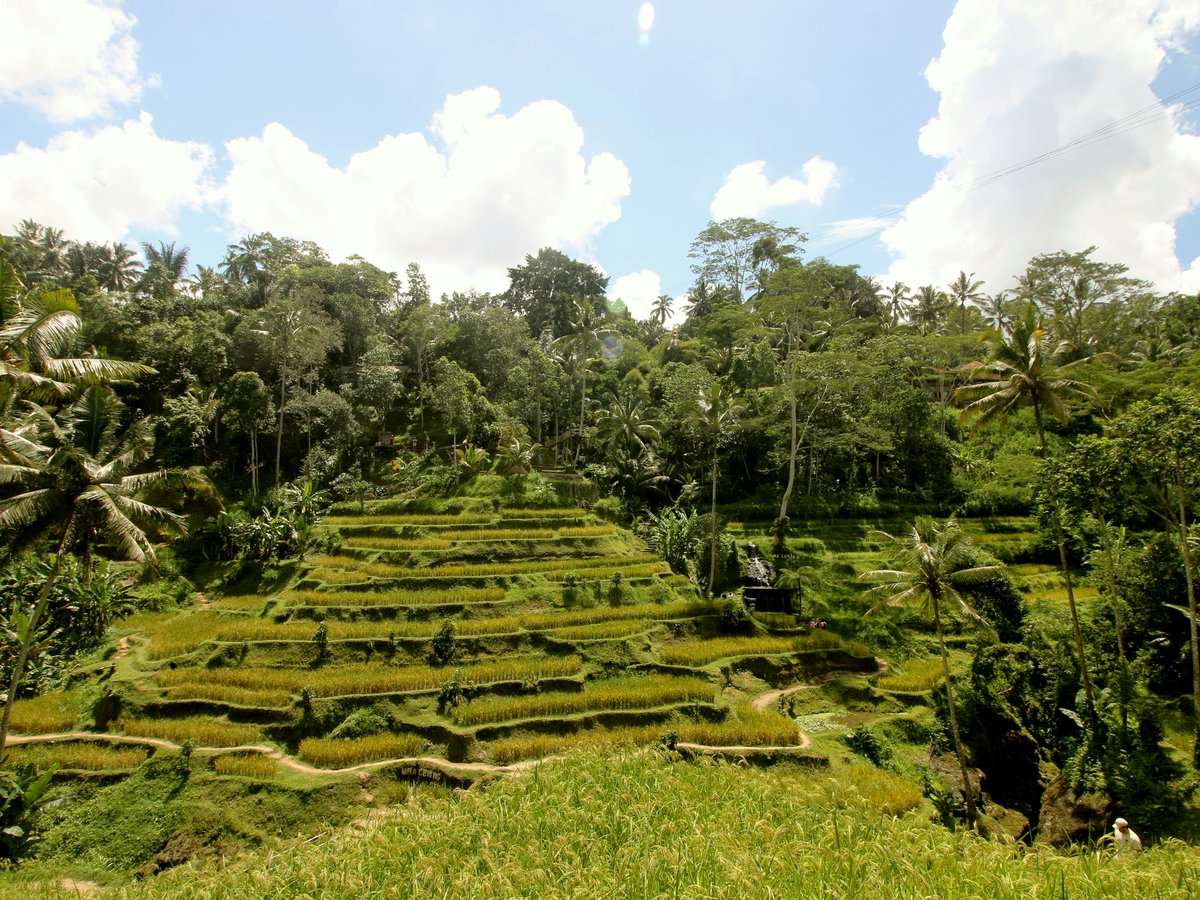
What language is spoken in Ubud?
Indonesian (Bahasa Indonesia) with Balinese spoken among locals. English proficiency in Ubud's tourist corridor along Jalan Raya Ubud and Monkey Forest Road sits around 7 out of 10. Staff at cafes, yoga studios, and guesthouses speak functional English. Outside the center, near villages like Tegallalang and Tirta Empul temple, expect closer to 2 out of 10. Indonesian uses the Latin alphabet, so street signs are readable on arrival.
Ubud runs on two languages. Bahasa Indonesia is the national language, the one on menus and road signs and in every transaction with someone from outside Bali. Balinese is what you'll hear between locals at the Ubud Art Market on Jalan Raya Ubud, or during ceremonies at Pura Taman Saraswati. The two sound different enough that even a few days of exposure trains your ear. Indonesian has no tones, no gendered nouns, and uses Latin script. That alone makes it one of the easier Southeast Asian languages to pick up at a survival level. A 20,000 IDR (about $1.12 at current rates) phrasebook from any of the bookshops along Jalan Dewi Sita will get you further than Google Translate, which tends to produce overly formal Indonesian that sounds strange in casual conversation.
English proficiency along Ubud's main tourist axis is solid. The staff at Seniman Coffee Studio on Jalan Sriwedari, the waiters at Locavore on Jalan Dewi Sita, and the front desks at guesthouses across Penestanan all handle English comfortably. You might notice the proficiency drops sharply once you leave that 2-kilometer radius. At Tirta Empul temple near Tampaksiring, about 15 kilometers northeast of central Ubud, the ticket-counter staff speak some English, but the women managing the sarong rental at the entrance mostly don't. Drivers on the Tegallalang ridge road tend to know prices and directions in English but not much beyond that. Worth noting, the younger Balinese generation, anyone under 30 or so, often speaks surprisingly good English from a combination of tourism exposure and school instruction.
The phrases that change your day are fewer than guidebooks suggest. 'Terima kasih' (thank you) said with a smile at Ibu Oka's warung near Ubud Palace after a plate of smoky babi guling will get a warmer response than pointing at the menu ever could. 'Berapa?' (how much?) at the art market stalls saves you the dance of pulling out your phone calculator. 'Tidak, terima kasih' (no, thank you) is the polite exit from the transport touts who cluster near the Monkey Forest entrance on Jalan Monkey Forest. Mind you, Balinese has its own greeting, 'Om Swastiastu,' which you'll hear at temple entrances and formal ceremonies. Say it at Gunung Kawi or when you enter a village temple compound. It signals respect in a way that 'hello' cannot. The hard 'r' in Indonesian is rolled slightly, and vowels land as they do in Spanish or Italian, not English. 'Satu' (one) sounds like 'sah-too,' not 'sat-oo.'
One practical gap catches first-timers. Restaurant menus outside the main Jalan Raya Ubud corridor, at the warungs in Keliki or along the Campuhan ridge walk, are often Indonesian-only. 'Ayam' is chicken, 'nasi' is rice, 'goreng' is fried, 'mie' is noodles. Those four words decode about 60% of any local menu. 'Pedas' means spicy. Point to it and shake your head. That gets 'not spicy' across faster than any translation app. The smell of clove cigarettes and frangipani incense will likely be your background while you read these menus at a plastic table, the warm humid air at around 23°C this time of year. For digital-nomad types, Ubud scores 7.8/10 on TTDI's digital-nomad suitability rubric (sourced from TTDI's editorial rubric), and the café English in spots like Anomali Coffee on Jalan Raya Ubud is good enough that you won't need Indonesian for a work session.
Languages spoken
Indonesian
Primary language: Indonesian (Bahasa Indonesia).
Useful phrases
- Thank youTerima kasihteh-REE-mah KAH-see
- How much?Berapa?beh-RAH-pah
- No, thank youTidak, terima kasihTEE-dahk, teh-REE-mah KAH-see
- Good morningSelamat pagiseh-LAH-maht PAH-gee
- Excuse mePermisipehr-MEE-see
- DeliciousEnakEH-nahk
- Not spicyTidak pedasTEE-dahk PEH-dahs
- OneSatuSAH-too
- Please / HelpTolongTOH-long
- Where is...?Di mana...?dee MAH-nah
- Plain waterAir putihAH-eer POO-teeh
- Balinese greetingOm Swastiastuohm swah-stee-AH-stoo
Last verified by automated review (v1.7.2) on . What is automated review?