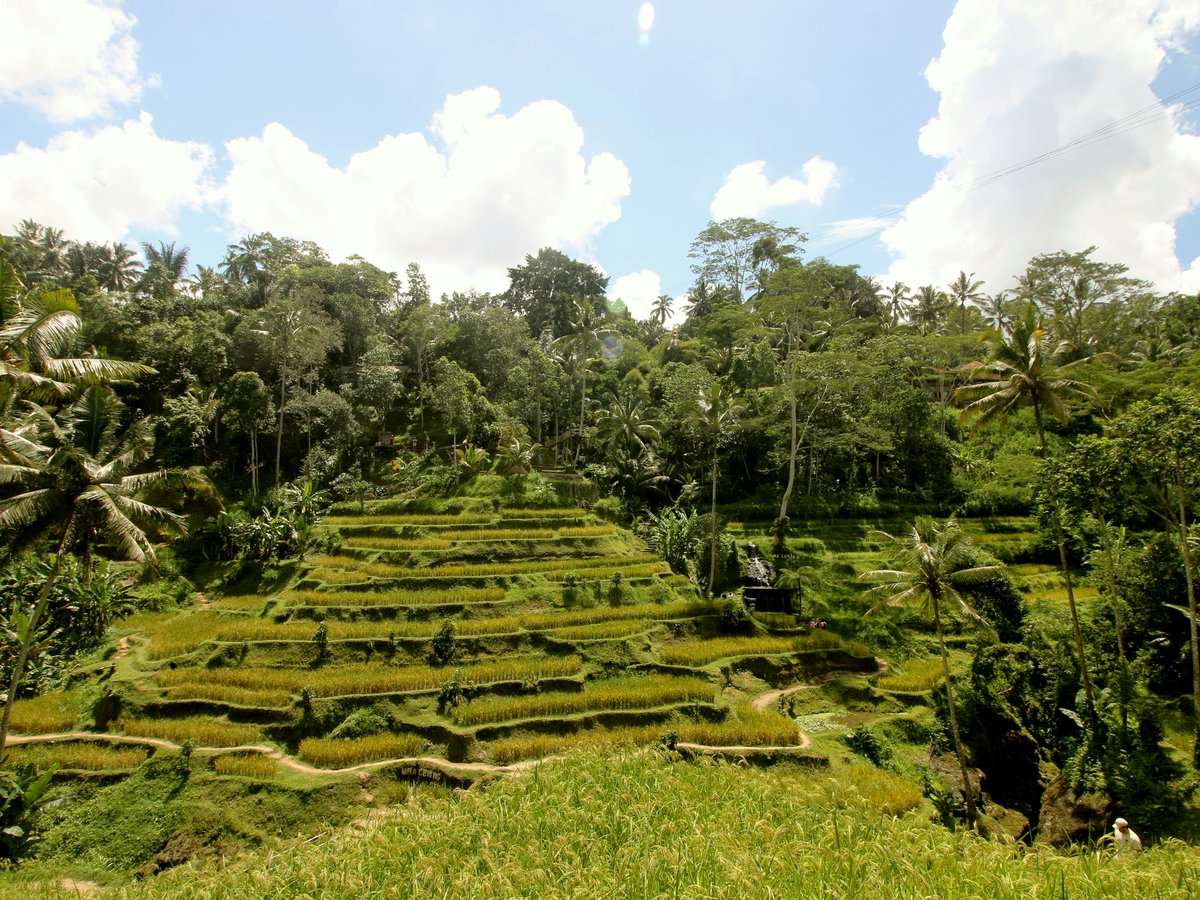
Ubud doesn't follow a grid. The town grew outward from Puri Saren Agung, the royal palace that still sits at the T-intersection of Jalan Raya Ubud and Jalan Monkey Forest. Neighborhoods spread along ridgelines between deep gorges that the Wos and Cerik rivers carved through soft volcanic rock over millennia. Walk west from the palace and you drop into the Campuhan valley, where the two rivers converge. South along Jalan Monkey Forest passes through the main tourist corridor before reaching the Sacred Monkey Forest Sanctuary, beyond which quieter villages begin. East leads to Peliatan, where a second royal family kept Balinese dance traditions alive across generations. North climbs through rice terraces toward Hindu temple complexes that date to the 11th century. Most of the town sits between 200 and 350 meters above sea level. The elevation keeps the air noticeably cooler than Bali's southern coast, particularly after sunset. Late August currently brings clear skies with temperatures around 27°C, though humidity near 62% means you'll likely feel the warmth settle on your skin by mid-morning. Distances look short on a map, but narrow sidewalks and hilly terrain stretch a 1.5 km walk to 25 or 30 minutes. Motorbikes remain the default for moving between neighborhoods, at about 70,000 to 80,000 IDR per day to rent. The Wikivoyage transport guide (https://en.wikivoyage.org/wiki/Ubud#Get_around) covers the specific options well.
Neighborhoods
-
Central Ubud
The core around Puri Saren Agung and the Jalan Raya Ubud corridor is the loudest, densest part of town. Jalan Monkey Forest runs bumper-to-bumper with scooters by 10 a.m. on most mornings. Hindu temple gates stand between shops selling sarongs and carved wooden figurines, sometimes separated by less than 3 meters. The Ubud Art Market opens across from the palace well before dawn, and its ground-level produce section still prices mangosteen and salak for local buyers. Along Jalan Dewi Sita and Jalan Goutama, you'll find the highest concentration of cafés with strong wifi and trilingual menus. A warung nasi campur plate runs about 30,000 IDR on Jalan Goutama. A smoothie bowl at one of the Instagram-forward spots on Jalan Dewi Sita goes for 65,000 IDR or more. That full range of Ubud eating exists within a single 50-meter stretch.
- Best for
- First-time visitors, short stays of 2 to 3 nights, anyone who wants restaurants, markets, and nightly dance performances within walking distance
- Key streets
- Jalan Raya Ubud (main east-west road, home to Museum Puri Lukisan, founded 1956), Jalan Monkey Forest (primary north-south axis), Jalan Dewi Sita (cafés and boutiques), Jalan Goutama (narrow lane with budget warungs and backpacker bars)
-
Campuhan
The word campuhan means 'where two rivers flow together' in Balinese, and this small neighborhood sits at the confluence of the Wos and Cerik rivers west of the palace. The Campuhan Ridge Walk starts here, a narrow footpath along a grassy spine between the two valleys with coconut palms falling away on both sides. Central Ubud is a 10-minute walk east across the bridge, but the feel shifts the moment you cross. The Blanco Renaissance Museum and a handful of mid-range hotels line Jalan Raya Campuhan. Scooter noise from Jalan Raya Ubud fades within 200 meters, replaced by river water, cicadas, and wind through stands of alang-alang grass.
- Best for
- Couples, walkers, photographers, anyone wanting quiet proximity to Central Ubud without the scooter noise
- Key streets
- Jalan Raya Campuhan (the road west from the palace bridge), the Campuhan Ridge Walk footpath between the two river valleys
-
Penestanan
This hilltop above Campuhan became an artist colony in the early 1960s when Dutch painter Arie Smit began encouraging local teenagers to paint. The Young Artists movement they founded still shapes the neighborhood's character. Today the steep lanes of Penestanan hold a mix of long-term expat renters, yoga retreat centers, and small guesthouses with valley views. The Yoga Barn at the southern end runs 15 to 20 classes per day. Roads are narrow, some still unpaved, and a 15% grade in places makes walking with groceries a real effort. Ubud scores 7.8/10 for digital-nomad suitability (sourced from TTDI's editorial rubric), and Penestanan is a large part of the reason. Monthly villa rentals here run between 4 and 8 million IDR, and the pace feels removed from the tourist core even though Central Ubud is a 20-minute walk downhill.
- Best for
- Digital nomads on month-long stays, yoga practitioners, artists, anyone comfortable with steep terrain and limited street lighting after dark
- Key streets
- Jalan Raya Penestanan (the main loop road through the hilltop), the Penestanan Steps connecting down to the Campuhan bridge below
-
Nyuh Kuning
South of the Sacred Monkey Forest Sanctuary, Nyuh Kuning holds more traditional Balinese residential architecture than anywhere in the Ubud area. Stone-carved compound walls line the single main road. Offerings of rice, flowers, and incense appear on every doorstep before 7 a.m. Roosters start around 4:30. The food options are fewer than the Central Ubud strip, but several family-run warungs serve reliable sate lilit and nasi campur at prices about 40% below what those same dishes cost on Jalan Monkey Forest. Guesthouses here run 150,000 to 350,000 IDR per night, making this the most affordable base in the Ubud area. The village goes dark and quiet by about 9 p.m.
- Best for
- Budget travelers, couples wanting quiet evenings, families with older children, anyone staying 4 or more nights who doesn't mind a 15-minute walk to the central restaurant strip
- Key streets
- The single main road through Nyuh Kuning village, plus a footpath connecting to the southern exit of the Sacred Monkey Forest
-
Sanggingan
Northwest of the palace along Jalan Raya Sanggingan, this ridge-top corridor holds the Neka Art Museum and a growing number of restaurants that draw visitors from across the Ubud area. The neighborhood sits above the Wos valley, and several hotels capitalize on west-facing terraces for sunset views across palm canopy. Foot traffic along Jalan Raya Sanggingan stays sparse. You hear birdsong and the occasional passing truck rather than the scooter swarm of Jalan Monkey Forest. Room rates tend to sit in the 500,000 to 1,200,000 IDR range, a middle ground between the budget guesthouses of Nyuh Kuning and the luxury compounds further northwest in Kedewatan.
- Best for
- Art enthusiasts, mid-range budgets, couples who want walkable access to restaurants without Central Ubud's crowd density
- Key streets
- Jalan Raya Sanggingan (the main road northwest from Jalan Raya Ubud), Jalan Lungsiakan (a quieter side road dropping toward the river valley with several boutique guesthouses)
-
Peliatan
East of Central Ubud, Peliatan was historically an independent kingdom with its own royal court. The ARMA (Agung Rai Museum of Art) sits in a compound of open-air pavilions surrounded by lotus ponds and frangipani trees whose scent carries in the late-afternoon heat. The neighborhood feels more residential and Balinese than Central Ubud to its west. The Peliatan legong dance troupe toured Europe and the United States in 1952, and nightly barong and kecak performances still run at local temples for about 80,000 IDR. Workshop sounds drift from family compounds along Jalan Raya Peliatan, where stone carving and woodworking remain family trades.
- Best for
- Culture-focused visitors, travelers who prefer local Balinese neighborhoods over tourist infrastructure, anyone interested in traditional dance and painting traditions
- Key streets
- Jalan Raya Peliatan (the main road east from Central Ubud), the ARMA museum compound and its surrounding lanes
-
Tegallalang
About 9 km north of Central Ubud along the road toward Kintamani, Tegallalang is more a day-trip destination than a place to base yourself. The Tegallalang Rice Terraces draw tour buses that line the road from mid-morning onward. The terraces remain actively farmed using the subak irrigation system, which UNESCO recognized as a Cultural Landscape in 2012. Further north, Tirta Empul holds sacred purification pools fed by a natural spring where Balinese Hindus come to pray. The 11th-century rock-hewn shrines at Gunung Kawi sit in a deep river valley, reached by descending about 300 stone steps (the Wikivoyage sightseeing notes at https://en.wikivoyage.org/wiki/Ubud#See cover both sites). A handful of ridge-top villas along this corridor offer valley views that stretch for kilometers, but you'll need a scooter or hired driver for everything.
- Best for
- Day-trippers from Central Ubud, temple visitors, anyone after rice-terrace photography or an immersion in the subak irrigation system
- Key streets
- The main north road from Ubud toward Kintamani, passing through Ceking, the most-photographed terrace viewpoint along the route
FAQ
Where should I stay in Ubud on a budget under $25 a night?
Nyuh Kuning's guesthouses come in well under that ceiling at the current rate of roughly 17,700 IDR to the dollar. Penestanan offers villa rooms in the 250,000 to 400,000 IDR range with valley views. Both neighborhoods sit within a 15 to 20-minute walk of the Central Ubud restaurant strip. The tradeoff is fewer nearby food options and darker, quieter streets after sundown.
Can I get around Ubud without renting a scooter?
Partly. Central Ubud, Campuhan, and Sanggingan are walkable from each other, though sidewalks are narrow or absent and the terrain is hilly. Peliatan is an easy 15-minute walk east. Reaching the Tegallalang terraces, the temple complexes further north, or Penglipuran Village (a traditional Balinese village about 45 km northeast with flat, paved pathways) requires wheels. Grab and GoJek ride apps work in the Ubud area, but availability drops noticeably after dark and during heavy rain.
How safe is Ubud for solo travelers?
Ubud scores 6.8/10 for solo-traveler safety (see the TTDI Solo-Safety Index). The risks are practical rather than violent. Scooter-filled roads without shoulders or sidewalks are the biggest daily hazard on foot. Uneven paving and open drains catch people after dark. Petty theft occurs in crowded market areas, mostly bag-snatching from passing scooters. Campuhan and Nyuh Kuning feel particularly calm at night due to low traffic and tight village community presence. The Wikivoyage safety notes (https://en.wikivoyage.org/wiki/Ubud#Stay_safe) cover common scams to watch for.
Is Ubud a good base for families with young children?
Ubud scores 5.8/10 for family friendliness (see the TTDI Family-Friendliness Index). The terrain is the main limitation. Steep roads, absent sidewalks, and aggressive scooter traffic make strollers difficult outside of Nyuh Kuning's flat main road. Activities in Central Ubud skew toward yoga retreats and art workshops rather than kid-focused attractions. That said, the Monkey Forest is a reliable hit with children as long as you hide all food and shiny objects. Several hotel pools in Sanggingan and Kedewatan welcome day-use guests for 100,000 to 200,000 IDR.
What is the LGBTQ+ situation like in Ubud?
Ubud scores 4.5/10 for LGBTQ+ friendliness (sourced from TTDI's editorial rubric). Bali tends to be more accepting than other Indonesian provinces, and same-sex couples in Ubud's tourist core are unlikely to face direct hostility at guesthouses or restaurants. That said, public displays of affection draw attention in most Balinese settings regardless of orientation. The cafés and yoga spaces in Penestanan tend to be the most openly welcoming spots. The further you stay from the Jalan Monkey Forest corridor, the more conservative the social environment becomes.
Last verified by automated review (v1.7.2) on . What is automated review?