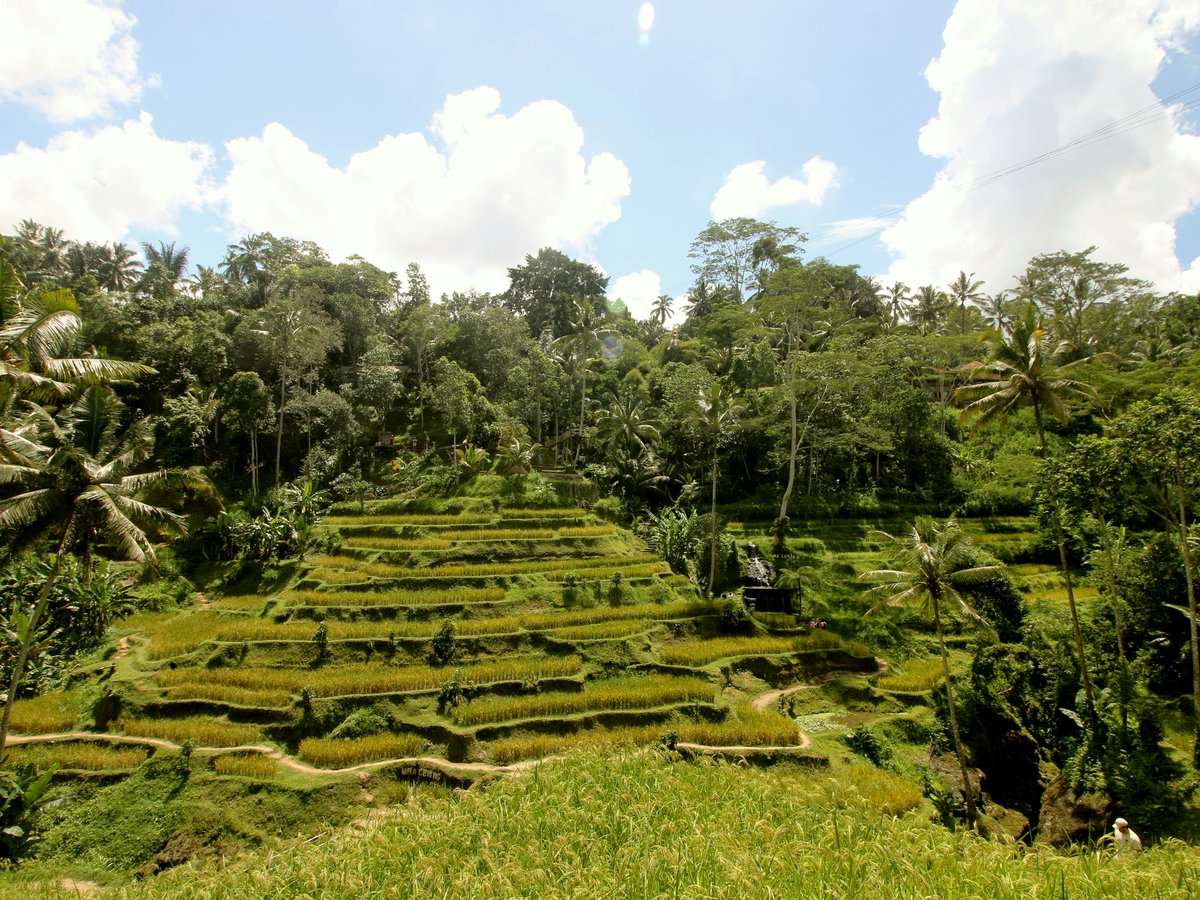
Ubud sits roughly 200 meters above sea level in Bali's central foothills, about 35 kilometers north of Ngurah Rai International Airport. Morning temperatures in late August tend to hover around 19°C before 8 a.m., cool enough to make the ridge walks pleasant before humidity builds past 80% through the afternoon. The town grew around the Puri Saren Agung palace compound, and cultural life still radiates from that center. Most Hindu pura here remain free to enter provided you wear a sarong and sash; loaners wait at nearly every gate. The rice paddies along the Wos, Ayung, and Petanu river valleys are open to anyone on foot, and Ubud's private galleries tend to charge nothing for a look. You could fill 3 or 4 days without spending beyond meals and a room, particularly during the dry season from May through September when the footpaths stay firm underfoot.
Free attractions
-
Campuhan Ridge Walk
This roughly 2-kilometer paved path follows a narrow ridge between two river gorges west of central Ubud. The trailhead sits near the Ibah Luxury Villas junction. Grass on either side grows waist-high during the November-to-March wet season and gets trimmed back after harvest. Early risers before 7 a.m. get the best light and the thinnest crowds. On clear mornings, coconut palms drop away to river level roughly 50 meters below on both sides. The path continues north to Bangkiang Sidem village for those who want to extend the walk. No ticket booth, no gate.
Campuhanwalking path, viewpoint, and green space -
Pura Taman Saraswati
A water temple built in the 1950s on commission from the Ubud royal family. The stone carvings are attributed to I Gusti Nyoman Lempad, one of Bali's most celebrated traditional artists. A lotus pond fronts the temple grounds, its pink and white blooms thickest in the wetter months, and the Lotus Cafe and a Starbucks flank the approach from Jalan Raya Ubud. Entry to the temple and the garden forecourt is free during daylight hours. The commercial noise falls away once you pass through the candi bentar, the traditional Balinese split gate. Evening dance performances sometimes use the temple as a stage, though those carry a separate ticket.
Central Ubudtemple and lotus garden -
Puri Saren Agung (Ubud Royal Palace)
The palace sits at the junction of Jalan Raya Ubud and Jalan Monkey Forest, the main crossroads in town. The front courtyard and its carved stone gates are open to visitors at no charge during the day. The Sukawati royal family still occupies the inner compound, and frangipani trees shade the carved guardian figures across the outer courtyard. Worth noting, the courtyard converts into a performance venue after dark, and those evening dance shows require tickets at the gate.
Central Ubudpalace and cultural site -
Pura Gunung Lebah
One of the oldest temples in the Ubud area, believed to date from as early as the 8th century. It sits at the point where two tributaries meet at the bottom of the Campuhan valley. Moss covers much of the dark volcanic stonework, and ferns grow out of the joints between blocks. The temple is free to enter and tends to draw far fewer visitors than the more photographed sites uphill. A stone bridge south of the temple gives a view straight down into the river gorge.
Campuhantemple -
Pura Dalem Ubud
A pura dalem, or temple of the dead, on Jalan Raya Ubud east of the main intersection. These temples in Bali are associated with Siwa in his destroyer aspect, and the stone carvings here lean toward fanged Rangda witch figures and bulging-eyed Barong faces rather than the gentler lotus motifs found at water temples. The grounds are smaller and quieter than the Saraswati compound a few hundred meters west. The usual temple dress code applies.
Central Ubudtemple -
Seniwati Gallery of Art by Women
Founded in 1991 by Australian expat Mary Northmore, this gallery on Jalan Sriwedari shows work by Balinese and Indonesian women artists. The permanent collection and rotating exhibitions are free to browse. Paintings span traditional Batuan-style narrative pieces, contemporary acrylics, and mixed-media work. The gallery operates as a nonprofit and has been part of Ubud's art scene since its founding. You might find yourself alone in the rooms on a weekday morning.
Sriwedarigallery and exhibition space -
Threads of Life Indonesian Textile Arts Center
A fair-trade gallery and shop on Jalan Kajeng dedicated to traditional Indonesian textiles from across the archipelago. The gallery side shows ikat from Flores, songket from Sumba, and batik from Java, with wall-mounted panels explaining each weaving tradition. Free to walk through. The shop sells finished textiles, but the exhibition space operates separately. Staff tend to be knowledgeable and happy to explain the differences between warp ikat and weft ikat if you ask.
Kajengtextile gallery and exhibition
Free activities
-
Browsing Pasar Seni Ubud (Ubud Art Market)
The market sits directly across from the Royal Palace on Jalan Raya Ubud. Stalls on the lower level sell woven baskets, batik sarongs, wooden carvings, and silver jewelry. The upper floor trends toward paintings and larger crafts. Mornings before 9 a.m. draw more local buyers shopping for offerings supplies and household goods. Tourist-oriented items take over by midday. Browsing costs nothing, and the vendors are accustomed to people looking without purchasing.
Central Ubudmarket browsing -
Kajeng Rice Field Walk
The path starts at the northern end of Jalan Kajeng, past the textile galleries, and heads into open rice paddies. The route loops through working fields for roughly 1.5 kilometers before connecting back to a parallel road. Dragonflies, frogs, and the sound of irrigation channels are constant company. The path is unshaded in places, so early morning or late afternoon visits are more comfortable. Farmers tend to be tolerant of walkers who stay on the raised bunds between plots.
Kajengwalking route and green space -
Sari Organic Walk
A well-worn footpath through rice terraces north of Ubud center, named after the Sari Organic restaurant that sits partway along the route. The walk heads north from near the intersection of Jalan Raya Ubud and Jalan Tirta Tawar through increasingly open farmland. You might hear nothing but wind through the rice stalks and the occasional motorbike on a distant lane. On clear mornings, Mount Agung becomes visible to the northeast. The terrain tends to be muddier than the Kajeng path after rain. Several small warungs along the route sell cold drinks if you need a break.
North Ubudwalking route and green space -
Walking Jalan Hanoman
Jalan Hanoman runs roughly parallel to Jalan Monkey Forest through central Ubud, connecting the main road to the southern neighborhoods. The street is lined with cafes, boutique shops, and small galleries, several of which are free to enter. Carved stone facades on older buildings carry the same Balinese motifs found at the temples. The sidewalk narrows in places, but traffic tends to be lighter than on the main road. Late afternoon is a good time for a walk, when the western light catches the stonework.
Central Ubudstreet walking and gallery browsing -
Watching the Morning Canang Sari Offerings
Every morning, shopkeepers and residents across Ubud place small canang sari offerings outside their doors. Each canang sari is a woven banana-leaf tray filled with flower petals, rice grains, and a stick of incense, and the sweet smoke tends to reach the sidewalks by 6 a.m. Observers who keep a respectful distance of a meter or two are welcome. The ritual repeats daily along every street in central Ubud, and yesterday's dried trays remain visible by the curbs even as fresh ones go down.
Throughout Ubudcultural observation
Free events
-
Odalan Temple Anniversary Ceremonies
Rotating; multiple times per month across different templesEvery Hindu temple in Bali celebrates its anniversary on a 210-day cycle following the Pawukon calendar rather than the Gregorian one. In Ubud, with dozens of pura in and around town, there seems to be an odalan happening somewhere most weeks. The celebrations involve gamelan orchestras, processions in full ceremonial dress, and elaborate offerings stacked in towers called gebogan. Visitors are welcome to observe and enter the temple grounds during odalan with appropriate clothing. Each odalan can last anywhere from 1 to 11 days depending on the temple's status in the local hierarchy.
Various temples in and around Ubud -
Galungan and Kuningan Festivals
Recurs on the Pawukon calendar cycle, roughly every 7 months by Gregorian reckoningGalungan marks the victory of dharma over adharma, and the streets of Ubud fill with tall penjor, curved bamboo poles decorated with coconut leaves, fruit, and rice cakes. Kuningan follows 10 days later. Families in traditional dress move between temples in long processions, and the air carries the scent of burning incense and frying ceremonial cakes. These festivals follow the same cycle as the odalan celebrations. The street decorations stay up for about 2 weeks, and visitors who happen to arrive during this period find a town that looks entirely different from its everyday self.
Throughout Ubud and all of Bali -
Ogoh-Ogoh Parade (Nyepi Eve)
Annually, the night before Nyepi (March or April, following the Saka lunisolar calendar)The night before Nyepi, Bali's Day of Silence, each neighborhood carries enormous papier-mâché figures of demons and mythological creatures through the streets. The figures can stand 3 to 5 meters tall. In Ubud, the parade route typically follows Jalan Raya Ubud past the palace. The noise is considerable, with drums, shouting, and firecrackers filling the streets. The parade is free to watch from the sidewalk.
Main roads through Ubud center -
Gallery Opening Nights
Irregular; check gallery notice boards or the tourist information officeUbud's art galleries hold opening receptions for new exhibitions throughout the year. Komaneka Fine Art Gallery on Jalan Monkey Forest, Tony Raka Art Gallery in Mas, and several smaller spaces along the main streets each host openings that are free to attend. These events typically include complimentary drinks and a chance to meet the artists. Schedules are irregular, so checking gallery notice boards or asking at the Ubud tourist information office on Jalan Raya Ubud is the most reliable way to find what is coming up.
Various galleries in and around Ubud -
Community Gamelan Rehearsals
Weekly or more frequently; typically eveningsMany of Ubud's neighborhood banjars, the local community associations, hold regular gamelan rehearsals in their bale banjar, the open-air community pavilion. The sound of bronze metallophones and drums carries across the rice fields on still evenings. Rehearsals are open to respectful observers, though asking before sitting down is courteous. Peliatan, the village directly east of Ubud, has a particularly strong gamelan and dance tradition and tends to rehearse several evenings per week.
Bale banjar (community pavilions) in Ubud's neighborhoods
Nearby Attractions That Require a Ticket
Not everything in the Ubud area is free, and knowing which sites charge admission helps with budgeting. The Sacred Monkey Forest Sanctuary on Jalan Monkey Forest currently charges around 80,000 IDR for foreign visitors. Gunung Kawi, an 11th-century rock-cut temple complex about 14 kilometers northeast of town, and Goa Gajah, a 9th-century archaeological site roughly 5 kilometers east, both charge in the 50,000 IDR range. Tirta Empul, the purification temple near Tampaksiring, carries a similar fee. The Tegallalang rice terraces north of Ubud have informal entry points with requested donations. On the museum side, Museum Puri Lukisan (founded 1956), the Neka Art Museum, and the Agung Rai Museum of Art charge between 50,000 and 100,000 IDR each. At the current exchange rate of roughly 17,737 IDR to 1 USD, even the priciest museum tickets run less than $6 per person.
Practical Notes for Zero-Budget Days
Carry a reusable water bottle. Ubud's tap water is not potable, but refill stations have become common along the main streets, typically charging 3,000 to 5,000 IDR per liter. A spare sarong in your daypack saves time if you plan to visit multiple temples in one outing, since the loaner supply at less-visited sites can run thin. Sunscreen matters for the exposed ridge and rice-field walks, even on overcast mornings. Wi-fi is widely available at cafes along Jalan Monkey Forest and Jalan Dewi Sita. TTDI rates the town 7.8 out of 10 for digital-nomad suitability (sourced from TTDI's editorial rubric). For solo visitors, TTDI rates Ubud 6.8 out of 10 for solo-traveler safety (see the TTDI Solo-Safety Index). The most reliable ATMs cluster near the main crossroads. Moneychangers in town should be approached with caution; the exchange rate at bank ATMs tends to be more transparent.
FAQ
Is the Sacred Monkey Forest Sanctuary in Ubud free to enter?
No. The Sacred Monkey Forest charges admission for all visitors, with separate rates for domestic and foreign guests. It is one of several paid attractions in the Ubud area. The temples, galleries, and walking routes described in this guide are genuinely free alternatives.
Can visitors attend Balinese temple ceremonies in Ubud?
Yes, most temple ceremonies are open to respectful visitors. Proper temple clothing is required, and loaners are available at most gates. Photography is usually permitted, but stepping in front of worshippers or standing on elevated platforms above them is considered disrespectful. During large celebrations, the temple grounds fill with local families carrying offerings, and staying to the side is appreciated.
Are the rice terraces around Ubud free to walk through?
The public footpaths through working rice paddies near Ubud are free. The walks described in this guide follow established trails on raised bunds between fields. The terraced sites that charge for entry, like Tegallalang about 9 kilometers to the north, are separate from these public paths. Mind you, farmers along the quieter routes tend to be fine with walkers who stay on the bunds and leave the irrigation channels alone.
What is the best free walking route in Ubud?
That depends on what you are after. The Campuhan Ridge is the most popular and offers open-sky views along a paved path. The Kajeng and Sari Organic routes pass through working rice paddies and feel more rural. For temple architecture and street life, a loop along Jalan Raya Ubud past the Saraswati temple and down Jalan Hanoman covers the cultural center on foot.
Do I need to carry cash for the free attractions in Ubud?
The attractions in this guide are genuinely free, with no donation box or tip jar at the entrance. That said, carrying some small Indonesian rupiah notes is useful for water refills, a drink from a warung, or an offering that catches your eye at the market. Most cafes along the main streets accept cards, but smaller warungs and market stalls are cash-only.
Last verified by automated review (v1.7.2) on . What is automated review?