Stay in Ubud in September
9 hotels in the Trip.com pool for Ubud, from US$18 a night.
Opens Trip.com on Fri 3 Sep to Sun 5 Sep 2027; change the dates there.
September in Ubud sits at the comfortable tail of Bali's dry season, and the single most important thing to know is that you're arriving after the July-August tourist peak but before the wet season begins in November. Daytime temperatures hover around 28.2°C (83°F) with nighttime lows near 21.2°C (70°F), warm enough for cotton but cool enough to sleep without air conditioning in the hillside guesthouses of Penestanan and Sayan. The 130mm of rainfall spread across roughly 22 days sounds like a lot on paper, but these tend to be short afternoon showers that clear within 30 to 45 minutes, leaving the rice terraces around Tegallalang looking their greenest.
Crowds thin noticeably from August's peak. The cafes along Jalan Dewi Sita have open tables at lunch. You can walk into the Sacred Monkey Forest Sanctuary without queueing at the gate. Hotel rates across Nyuh Kuning and central Ubud drop as the Australian school-holiday travelers head home. September might not be the single best month for a visit, since June's 90mm of rain earns that distinction, but it sits comfortably in the top tier. You get dry-season weather with shoulder-season pricing and the freedom to walk into restaurants that needed reservations 4 weeks earlier.
Bali's cultural calendar stays active regardless of the Gregorian month. Balinese Hindu ceremonies follow the 210-day Pawukon cycle, so temple rituals at places like Tirta Empul and Gunung Kawi continue year-round. The full moon ceremony (Purnama) in mid-September draws worshippers to water temples across Gianyar regency, and visitors are welcome to observe, provided they wear a sarong and sash that temple attendants lend for a small donation.
Why visit in September
- September's 130mm of rainfall is less than a third of January's 348mm, and the showers follow a predictable mid-afternoon pattern that rarely disrupts a full day's plans.
- The Australian school holidays end in mid-August, which means September sees a measurable drop in visitor numbers at landmarks like the Sacred Monkey Forest and Tegallalang Rice Terraces.
- Hotel and villa rates in the Ubud area settle into shoulder-season levels, offering noticeably better value than July or August without the monsoon-season discounts that come with November's 286mm of rain.
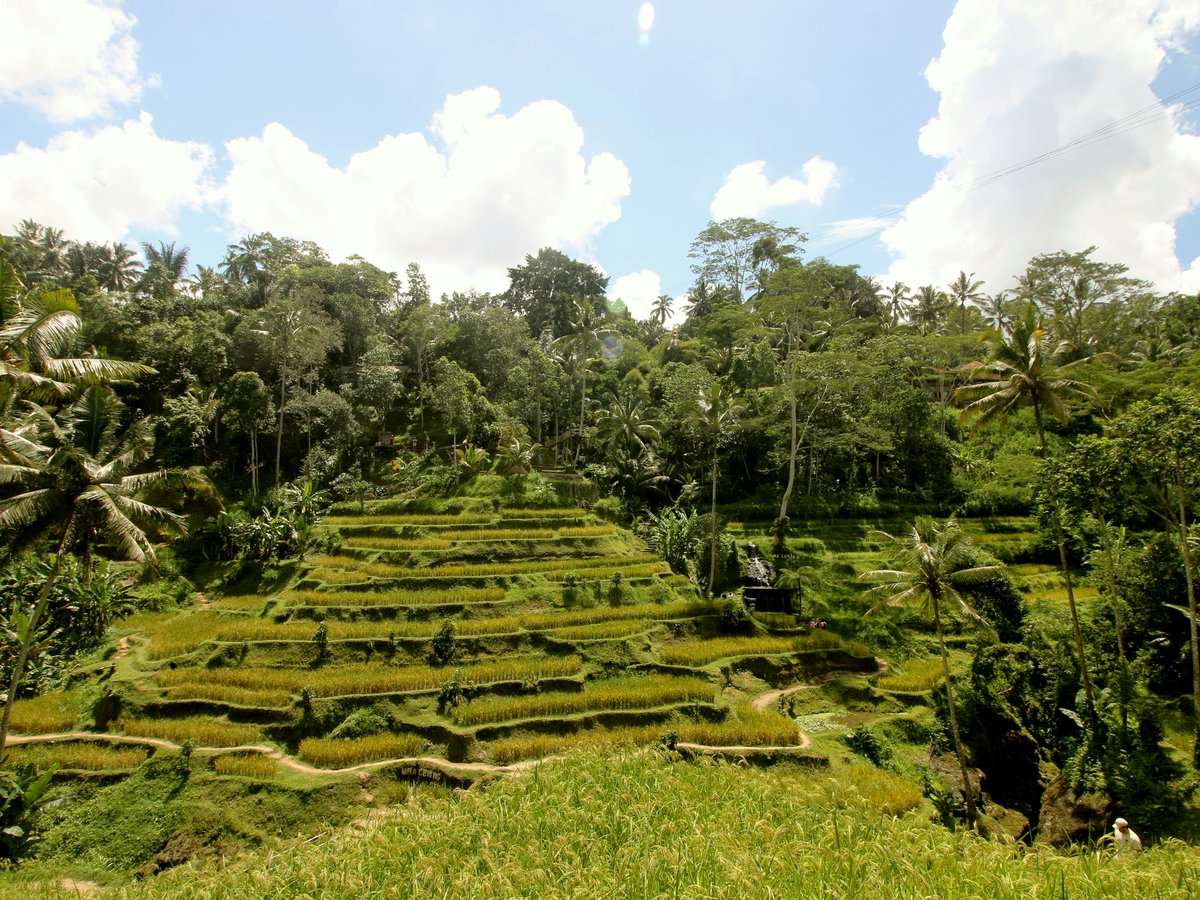
- The rice terraces reach peak saturation of green in September, fed by months of accumulated moisture but lit by consistent dry-season light, making it one of the strongest months for landscape photography.
Worth knowing
- Humidity holds at 85%, which can feel oppressive in sheltered spots away from the ridge breezes, especially along the lower streets of central Ubud around Jalan Monkey Forest.
- With rain falling on 22 of 30 days, you will encounter at least one shower on almost every day of your trip, and occasionally a heavier downpour that lasts over an hour.
- September lacks a marquee festival or event to anchor a trip around. The Ubud Writers and Readers Festival typically falls in October, and Galungan dates rotate on the 210-day Pawukon calendar.
Best for
Think twice if
September falls within the drier arc that runs from May through October. Days feel warm and gently sticky, with equatorial sun breaking through by mid-morning even when clouds linger. Rain arrives in short, concentrated afternoon bursts, typically between 14:00 and 16:00, and clears by early evening. Mornings tend to be the most comfortable part of the day, with temperatures that feel pleasant rather than oppressive. The breeze through the Ayung river valley near Sayan provides relief from the moisture in the air, while sheltered lanes in the town center can feel close by midday.
Seasonal caution
- The equatorial UV index in September reaches 10 to 11 on clear mornings, strong enough to burn unprotected skin in under 15 minutes. Cloud cover reduces the index only modestly, so sunscreen is necessary even on overcast days.
- Dengue-carrying Aedes mosquitoes are active year-round in the Ubud highlands, with a slight uptick during the late dry season as brief rain creates standing water in puddles and containers. Cover exposed skin at dawn and dusk, and consider accommodation with screened windows.
Year-round climate
Averages from the last 5 years.
| Month | Avg high (°C) | Avg low (°C) | Rainfall (mm) |
|---|---|---|---|
| Jan | 29 | 23 | 348 |
| Feb | 29 | 23 | 304 |
| Mar | 30 | 22 | 246 |
| Apr | 29 | 22 | 151 |
| May | 29 | 22 | 136 |
| Jun | 28 | 22 | 90 |
| Jul | 27 | 21 | 135 |
| Aug | 27 | 21 | 114 |
| Sep | 28 | 21 | 130 |
| Oct | 29 | 22 | 135 |
| Nov | 29 | 22 | 286 |
| Dec | 29 | 23 | 283 |
Best things to do in September
Dawn walk on Campuhan Ridge
natureA 2km paved path along a narrow ridge between two river valleys, starting near the Ibah hotel in Campuhan and ending at Bangkiang Sidem village. The ridge sits above the tree canopy, with views across to coconut palms and, on clear mornings, the silhouette of Gunung Agung 60km to the east.
September's dry mornings keep the path firm and the valley views clear. From November through March, early fog and muddy sections make the walk less rewarding.Booking tipNo booking needed. Arrive before 07:00 to beat the heat and the tour groups.
Rice terrace photography at Tegallalang
sightseeingThe most photographed section of Bali's UNESCO-recognized subak irrigation system, with tiered paddies cascading down a steep valley 20 minutes north of central Ubud. The subak system received its UNESCO recognition in 2012.
The terraces reach their deepest green in September after months of accumulated rain, while dry-season light provides consistent golden-hour conditions for photography.Booking tipThe terraces are busiest between 10:00 and 14:00. Arrive at 07:30 or after 16:00 for the best light and fewest visitors.
Purification ceremony (melukat) at Tirta Empul
culturalBalinese Hindu worshippers queue to pass through a series of stone spouts fed by a natural spring at this 10th-century temple near Tampaksiring, about 30 minutes northeast of Ubud. Visitors can participate in the melukat ritual, standing under each spout in sequence.
September's smaller crowds mean shorter waits at the holy springs compared to the July-August peak, allowing a more contemplative experience at each spout.Booking tipHire a local guide who can explain the ritual sequence. Temple entry requires a sarong and sash, available at the gate.
White-water rafting on the Ayung River
adventureClass II to III rapids through a jungle-lined gorge with carved stone reliefs along the riverbanks. The Ayung is Bali's longest river, and the rafting section near Sayan runs about 10km with several moderate drops.
Water levels remain solid from prior months while September's reduced rainfall creates more predictable conditions than the wet-season extremes. The gorge temperature stays cool even at midday.Booking tipMorning departures (starting around 09:00) finish before the afternoon rain. Book at least 2 days ahead for weekend slots.
Cycling through Penglipuran Village
cyclingA pedal from the Ubud area north to one of Bali's best-preserved traditional villages, where bamboo-framed houses line a single pedestrian street flanked by identical family compounds. The ride covers about 25km each way with some serious hill climbing.
Dry roads and cooler September mornings, around 21°C at dawn, make the hilly route manageable without the slippery descents and sweat of wet-season riding.Booking tipGuided cycling tours handle the uphill portion with a van shuttle. Self-guided riders should leave before 07:00.
Visiting Goa Gajah (Elephant Cave)
culturalA 9th-century archaeological site 5km southeast of central Ubud featuring a carved demon-face cave entrance, Hindu and Buddhist rock reliefs, and a set of bathing fountains fed by natural springs. The carved facade alone merits the visit.
The steep stone steps down to the site are safer when dry, and September's lower visitor count lets you photograph the carved entrance without competing for angles.Booking tipCombine with a stop at Yeh Pulu relief carvings, a 10-minute walk east. Both sites are manageable in a single morning.
Exploring Sanggingan's museum row
culturalThree art museums sit within walking distance along the road through Sanggingan, north of central Ubud. The Neka Art Museum, Blanco Renaissance Museum, and several private galleries cover everything from classical kamasan painting to contemporary Indonesian abstraction.
September's afternoon rain showers make indoor museum time a practical, comfortable use of the 14:00 to 16:00 window when outdoor plans get disrupted. Fewer visitors means quieter galleries.Booking tipThe Neka Art Museum alone can fill 2 to 3 hours. Budget a full afternoon if you want to see all three.
What to eat in September
In season: fruit
Salak Bali (snake fruit)
The scaly-skinned fruit grows in abundance across the Ubud corridor and the Sibetan district to the east. September markets stock firm, copper-colored specimens with the sweet-tart crunch that the Balinese salak variety is known for. Peel back the brittle skin and eat the segmented flesh straight, discarding the seed.
On menus now
Babi guling (suckling pig)
Bali's signature roast pork, slow-turned over coffee-wood coals until the skin crackles. Available year-round at dedicated warung, but September's frequent temple ceremonies increase the supply of freshly prepared babi guling in village markets around Peliatan and Mas, where family-scale preparations spill over into public sale. The meat comes with lawar (a spiced coconut-and-vegetable mix) and steamed rice.
What to drink
Kintamani Arabica coffee
Bali's Kintamani highlands, about 40km north of Ubud, wrap up their Arabica coffee harvest by late September. This is the window for the freshest single-origin beans, and roasteries in the Ubud area brew cups with a brightness that fades as the stored beans age through the wet season. The volcanic soil at 1,200 meters gives the beans a citrus note distinct from Javanese or Sumatran coffee.
Jamu kunyit asam
A traditional Javanese-Balinese herbal tonic made from fresh turmeric, tamarind, and palm sugar. Women carry glass bottles of it through Ubud's morning markets, and locals drink it daily for digestion and immunity. September's dry-to-wet transition is traditionally when families increase their jamu intake, and you'll see more varieties on offer than in peak tourist months.
In markets
Single-origin Bali cacao
The cacao harvest across Bali's lowland and mid-altitude farms runs from roughly April through November, with September sitting in the peak window. Small-batch producers around the Tabanan and Gianyar regencies sell fresh cacao nibs, raw drinking chocolate, and bean-to-bar tablets that reflect the harvest's quality in a way that stored beans from months later cannot match.
Regular events in September
Purnama (Full Moon Ceremony)Free
Balinese Hindu temples across Gianyar regency hold prayers and offerings on the full moon. Water temples, including Tirta Empul and Pura Tirta Sudamala, see the largest gatherings. Visitors may observe from designated areas if dressed in temple attire.
Mid-September (exact date follows the lunar calendar)Tilem (New Moon Ceremony)Free
A quieter counterpart to Purnama, observed at temples on the new moon. Locals bring offerings and pray for spiritual cleansing. The atmosphere is more subdued and intimate than the full moon observance.
Early September (exact date follows the lunar calendar)Hari Olahraga Nasional (National Sports Day)Free
Indonesia's national sports holiday, marked on September 9 each year. Schools and community organizations in the Ubud area hold morning sporting events, group runs, and friendly tournaments. The main gathering in Ubud typically takes place at the Lapangan Ubud sports field.
September 9Nightly traditional dance performances at Puri Saren Agung
Legong, Barong, and Kecak dance troupes from Peliatan and surrounding villages perform in the inner courtyard of the Ubud Royal Palace. September's smaller audiences create a more intimate atmosphere than the packed July-August shows. Performances run at 19:30.
Nightly throughout SeptemberBest places this September
Campuhan Ridge Walk
nature walkThe 2km ridge path is at its most walkable in September, with dry footing and clear morning views across the valley. On low-humidity mornings, the profile of Gunung Agung appears on the eastern horizon.
CampuhanTegallalang Rice Terraces
scenic viewpointThe iconic subak-irrigated terraces reach their deepest green in September, lit by consistent dry-season sun. The main viewpoint is free, though the lower terrace paths charge a small donation.
TegallalangMuseum Puri Lukisan
art museumFounded in 1956, Ubud's oldest art museum houses 4 buildings of traditional and modern Balinese painting. The shaded garden between buildings is a cool retreat from September's midday warmth.
Central UbudPuri Saren Agung (Ubud Royal Palace)
historic palaceThe royal compound facing the Art Market. September's nightly dance performances in the inner courtyard draw smaller audiences than peak months, and the carved stone gates photograph well in late-afternoon light.
Central UbudNeka Art Museum
art museumFive exhibition pavilions on a Sanggingan hillside covering Balinese art from classical kamasan work to modern abstraction. The outdoor sculpture garden and terraces glow green in September's late-dry-season lushness.
SangginganGoa Gajah (Elephant Cave)
archaeological siteThe 9th-century cave temple's demon-face entrance and bathing fountains sit at the bottom of a steep stone staircase. September's dry conditions make the descent safer than in the wet months, when moss turns the steps slick.
BeduluPenglipuran Village
traditional villageA remarkably preserved traditional village 45 minutes north of Ubud. The bamboo-framed houses and packed-earth paths are at their most photogenic when September's dry weather firms up the ground. The village's uniform architecture follows centuries-old building codes.
Bangli regency
Your packing checklist
Tick items off as you pack. Your progress saves in this browser.
All packed — have a great trip.
Insider tips
The morning market (Pasar Ubud) on Jalan Raya Ubud runs from roughly 04:00 to 08:00 for locals buying fresh produce. By 09:00 it transitions into the tourist-oriented Art Market with marked-up prices. September's quieter mornings mean the produce section stays active a bit longer, and the fruit stalls are where you'll find the best salak Bali.
The afternoon rain follows a remarkably consistent pattern in September. Cloud cover builds from about 13:00, rain falls between 14:00 and 16:00, and skies clear by 17:00. Plan temple visits and terrace walks for the morning, save indoor time for the afternoon window.
Ubud scores 6.8 out of 10 for solo-traveler safety (see the TTDI Solo-Safety Index). Walking alone after dark on the main roads like Jalan Raya Ubud and Jalan Monkey Forest feels generally safe. The smaller village lanes in Peliatan and Sanggingan lack streetlights, though, so a small headlamp for the walk home from dinner is more useful than you'd expect.
Villa and guesthouse owners in Penestanan and Nyuh Kuning often offer unpublished weekly or monthly discounts in September, since they're trying to fill gaps between the August rush and the pre-Christmas bookings. Ask in person or message directly; these rarely appear on booking platforms.
Avoid these mistakes
- Scheduling every outdoor activity for the afternoon. September's rain pattern is predictable, with clear mornings and showers arriving by mid-afternoon. Visitors who save their Tegallalang or Campuhan plans for after lunch end up waiting out rain, while mornings are reliably dry and 5 to 7 degrees cooler.
- Packing only shorts and tank tops. Bali's temples require covered shoulders and knees, and September's active ceremony calendar means you'll encounter temple visits even on casual days. Getting turned away at the gate of a temple like Goa Gajah because of exposed shoulders wastes the 30-minute drive.
- Assuming that dry season means no rain. September still averages rain on more than 70% of days. The difference from wet season is the duration of each shower, not its frequency. Wet-season storms can last 3 to 4 hours. September's pass in under 40 minutes. Plan around them rather than being surprised.
Practical tips for September
September's shoulder-season status means fewer visitors, but Ubud's core infrastructure runs on the same schedule year-round. Legong and Barong dance performances at Puri Saren Agung run nightly throughout the month. Book multi-day cooking or yoga courses at least a week ahead, since September class sizes are smaller and cancellation thresholds are lower. If you're heading to the coast for a Nusa Penida snorkeling trip, September currents near Manta Point can run stronger than in calmer months; confirm conditions with operators the morning of departure. For longer stays, renting a motorbike from a local shop beats hailing individual rides. Ubud's hills make walking between Sanggingan and Peliatan a genuine workout, and September's dry roads are well-suited to two-wheel navigation. Mobile coverage on Telkomsel runs reliably in central Ubud but drops in the northern villages toward Kintamani. The Ubud area does not have any major closure days in September. Nyepi (Balinese Day of Silence, when the entire island shuts down) falls in March, so there are no surprises on that front.
FAQ
Is September a good time to visit Ubud?
September ranks roughly 4th out of 12 months for visiting Ubud. You get dry-season weather without the peak-season crowds that fill the town in July and August. The rain that does fall arrives in predictable afternoon windows and passes quickly. June tends to be drier overall, but September's combination of comfortable weather, shoulder-season pricing, and thinner crowds makes it one of the stronger value propositions across the calendar.
What is the weather like in Ubud in September?
Warm and humid, with brief afternoon rain. September sits in the drier half of Ubud's year, between the driest month (June) and the monsoon onset in November. Mornings tend to be clear and comfortable for outdoor activities, with clouds building by early afternoon and short rain by mid-afternoon. Evenings cool down enough for a light layer along the river valleys. The equatorial sun is strong even through cloud cover, so sunscreen is necessary year-round.
Is Ubud crowded in September?
Noticeably less so than in July and August, which draw Australian families during school holidays and European summer travelers. September sits in the shoulder season. You will still encounter other tourists at the major sites, but queues shorten considerably and restaurants along Jalan Dewi Sita and Jalan Hanoman that required reservations in August often have walk-in tables. It still feels livelier than the quiet wet-season months of January and February.
Is Ubud suitable for families visiting in September?
Ubud scores 5.8 out of 10 for family friendliness (see the TTDI Family-Friendliness Index). The main challenges include steep, uneven paths around the rice terraces and the monkeys at the Monkey Forest, which can intimidate young children. September's smaller crowds help, since less-packed pathways reduce the stress of navigating with toddlers. Several cooking classes and art workshops welcome children over 6, and the central town is walkable enough to manage without a car seat for most activities.
Are there any major festivals in Ubud in September?
September does not have a marquee festival in Ubud. The Ubud Writers and Readers Festival typically falls in October, the Bali Spirit Festival runs in spring, and Galungan dates rotate on the 210-day Pawukon calendar. That said, Balinese Hindu ceremonies happen year-round regardless of the Gregorian month. You will likely encounter Purnama (full moon) and Tilem (new moon) observances at local temples, and Hari Olahraga Nasional (National Sports Day) is observed on September 9. Check local bulletin boards on Jalan Raya Ubud for upcoming ceremony dates.
Things to Do in Ubud in September
 Free cancellation
 Best of Ubud Full-Day Tour with Jungle Swing
Day trip: 10 hours, free cancellation.
via Viator Free cancellation
 Ubud: Monkey Forest, Jungle Swing, Rice Terrace and Water Temple
Day trip: free cancellation.
via Viator Free cancellation
 Private Uluwatu Sunset Tour with Kecak Dance and Dinner
Day trip: 7 hours, free cancellation.
via Viator Free cancellation
 Tanah Lot and North Bali Tour: Scenic Journey
Day trip: free cancellation.
via Viator Free cancellation
 Nusa Penida All-Inclusive Day Trip
Day trip: 12 hours, free cancellation.
via Viator Free cancellation
 Bali Snorkeling Tour at Blue Lagoon Beach - All-Inclusive
Day trip: 6 hours, free cancellation.
via ViatorFind a flight to Ubud
Live fares to Ubud appear here once cookies are accepted.
Last verified by automated review (v1.7.2) on . What is automated review?