Stay in Ubud in December
9 hotels in the Trip.com pool for Ubud, from US$18 a night.
Opens Trip.com on Fri 4 Dec to Sun 6 Dec 2026; change the dates there.
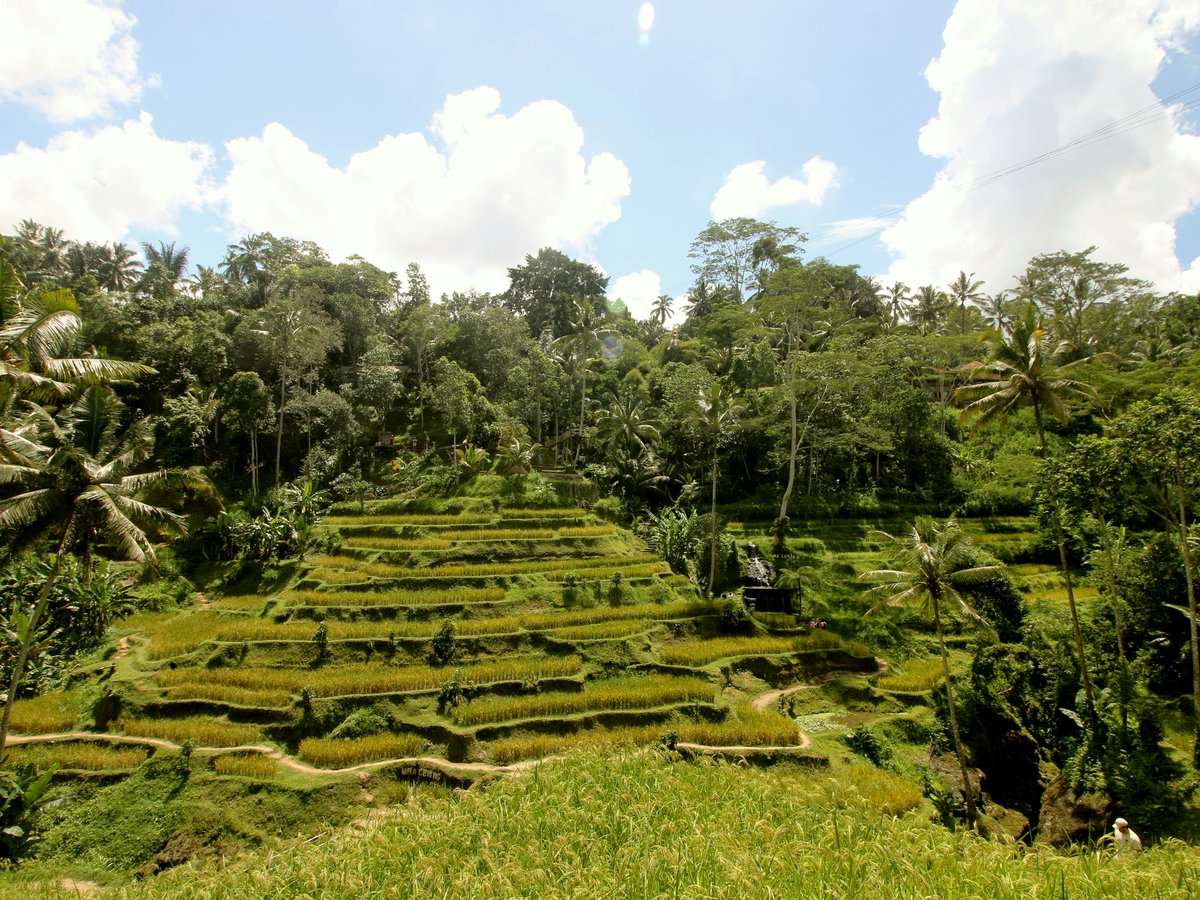
December in Ubud means rain. Expect daily highs near 29.3°C (85°F) with lows around 22.6°C (73°F), which sounds tropical and pleasant enough, but the 283mm of rainfall spread across roughly 27 of the month's 31 days turns that comfort into a damp, sticky reality. Humidity sits at 86%. The Ayung River swells to a brown torrent after each storm, stone pathways along Jalan Raya Ubud flood within minutes, and the rice terraces around Tegallalang turn an almost impossibly bright shade of green. The air smells of wet earth and frangipani.
Here is the real problem with a December visit. You are paying the highest prices of the year for some of the worst weather of the year. Christmas and New Year bring waves of Australian families, European couples, and domestic Indonesian visitors. Guesthouses along Jalan Bisma and Jalan Kajeng that go for 400,000 IDR (about 23 USD at current rates) per night in June can reach 800,000 to 1,000,000 IDR in the final two weeks of the month. Restaurants in Penestanan fill by 7 PM. Parking near the Sacred Monkey Forest Sanctuary becomes a 45-minute ordeal on weekends.
To be fair, Ubud in the rain has its own particular character. Temple ceremonies at Tirta Empul continue regardless of weather. The Campuhan Ridge Walk at dawn, before the clouds stack up, feels close to private compared to July's shoulder-to-shoulder trail. And the pace of town, slower and more inward than the beach scene at Seminyak or Sanur, suits long rainy afternoons spent in a warung with a pot of kopi Bali and a plate of crispy pisang goreng while thunder rolls across the valley.
Why visit in December
- Rice terraces at Tegallalang and around Keliki village reach their most saturated green of the year, fed by consistent rainfall, making this the strongest month for landscape photography on overcast mornings when the light is soft and even
- Temple ceremonies continue through wet season, and sites like Gunung Kawi see noticeably fewer visitors than during the August crush, so you can observe offerings and processions without being herded behind a rope line
- Afternoon downpours clear the air, and mornings before 9 AM often break sunny and cool, perfect for the Campuhan Ridge Walk or an early cycle through Nyuhkuning village before the clouds build
- The holiday period brings special menus and events to restaurants and yoga studios along Jalan Dewi Sita, with Christmas Eve and New Year's Eve dinners becoming a fixture of the peak-season calendar
Worth knowing
- Rain falls on all but 3 or 4 days of the month, with individual storms dropping 20-30mm in under an hour and flooding low-lying footpaths near Jalan Monkey Forest and the river crossings south of Puri Saren Agung
- Peak-season pricing is steep, with accommodation running 50-100% above the June baseline, and popular guesthouses in Penestanan and along Jalan Bisma booking out weeks ahead of the holiday corridor
- The moisture level makes outdoor exertion uncomfortable by mid-morning, and clothes stored in your bag tend to develop a mildewy smell within 2-3 days if not aired in the warm breeze
- Leeches appear on forest trails around the Sacred Monkey Forest and along the Campuhan riverbank after heavy rain, which is not dangerous but catches first-time visitors off guard
Best for
Think twice if
Deep wet season. Rain tends to arrive in powerful afternoon bursts rather than all-day drizzle. Mornings often start clear and humid, with cloud cover building by 11 AM and the heaviest showers falling between 2 PM and 5 PM. Nights feel warm and damp, with the temperature range staying narrow throughout the 24-hour cycle. Thunder is common, sometimes spectacular. The dry season months of June through September feel like a different climate entirely, with less than half the monthly moisture.
Seasonal caution
- Flash flooding on low-lying roads and footpaths in central Ubud, particularly near the river crossings south of Puri Saren Agung. Water can rise 15-20cm in under 30 minutes during a heavy storm, turning Jalan Monkey Forest into a shallow stream.
- Dengue mosquito activity rises during wet season. Standing water from daily rain creates breeding sites in gutters, flower pots, and rice paddy edges. Use repellent containing DEET or picaridin, particularly at dawn and dusk.
- River currents on the Ayung increase significantly after sustained rainfall. White-water rafting operators still run trips, but conditions are rougher than the gentle class I-II of dry season. Confirm your operator's wet-season safety record before booking.
Year-round climate
Averages from the last 5 years.
| Month | Avg high (°C) | Avg low (°C) | Rainfall (mm) |
|---|---|---|---|
| Jan | 29 | 23 | 348 |
| Feb | 29 | 23 | 304 |
| Mar | 30 | 22 | 246 |
| Apr | 29 | 22 | 151 |
| May | 29 | 22 | 136 |
| Jun | 28 | 22 | 90 |
| Jul | 27 | 21 | 135 |
| Aug | 27 | 21 | 114 |
| Sep | 28 | 21 | 130 |
| Oct | 29 | 22 | 135 |
| Nov | 29 | 22 | 286 |
| Dec | 29 | 23 | 283 |
Holidays and festivals in December
Public holidays
- Christmas Day(Hari Raya Natal)25 December 2026
Best things to do in December
Early-morning Tegallalang Rice Terrace walk
natureThe terraces north of Ubud are at peak green saturation during wet season. The subak irrigation system runs at full capacity, with water cascading between stepped levels. Arrive before 8 AM when the light is soft, diffused, and the mist still clings to the lower paddies. Admission is 15,000 IDR per person.
Consistent rainfall produces the most vivid green of the entire year, and the brief morning window before clouds build offers the best photography light of any seasonBooking tipNo booking needed, but arrive before 8 AM. The parking area fills by 9:30 AM during peak season, and by then the clouds have usually rolled in.
Tirta Empul purification ritual
cultureThe sacred water temple near Tampaksiring, about 30 minutes north of Ubud, draws Balinese Hindus for melukat (ritual purification) under its 13 carved stone fountains. Visitors can participate by wearing a sarong and following the sequence of springs from left to right. The water is cold even in the tropical warmth.
Wet-season water flow makes the temple springs stronger and fuller than in the dry months, and the Purnama (full moon) ceremony draws a more contemplative crowd than August's selfie-line energyBooking tipArrive before 9 AM to participate in the purification without a long queue. Sarongs are available to borrow at the entrance for a small donation.
Rainy-day museum circuit in central Ubud
cultureMuseum Puri Lukisan on Jalan Raya Ubud and ARMA (Agung Rai Museum of Art) in Peliatan are both walkable from the town center. Puri Lukisan traces Balinese painting from the classical Kamasan style through the Ubud and Batuan schools. ARMA's collection includes work by Walter Spies and Rudolf Bonnet alongside contemporary Balinese artists. Both have garden courtyards where the sound of rain hitting frangipani leaves provides the soundtrack.
Afternoon rains make indoor activities essential from roughly 2 PM to 5 PM, and these two museums, a 20-minute walk apart, together fill a full rainy afternoon without feeling rushedBooking tipMuseum Puri Lukisan admission is 85,000 IDR. ARMA charges 80,000 IDR. No advance booking needed, and weekday afternoons are quieter than weekend mornings.
Ayung River white-water rafting
adventureThe swollen Ayung River raises the rapids from dry season's gentle class I-II to a more engaging class II-III. The 12km stretch through the gorge passes carved reliefs on the riverbank and thick tropical vegetation overhead. Mist rises off the water between rain showers.
Higher water levels from sustained rainfall make the rapids more dynamic than the calm float of June through September, and the gorge traps moisture creating atmospheric conditions you will not see in dry seasonBooking tipBook morning departures (8-9 AM start) when rain is least likely. Confirm your operator's wet-season safety briefing before committing.
Cooking class with a morning market visit
foodSeveral Ubud-area cooking schools begin with a 6:30 or 7 AM trip to the Pasar Ubud morning market on Jalan Raya, where you select ingredients from local vendors. The market smells of galangal, turmeric, and fresh pandan leaves. Wet-season fruit stalls are piled with mangosteen and rambutan that you can fold into dessert courses.
Wet-season tropical fruits are at their peak abundance and lowest prices at the morning market, and the class itself fills rainy midday hours productively rather than leaving you stranded indoorsBooking tipBook at least 3-4 days ahead during the Christmas week. Morning market visits start early, and the market thins out by 9 AM.
Campuhan Ridge Walk at dawn
natureThe 2km paved path along the narrow ridge between two river valleys starts near the western edge of town. The trail runs through tall grass with views of palm-filled valleys on both sides. The grass rustles in the early breeze, and the valley below is quiet except for roosters and the distant sound of the river.
Mornings between 6 and 8 AM are often clear and relatively cool before the humidity builds. The grass along the ridge is tall and green from weeks of rain, a completely different texture than the dry-season brown. The trail gets busy by 8:30 AM during peak season, so dawn starts reward you with near-solitude.Gunung Kawi temple visit
cultureThis 11th-century rock-cut temple in a river valley near Tampaksiring requires a descent of about 300 stone steps through rice paddies. The 10 carved candi (shrines), each roughly 7 meters tall, sit in niches cut into the cliff face along the Pakerisan River. Moss covers much of the stone, and the river sound echoes off the canyon walls.
The wet season fills the river and surrounding paddies, giving the site a lush, overgrown feel that suits its age. Visitor numbers thin compared to July and August despite the overall peak-season crowds concentrating in central Ubud.Booking tipGo mid-morning on a weekday if possible. The site opens at 8 AM. Bring a sarong or rent one at the top for 10,000 IDR. The stone steps are slippery after rain, so grip footwear is not optional.
What to eat in December
In season: fruit
Manggis (Mangosteen)
December marks the start of mangosteen season in Bali. The thick purple rind cracks open to reveal white, sweet-tart segments that taste like a cross between lychee and peach. Vendors along Jalan Raya Ubud sell them by the kilo for around 25,000-35,000 IDR. Look for fruit that gives slightly when pressed.
Rambutan
The hairy red fruit hits peak sweetness around this time of year. Sold in bunches at the morning market near Jalan Raya, a kilo runs about 15,000-20,000 IDR. The sweetest variety in Bali tends to be the smaller, darker-skinned ones from the Gianyar lowlands.
On menus now
Lawar
This ceremonial dish of minced meat, grated coconut, and spices appears more frequently during December's temple ceremony cycle. The version made with young jackfruit (lawar nangka) is particular to the Gianyar regency, where Ubud sits. Look for it at warungs near Peliatan village after morning ceremonies.
Street food peaks
Pisang Goreng
Fried banana fritters, crisp and hot from the oil, are the default rainy-afternoon snack across Ubud. The rain pattern of dry mornings and heavy afternoon storms makes the 3 PM pisang goreng at a warung doorway one of December's small pleasures. A plate runs 5,000-10,000 IDR.
What to drink
Es Daluman
A cold drink made from green grass jelly, coconut milk, and palm sugar. The heavy humidity of wet season makes this the most satisfying thing you can drink after walking the terraces north of town. Sold at most warungs for 10,000-15,000 IDR, it tastes like sweetened coconut with a slippery, herbal undertone.
Regular events in December
Purnama (Full Moon) ceremonyFree
Balinese Hindus observe Purnama with prayers, offerings, and ceremonies at temples across Ubud. Tirta Empul and Pura Dalem Ubud tend to see the largest gatherings. Visitors can observe respectfully from outside the inner temple compound. The processions of women carrying fruit towers on their heads, dressed in white lace kebaya, are worth timing your visit around.
December full moon (date shifts yearly, typically mid-month)Christmas Eve and Christmas Day celebrations
Hotels and restaurants along Jalan Dewi Sita and Jalan Bisma host special dinner menus, and some add live gamelan or acoustic performances. Bali is Hindu-majority, so these are tourism-driven rather than local religious observances, though the Balinese hospitality industry embraces the occasion warmly.
December 24-25New Year's Eve gatherings
Restaurants in central Ubud offer set menus and late-night dining. The atmosphere skews toward live music and candlelit dinners rather than the beach fireworks of Kuta. Some yoga centers hold intention-setting or meditation gatherings that draw a quieter crowd.
December 31Tilem (New Moon) ceremonyFree
The monthly new moon ceremony is observed at temples with prayers and small offerings. Less dramatic than Purnama, but the quieter atmosphere at Pura Taman Saraswati in central Ubud, with its lotus pond reflecting lamplight, provides a contemplative counterpoint to the holiday buzz.
December new moon (date shifts yearly)Best places this December
Tegallalang Rice Terraces
natureThe subak irrigation system keeps water cascading between terrace levels, and the paddies reach their deepest green of the year. Go before 8 AM to photograph the stepped landscape without crowds or heavy cloud cover. The smell of wet earth and growing rice is strongest in the first hour after dawn.
TegallalangMuseum Puri Lukisan
museumUbud's oldest art museum, opened in 1956, holds four buildings of Balinese painting and wood carving. The garden courtyard fills with the sound of rain during afternoon storms, making it one of the more pleasant places to wait out a downpour. A reliable 2-3 hour visit.
Central UbudNyuhkuning village
neighborhoodThe residential neighborhood south of the Sacred Monkey Forest stays quieter than central Ubud even during peak season. Small galleries, woodcarving workshops, and a handful of warungs line the main road. Walking the back lanes after a morning rain reveals small family temples wrapped in moss and the scent of incense drifting from doorways.
NyuhkuningPenglipuran Village
cultural siteA traditional Bali Aga village about 45 minutes north of Ubud, with uniform bamboo-gate compounds lining a single uphill path. The bamboo forest behind the village grows dense and dripping during wet season, and the cooler elevation (roughly 700m above sea level) provides a slight break from Ubud's lowland moisture. Admission is 50,000 IDR for international visitors.
Bangli regencyARMA (Agung Rai Museum of Art)
museumThe campus in Peliatan spreads across gardens with bale (open pavilions) where you can sit during rain and watch the downpour hit the lotus ponds. The permanent collection spans classical Kamasan painting to modern work. Dance performances happen in the open-air stage on select evenings, weather permitting.
PeliatanPura Taman Saraswati
templeThe water temple in central Ubud sits behind a lotus pond on Jalan Raya. The lotus blooms are particularly full during wet season, with pink and white flowers sitting above the water surface. Free to enter during the day. Kecak dance performances are held in the outer courtyard on some evenings, though heavy rain occasionally forces cancellations.
Central UbudKeliki village
cultural siteA painting village about 5km north of central Ubud, known for its miniature-style Keliki painting tradition. The winding road passes through rice paddies at their most scenic during wet season. Several family studios welcome visitors for informal painting lessons, and prices for original miniatures start around 300,000 IDR.
Keliki
Your packing checklist
Tick items off as you pack. Your progress saves in this browser.
All packed — have a great trip.
Insider tips
The Pasar Ubud morning market on Jalan Raya has two faces. Before roughly 8:30 AM, it serves locals with fresh produce, spices, and ceremonial supplies at local prices. After 9 AM, the stalls pivot to tourist souvenirs at 3-4x the markup. Come early for the real market, and buy your mangosteen here rather than from roadside vendors near the terraces, where a kilo costs nearly double.
When the afternoon rain hits, head for one of the covered warungs in Penestanan rather than the tourist-facing cafes on Jalan Dewi Sita. Prices tend to be 30-50% lower, the food is often better (the nasi campur especially), and you get to watch the storm roll over the valley from a covered terrace instead of a sealed, air-conditioned window.
Renting a motorbike in December requires honest self-assessment. The 20-minute ride north to the terraces on Jalan Raya Tegallalang is manageable in the morning, but afternoon rain reduces visibility and floods dips in the road surface. If you are not experienced with motorbikes in wet tropical conditions, hiring a driver for 400,000-500,000 IDR per day is safer and not dramatically more expensive.
The Kecak fire dance performed at various temple venues across Ubud continues through wet season, but open-air performances sometimes move under cover or cancel during heavy downpours. Check with your guesthouse that morning rather than relying on a booking made days earlier. The evening performances at Pura Taman Saraswati are among the most atmospheric, with the lotus pond reflecting the firelight.
Avoid these mistakes
- Booking a full-day outdoor itinerary (rice terrace walk, waterfall, temple visit) without building in a 2-3 hour afternoon buffer for rain. The storms rarely last more than 90 minutes, but they will disrupt any schedule that assumes continuous sunshine. Split activities into morning (outdoor) and late afternoon (indoor or covered) blocks.
- Packing only lightweight summer clothes without rain protection. Visitors who assume Bali equals beach weather arrive in cotton t-shirts and open sandals, then spend their first afternoon shivering under a warung awning after getting drenched on the walk back from the Sacred Monkey Forest.
- Waiting until arrival to book accommodation for the December 20 through January 3 corridor. Popular Jalan Bisma and Penestanan guesthouses reach full occupancy 3-4 weeks before Christmas. Booking 6 weeks ahead gives better rates and location choices than walking in and hoping for a vacancy.
- Assuming the Sacred Monkey Forest Sanctuary will be less crowded because of rain. The monkeys are active regardless of weather, and the forest canopy provides natural shelter, so visitors pack in during showers. Mid-morning on a weekday remains the least crowded window.
Practical tips for December
Book accommodation for the December 20 through January 3 window at least 6 weeks ahead. Currency exchange counters in central Ubud along Jalan Raya typically offer better rates than those at Ngurah Rai airport in Denpasar, currently around 17,737 IDR per 1 USD. ATMs are plentiful but sometimes run low on cash during peak season weekends, so withdraw before Saturday if you can. Restaurants along Jalan Dewi Sita and Jalan Bisma may require reservations for Christmas Eve and New Year's Eve dinners, with set menus in the 300,000-600,000 IDR range. Temple dress code (sarong and sash covering knees and shoulders) applies year-round regardless of weather. Many yoga studios and wellness centers book up for multi-day retreats during the holiday period, so drop-in spots are more likely at smaller shalas in Penestanan than the larger centers on Jalan Hanoman. The drive from the airport to Ubud takes about 90 minutes in normal traffic but can stretch past 2 hours during holiday congestion on the road through Batubulan. If you arrive after dark during a downpour, add another 30 minutes to that estimate.
FAQ
Is December a good time to visit Ubud?
It is one of the weaker months, honestly. Deep wet season rainfall combined with the highest prices and heaviest crowds of the year makes the value proposition poor compared to May, June, September, or October, when the weather is drier and accommodation rates are 40-50% lower. That said, the town still functions, temples remain open, and the rain-fed landscape is striking in a way the dry season cannot match. If December is your only available window, plan around the rain pattern (outdoor mornings, indoor afternoons) and book accommodation well in advance.
What is the weather like in Ubud in December?
Warm, humid, and wet. Daytime temperatures are comfortable in the shade, but the moisture in the air makes it feel heavier than the thermometer suggests. Rain falls on nearly every day of the month, typically arriving in powerful afternoon bursts between 2 PM and 5 PM rather than all-day drizzle. Mornings are often partly sunny and pleasant for walking. Thunder and lightning are common but brief, and the skies usually clear by early evening.
Is Ubud crowded in December?
Yes, particularly from around December 20 through early January. Christmas and New Year holidays draw Australian families, European couples, and domestic Indonesian visitors. The town center around Puri Saren Agung, the Sacred Monkey Forest, and popular restaurants on Jalan Dewi Sita are noticeably busier than in the shoulder months. Outlying areas like Keliki and the ridge walk stay comparatively quiet, especially before 9 AM.
How many days should I spend in Ubud in December?
Plan for 4-5 days to account for rain disruptions. A 2-day itinerary that would work comfortably in dry season might need 3-4 days when at least one afternoon will likely be a total washout. With 5 days, you can fit in the major temples, a cooking class, the rice terraces, and a rafting trip while keeping your schedule flexible enough to shift activities when the weather cooperates.
Should I rent a motorbike in Ubud during December?
Only if you have experience riding in tropical rain. The roads around Ubud are narrow, with sharp curves, no shoulders, and drainage channels that flood quickly. Visibility drops during heavy downpours, and wet stone surfaces near temples are particularly treacherous. An experienced rider who sticks to morning excursions will be fine. For everyone else, hiring a private driver for the day (400,000-500,000 IDR) is safer and the convenience often outweighs the modest extra cost over a scooter rental.
Things to Do in Ubud in December
 Free cancellation
 Best of Ubud Full-Day Tour with Jungle Swing
Day trip: 10 hours, free cancellation.
via Viator Free cancellation
 Ubud: Monkey Forest, Jungle Swing, Rice Terrace and Water Temple
Day trip: free cancellation.
via Viator Free cancellation
 Private Uluwatu Sunset Tour with Kecak Dance and Dinner
Day trip: 7 hours, free cancellation.
via Viator Free cancellation
 Tanah Lot and North Bali Tour: Scenic Journey
Day trip: free cancellation.
via Viator Free cancellation
 Nusa Penida All-Inclusive Day Trip
Day trip: 12 hours, free cancellation.
via Viator Free cancellation
 Bali Snorkeling Tour at Blue Lagoon Beach - All-Inclusive
Day trip: 6 hours, free cancellation.
via ViatorFind a flight to Ubud
Live fares to Ubud appear here once cookies are accepted.
Last verified by automated review (v1.7.2) on . What is automated review?