Stay in Ubud in February
9 hotels in the Trip.com pool for Ubud, from US$18 a night.
Opens Trip.com on Fri 5 Feb to Sun 7 Feb 2027; change the dates there.
February lands at the peak of Ubud's wet season, and the numbers are worth knowing before you book. Expect rain on roughly 27 of the month's 28 days, with 304mm of total rainfall and humidity sitting at 87%. The totals sound grim, but February's daily rhythm tells a different story. Highs reach about 29°C (84°F) under hazy morning skies, and nights settle near 22°C (72°F). By early afternoon, heavy thunderstorms roll down from the central Balinese highlands, dump rain for an hour or two, then clear enough for an evening walk through Penestanan or along the Campuhan ridge.
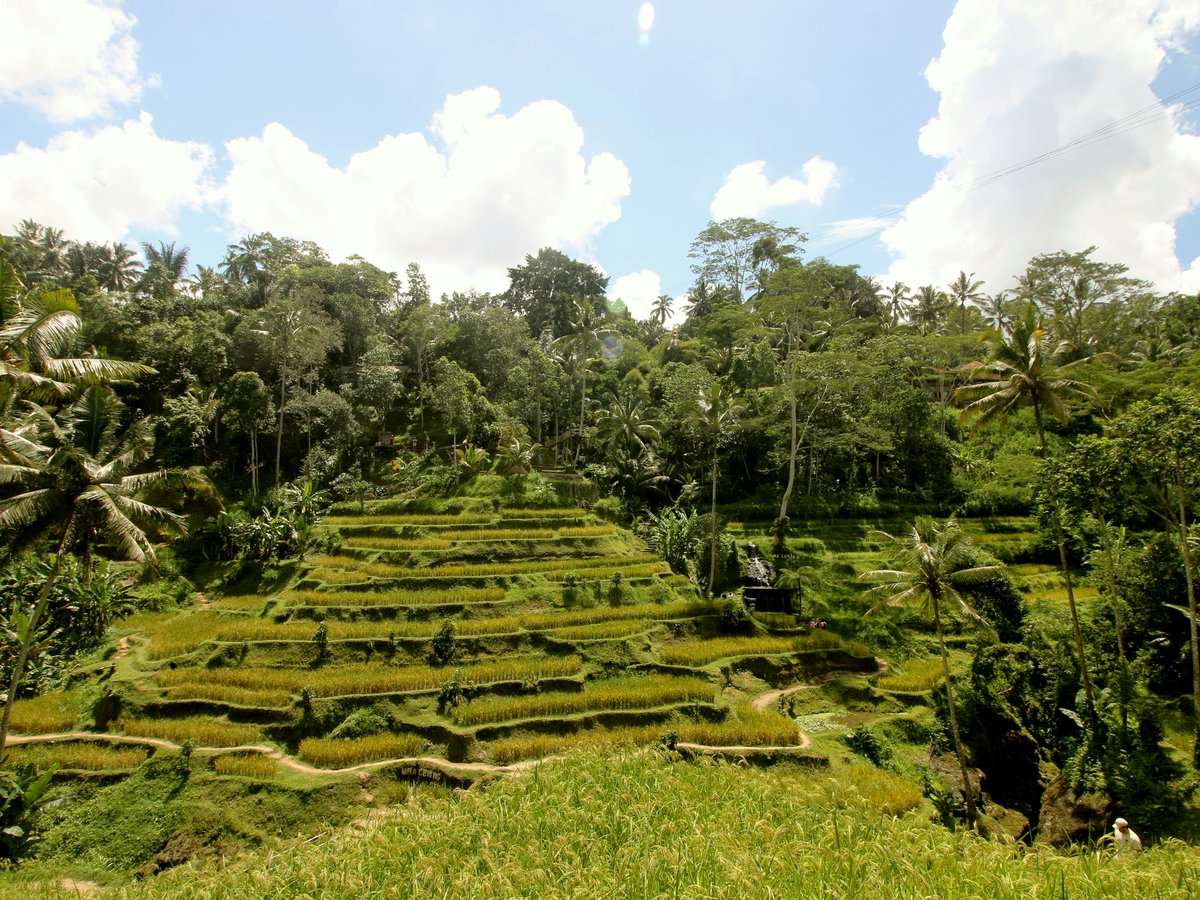
Tegallalang's rice terraces reach a saturated green in February that dry-season photographs can't match. The gorge below Gunung Kawi fills with waterfalls you won't see in August. Crowds at the Sacred Monkey Forest Sanctuary thin noticeably, and guesthouse owners in Nyuhkuning and Peliatan have rooms to spare at rates well below the July peak.
Mind you, the drawbacks are real. Motorbike rides on the narrow roads between Ubud and Kintamani get trickier in downpours, and Gianyar Regency's persistent humidity keeps cotton clothing damp for hours. If you're flexible enough to plan outdoor time before noon and indoor activities after, February delivers Ubud at well below its high-season cost. If you need five consecutive dry days for landscape photography, hold out for June.
Why visit in February
- The Ayung and Petanu river valleys display their deepest greens in February, with seasonal waterfalls and irrigation channels running at full force after weeks of accumulated rain
- Low-season accommodation rates mean villas and guesthouses across Ubud cost meaningfully less than in July or August, and owners often negotiate further for stays over 5 nights
- Morning visits to sites like Goa Gajah and the Tirta Empul complex are genuinely uncrowded, sometimes with fewer than a dozen visitors before 09:00
- Peak tropical fruit season means varieties like mangosteen, rambutan, and Balinese durian are at their sweetest and cheapest at roadside stalls and morning markets across Gianyar Regency
Worth knowing
- Near-daily afternoon thunderstorms can strand you indoors for 2-3 hours, cutting short excursions to farther sites like Penglipuran Village or Sanur Beach
- Persistent humidity puts camera gear and electronics at risk of moisture damage, and cotton clothing feels damp within an hour of leaving your guesthouse
- Mount Batur trekking routes become muddy and occasionally close, limiting highland excursion options
Best for
Think twice if
Nearly every day in February brings rain to Ubud, typically as heavy afternoon thunderstorms that build over the volcanic highlands and clear by early evening. Mornings tend to start warm and overcast, with occasional windows of direct sun before the clouds thicken. The persistent moisture means clothes dry slowly on outdoor lines across town, and the equatorial air sits thick on your skin through the afternoon hours. The surrounding rice paddies and river valleys respond with the deepest green the landscape produces all year.
Seasonal caution
- February's monthly rainfall exceeding 300mm ranks second-heaviest in Ubud's annual cycle, with occasional flash-flooding on low-lying roads near the Petanu and Ayung rivers after sustained afternoon storms
- Mosquito activity rises sharply during the wet months across Gianyar Regency, increasing dengue risk. DEET-based repellent, long sleeves at dusk, and accommodation with screened windows all reduce exposure.
Year-round climate
Averages from the last 5 years.
| Month | Avg high (°C) | Avg low (°C) | Rainfall (mm) |
|---|---|---|---|
| Jan | 29 | 23 | 348 |
| Feb | 29 | 23 | 304 |
| Mar | 30 | 22 | 246 |
| Apr | 29 | 22 | 151 |
| May | 29 | 22 | 136 |
| Jun | 28 | 22 | 90 |
| Jul | 27 | 21 | 135 |
| Aug | 27 | 21 | 114 |
| Sep | 28 | 21 | 130 |
| Oct | 29 | 22 | 135 |
| Nov | 29 | 22 | 286 |
| Dec | 29 | 23 | 283 |
Best things to do in February
Dawn walk through Tegallalang Rice Terraces
natureThe rice terraces north of Ubud are Bali's most photographed agricultural landscape. The subak irrigation system, a UNESCO-recognized tradition, channels water through hundreds of stepped paddies. Arrive before 07:00 to catch morning mist trapped in the valley below the main viewpoint, before the overcast builds.
February's persistent rains keep the paddies fully flooded, creating mirror-like reflections in early-morning light that dry-season visits can't produce.Booking tipNo booking needed. Walk past the main car park and south along the ridge path to find less crowded viewpoints away from the selfie platforms.
Purification ritual at Tirta Empul Temple
culturalTirta Empul's spring-fed pools in Tampaksiring have hosted purification ceremonies since the temple's founding in 962 CE. Visitors can participate by wading through a sequence of carved stone spouts, each representing a different stage of spiritual cleansing. The spring water holds a steady temperature year-round.
February's lower visitor numbers mean the purification pools have shorter queues, allowing a more contemplative pace instead of the shoulder-to-shoulder flow of high season.Booking tipArrive before 09:00 for the smallest crowds. Bring your own sarong or rent one at the entrance.
Balinese cooking class
foodSeveral cooking schools in the Peliatan and Mas neighborhoods run morning sessions that start with a guided market tour, followed by 3-4 hours of hands-on preparation of dishes like lawar, sate lilit, and nasi campur. The morning market visit doubles as a food-culture introduction to Balinese ingredients.
Afternoon storms make indoor activities practical after noon, and February's peak fruit season means seasonal ingredients like mangosteen and jackfruit appear in some class menus.Booking tipBook 2-3 days ahead. Morning sessions that begin before 08:00 avoid both the midday heat and the afternoon rain window.
Morning visit to Gunung Kawi royal tombs
culturalThe 11th-century rock-cut shrines in Tampaksiring sit at the bottom of a steep river valley, carved into cliff faces along the Pakerisan River. The walk down takes about 15 minutes through rice paddies, and the return climb is steeper than it looks. The carved facades stand over 7 meters tall.
With fewer visitors in February, the narrow paths down to the shrines feel less like a tourist queue. Moss and ferns coat the carved stonework after weeks of rain, and the ravine's waterfalls run at full force.Booking tipGo early to avoid the midday heat on the climb back up. The site opens at 08:00.
Rainy-afternoon art gallery circuit
cultureThe Neka Art Museum in Sanggingan and ARMA (Agung Rai Museum of Art) in Peliatan house major collections of Balinese and Indonesian art. The Neka spans five buildings with work from the 1930s Pita Maha movement through contemporary pieces, while ARMA includes paintings by Walter Spies and I Gusti Nyoman Lempad.
February's 2-3 hour afternoon storms make indoor cultural sites the most practical afternoon activity, and low-season visitor numbers mean you can study individual paintings without being crowded out.Yoga retreat in Penestanan or Campuhan
wellnessUbud has become one of Southeast Asia's primary yoga and wellness destinations, with studios concentrated in the western neighborhoods of Penestanan and Campuhan. Multi-day retreats typically combine morning asana sessions with meditation, Balinese healing traditions, and plant-based meals sourced from nearby farms.
Low season means smaller class sizes, better teacher-to-student ratios, and discounted retreat packages. The sound of afternoon rain on a bamboo studio roof has its own appeal for some practitioners.Booking tipBook retreat packages directly with studios for better rates than through international aggregator platforms.
Campuhan Ridge Walk at dawn
natureThis 2-kilometer paved path follows a narrow ridge between the Wos river valleys, starting near the western edge of the Campuhan neighborhood. The walk takes about 40 minutes each way at a comfortable pace, with views down into both forested valleys and across to the surrounding palm canopy.
February mornings before the rain often produce low mist in the valleys below the ridge, creating a layered landscape effect. The grass along the path stays green rather than the straw-brown color of dry-season months.Booking tipNo booking needed. Start before 07:00 to catch the mist and avoid the humidity that builds by mid-morning.
What to eat in February
In season: fruit
Mangosteen (Manggis)
Bali's mangosteen season runs December to March, and February fruit tends to be at peak ripeness. The thick purple rind splits to reveal sweet-tart white segments that rarely survive export without bruising. Eating them fresh at a roadside stall in Tegallalang or Mas is a different experience from the imported version.
Balinese Durian
Balinese durian is smaller and milder than Javanese or Malaysian varieties, with a shorter season that typically spans December through February. Stalls along the road north toward Kintamani sell it by the piece, and the smell will find you before you find the stall.
Rambutan
Red, hairy-skinned rambutan hits peak season in Bali during the first quarter of the year. February fruit tends to be sweeter and juicier than late-season specimens sold in April. Bunches appear at roadside stalls throughout the regency for very little.
Nangka (Jackfruit)
The wet season brings jackfruit to full sweetness across Bali, and in February the large spiky pods appear frequently in warungs and at morning produce markets around central Ubud. The yellow flesh tastes somewhere between mango and pineapple, with a chewier texture.
Street food peaks
Rujak
February's peak fruit season makes rujak, the Balinese spicy fruit salad, particularly good this month. Vendors in central Ubud toss together ripe mango, papaya, pineapple, and unripe mangosteen with chili, palm sugar, and shrimp paste. The combination of sweet peak-season fruit against the salty-spicy dressing is sharper than it sounds.
What to drink
Jamu Kunyit Asam
This traditional turmeric and tamarind tonic is served warm at warungs across Ubud and is particularly welcome on damp February mornings. The ginger and turmeric base warms the stomach, and locals consider it a preventive remedy for wet-season chills. Look for the jamu gendong sellers who carry glass bottles in a basket on their backs through the Peliatan and Mas neighborhoods.
Regular events in February
Purnama (Full Moon) ceremony at Tirta Empul and Pura Dalem UbudFree
Balinese Hindu temples hold prayer ceremonies on every full moon night, with Tirta Empul and Pura Dalem Ubud among the more accessible for visitors. Devotees bring offerings of flowers, incense, and food. The temple courtyards fill with the sound of gamelan and the scent of burning sandalwood. Visitors can observe respectfully from the outer courtyard.
Full moon date varies annually, falls once in FebruaryKecak and Legong dance performances at Puri Saren Agung
The Ubud Royal Palace hosts traditional Balinese dance performances most evenings throughout the year, with Kecak (the percussive monkey-chant piece performed by 50-70 men in concentric circles) and Legong (a refined court dance) rotating through the weekly schedule. Performances run about 90 minutes under the open-air pavilion. February's smaller audiences mean better sightlines from the rear seating areas.
Most evenings, typically starting at 19:00 or 19:30Ogoh-ogoh construction season (pre-Nyepi)Free
In years when Nyepi (Balinese Day of Silence) falls in March, community banjars across Ubud begin building giant papier-mache demon effigies called ogoh-ogoh in late February. The construction happens in open-air workshops visible from the street, and watching the teams of young men sculpt and paint these towering figures is one of the more authentic cultural encounters available to visitors. The effigies are paraded and burned the night before Nyepi.
Late February through early March, depending on the Saka lunar calendarBest places this February
Goa Gajah (Elephant Cave)
templeThis 9th-century archaeological site in Bedulu, about 6km southeast of central Ubud, features a carved rock-face entrance leading to a meditation cave. February's rain feeds the bathing fountain pools at the entrance, and the site draws noticeably fewer visitors than during peak months. The carved Bhoma face over the entrance is one of Bali's most recognizable pieces of rock art.
BeduluNeka Art Museum
museumFive pavilions in the Sanggingan neighborhood house a comprehensive collection of Balinese painting from the Pita Maha era (1930s) through contemporary work. The photography pavilion upstairs is easy to miss but worth finding. February afternoons, when the rain keeps visitors inside, are when the museum feels most useful as a shelter and a cultural anchor.
SangginganPasar Ubud (Morning Market)
marketThe produce section of Ubud's central market operates from around 04:00 to 08:00, before the tourist-oriented craft stalls open later in the morning. February's peak fruit season fills the ground-floor stalls with mangosteen, rambutan, and salak Bali. The market sits on Jalan Raya Ubud near the Royal Palace.
Central UbudPenglipuran Village
villageThis traditional Bali Aga village about 25km north of Ubud maintains centuries-old architectural uniformity along a single broad stone path. The drive takes about 45 minutes from central Ubud, and February's lower visitor numbers let you walk the village path without competing for space with tour groups. The bamboo forest behind the village is particularly lush during the wet season.
Bangli RegencyARMA (Agung Rai Museum of Art)
museumSet in landscaped gardens in the Peliatan neighborhood, ARMA combines a permanent art collection including works by Walter Spies and I Gusti Nyoman Lempad with a performance stage and reference library. The gardens are especially green after February rains, and the covered galleries make reliable shelter during afternoon storms.
PeliatanPura Dalem Ubud
templeThis temple of the dead in central Ubud, across from the western end of the Sacred Monkey Forest, features elaborately carved Rangda and Bhoma figures on its outer walls. The temple regularly hosts Purnama and other ceremony nights, and February's quieter atmosphere makes it easier to observe the rituals from the outer courtyard without the dry-season press of visitors.
Central UbudTaman Saraswati (Lotus Temple)
templeThe lotus pond and temple on Jalan Raya Ubud, designed by I Gusti Nyoman Lempad, fills with blooming lotus during the wet months. February's sustained moisture keeps the pond at full level and the flowers at their most photogenic, particularly in morning light before the overcast thickens. The cafe overlooking the pond is a reasonable spot to wait out an afternoon storm.
Central Ubud
Your packing checklist
Tick items off as you pack. Your progress saves in this browser.
All packed — have a great trip.
Insider tips
The best-value warungs in central Ubud sit on the smaller side streets off Jalan Goutama and Jalan Dewi Sita, not along Jalan Raya Ubud or Jalan Monkey Forest where tourist-facing restaurants charge 3-4 times more for similar dishes.
Ask your guesthouse staff about upcoming odalan (temple anniversary) ceremonies. These follow a 210-day Pawukon cycle at every temple in the area, and February often catches one at a smaller, less-touristed temple in Peliatan or Mas where visitors are genuinely welcomed.
The sound of gamelan rehearsal carries through the residential streets of Peliatan and Mas in the evenings. Walking the side roads between 18:00 and 20:00 on weekday evenings, you'll hear community banjars practicing for upcoming ceremonies. These rehearsals are one of Ubud's most genuine cultural encounters, and they happen year-round.
For stays longer than a week, renting a villa directly through local owners in Nyuhkuning or Kedewatan typically costs substantially less than booking the same property through an international platform. Ask at your first guesthouse for contacts.
Avoid these mistakes
- Booking a full-day outdoor itinerary that schedules rice-terrace visits or temple excursions for 14:00. In February, plan all open-air activities for before noon, and save indoor experiences like cooking classes, spa sessions, or museum visits for after the afternoon storms pass.
- Riding a rented motorbike in flip-flops during February rain. Ubud's roads become genuinely slippery in downpours, with standing water on curves and drainage channels that overflow onto the pavement. If you rent a motorbike, wait for the rain to stop before riding, and wear closed shoes.
- Packing only cotton clothing for a week-long stay. In the sustained humidity of February, cotton takes far longer to dry than synthetic alternatives, and you'll run out of wearable shirts faster than you expect. Two or three synthetic quick-dry tops solve the problem.
Practical tips for February
Book accommodation with air conditioning and a clothes-drying rack or indoor line. Both matter more in February's humidity than in the dry months. Grab Indonesian Rupiah from ATMs near Jalan Raya Ubud or along Jalan Monkey Forest, since smaller warungs and temple donation boxes deal in cash only. At the current rate, 1 USD converts to approximately 17,700 IDR, so a 50,000 IDR note is worth about 2.80 USD. Temple visits require a sarong and sash covering the legs, available for rent at each entrance, though carrying your own saves time. Ride-hailing apps like Gojek and Grab operate in the Ubud area but face restrictions from local transport cooperatives, so pickup locations can be limited near central Ubud. For excursions to Tirta Empul or Penglipuran Village, hiring a driver for the day through your guesthouse is often more practical and safer than navigating wet highland roads yourself. Most restaurants, shops, and activity operators remain open year-round with no February-specific closures, though some outdoor adventure companies may cancel Mount Batur sunrise treks on heavy-rain mornings.
FAQ
Is February a good time to visit Ubud?
February is a fair time to visit, ranking 11th out of 12 months for Ubud. The main trade-off is near-daily afternoon rain in exchange for lower prices, thinner crowds, and the lushest landscapes of the year. If you're comfortable planning outdoor activities for mornings and shifting to indoor options after the storms hit, it can be a rewarding month. If you want consistent dry weather, the June-to-September window is the stronger choice.
What is the weather like in Ubud in February?
Warm, wet, and humid. Daytime highs reach about 29°C (84°F) and nights cool to around 22-23°C (72-73°F). Rain falls on nearly every day, but it typically arrives as heavy afternoon thunderstorms rather than all-day drizzle. Mornings are usually dry enough for outdoor activity, and the storms tend to clear by early evening. The month's total rainfall of about 300mm makes it the second-wettest month after January.
Is Ubud crowded in February?
No. February is one of Ubud's quieter months for international tourism. Most visitors time their trips for the June-September dry season or late December and early January holiday period. By mid-February the holiday crowds have cleared, and you'll find shorter queues at major sites, more available tables at restaurants along Jalan Dewi Sita, and guesthouse owners willing to negotiate on rates.
Can you still visit the Tegallalang Rice Terraces in February?
Yes, and they're arguably at their best. The paddies are fully flooded from the ongoing rains, and the vegetation reaches maximum green. Go in the morning before the afternoon storms build. The paths between terrace levels can be slippery after rain, so wear sandals or shoes with good grip. The main viewing areas stay accessible year-round regardless of weather.
What should I budget per day for Ubud in February?
February is one of the cheapest months to visit. Meals at local warungs in central Ubud run around 25,000-50,000 IDR per plate, and activity costs like temple entry fees, cooking classes, and guided tours hold steady across seasons. The real savings come from accommodation. Guesthouses and villas that charge premium rates in July and August drop their prices notably during the February low season. Daily spend varies widely depending on where you sleep, but the gap between February and high-season pricing is significant across all tiers.
Things to Do in Ubud in February
 Free cancellation
 Best of Ubud Full-Day Tour with Jungle Swing
Day trip: 10 hours, free cancellation.
via Viator Free cancellation
 Ubud: Monkey Forest, Jungle Swing, Rice Terrace and Water Temple
Day trip: free cancellation.
via Viator Free cancellation
 Private Uluwatu Sunset Tour with Kecak Dance and Dinner
Day trip: 7 hours, free cancellation.
via Viator Free cancellation
 Tanah Lot and North Bali Tour: Scenic Journey
Day trip: free cancellation.
via Viator Free cancellation
 Nusa Penida All-Inclusive Day Trip
Day trip: 12 hours, free cancellation.
via Viator Free cancellation
 Bali Snorkeling Tour at Blue Lagoon Beach - All-Inclusive
Day trip: 6 hours, free cancellation.
via ViatorFind a flight to Ubud
Live fares to Ubud appear here once cookies are accepted.
Last verified by automated review (v1.7.2) on . What is automated review?