Stay in Ubud in May
9 hotels in the Trip.com pool for Ubud, from US$18 a night.
Opens Trip.com on Fri 7 May to Sun 9 May 2027; change the dates there.
May in Ubud falls between the wet and dry seasons. That transition is the most important thing to understand about visiting this month. The monsoon rains that drop over 300mm on the town in January have tapered to about 136mm, spread across roughly 21 days. But the character has changed. These are mostly afternoon cloudbursts that blow through in 20 to 40 minutes, leaving the air smelling of wet frangipani and warm stone. Mornings tend to be clear and warm, with temperatures reaching 29°C (84°F) and lows around 22.3°C (72°F) at night. Humidity sits at 84%, the kind that fogs your camera lens the moment you step out of air conditioning.
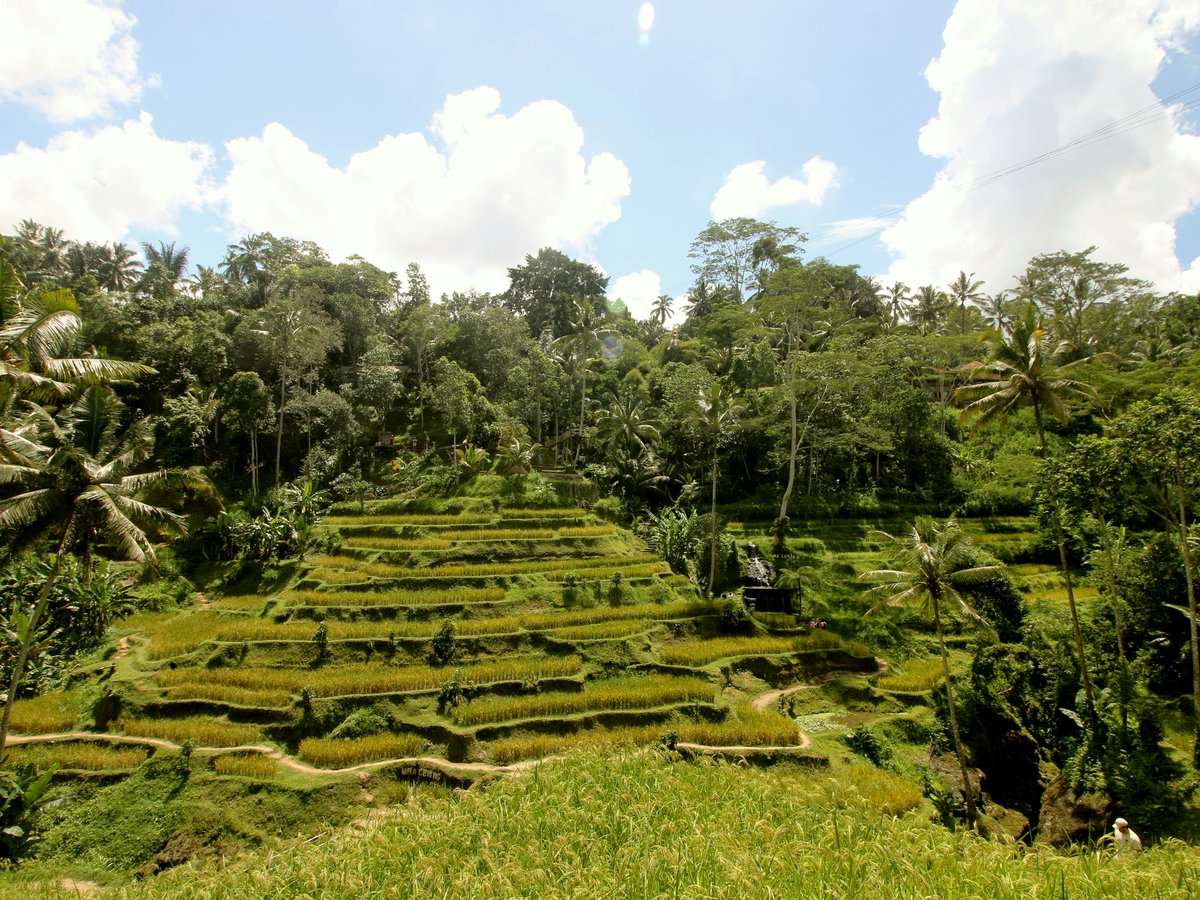
The real advantage of May is what's absent. Peak-season crowds from Australia and Europe don't arrive until late June, so the Tegallalang Rice Terraces feel spacious, yoga shalas in Penestanan have open spots, and guesthouses along Jalan Monkey Forest are negotiable on price. The terraces themselves look their best right now, freshly planted and glowing an almost electric green from months of accumulated rain. You might get the Campuhan Ridge Walk to yourself before 8am.
That said, May is a gamble. Some years the dry season locks in by the first week. Other years the wet season lingers past mid-month, and you'll find yourself watching rain sheet off the carved 9th-century stone at Goa Gajah for an hour before it clears. Pack for both outcomes. Tegenungan Waterfall runs at full force from the wet season's residual flow, with more water volume than you'll see from August onward.
Why visit in May
- Rainfall has tapered to roughly a third of January's peak, arriving mostly as short afternoon showers that leave mornings clear for temple visits and rice terrace walks at Tegallalang and beyond.
- Tourist numbers at popular sites like the Sacred Monkey Forest Sanctuary and Tirta Empul Temple sit well below July-August congestion, with shorter queues and calmer monkeys.
- Accommodation rates across Kedewatan and central Ubud reflect shoulder-season positioning, with genuine room to negotiate multi-night stays at villas and guesthouses.
- Rice terraces are freshly planted and at peak green saturation, still fed by the wet season's water table, a visual window that fades as the paddies mature to gold by August.
- Waterfalls including Kanto Lampo are at their highest water volume from accumulated wet-season runoff, producing full-curtain flows that thin to narrow streams by late September.
Worth knowing
- Rain touches most days of the month, and you'll likely lose at least one full afternoon to downpours that arrive with little warning beyond a sudden darkening of the sky.
- Persistent humidity makes midday walks uncomfortable, particularly along exposed stretches of the Campuhan Ridge after 10am, where shade thins and heat radiates off the paved path.
- Some adventure operators run fewer departure times for whitewater rafting and cycling tours in May, reflecting lower bookings. You might find only morning slots instead of the 3-4 daily options in peak season.
- Mosquito activity remains elevated from the wet season, particularly around rice paddies and river valleys in the Sayan and Nyuh Kuning areas at dusk.
Best for
Think twice if
May feels like the wet season slowly loosening its grip on Ubud. Mornings typically dawn clear and warm, with cloud cover building through midday and short, heavy showers arriving between 14:00 and 17:00. The rain is warm, not cold. The air afterwards smells of damp earth and tropical flowers. Nights cool enough for sleep without air conditioning if your room has good airflow, though most visitors still prefer it. You can expect roughly 3 out of every 4 days to see some rain, but fewer than half of those lose more than an hour to it. The UV index near the equator stays high even on overcast mornings.
Seasonal caution
- UV index at 8° south latitude runs 9-11 even under cloud cover. Burns happen faster than most visitors from temperate climates expect, and overcast mornings create a false sense of protection.
- Afternoon storms can build within 15 minutes and occasionally bring lightning. Avoid exposed ridgelines and open rice terraces if you see tall cumulonimbus clouds forming to the west.
Year-round climate
Averages from the last 5 years.
| Month | Avg high (°C) | Avg low (°C) | Rainfall (mm) |
|---|---|---|---|
| Jan | 29 | 23 | 348 |
| Feb | 29 | 23 | 304 |
| Mar | 30 | 22 | 246 |
| Apr | 29 | 22 | 151 |
| May | 29 | 22 | 136 |
| Jun | 28 | 22 | 90 |
| Jul | 27 | 21 | 135 |
| Aug | 27 | 21 | 114 |
| Sep | 28 | 21 | 130 |
| Oct | 29 | 22 | 135 |
| Nov | 29 | 22 | 286 |
| Dec | 29 | 23 | 283 |
Holidays and festivals in May
Public holidays
- Labour Day(Hari Buruh Internasional)1 May 2027
- Ascension Day(Kenaikan Isa Almasih)6 May 2027
Best things to do in May
Tegallalang Rice Terrace morning walk
natureThe centuries-old subak irrigation terraces north of central Ubud are at peak visual intensity in May. The paddies have been recently planted after the wet season, and the young rice shoots create an unbroken carpet of green across the carved hillside. The light between 06:30 and 08:00 is soft and warm, with mist still sitting in the valley below.
Recent wet-season planting means the terraces are at maximum green saturation, a window that fades as the rice matures to gold through July and August.Booking tipNo booking needed. Arrive before 07:00 to walk the trails before tour buses from southern Bali start arriving around 09:30.
Tirta Empul purification ritual
culturalThe spring-fed temple at Tampaksiring, roughly 30 minutes northeast of central Ubud, allows visitors to participate in the melukat purification ceremony. You wade through a series of stone-carved fountains, each with its own spring spout, while offerings float past in the current. The water is cold, startlingly so against sun-warmed skin.
Lower visitor numbers in May mean shorter queues at the purification pools, sometimes under 10 minutes versus the 45-minute waits common during the August peak.Booking tipBring your own sarong. Rental sarongs at the entrance are often damp from previous visitors by mid-morning.
Gunung Kawi temple descent
culturalThe 11th-century royal tombs are carved into a cliff face at the bottom of a river valley, reached by roughly 300 stone steps through the jungle canopy. The Pakerisan River runs through the complex, and the carved rock shrines stand taller than a two-story building. Ferns and moss cover every surface that isn't actively maintained.
The valley is at its most dramatic in May, thick with wet-season growth. The river runs full but not dangerously so, and the damp stone carvings photograph better under diffused cloud light than harsh dry-season sun.Booking tipGo before 09:00. The steps back up are punishing in midday heat and humidity.
Tegenungan Waterfall swim
natureA roughly 15-meter waterfall about 20 minutes southeast of Ubud center. The pool at the base is deep enough to swim in, and the mist coming off the falls keeps the surrounding gorge noticeably cooler than the road above. The roar of the water at high flow drowns out everything else.
Water volume is still high from wet-season runoff, producing the full-curtain flow that thins to a narrow stream by late September. Clear May mornings let light catch the spray.Booking tipArrive before 08:30. The parking lot fills by 10:00 and the pool area becomes too crowded for comfortable swimming by midday.
Market-to-table Balinese cooking class
foodSeveral cooking schools in the Ubud area run sessions that start at Pasar Seni Ubud's food market around 07:00. You shop for ingredients with the instructor, then return to an outdoor kitchen to cook 5-7 Balinese dishes. May sessions often incorporate mangosteen and rambutan into dessert courses alongside the staple base gede spice paste and coconut-heavy curries.
The overlap of early tropical fruit season with the tail of wet-season herb growth means a wider ingredient range than dry-season classes typically offer.Booking tipBook 3-4 days ahead for weekend sessions. Weekday classes often have space on the day.
Ayung River whitewater rafting
adventureA 10-12 kilometer stretch of the Ayung River through a gorge lined with cliff faces, carved Hindu reliefs, and trailing jungle canopy. The rapids are Class II-III, manageable for beginners but enough to keep you alert. The water is warm, brown from sediment, and the canyon walls echo every splash and shout back at you.
Residual wet-season water levels keep the rapids at their most engaging Class III grade. By August and September, some sections flatten to lazy-river pace.Booking tipMorning departures between 08:00 and 09:00 finish before the afternoon rains. Operators based in Kedewatan offer the most scenic put-in points along the upper river.
Penglipuran Village cultural visit
culturalA traditional Bali Aga village about 45 minutes north of Ubud, where houses follow a centuries-old layout along a single stone-paved central avenue. The bamboo architecture and uniform compound gates look like nothing else on the island. The community maintains the gardens meticulously, and the scent of clove and frangipani hangs in the still air between the compounds.
End-of-wet-season rainfall keeps the village gardens in peak bloom. Lower tourist numbers mean you can walk the main avenue without weaving through tour groups, and some residents are more willing to talk during quieter months.Booking tipCombine with a stop at Kintamani on the drive north. Volcano views from the road above Lake Batur are often clear in the morning before clouds build.
What to eat in May
In season: fruit
Mangosteen
The season opens in May across Bali. The thick purple rind cracks to reveal snow-white segments with a sweet-tart flavor unlike anything else in the tropical fruit world. Market stalls along Jalan Raya Ubud sell them by the kilogram for a fraction of what tourist-facing restaurants charge at breakfast.
Rambutan
Red, hairy-skinned fruit entering peak season across Bali. The local variety tends sweeter and less acidic than mainland Indonesian rambutan. You'll find them sold in bunches at Pasar Seni Ubud's morning market section before 07:00.
Salak Bali
Bali's own snake fruit variety, grown around the Karangasem regency to the east. The dry-season transition improves harvest quality, yielding crisper, less watery fruit with a honey-like sweetness and a dry, almost tannic finish.
On menus now
Lawar
Finely chopped meat mixed with vegetables, grated coconut, and a complex spice paste. Traditionally prepared for temple ceremony offerings, and May's odalan season means community feasts at village temples where fresh lawar appears alongside roasted suckling pig. The texture is coarse, and the coconut gives it a slight sweetness against the chili heat.
What to drink
Jamu kunyit asam
Traditional turmeric-and-tamarind tonic served cold from glass bottles at market stalls and warungs across Ubud. The ginger warmth cuts through the humidity in a way that iced coffee doesn't. Several warungs in Peliatan still make it fresh each morning from hand-ground roots.
Regular events in May
Hari Buruh (International Labour Day)Free
National public holiday across Indonesia. Government offices, banks, and some shops close for the day. Tourist-facing businesses in Ubud stay open, but expect reduced hours at pharmacies and the post office on Jalan Raya Ubud.
May 1Waisak (Vesak Day)Free
National holiday marking the birth, enlightenment, and passing of the Buddha. The largest celebrations take place at Borobudur in central Java, but Bali's Buddhist community holds smaller lantern processions and prayer sessions. In Ubud, the day is quiet and most tourist infrastructure operates normally. The exact date follows the lunar calendar and shifts each year.
Mid-May, lunar calendar dependentHari Kebangkitan Nasional (National Awakening Day)Free
Commemorates the founding of the Budi Utomo nationalist movement in 1908. A national holiday with flag ceremonies at government buildings. Tourist impact is minimal, but if you pass a school or government office, you'll see the ceremonies in progress. Banks close.
May 20Nightly Kecak and Legong dance at Puri Saren Agung
The Ubud Royal Palace hosts traditional Balinese dance performances most evenings at 19:30. The Kecak fire dance features a circle of 50-70 chanting men performing the Ramayana epic by firelight. May's lower attendance means front-row floor seating is available without arriving 45 minutes early, as you'd need to in July or August. Tickets run around 100,000 IDR at the entrance.
Nightly, 19:30Best places this May
Campuhan Ridge Walk
natureA narrow paved path along a grassy ridge between two river valleys on Ubud's western edge. The 2-kilometer walk offers open views of palm groves and terraced hillsides on both sides. In May, the grass is still green from wet-season rains rather than the burnt brown it turns by September. The path starts near the confluence of the Wos rivers.
CampuhanMuseum Puri Lukisan
museumUbud's oldest art museum, founded in 1956, with four pavilions set in gardens along the main road. The permanent collection traces Balinese painting from the Kamasan wayang style through the 1930s Pitamaha movement to contemporary work. A strong rainy-afternoon option when the weather closes in after lunch.
Central UbudSacred Monkey Forest Sanctuary
natureA 12.5-hectare nature reserve and Hindu temple complex at the southern end of Jalan Monkey Forest. Home to over a thousand long-tailed macaques. The ancient banyan trees create a dense canopy that keeps the forest floor several degrees cooler than the surrounding streets. In May, the lower visitor count changes the dynamic with the monkeys, who tend to be calmer when fewer tourists are waving food around.
Nyuh KuningNeka Art Museum
museumA multi-building museum on Jalan Raya Sanggingan with one of Bali's strongest collections of traditional and modern art, including work by Arie Smit and I Gusti Nyoman Lempad. The East-West pavilion traces the influence of European artists who settled in Ubud in the 1930s. The landscaped grounds between buildings offer views down into the Campuhan river valley.
SangginganPasar Seni Ubud (Ubud Art Market)
marketA two-story market on Jalan Raya Ubud across from the Royal Palace. The ground floor sells sarongs, wood carvings, and woven baskets. The real draw in May is the morning produce section between 05:00 and 08:00, where local farmers bring the season's first mangosteen and rambutan. Produce prices are fixed. The handicraft stalls expect negotiation.
Central UbudGoa Gajah (Elephant Cave)
templeA 9th-century archaeological site about 6 kilometers southeast of central Ubud. The cave entrance is carved into a demon's open mouth, and the interior holds lingam-yoni shrines. The surrounding bathing pools and garden terraces are fed by spring water. The moss-covered stone and diffused light on overcast May afternoons give the site an atmosphere that harsh dry-season sun strips away.
Bedulu
Your packing checklist
Tick items off as you pack. Your progress saves in this browser.
All packed — have a great trip.
Insider tips
The produce section of Pasar Seni Ubud operates on a completely different clock from the tourist-facing handicraft stalls. Farmers arrive around 04:30 and the best seasonal fruit, including early-season mangosteen, is picked over by 07:00. If you show up at 10:00, you'll see only the handicraft market and miss the food entirely.
Ubud scores 6.8/10 for solo-traveler safety (see the TTDI Solo-Safety Index). The central area between Jalan Monkey Forest and Jalan Raya Ubud feels safe on foot until late evening, but the unlit roads beyond the ridge in Campuhan and south through Nyuh Kuning after dark are best navigated by scooter with headlights rather than on foot.
Temple ceremonies (odalan) follow the 210-day Balinese Pawukon calendar, not the Western calendar, so they land on different dates each year. Ask your guesthouse host which temples have ceremonies during your visit. Attending as a respectfully dressed observer is usually welcomed, and you'll see Balinese religious life in a way no ticketed cultural performance replicates.
The co-working scene along Jalan Goutama in central Ubud is more productive in May than during high season. Power outlets and reliable wifi are easier to secure when every seat isn't claimed by 09:00. The Hubud co-working space near the Monkey Forest offers day passes if you need guaranteed fast internet.
Avoid these mistakes
- Scheduling a full-day outdoor itinerary without a rain backup plan. The clear mornings create a false sense of all-day comfort, but the afternoon pattern in May is rain more often than not. Front-load outdoor activities before 10:00 and keep Museum Puri Lukisan, the Neka Art Museum, cooking classes, or spa visits in reserve for after lunch.
- Trusting a weather forecast beyond 48 hours. May's transitional position between seasons makes longer predictions unreliable. The apps might promise 5 days of sun and deliver 3 days of afternoon storms. Build flexibility into each day rather than committing to a rigid schedule.
- Attempting the Campuhan Ridge Walk or open rice terrace visits after 10:30. The clear mornings tempt visitors to linger over breakfast and start late. But humidity builds rapidly through mid-morning, and storm clouds often form over the western hills by 11:30. The comfortable window for exposed walking runs from about 06:00 to 09:30.
- Renting a scooter without tropical rain experience. May's afternoon storms arrive fast, and the roads between Ubud and attractions like Gunung Kawi become slippery within minutes. If you haven't ridden in heavy rain before, hire a driver for the first few excursions and see how conditions change.
Practical tips for May
May falls between the wet-season lows and dry-season peaks for tourism, so advance booking is helpful but not critical. Reserve accommodation at least a week ahead for properties in Sayan and Kedewatan. Central Ubud guesthouses usually have walk-in availability. The Indonesian rupiah trades at roughly 17,700 IDR to 1 USD. Cash is still preferred at warungs, market stalls, and temple entrance counters. ATMs cluster around Jalan Raya Ubud and Jalan Monkey Forest but occasionally run low on weekends. Download a ride-hailing app before arriving, as Ubud's roads are confusing and few drivers use meters. Temple dress codes are enforced, not suggested. Covered shoulders and a sarong are non-negotiable at every Hindu temple, including the inner areas of the Monkey Forest. Most attractions open by 08:00 and close between 17:00 and 18:00. Restaurant kitchens in central Ubud typically close by 22:00. Pharmacies along Jalan Raya carry mosquito repellent, sunscreen, and basic medications, but selection is limited compared to Seminyak or Denpasar. May's national holidays on the 1st and 20th close banks and government offices but leave tourist infrastructure running normally. Ubud scores 4.5/10 for LGBTQ+ friendliness (sourced from TTDI's editorial rubric), reflecting Indonesia's broader social conservatism. Public displays of affection between any couple are uncommon in Balinese culture, regardless of orientation. Wikivoyage's Ubud guide (https://en.wikivoyage.org/wiki/Ubud#Get_around) covers local transport options and neighborhood orientation, and its safety section (https://en.wikivoyage.org/wiki/Ubud#Stay_safe) is worth reading before arrival.
FAQ
Is May a good time to visit Ubud?
May is a solid shoulder-season month for Ubud. You'll deal with some rain most days, but it tends to arrive as short afternoon showers rather than the all-day downpours of the deep wet season from January through March. Temperatures are comfortable, crowds are well below peak-season levels, and prices reflect the transition period. It's not the single best month for guaranteed dry weather (June through August holds that edge), but it offers a genuinely good balance of value, green landscapes, and elbow room.
What is the weather like in Ubud in May?
Warm and humid with intermittent afternoon rain. The daily pattern is clear mornings, building clouds by midday, and short heavy showers between roughly 14:00 and 17:00. Temperatures stay in the high 20s Celsius (low-to-mid 80s Fahrenheit), and humidity runs high enough to fog your sunglasses every time you step out of air conditioning. The monthly rainfall total puts May well below the wet-season peak months but above the driest stretch from June through August.
Is Ubud crowded in May?
Not compared to the rest of the year. May sits before the main tourist season, which runs from late June through September and again around Christmas and New Year. The influx of Australian and European visitors hasn't started yet. You'll find shorter queues at the Monkey Forest and Tirta Empul, easier restaurant reservations, and more leverage negotiating accommodation rates. The town isn't empty, as Ubud has a large resident expat and digital nomad community, but the pressure of peak season is absent.
Do I need a visa to visit Indonesia in May?
Most nationalities can enter on a Visa on Arrival (VOA) valid for 30 days, purchasable at Ngurah Rai airport in Denpasar for 500,000 IDR (roughly 28 USD at current exchange rates). The VOA is extendable once for another 30 days at a local immigration office. Check your country's specific eligibility before travel. The month doesn't affect visa policy, but the airport queue for VOA purchase can run 30-60 minutes during busy arrival windows. Wikivoyage's arrival section (https://en.wikivoyage.org/wiki/Ubud#Get_in) has additional transport and arrival details.
What should I budget per day for Ubud in May?
Budget travelers in guesthouses, eating at warungs, and using scooters can manage on 400,000-600,000 IDR per day (roughly 22-34 USD). Mid-range travelers in boutique hotels with restaurant meals and guided activities should plan for 1,500,000-2,500,000 IDR (approximately 85-140 USD). May's shoulder-season pricing means you're paying less than you would for the same experience in July or August, with better odds of negotiating on multi-night stays and activity packages.
Things to Do in Ubud in May
 Free cancellation
 Best of Ubud Full-Day Tour with Jungle Swing
Day trip: 10 hours, free cancellation.
via Viator Free cancellation
 Ubud: Monkey Forest, Jungle Swing, Rice Terrace and Water Temple
Day trip: free cancellation.
via Viator Free cancellation
 Private Uluwatu Sunset Tour with Kecak Dance and Dinner
Day trip: 7 hours, free cancellation.
via Viator Free cancellation
 Tanah Lot and North Bali Tour: Scenic Journey
Day trip: free cancellation.
via Viator Free cancellation
 Nusa Penida All-Inclusive Day Trip
Day trip: 12 hours, free cancellation.
via Viator Free cancellation
 Bali Snorkeling Tour at Blue Lagoon Beach - All-Inclusive
Day trip: 6 hours, free cancellation.
via ViatorFind a flight to Ubud
Live fares to Ubud appear here once cookies are accepted.
Last verified by automated review (v1.7.2) on . What is automated review?