Stay in Ubud in July
9 hotels in the Trip.com pool for Ubud, from US$18 a night.
Opens Trip.com on Fri 2 Jul to Sun 4 Jul 2027; change the dates there.
July is peak season in Ubud, full stop. European summer holidays and Australian school breaks send the largest tourist wave of the year to Bali's highland cultural center, pushing accommodation prices to their annual ceiling. Guesthouses in Nyuh Kuning that go for 350,000 IDR per night in February can list at 600,000 to 800,000 IDR in July. Walk-in dinner tables near Puri Saren Agung disappear before sunset. The 10 AM tour buses at Tegallalang Rice Terraces line up end to end.
Bali's dry season, to be fair, earns the demand. July averages a high of 27°C (81°F) and a low of 21°C (70°F), making Ubud noticeably cooler than the beach strip around Sanur Beach and Pantai Seminyak to the south. The town sits at roughly 200 meters elevation in Gianyar Regency, and mornings can feel genuinely crisp, enough to want a light layer at a 7 AM breakfast. Humidity hovers around 86%, so the air still carries weight, but without the suffocating heat Bali's coast produces in the wet season. About 135mm of rain falls across roughly 25 days in a typical July, though most of it arrives as brief afternoon showers that clear within 30 to 45 minutes.
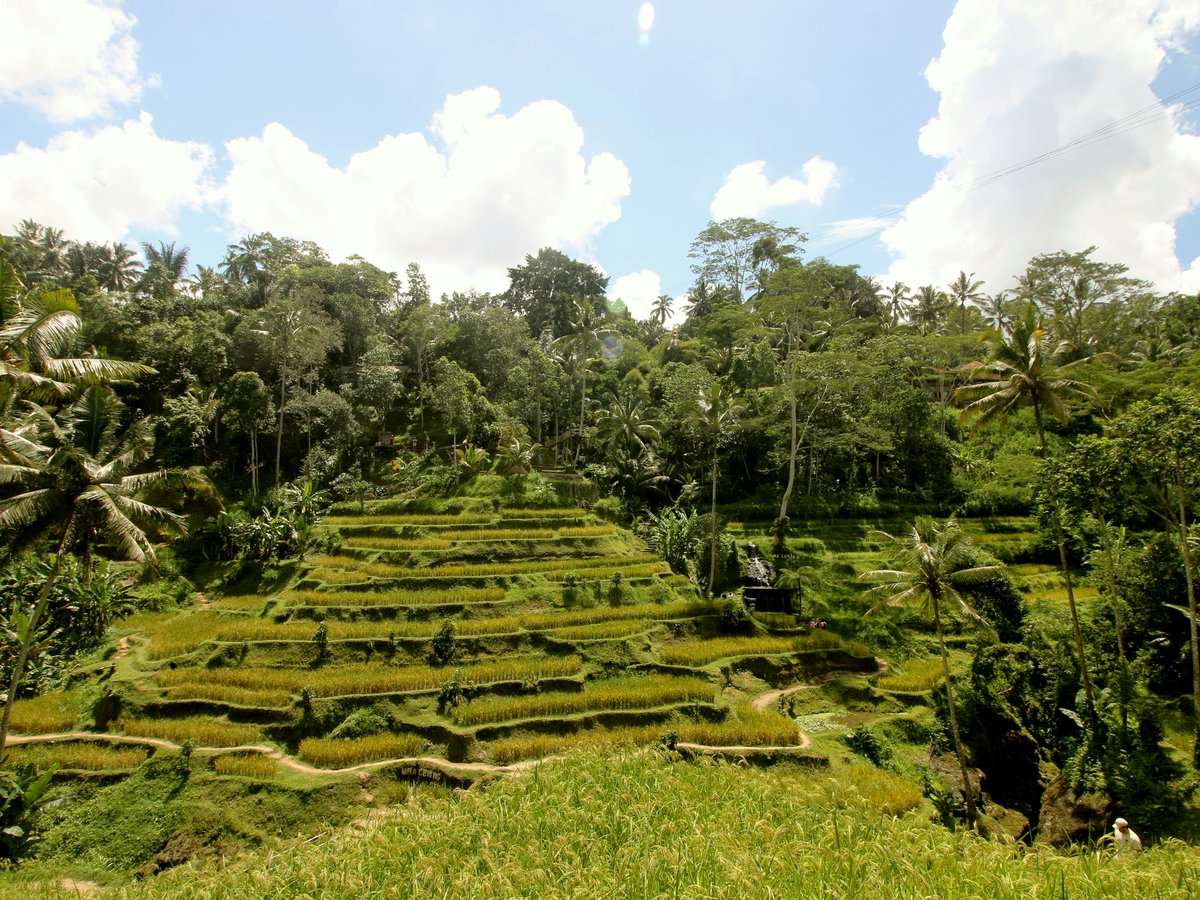
Dry trails, green rice terraces, and comfortable walking temperatures make July one of Ubud's strongest months for outdoor activities. You pay for it with crowds at every headline site and prices that reflect the demand. Compared to January's 348mm of monthly rain, when the paths along Campuhan Ridge turn slippery and rivers run high, July feels like a different place entirely. The terraces around Tegallalang catch late-afternoon light, and the carved rock shrines at Gunung Kawi stand sharp against a dry sky.
Why visit in July
- Reliably dry mornings and evenings. Rain concentrates in a short afternoon window, leaving 6 AM through early afternoon and 4 PM onward consistently clear for temple visits, rice terrace walks, and cycling.
- Comfortable walking temperatures. Ubud's July highs stay well below 30°C, making full-day circuits through temple complexes and terraced hillsides feasible without heat exhaustion risk.
- Rice terraces at peak visual form. Fields planted during the wet season glow in bright green by July, and dry paths make the deeper routes through the Sayan Valley and Kedewatan accessible on foot.
- Pesta Kesenian Bali (Bali Arts Festival) closes in early-to-mid July with performance highlights and craft exhibitions at Taman Werdhi Budaya Art Centre in Denpasar, about 90 minutes south of Ubud by car.
Worth knowing
- Peak-season crowds at every major site. Expect queues of 20 to 40 minutes at the Sacred Monkey Forest Sanctuary by mid-morning, and shoulder-to-shoulder foot traffic at the main Tegallalang viewpoints through midday.
- The most expensive month to visit Ubud. Accommodation, private drivers, and activity operators all charge peak rates that significantly exceed the shoulder-month pricing available in May and September.
- Persistent humidity despite the dry-season label. Clothes and towels take overnight to air-dry in guesthouses without AC, and the moisture shows in everything from foggy camera lenses to swollen wooden doors.
- July sits between two drier months. June receives about 90mm of rain and August roughly 114mm, making July slightly wetter than its immediate dry-season neighbors.
Best for
Think twice if
Ubud's inland elevation keeps July temperatures well below Bali's southern beach zones, making the town comfortable for full-day outdoor plans. July rain arrives in a predictable early-afternoon window and clears within the hour, leaving mornings and evenings dry. The persistent humidity lends a thickness to the air even on cloudless days in Ubud. Temperature variation across Bali's full calendar year is minimal, so the dry-season months set themselves apart by precipitation rather than heat.
Year-round climate
Averages from the last 5 years.
| Month | Avg high (°C) | Avg low (°C) | Rainfall (mm) |
|---|---|---|---|
| Jan | 29 | 23 | 348 |
| Feb | 29 | 23 | 304 |
| Mar | 30 | 22 | 246 |
| Apr | 29 | 22 | 151 |
| May | 29 | 22 | 136 |
| Jun | 28 | 22 | 90 |
| Jul | 27 | 21 | 135 |
| Aug | 27 | 21 | 114 |
| Sep | 28 | 21 | 130 |
| Oct | 29 | 22 | 135 |
| Nov | 29 | 22 | 286 |
| Dec | 29 | 23 | 283 |
Best things to do in July
Early-morning Campuhan Ridge Walk
hikingThe 2-kilometer ridge path runs between two Sungai Wos river valleys, starting near the western edge of Campuhan village. Dry-season grasses turn golden on both hillsides, framing the trail with open views toward the palm canopy below.
Dry trails and clear morning light before 8 AM. In the wet season the path gets muddy and views are often obscured by low cloud.Booking tipFree, no booking needed. Arrive by 6:30 AM to beat the July crowds.
White-water rafting on the Ayung River
adventureClass II to III rapids over roughly 10 kilometers through a jungle-carved gorge near Kedewatan, with carved stone faces visible on the cliff walls. The run takes about 2 hours including breaks.
Dry-season water levels are predictable and safe. Wet-season flash-flood risk increases, and some operators suspend morning runs entirely.Booking tipBook 3 to 4 days ahead in July. Morning departure slots fill before afternoon ones.
Sunrise purification at Tirta Empul Temple
culturalThe holy spring temple in Tampaksiring, about 15 kilometers northeast of Ubud, where Balinese Hindus purify themselves through a series of stone-carved water spouts. International visitors can participate in the purification ritual with a guide.
Dry-season water flow through the spring spouts is steady and clear, and the 7 to 8 AM morning light illuminates the inner courtyard before tour groups arrive around 10 AM.Booking tipArrive before 8 AM. Entry typically runs around 50,000 IDR for international visitors.
Cycling through Tegallalang and Ceking
cyclingGuided and self-guided cycling routes run from the northern rim of the Tegallalang terraces through the village of Ceking, descending back toward central Ubud along narrow farm roads with panoramic terrace views.
Dry roads and firm shoulders make the route rideable without mud hazards. The rice paddies stay bright green from the recent wet season, providing the visual contrast that makes the ride distinctive.Booking tipBook group tours 2 to 3 days in advance. Morning departures starting around 8 AM offer the best light and coolest temperatures.
Balinese cooking class in Peliatan
culinaryHalf-day classes begin with a guided visit to Pasar Ubud, the local morning market separate from the tourist art market, then continue at a home kitchen for 4 to 5 Balinese dishes including lawar, sate lilit, and jamu.
Peak season keeps classes running daily with full schedules, and the morning market stocks seasonal fruits like mangosteen and rambutan at their ripest.Booking tipBook at least 3 to 4 days ahead in July. Morning sessions starting at 8 AM tend to fill before afternoon ones.
Walking the Sayan Valley rice terraces
hikingA quieter alternative to the main tourist terraces, the fields in the Sayan Valley run along the Ayung River west of central Ubud. Paths wind between working paddies with far fewer visitors and no entrance fee.
Dry, walkable paths and full-green terraces. This route avoids the July peak-season crowds concentrated at the more famous northern terraces.Dawn visit to Gunung Kawi
culturalThe 11th-century rock-cut candi (memorial shrines) sit in a river valley near Tampaksiring, reached by descending roughly 300 stone steps through a palm forest. The 10 carved rock facades stand over 7 meters tall.
Dry steps significantly reduce the slip hazard on the steep descent. Morning light between 7 and 9 AM catches the carved facades at their sharpest, and the lower dry-season river exposes more of the temple complex.Booking tipArrive before 9 AM to avoid the tour groups that arrive from the south coast mid-morning.
What to eat in July
In season: fruit
Manggis (mangosteen)
Bali's mangosteen harvest peaks between June and September, with July at the heart of the season. The dark purple fruit appears at morning produce stalls along Jalan Raya Ubud for 15,000 to 25,000 IDR per kilogram. The white segmented flesh inside tastes like a cross between a peach and a lychee, with a floral sweetness that fades quickly after picking.
Salak Bali (snake fruit)
The Bali variety of snake fruit grows in the volcanic soils near Karangasem, east of Ubud, and peaks during the dry months. The skin feels like snakeskin under your fingers, and the flesh is crunchy, apple-like, and sweeter than its Javanese cousin.
Rambutan
A second fruiting window often overlaps with July across Bali's lowlands. Roadside sellers between Ubud and the woodcarving village of Mas stock bunches for around 10,000 IDR. The hairy red shells peel back to reveal translucent, grape-textured flesh.
Street food peaks
Jagung bakar (grilled corn)
Dry-season corn harvest brings fresh ears to roadside charcoal grills throughout Gianyar Regency. The kernels char over coconut-husk coals and get brushed with a sweet soy and lime-chili paste. The smoky-sweet smell carries from 10 meters away.
What to drink
Jamu kunyit asam
The traditional turmeric-and-tamarind tonic appears at warungs across Peliatan and along Jalan Goutama. July's cool mornings make the warm version particularly satisfying, served in small glasses for 5,000 to 10,000 IDR. The ginger-forward warmth hits your throat first, then the tamarind's tang lingers.
Regular events in July
Pesta Kesenian Bali (Bali Arts Festival)Free
Bali's largest annual arts festival wraps up in early-to-mid July with closing ceremonies, traditional dance performances, gamelan competitions, and craft exhibitions at Taman Werdhi Budaya Art Centre in Denpasar. Day trips from Ubud take about 90 minutes each way.
Early to mid-July (closing ceremonies; the festival opens mid-June)Festival Layang-Layang (Bali Kite Festival)Free
Traditional kite competitions featuring massive bebean (fish-shaped), janggan (dragon-shaped), and pecukan (leaf-shaped) kites flown by village teams from across Bali, held at Padang Galak Beach near Sanur. Some kites span 10 meters or more, and the deep thrum of their bowstrings carries from hundreds of meters away.
Weekend competitions throughout July during dry-season windsPurnama (Full Moon Ceremony)Free
Balinese Hindu temples hold purification and prayer ceremonies on the full moon each month. Tirta Empul, Goa Gajah, and Taman Saraswati all see increased ceremonial activity, with local families arriving in full temple dress carrying elaborate offering towers.
The full moon date in July (varies by year)Evening dance at Puri Saren Agung
The Ubud Royal Palace courtyard hosts nightly Legong, Barong, and Kecak dance performances backed by live gamelan orchestras. Dry July evenings mean performances rarely get rained out, unlike the wet season when cancellations are common. Tickets typically run 100,000 IDR.
Nightly, typically starting at 7:30 PMBest places this July
Campuhan Ridge Walk
natureThe hillside path is at its most comfortable in July, with dry golden-grass slopes and solid footing along the full route. The Sungai Wos valleys drop away on either side, and on clear mornings the view extends to Mount Agung in the northeast.
CampuhanTegallalang Rice Terraces
natureThe subak-irrigated terraces north of Ubud are at their most photogenic in early dry season, when the paddies hold their green from recent planting. The Ceking viewpoint offers the widest panorama. Visit before 9 AM or after 4 PM to avoid the midday tour-bus window.
TegallalangSacred Monkey Forest Sanctuary (Mandala Suci Wenara Wana)
nature and templeThe 12.5-hectare forest at Ubud's southern edge shelters over 1,200 long-tailed macaques and three Hindu temples. July's drier canopy lets filtered light reach the moss-covered statues and carved stone bridges on the forest floor, improving conditions for photography.
Central UbudTaman Saraswati Temple
templeThe lotus-pond temple on Jalan Raya Ubud was designed by the Balinese architect I Gusti Nyoman Lempad. The lotus flowers tend to bloom more fully during the dry months, and the front-stage evening dance performances benefit from clear July skies.
Central UbudARMA (Agung Rai Museum of Art)
museumA garden compound along Jalan Raya Pengosekan housing Balinese and Indonesian fine art, including works by Walter Spies and Rudolf Bonnet from the 1930s. The open-air pavilions and sculpture garden are most enjoyable in dry weather, and the shaded paths smell of frangipani after a morning watering.
PengosekanPenglipuran Village
cultural villageA traditional Balinese village in Bangli Regency, about 45 minutes north of Ubud by car. The uniform bamboo-roofed houses line a single clean central path. July's dry weather makes the walk through the village and its surrounding bamboo forest pleasant and mud-free.
Bangli (day trip)Goa Gajah (Elephant Cave)
archaeological siteA 9th-century archaeological site about 6 kilometers southeast of central Ubud in Bedulu village. The carved demon-mouth cave entrance and bathing fountain pools are less obscured by water runoff in the dry season, and the weathered stone carvings photograph with sharper detail.
Bedulu
Your packing checklist
Tick items off as you pack. Your progress saves in this browser.
All packed — have a great trip.
Insider tips
The Ubud Art Market (Pasar Seni Ubud) opens to local buyers as early as 4 AM. Arrive before 8 AM for significantly better prices on textiles and carvings. By 10 AM the stalls face a steady stream of tour-bus visitors, and starting prices roughly double.
Penestanan's rice field paths offer the same terraced landscape as the famous northern terraces with a fraction of the foot traffic. Walk west from Jalan Raya Ubud past the Penestanan steps, and within 15 minutes you reach working paddies with no admission fee and no crowds.
If you spot penjor (tall decorated bamboo poles) lining a road, a temple ceremony is underway in that neighborhood. You can usually enter the outer courtyard respectfully in a sarong. The processions with gamelan orchestras and towering offerings happen frequently throughout July and are among the most genuine cultural encounters in Ubud.
The Neka Art Museum on Jalan Raya Sanggingan is far less crowded than the central market area and holds significant works by European and Balinese artists who settled in Ubud from the 1930s onward. Entry is 100,000 IDR. You will likely have several gallery rooms to yourself even in peak July.
For dinner without the central Ubud rush, walk south through the Monkey Forest to Nyuh Kuning village. A handful of warungs and cafes there serve the same quality at lower prices with noticeably fewer visitors.
Avoid these mistakes
- Scheduling outdoor temple visits between 1 PM and 3 PM in July. The afternoon rain window is predictable enough to plan around. Mornings and late afternoons are dry, the light is better, and the heat is lower. Reserve the midday hours for indoor activities, cooking classes, or cafes.
- Arriving at Tegallalang Rice Terraces between 10 AM and 2 PM, when tour buses from the Kuta and Seminyak hotel zones are at their peak. By 3:30 PM most groups have left, and the late-afternoon light on the paddies is worth the wait.
- Not booking accommodation well in advance for July. Ubud's busiest month fills the better guesthouses in Penestanan, Nyuh Kuning, and central Ubud early. Last-minute arrivals face outlying options or inflated walk-in rates.
- Underestimating humidity's effect on stamina. The thermometer reads comfortable, but the moisture in the air makes extended terrace walks and temple-stair climbs feel considerably harder. Carry water, pace yourself, and plan rest stops at sites like Gunung Kawi where the return climb is all uphill.
Practical tips for July
Book accommodation and popular cooking classes 4 to 6 weeks before your July arrival, particularly in central Ubud and Penestanan. Restaurants on Jalan Dewi Sita, Jalan Goutama, and Jalan Hanoman fill by 7 PM most evenings, so eat early or try smaller warungs in Peliatan. Temple visits require a sarong and sash at every site, from major complexes to neighborhood village temples. Scooter rental runs about 70,000 to 100,000 IDR per day (roughly 4 to 6 USD at current exchange rates), and a valid international driving permit is technically required though enforcement varies. Most ATMs along Jalan Raya Ubud accept international cards, but carry cash for market purchases and smaller warungs. The 50,000 IDR note is the most practical denomination for daily transactions. Yoga studios in Penestanan often post their July schedules only 1 to 2 weeks ahead on Instagram rather than on established booking platforms.
FAQ
Is July a good time to visit Ubud?
July is one of Ubud's better months for weather, with comfortable temperatures and mostly brief afternoon rainfall. The trade-off is peak-season pricing and the largest crowds of the year, driven by international school holidays. If you value fewer visitors and lower costs, May, June, or September deliver similar weather conditions with significantly less tourist density. If reliable dry-season weather matters more than cost, July delivers.
What is the weather like in Ubud in July?
Mild and pleasant, with highs comfortably below 30°C and lows cool enough for a light layer in the morning. Rain falls on most days but concentrates in brief afternoon showers that pass within the hour. The air stays noticeably humid throughout. Ubud is several degrees cooler than Bali's southern beach areas, which is one of the main reasons visitors choose it as a base during the dry season.
Is Ubud crowded in July?
Yes, July is Ubud's busiest month alongside August. The Sacred Monkey Forest, the Tegallalang terraces, and the evening performances at the Royal Palace all draw peak-season crowds. The practical impact includes longer waits at popular restaurants, higher accommodation prices, and the need to book activities days in advance. Visiting major sites before 8 AM and eating dinner early are the most effective ways to manage the density.
Does it rain every day in Ubud in July?
Nearly. The majority of July days see some rainfall, but the showers tend to arrive in a predictable early-afternoon window and clear quickly. Total monthly precipitation is moderate by Bali standards, well below the wet-season months. Mornings are almost always dry, and evenings clear in time for dinner. A full-day washout in July is rare.
How far in advance should I book a hotel in Ubud for July?
Plan several weeks ahead for guesthouses and villas in central Ubud, Penestanan, or Nyuh Kuning. The better-reviewed properties in these neighborhoods fill early for July stays, especially for bookings longer than 3 nights. If you are flexible on location and willing to stay in villages like Mas or Peliatan, you may find availability on shorter notice at lower rates.
Things to Do in Ubud in July
 Free cancellation
 Best of Ubud Full-Day Tour with Jungle Swing
Day trip: 10 hours, free cancellation.
via Viator Free cancellation
 Ubud: Monkey Forest, Jungle Swing, Rice Terrace and Water Temple
Day trip: free cancellation.
via Viator Free cancellation
 Private Uluwatu Sunset Tour with Kecak Dance and Dinner
Day trip: 7 hours, free cancellation.
via Viator Free cancellation
 Tanah Lot and North Bali Tour: Scenic Journey
Day trip: free cancellation.
via Viator Free cancellation
 Nusa Penida All-Inclusive Day Trip
Day trip: 12 hours, free cancellation.
via Viator Free cancellation
 Bali Snorkeling Tour at Blue Lagoon Beach - All-Inclusive
Day trip: 6 hours, free cancellation.
via ViatorFind a flight to Ubud
Live fares to Ubud appear here once cookies are accepted.
Last verified by automated review (v1.7.2) on . What is automated review?