Stay in Ubud in January
9 hotels in the Trip.com pool for Ubud, from US$18 a night.
Opens Trip.com on Fri 1 Jan to Sun 3 Jan 2027; change the dates there.
January in Ubud brings 348mm of rain across 28 days. No other month comes close. February, the runner-up, logs 304mm. Humidity sits near 87%, and while daytime temperatures reach a comfortable 28.9°C (84°F) with nighttime lows around 22.6°C (73°F), the moisture makes everything feel heavier than those numbers suggest. A typical January morning in the valley starts clear and warm. You step outside your guesthouse in Penestanan around 7 a.m. to blue sky. By early afternoon the first heavy drops arrive. By mid-afternoon the streets run like small rivers. Most downpours clear within 2 to 3 hours, and evenings tend to be still and warm.
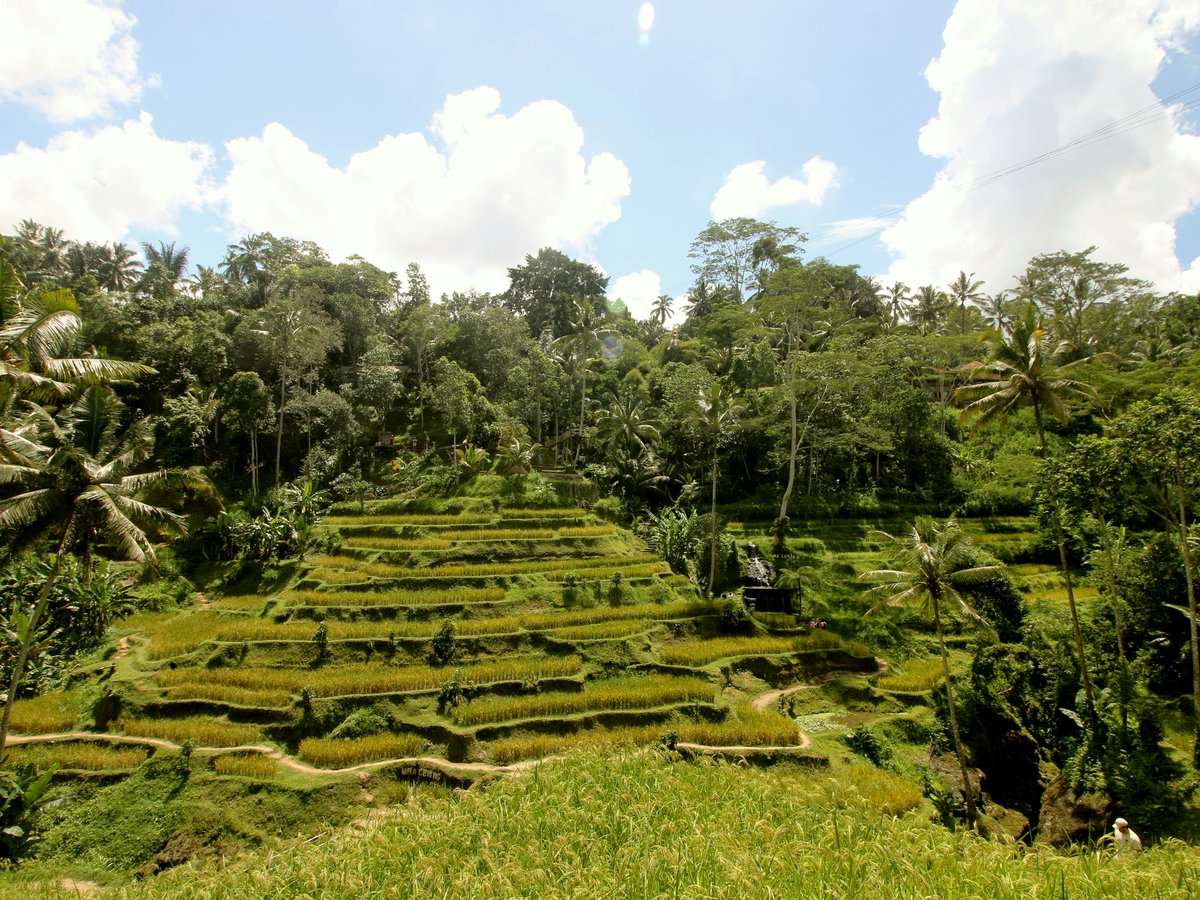
The Tegallalang Rice Terraces, fed by all that water, turn a shade of green that the dry-season version, dusty and golden in August, cannot match. The Campuhan Ridge Walk, normally packed in July, is nearly empty before 9 a.m. Hotel rates in neighborhoods like Sayan and Kedewatan drop after the first week, once the New Year holiday crowd clears. If you can handle getting soaked every afternoon, you will find a quieter, cheaper, and arguably more photogenic Ubud than the one that fills social media feeds during peak season. If you need reliable sunshine, skip to June.
Why visit in January
- Bali's signature rice-terrace landscape is at its most photogenic during peak wet season, with full irrigation channels creating mirror-like reflections in the paddies north of Ubud.
- Guesthouse and villa rates fall sharply after the first week of January, making mid-to-late January one of the cheapest windows for quality accommodation across the Gianyar regency.
- Temple queues at the Sacred Monkey Forest and at water temples shrink considerably compared to the July-August peak, with some morning visits feeling close to private.
- Waterfalls within 30 minutes of central Ubud, including Tegenungan and Tibumana, reach their most dramatic flow and spray.
Worth knowing
- Near-daily rainfall, concentrated in heavy afternoon bursts, reliably shuts down outdoor plans for 2 to 3 hours each day.
- The humidity makes even a short walk along Jalan Raya feel exhausting, and camera gear fogs instantly when moving from air-conditioned spaces to the outdoors.
- Trails to riverside temple complexes and the ridges north of Campuhan become slippery or temporarily close after sustained downpours.
- Mosquito populations increase with wet-season standing water across Ubud's river corridors, raising the dengue risk that health authorities track each wet season.
Best for
Think twice if
January sits at the peak of Ubud's monsoon season. Mornings in the valley typically start clear and warm, with clouds building over central Bali's highlands before noon. Rain tends to arrive in the early afternoon and clear by sunset, a cycle consistent enough that trekking guides in Tegallalang schedule morning-only outings from December through February. Overnight temperatures stay mild enough that most guesthouses in Nyuh Kuning and Keliki rely on fans rather than air conditioning. Worth noting, the warmth combined with tropical moisture keeps your skin damp from mid-morning through midnight, even without exertion.
Seasonal caution
- Flash flooding occurs along the Ayung River gorge and Wos River valley during peak downpours, particularly after 2 to 3 consecutive days of heavy rain. Avoid walking near swollen rivers or through roadside drainage channels.
- Wet-season standing water breeds Aedes aegypti mosquitoes, which carry dengue fever. Ubud's river-valley geography concentrates the risk, and Bali's Gianyar regency typically sees elevated case counts from December through March.
- Landslips occasionally close narrow roads in the hills north of Ubud toward Kintamani and Penelokan. Check road conditions with your guesthouse host or a local driver before riding a motorbike on mountain routes after sustained rain.
Year-round climate
Averages from the last 5 years.
| Month | Avg high (°C) | Avg low (°C) | Rainfall (mm) |
|---|---|---|---|
| Jan | 29 | 23 | 348 |
| Feb | 29 | 23 | 304 |
| Mar | 30 | 22 | 246 |
| Apr | 29 | 22 | 151 |
| May | 29 | 22 | 136 |
| Jun | 28 | 22 | 90 |
| Jul | 27 | 21 | 135 |
| Aug | 27 | 21 | 114 |
| Sep | 28 | 21 | 130 |
| Oct | 29 | 22 | 135 |
| Nov | 29 | 22 | 286 |
| Dec | 29 | 23 | 283 |
Holidays and festivals in January
Public holidays
- New Year's Day(Tahun Baru Masehi)1 January 2027
Best things to do in January
White-water rafting on the Ayung River
outdoor adventureThe Ayung runs through a deep gorge west of Ubud center, with several operators launching half-day trips from Kedewatan village covering roughly 12 kilometres of river. January's rainfall transforms the typical Class I-II run into something closer to Class II-III, with stronger currents and splashover rapids.
Peak water levels produce the strongest rapids of the year, upgrading the typical gentle float into a ride with real momentum.Booking tipBook through a Kedewatan-based operator rather than a Kuta beach agency to avoid a 30 to 50% markup.
Waterfall chasing in the Gianyar valleys
natureTegenungan drops roughly 15 metres into a swimmable pool about 15 minutes by motorbike from central Ubud. Tibumana, about 30 minutes east, sits in a quieter jungle gorge with a gentler cascade and cooler air from the surrounding canopy.
Fewer visitors in wet season mean you might have the swimming pool at the base of Tegenungan to yourself, something that rarely happens from June through September.Booking tipArrive before 9 a.m. to enjoy the falls before the afternoon rain and to minimize sharing the pools.
Morning photography on Campuhan Ridge
photographyThe ridge trail begins at Pura Gunung Lebah near the Campuhan bridge and follows a narrow grassy spine between two river valleys for about 2 kilometres. In January, the valleys fill with morning mist that burns off by around 9 a.m., creating a 2-hour window for atmospheric landscape work.
Wet-season morning mist fills the valley below the ridge, producing layered conditions that vanish entirely from May through October.Museum afternoons at ARMA or Neka Art Museum
cultureThe Agung Rai Museum of Art in Peliatan and the Neka Art Museum in Sanggingan offer hours of Balinese painting, woodcarving, and kris collections. ARMA's garden pavilions hold rotating exhibitions alongside permanent works by Walter Spies and Affandi.
January afternoons need reliable indoor plans. Both museums see far fewer visitors in wet season, letting you linger without the peak-season crowd shuffle.Booking tipARMA occasionally hosts evening cultural performances with gamelan and dance. Check the schedule board near the entrance.
Cooking classes with wet-season ingredients
culinaryMultiple cooking schools in central Ubud operate half-day classes starting around 8 a.m. with a guided walk through the Jalan Raya morning market, followed by hands-on preparation in a covered outdoor kitchen.
Young green jackfruit, fresh turmeric root, and lemongrass are at peak abundance in January. The morning market walk is comfortable in cooler pre-rain air.Booking tipClasses fill even in low season because group sizes are small, typically 6 to 10 people. Book 3 to 4 days ahead.
Tirta Empul purification ritual
cultural/spiritualThe 10th-century Hindu water temple northeast of Ubud draws both Balinese worshippers and visitors to its spring-fed purification pools. Participants move through a sequence of stone-carved spouts, immersing under water cold enough to make you gasp even in tropical heat.
The rice paddies lining the road from central Ubud are at their deepest green in January, making the 30-minute drive as scenic as the destination.Booking tipBring a dry change of clothes and a towel. You will be fully immersed, and the drive back in wet clothes with air conditioning is uncomfortable.
Sunrise trekking to Mount Batur
trekkingThe 1,717-metre active volcano sits about 90 minutes north of Ubud. Treks depart around 3:30 a.m. from Toya Bungkah village. The 2-hour climb follows volcanic gravel to the summit, where guides cook eggs in steam vents while you wait for first light over Lake Batur.
Lower tourist numbers mean trekking groups are smaller, sometimes fewer than 10 people versus 50-plus in August. The trade-off is less predictable cloud cover.Booking tipBook with a Kintamani-based guide and confirm a rain-or-reschedule policy, since January cloud cover can obscure the sunrise entirely.
Exploring the Gunung Kawi temple complex
cultural/historicalThe 11th-century carved cliff shrines sit in a river valley near Tampaksiring, about 30 minutes northeast of Ubud. A descent of 370 stone steps leads through terraced paddies to rock-cut candi carved into the cliff face. The return climb is steep enough to test your lungs.
The canyon walls turn vivid green with moss and ferns in wet season, and the river at the bottom runs full and fast. Reduced visitor numbers make the narrow stairway far less congested.Booking tipGo early morning. The descent and return are more manageable in cooler pre-rain air, and you will share the stairway with fewer people.
What to eat in January
In season: fruit
Mangosteen
Bali's mangosteen harvest peaks from December through February. The fruit appears at Ubud's morning market on Jalan Raya and from roadside sellers heading north for around 20,000 to 30,000 IDR per kilogram. Thick purple rind, translucent white segments, flavor somewhere between lychee and peach.
Rambutan
Red, hairy-shelled rambutan appears in piles at every market and roadside stall across central Bali during the wet months. Sellers along the road toward Tirta Empul stack them in pyramids, with bags of 10 to 15 fruits for about 10,000 IDR.
Salak (Snake Fruit)
Bali's signature fruit grows in the cooler hills near Sibetan village, about 90 minutes northeast of Ubud. January's persistent moisture produces especially juicy specimens with a sweet-tart bite and a faint astringent finish.
On menus now
Lawar
A traditional Balinese ceremonial dish of minced meat, shredded coconut, and fresh green jackfruit or young banana blossom, mixed with spices. Wet-season jackfruit ripens more fully, and cooks in Peliatan say the January version carries a sweeter, more layered flavor.
Bubur Injin
Warm black rice pudding served with thick coconut cream in warungs across central Ubud. The pairing of January's evening cool (temperatures settle into the low 20s Celsius after dark) with a steaming bowl of sweetened rice is one of wet-season Bali's small comforts.
What to drink
Jamu
A traditional Javanese herbal tonic made from fresh turmeric, ginger, tamarind, and honey, served warm in small glasses at warungs around Jalan Hanoman. Bright golden-yellow and intensely bitter, about 10,000 IDR per glass.
Regular events in January
Purnama (Full Moon Ceremony)Free
Balinese Hindus mark each full moon with prayers and offerings at local temples. Women carry towering gebogan (fruit-and-flower offerings) on their heads, accompanied by gamelan music. Visitors may observe from outside the inner sanctum at temples like Pura Taman Saraswati and Pura Dalem Ubud.
Mid-January (exact date follows the lunar calendar and shifts each year)Tilem (New Moon Ceremony)Free
The complement to Purnama, held on each new moon. A quieter ceremony focused on spiritual cleansing. Temples across Ubud hold early-morning rituals, and offerings appear at household shrines and roadside altars throughout town.
Late January or early February (follows the lunar calendar)Odalan (Temple Anniversary Ceremonies)Free
Each of Ubud's hundreds of Hindu temples celebrates its anniversary once every 210 days on the Balinese Pawukon calendar. In any given week, 2 or 3 temples in the greater Ubud area hold multi-day odalan with processions, gamelan orchestras, and community offerings.
Throughout January; ask your guesthouse host which nearby temple is celebrating that weekBest places this January
Tegallalang Rice Terraces
natureThe terraced paddies about 20 minutes north of central Ubud fill to the brim with irrigation water in January. The subak channels overflow, creating cascading reflections across the stepped paddies. Viewing platforms along the main road are notably less crowded than during dry-season months.
TegallalangSacred Monkey Forest Sanctuary
nature/templeThe 12.5-hectare forest on the southern edge of central Ubud is at its lushest and muddiest in January. Moss-covered stone sculptures, dragon staircases, and bridge crossings in the three temple compounds look their most atmospheric when wet.
Ubud centerPenglipuran Village
culturalA traditional Balinese village about 45 minutes north of Ubud in the Bangli regency. The uniform bamboo-and-stone architecture photographs well against January's overcast sky. Fewer tour buses in wet season mean a more genuine sense of daily village rhythm.
BangliMuseum Puri Lukisan
museumUbud's oldest art museum, founded in 1956 on Jalan Raya. The permanent collection traces Balinese painting from pre-colonial Kamasan wayang-style works through the Pita Maha movement of the 1930s to the Young Artists school of the 1960s. The lotus-pond garden courtyard offers a calm retreat between showers.
Ubud centerNeka Art Museum
museumSpread across hillside pavilions in Sanggingan, about 2 kilometres west of Ubud center. Four collections cover Balinese, Indonesian, and foreign artists who worked in Bali, including a room dedicated to Arie Smit. Upper pavilions offer views into the Campuhan valley, especially atmospheric when January mist fills the gorge.
SangginganPura Taman Saraswati
templeA water temple in central Ubud fronted by a lotus pond that fills completely during wet season. The temple hosts regular evening dance performances, including Legong and Ramayana, against ornate stone carvings. January's smaller audiences make it easier to find a good sightline from the cafe seating across the pond.
Ubud center
Your packing checklist
Tick items off as you pack. Your progress saves in this browser.
All packed — have a great trip.
Insider tips
The morning market on Jalan Raya Ubud (the local produce market near Pura Desa, not the tourist art market on the opposite side) opens before 6 a.m. and sells mangosteen, salak, and rambutan at roughly half the price of tourist-area sellers near the Monkey Forest entrance.
If you are staying more than 5 days in mid-to-late January, negotiate your room rate directly with the guesthouse owner in person. Walk-in rates after the holiday period run 20 to 40% below what booking platforms list, and many smaller properties prefer cash-paying guests.
The best window for the Tirta Empul purification pools is between 8 and 9 a.m. on a weekday. By mid-morning, tour buses from the southern Bali coast start arriving. In January, even a late-morning visit is manageable compared to dry-season queues.
Download offline maps before heading to rural temples or waterfalls north of Ubud center. Mobile data coverage drops on the roads between Ubud and Kintamani, and January flooding occasionally closes smaller roads that navigation apps still show as open.
Families with young children face extra friction in January. TTDI rates Ubud's family friendliness at 5.8 out of 10 (see the TTDI Family-Friendliness Index). Steep temple stairs, unpaved paths at rural sites, and limited children's menus at most warungs are year-round realities, but January's wet conditions make the footing notably worse.
Avoid these mistakes
- Scheduling a full-day outdoor itinerary with no rain backup. January's afternoon storms will cancel open-air plans after lunch. Stack outdoor activities before noon and keep an indoor option (museum, cooking class, spa) for every afternoon.
- Renting a motorbike without wet-weather riding experience. Ubud's steep roads flood quickly, and the combination of wet stone, oil slicks, and heavy traffic near the central market creates conditions that catch even experienced riders. If you have not ridden in sustained tropical rain, hire a driver or use Grab.
- Booking an open-air bathroom villa for the romance factor. The concept works in dry season, but spending January's wettest weeks with rain falling into your bathing area, mildew building on towels overnight, and mosquitoes breeding in pooled water turns the luxury into genuine regret.
- Packing only one pair of shoes. Whatever you wear to the Monkey Forest or a waterfall trek will be soaked by the end. Bring a second pair to rotate while the first dries, which takes 12 to 18 hours at January's humidity.
Practical tips for January
January accommodation splits into two pricing windows. The first week (through about January 7) carries New Year holiday surcharges, so book at least 3 weeks ahead if arriving before the 8th. After that, walk-in negotiation at guesthouses often beats online platform rates. The Indonesian rupiah trades at roughly 17,737 IDR to 1 USD. ATMs with Visa and Mastercard access line Jalan Raya and Jalan Monkey Forest, though some charge withdrawal fees of 25,000 to 50,000 IDR per transaction. Temple dress codes require a sarong and sash at every Hindu temple in Bali. Grab ride-hailing works in Ubud but meets occasional friction near the Royal Palace (Puri Saren Agung) and Monkey Forest entrance, where traditional taxi drivers enforce their own pickup zones. Many warungs and smaller shops deal in cash only, and card readers occasionally fail during wet-season power fluctuations. Carry a small flashlight for evening walks along unlit roads in Penestanan and Nyuh Kuning, where street lighting is sparse and puddles hide potholes after dark.
FAQ
Is January a good time to visit Ubud?
It is honestly the toughest month weather-wise, with more rainfall than any other period in the year. But if you are flexible with daily timing, comfortable shifting to indoor plans each afternoon, and drawn to lower prices and thinner crowds after the first week, January has genuine appeal. The landscape is at its lushest, and the town feels more like a Balinese hill town than the tourist corridor it becomes in peak season. First-time visitors who want guaranteed outdoor conditions should consider May through September instead.
What is the weather like in Ubud in January?
Warm, wet, and humid. Rain follows a fairly predictable daily rhythm, with clear mornings giving way to heavy afternoon storms that typically clear by early evening. Temperatures stay in the high 20s Celsius (low-to-mid 80s Fahrenheit), and nights are cool enough for sleeping with a fan. The humidity is the real challenge. Expect fogged lenses, damp clothes, and a general stickiness from mid-morning onward.
Is Ubud crowded in January?
The first week, through about January 7, still carries overflow from New Year, and the Monkey Forest and Tegallalang can feel busy during that stretch. After the 7th, tourist numbers drop noticeably. By mid-January you will find shorter temple queues, available tables at restaurants that need reservations in August, and a generally calmer pace. Not deserted, but a clear difference from peak season.
Can I still visit the rice terraces when it is raining?
Yes, and many photographers argue they look best in the wet. The paddies fill with water and turn an intense green that the dry season cannot produce. The narrow paths between terrace levels do become slippery, and some steeper edge sections can be hazardous in active rain. Waterproof sandals with grip are essential, and it is worth avoiding the most exposed paths immediately after a heavy downpour.
Is Ubud safe for solo travelers in January?
TTDI rates Ubud's solo-traveler safety at 6.8 out of 10 (see the TTDI Solo-Safety Index). The main concerns are motorbike theft, petty scams near high-traffic tourist areas, and the increased accident risk on wet roads. Violent crime against tourists is rare. Solo travelers generally report feeling safe walking central Ubud after dark, though quieter residential lanes need a phone torch. The low wet-season crowds mean fewer touts targeting tourists, which many solo visitors find more relaxing.
Things to Do in Ubud in January
 Free cancellation
 Best of Ubud Full-Day Tour with Jungle Swing
Day trip: 10 hours, free cancellation.
via Viator Free cancellation
 Ubud: Monkey Forest, Jungle Swing, Rice Terrace and Water Temple
Day trip: free cancellation.
via Viator Free cancellation
 Private Uluwatu Sunset Tour with Kecak Dance and Dinner
Day trip: 7 hours, free cancellation.
via Viator Free cancellation
 Tanah Lot and North Bali Tour: Scenic Journey
Day trip: free cancellation.
via Viator Free cancellation
 Nusa Penida All-Inclusive Day Trip
Day trip: 12 hours, free cancellation.
via Viator Free cancellation
 Bali Snorkeling Tour at Blue Lagoon Beach - All-Inclusive
Day trip: 6 hours, free cancellation.
via ViatorFind a flight to Ubud
Live fares to Ubud appear here once cookies are accepted.
Last verified by automated review (v1.7.2) on . What is automated review?