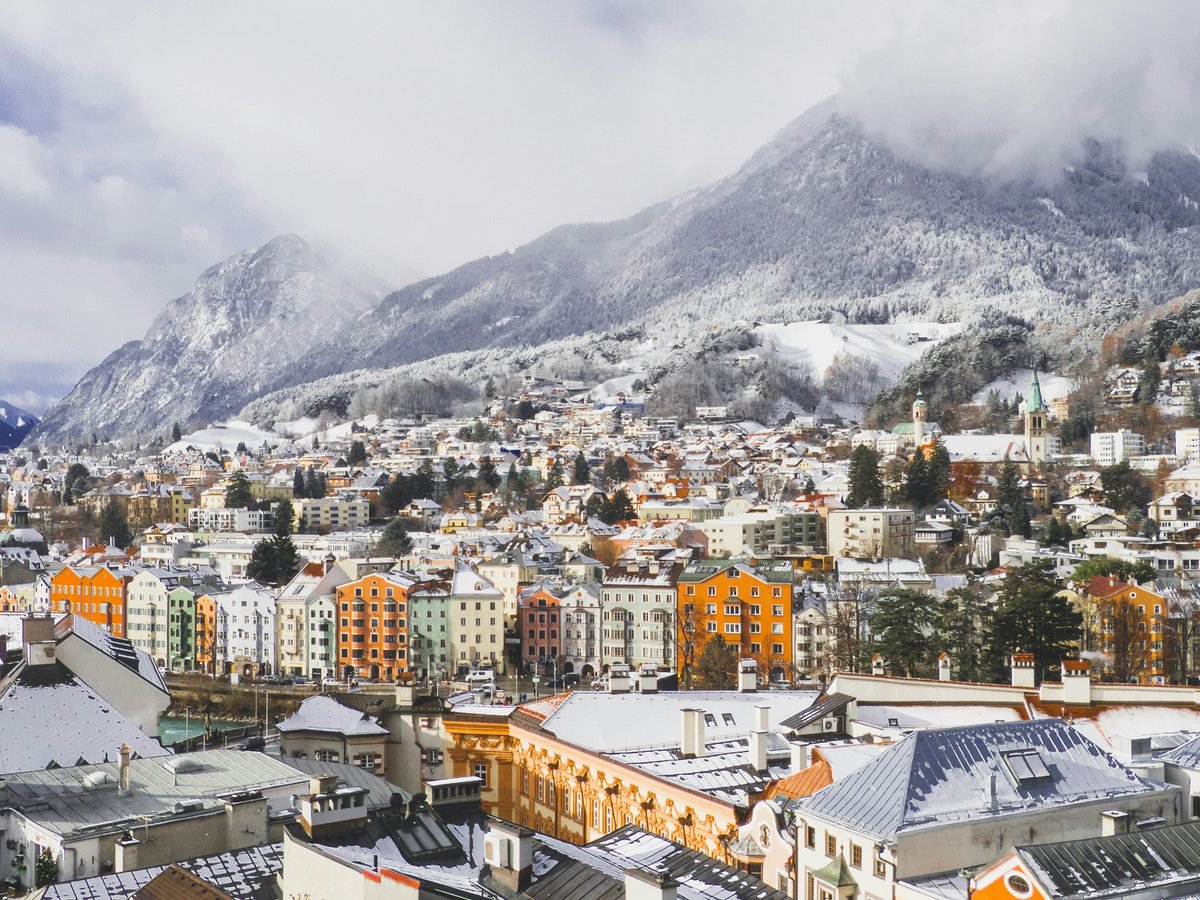
Stay in Innsbruck in September
43 hotels in the Trip.com pool for Innsbruck, from US$91 a night.
Opens Trip.com on Fri 25 Sep to Sun 27 Sep 2026; change the dates there.
September in Innsbruck is the month when the city exhales. The summer tour groups that pack the Altstadt in July and August have largely moved on, but the weather still cooperates for Alpine hiking, with daytime highs around 22°C (72°F) and crisp overnight lows near 11°C (52°F). The Nordkette range north of the city starts showing its first golden larch needles above 1,800 metres (5,900 feet), and most trails on Patscherkofel remain snow-free through the month up to about 2,800 metres (9,200 feet). This is the month Tyrol celebrates the Almabtrieb, the ceremonial cattle drive down from high summer pastures, with flower-crowned cows parading through village streets to the sound of heavy brass bells.
Rain is the honest caveat. September averages 142mm across roughly 13 wet days, which is comparable to August's 143mm. Afternoon showers tend to build over the Karwendel to the north and drift into the Inn Valley, though they rarely last longer than an hour. Mornings are usually dry and crisp around 12-14°C (54-57°F), the kind of air that smells faintly of pine resin and damp stone. Experienced hikers in the region plan their summit pushes before noon and save the Altstadt for afternoon wandering under the Laubengänge arcades along Herzog-Friedrich-Straße.
Hotel rates in neighborhoods like Pradl and Wilten drop noticeably from the July-August peak. The ski season hasn't started yet, so Innsbruck sits in a genuine shoulder period between its two main tourist economies. Restaurants along the Inn in Mariahilf are less frantic. You can grab a table at the Markthalle food stalls without the 20-minute wait that July demands. That said, September isn't deserted. The Tiroler Landestheater opens its new season, university students return, and the city has a working, lived-in energy that the peak summer months lack.
Why visit in September
- Summer hiking trails on the Nordkette and Patscherkofel remain snow-free at most elevations, but the July-August crowds have thinned noticeably. Trail parking at the Hungerburgbahn station is available on weekday mornings.
- The Almabtrieb cattle drives across Tyrolean villages are a living Alpine tradition that peaks in mid-to-late September. Decorated cows, traditional Schuhplattler dancers, and the deep clanging of brass cowbells make this one of central Europe's more genuine folk events.
- Shoulder-season hotel pricing brings mid-range rooms down from summer rates. The gap between what you'll pay in Saggen in August versus September can be 20-30%, and availability is rarely an issue outside the Almabtrieb weekends.
- Early autumn light in the Inn Valley is noticeably softer than the harsh midday sun of July. The pastel facades along the Mariahilf waterfront and the Goldenes Dachl photograph well in the lower-angle afternoon sun.
- Seasonal produce peaks at the weekly Bauernmarkt. Tyrolean plums, chanterelle mushrooms, fresh Almkäse from the summer pastures, and the first Sturm (young wine) all appear in September.
Worth knowing
- Rain is persistent. At 142mm across 13 days, September is one of Innsbruck's wetter months. Afternoon showers are common enough that you'll need a real rain shell, not a packable windbreaker. Multi-day hut-to-hut hikes carry real weather risk.
- Mountain infrastructure starts winding down. Some Alpine huts above 2,000 metres (6,600 feet) close in late September for the interseason, and cable car schedules on smaller lifts may shift to reduced hours by the last week of the month.
- Temperatures drop quickly after sunset. A sunny 22°C afternoon can feel like 8°C by 8pm, and the temperature swing catches visitors who packed for one season instead of two.
Best for
Think twice if
September in Innsbruck feels like late summer giving way to early autumn. Days are warm enough for hiking in a T-shirt, but mornings carry a noticeable chill, and the temperature can drop 10 degrees in an hour if clouds move in from the Karwendel. The Inn Valley funnels weather systems through quickly, so showers tend to be intense but brief. Humidity sits at 77%, which you'll notice as a faint dampness on stone surfaces in the Altstadt on overcast mornings. By the last week of September, sunset falls before 7pm, and the mountains take on a sharper, colder light.
Seasonal caution
- Mountain weather above 2,000 metres (6,600 feet) can change within 30 minutes. A clear morning at Hafelekar summit (2,334m) can turn into near-zero visibility with driving rain or even sleet by early afternoon. Check the Tyrolean avalanche and weather service (Lawinenwarndienst Tirol) forecasts before any high-altitude hike.
- Early-season snowfall is possible above 2,500 metres (8,200 feet) in late September. The Nordkette ridgeline and Patscherkofel summit can see dustings that make exposed rock sections slippery and trail markings harder to follow.
Year-round climate
Averages from the last 5 years.
| Month | Avg high (°C) | Avg low (°C) | Rainfall (mm) |
|---|---|---|---|
| Jan | 6 | -3 | 73 |
| Feb | 9 | -1 | 59 |
| Mar | 12 | 2 | 89 |
| Apr | 15 | 4 | 89 |
| May | 19 | 9 | 176 |
| Jun | 26 | 14 | 146 |
| Jul | 26 | 15 | 162 |
| Aug | 26 | 15 | 143 |
| Sep | 22 | 11 | 142 |
| Oct | 18 | 8 | 78 |
| Nov | 11 | 1 | 100 |
| Dec | 7 | -1 | 78 |
Holidays and festivals in September
Public holidays
- Saint Rupert's Day(Rupertitag)24 September 2026
Headline events
Almabtrieb (Tyrolean Cattle Drive)
Mid-to-late September, varying by valley. Most fall between September 15 and September 28.
The annual return of cattle from high Alpine summer pastures to valley farms, celebrated across Tyrol with flower-crowned cows, traditional Tyrolean brass bands, Schuhplattler dancing, and village markets serving Almkäse and Bauernkrapfen. Each valley holds its own Almabtrieb on a different date, so you can often catch more than one during a week-long stay. The Stubaital and Wipptal celebrations south of Innsbruck are among the most accessible from the city. The sight of 60-80 decorated cows filing through a narrow village street, bells clanging, is one of the more memorable things you'll see in the Alps.
Best things to do in September
Hike the Nordkette Panoramaweg
hikingThe high-altitude trail from the Hafelekar summit station (2,334m / 7,657 feet) traverses the ridgeline above Innsbruck with views south across the Inn Valley to the Stubai Alps. The route runs along exposed limestone ridges with sections of fixed cable, and the panorama on a clear September morning extends to the Brenner Pass and the Italian border peaks.
The trail is typically snow-free through September. Summer crowds have thinned, and the lower sun angle creates sharper mountain shadows for photography. By October, early snow can close exposed sections.Booking tipTake the first Nordkettenbahnen departure (typically 8:30am) to avoid afternoon clouds. No booking required for the hike itself, but cable car tickets are cheaper when purchased online the day before.
Attend an Almabtrieb in the Stubaital
culturalDrive or bus 30 minutes south from Innsbruck to the Stubai Valley for one of Tyrol's most accessible cattle-drive celebrations. The decorated cows parade through villages like Fulpmes and Neustift while brass bands play, farmers sell Almkäse and Bauernkrapfen from stalls, and Schuhplattler dancers perform in Lederhosen on wooden stages. The whole thing has a relaxed, communal atmosphere that feels more like a family reunion than a tourist event.
Almabtrieb only happens in September when cattle descend from high pastures. Each valley picks its own date, so check locally. This is a once-a-year event with no equivalent in other months.Booking tipNo tickets needed. Arrive early (before 10am) for parking in the village. The Stubai Valley bus (STB line) runs from Innsbruck Hauptbahnhof and avoids the parking problem entirely.
Cycle the Inntalradweg (Inn Valley bike path)
outdoorThe flat, paved cycle path follows the Inn River through Innsbruck and continues east toward Hall in Tirol and west toward Völs. The 15km stretch from Innsbruck to Hall passes through riverside meadows, under the Nordkette, and past the old salt-trading town's medieval Altstadt. Bike rental shops in Pradl and near the Hauptbahnhof offer day rentals.
September temperatures of 18-22°C (64-72°F) are ideal for cycling. The July-August heat of 26°C made midday rides sweaty, and the riverside path is less crowded with joggers and families after the school holidays end.Booking tipNo advance booking needed for bike rentals on weekdays. Weekend mornings in September can still see short waits at popular rental shops near the Hauptbahnhof.
Walk the Altstadt and Hofburg
sightseeingInnsbruck's medieval core fits within a 15-minute walk. The Goldenes Dachl on Herzog-Friedrich-Straße, the Hofburg imperial palace, the Hofkirche with its 28 oversized bronze statues (the 'Black Men'), and the Stadtturm watchtower are all within 300 metres of each other. The narrow lanes smell of fresh bread from bakeries and damp limestone after a morning shower.
Comfortable 20-22°C temperatures make the tight medieval streets pleasant rather than claustrophobic. In July, the Altstadt's stone surfaces radiate heat and the crowds pack the alleys shoulder-to-shoulder. September offers elbow room and softer afternoon light on the pastel facades.Booking tipThe Hofburg and Hofkirche are rarely at capacity in September. No advance tickets needed.
Ride the Hungerburgbahn to Hungerburg
sightseeingZaha Hadid's futuristic funicular stations climb from the Congress station in the city center to Hungerburg at 860 metres (2,822 feet) in 8 minutes. The top station opens onto a terrace with a direct view across the Inn Valley to the Bergisel Schanze ski jump and the Stubai glaciers beyond. The Alpenzoo sits at the midway station.
September mornings often produce a temperature inversion that fills the Inn Valley with fog while Hungerburg sits above it in sunshine. The effect, looking down onto a white sea of cloud with peaks poking through, is most common in the transition months of September and October.Booking tipThe Innsbruck Card covers the Hungerburgbahn and is better value in September because you can combine mountain transport with museum entry without fighting peak-season queues at either.
Forage for wild mushrooms in the Nordkette foothills
outdoorThe mixed forests between Hungerburg and the Arzler Alm above Hötting are prime territory for chanterelles (Eierschwammerl) and porcini (Steinpilze). The damp forest floor after September rains smells of earth and decaying leaves, and the golden chanterelles stand out against the dark humus. Guided foraging walks led by local naturalists depart from Hungerburg on weekend mornings.
Wild mushroom season peaks in September after the summer rains have saturated the forest floor. August is slightly too early for the full flush, and by October the first frosts can end the season abruptly.Booking tipGuided walks fill up 1-2 weeks ahead for September weekends. Check with the Innsbruck tourist office on Burggraben for current offerings. Independent foraging is permitted but requires knowing your species.
Visit the Bergisel Schanze
sightseeingZaha Hadid's ski jump tower in Wilten, 3km south of the Altstadt, is open to visitors year-round. The panoramic café at the top of the 50-metre tower offers a 360-degree view of Innsbruck and the surrounding ranges. The elevator ride to the top takes about 2 minutes, and the viewing platform looks straight down the steep in-run, which gives you a visceral sense of what ski jumpers face at the Four Hills Tournament in January.
September's clear mornings offer some of the year's sharpest mountain views from the tower. Summer haze has lifted, and the early autumn light picks out individual peaks on the Stubai ridge that disappear into white glare in July.Day trip to Swarovski Kristallwelten in Wattens
sightseeingThe Swarovski Crystal Worlds art installation sits 15km east of Innsbruck in the town of Wattens. The underground Chambers of Wonder feature rotating installations by international artists, and the outdoor garden has a crystal cloud sculpture and a hedge maze. A direct shuttle bus runs from Innsbruck's Hauptbahnhof.
September sees noticeably fewer tour groups than the July-August peak. The outdoor garden areas are comfortable at 20°C, and the shuttle bus runs on schedule rather than being delayed by summer traffic on the A12.Booking tipOnline tickets are a few euros cheaper than the door price. Weekday mornings (Tuesday through Thursday) are the quietest even in September.
What to eat in September
On menus now
Zwetschgenknödel
Plum dumplings made with Tyrolean Zwetschgen (damson plums) that peak in September. The dumplings are boiled, rolled in buttered breadcrumbs, and dusted with cinnamon sugar. You'll find them as a main course at traditional Gasthäuser in Wilten and the Altstadt, not as dessert. The best versions use fruit so ripe it collapses into a tart jam inside the potato dough.
Kürbiscremesuppe (pumpkin cream soup)
Austrian pumpkin season opens in September, and this velvety soup appears on nearly every Gasthaus menu. The Styrian pumpkin-seed oil drizzled on top has a dark green, intensely nutty flavor. Markthalle vendors sell whole Hokkaido pumpkins alongside the soup at their stalls.
What to drink
Sturm (young wine)
The first partially fermented grape must from the Austrian harvest appears in Innsbruck restaurants and Buschenschänken (wine taverns) in September. It is cloudy, slightly fizzy, sweet-tart, and deceptively strong. Tyrolean bars in Hötting and St. Nikolaus tend to pour it by the Viertel (quarter litre). It has a shelf life of days, so what you drink in September cannot be replicated in October.
In markets
Eierschwammerl (Chanterelle mushrooms)
Wild chanterelles foraged from the forests around the Nordkette and Patscherkofel are at their September peak after summer rains. Restaurants across Innsbruck run Schwammerlzeit (mushroom season) specials, typically sautéed with butter and parsley or folded into Knödel. The golden color and peppery, faintly apricot smell are distinctive.
Tiroler Almkäse (Alpine cheese)
The Almabtrieb brings the summer's production of hard Alpine cheese down from mountain dairies. September Almkäse has been aging since June or July in high-altitude huts, and the flavor is nuttier and more complex than valley-produced cheese. The Bauernmarkt at Markthalle is the best place to taste and buy direct from the producers.
Festival food
Bauernkrapfen
Fried yeast-dough pastries filled with sour cream or jam, traditional at Almabtrieb and harvest celebrations across Tyrol. The dough is pulled thin in the center so it puffs and crisps unevenly, with a chewy rim and a translucent, crackly middle. They are served warm from outdoor stalls at every village festival in September, and the smell of hot oil and yeast carries across the square.
Regular events in September
Erntedankfest (Harvest Thanksgiving)Free
Tyrolean harvest thanksgiving celebrations with decorated church altars, processions, and community feasts. In Innsbruck, the Stift Wilten basilica typically hosts one of the larger observances with a procession through the Wilten neighborhood.
Late September to early October, usually the last Sunday in SeptemberTiroler Landestheater Season Opening
Innsbruck's main theater and opera house on Rennweg opens its new performance season in September with opera, drama, and dance premieres. The opening-night program typically features a flagship opera production.
Mid-September, usually the second or third weekWochenmarkt am Sparkassenplatz (Weekly Market)Free
The Saturday farmers market at Sparkassenplatz in the Altstadt is at its seasonal best in September, with Tyrolean producers bringing harvest plums, mushrooms, fresh Almkäse, honey, and Speck directly from farms in the Wipptal and Stubaital valleys.
Every Saturday morning, year-round, but September has the widest harvest selectionInnsbrucker Bauernherbst (Farmers' Autumn)Free
A loose season of harvest-themed events across the greater Innsbruck region, including open-farm days, cheese-tasting events at Alpine dairies, and traditional cooking demonstrations. Individual events are organized by farming cooperatives in the valleys south and east of the city.
Throughout September and into OctoberBest places this September
Hofgarten
parkThe imperial garden north of the Hofburg is at its most pleasant in September. The old-growth trees (some dating to the 16th century) start to turn, and the wide lawns are warm enough for sitting in the afternoon but not the baking heat of July. The free outdoor chess sets attract a regular crowd of local players. On dry September evenings the garden has a particular stillness, with the Nordkette glowing pink above the treeline at sunset.
SaggenMarkthalle Innsbruck
marketThe covered market hall on Innrain is the best single stop for September's seasonal produce. Ground-floor stalls sell Tyrolean Speck, Graukäse, fresh chanterelles, and harvest plums. The upper level has casual restaurants and a terrace overlooking the Inn River. September mornings here have a different atmosphere from the tourist-heavy summer months, with more locals doing their weekly shopping.
MariahilfAlpenzoo Innsbruck
zooEurope's highest-elevation zoo at 750 metres (2,460 feet) on the Hungerburgbahn midway station specializes in Alpine species. September is a good time for the brown bears, which are actively fattening before winter and tend to be more visible than in the sluggish heat of summer. The ibex enclosure sits on a natural rock face with views down to the Inn Valley.
HöttingMariahilf waterfront
neighborhoodThe row of colorful 16th- and 17th-century facades along the south bank of the Inn is one of Innsbruck's most photographed spots. In September, the lower afternoon sun hits the pastel pinks, yellows, and greens at an angle that brings out color detail flattened by July's overhead light. The Innsteg pedestrian bridge gives the widest view of the row reflected in the river.
MariahilfSeegrube viewing terrace
viewpointThe Nordkettenbahnen midway station at 1,905 metres (6,250 feet) has a sun terrace and restaurant with an unobstructed south-facing view over Innsbruck and the Stubai Alps. On a clear September morning, visibility can exceed 100km. The terrace is warm enough for coffee in the sun but carries a noticeable wind, so bring a layer.
NordketteStift Wilten
churchThe Premonstratensian abbey and its ornate Rococo basilica sit at the southern edge of the Wilten neighborhood, about 2km from the Altstadt. In late September, the Erntedankfest (harvest thanksgiving) procession passes through the streets around the basilica. Even outside the festival, the basilica's painted ceiling and gilded stucco work are worth the 20-minute walk from the center.
WiltenPatscherkofel summit trail
hikingThe Patscherkofelbahn cable car south of the city reaches 1,964 metres (6,443 feet), and a moderate 90-minute trail leads to the 2,246-metre summit. The panorama from the top covers the Stubai, Zillertal, and Karwendel ranges. September's drier mornings and cooler temperatures make this a more comfortable climb than the sweaty July-August ascent, and the alpine meadows along the route still carry the last of the summer wildflowers.
Igls
Your packing checklist
Tick items off as you pack. Your progress saves in this browser.
All packed — have a great trip.
Insider tips
Take the first Nordkettenbahnen cable car of the day, usually around 8:30am. September mornings above the Inn Valley fog line offer the clearest mountain views of the year, and by noon the clouds often build in from the west. The difference between an 8:30am and an 11am ascent can be the difference between 100km visibility and a grey wall.
For the Almabtrieb, skip the larger commercial festivals and head to a smaller valley celebration in the Wipptal or Sellraintal south of Innsbruck. The crowds are a fraction of the major Stubaital events, the farmers are more approachable, and the Bauernkrapfen come straight from the oil rather than sitting on a tray. Ask at the tourist office on Burggraben for that year's specific dates and locations.
The Saturday market at Sparkassenplatz is where Innsbruck locals buy their weekly Speck and cheese, not the Markthalle (which is good but skews slightly more tourist-friendly). Arrive before 9am for the best selection of wild mushrooms and seasonal produce from the Wipptal farms.
If you're visiting the Hofburg and Hofkirche, the combined Innsbruck Card also covers the Hungerburgbahn and Nordkettenbahnen. In September, the card's value is higher than in summer because you can use the mountain transport without the 30-minute cable car queues that plague July and August.
September evening temperatures drop fast. The terrace restaurants along the Inn in Mariahilf and St. Nikolaus look appealing at 5pm in warm sun, but by 7:30pm you'll want to be inside. Many locals shift to the indoor rooms of Gasthäuser in Wilten and Pradl after mid-September.
Avoid these mistakes
- Starting a high-altitude hike at noon. September afternoon storms build over the Karwendel and Nordkette with little warning, and being caught above treeline at 2,200 metres in a thunderstorm is genuinely dangerous. Local hikers leave before 8am and plan to be below the ridgeline by early afternoon.
- Packing only summer clothing. September days feel like late summer, but evenings and mountain elevations feel like early winter. Visitors who pack shorts and T-shirts for a 22°C forecast find themselves cold and miserable by dinnertime at 10°C. Layers are the only strategy that works across a 12-degree daily swing.
- Assuming all cable cars and mountain huts run full schedules through September. Several smaller lifts and high-altitude Alm huts begin their autumn closures in the last week of September, sometimes without much advance notice. Check the Nordkettenbahnen and Patscherkofelbahn websites for current operating hours before planning a summit day.
- Missing the Almabtrieb by a day. Each valley holds its cattle drive on a specific date that varies year to year, and showing up the day after means an empty village square. The dates are typically confirmed only 2-4 weeks in advance. Check the Tirol tourist board or the Innsbruck tourist office for the current year's schedule rather than relying on last year's dates.
Practical tips for September
Book high-altitude hikes for the first half of September to avoid late-month hut closures. The Tiroler Landestheater program is usually published online by early September, so check a week or two before your trip if you want opening-night tickets. Restaurant reservations in the Altstadt are easier to get than in summer, but weekend dinners at popular spots in Mariahilf still fill by Thursday. Layers are non-negotiable. A sunny 22°C morning can turn into a 10°C rain squall by 3pm, and you need clothing that handles both without a hotel stop in between. The Innsbruck Card covers most cable cars and museums and is better value in September when queues are shorter. Currency is euros, tipping is customary at 5-10% in sit-down restaurants. Most shops in the Altstadt close by 6pm on weekdays and 5pm on Saturdays. Sunday closures are still standard across Innsbruck, so stock up on supplies by Saturday afternoon. The Innsbruck Hauptbahnhof connects directly to Munich (1 hour 45 minutes by rail), Salzburg (2 hours), and Bolzano across the Italian border (2 hours), so September day trips by train are practical and pleasant.
FAQ
Is September a good time to visit Innsbruck?
September is one of the best months for Innsbruck, particularly for hiking and cultural experiences. Daytime highs average 22°C (72°F), which is warm enough for comfortable outdoor activity without the 26°C heat of July-August. Summer crowds have thinned noticeably, hotel prices drop from peak rates, and the Almabtrieb cattle drives offer a cultural experience unique to this month. The main drawback is rain. At 142mm across 13 days, September is one of the wetter months, so you'll need waterproof gear and flexibility in your plans. That said, mornings are usually dry, and showers tend to be afternoon affairs that clear within an hour.
What is the weather like in Innsbruck in September?
Expect average highs of 22°C (72°F) and lows of 11°C (52°F) with 77% humidity. Rainfall averages 142mm spread across about 13 days, typically as afternoon showers rather than all-day downpours. Mornings tend to be crisp and dry, warming through the day before clouds build in the afternoon. The temperature swing between morning and evening is significant, sometimes 10-12 degrees in a few hours. At higher elevations on the Nordkette or Patscherkofel, temperatures run 6-10 degrees cooler than the valley floor. Late September can bring the first dustings of snow above 2,500 metres.
Is Innsbruck crowded in September?
Noticeably less crowded than July and August. The summer tour groups have mostly moved on, Austrian and German school holidays are over, and the ski season hasn't started. You'll find shorter queues at the Nordkettenbahnen cable car, available tables at Altstadt restaurants without reservations on weeknights, and actual space to walk on Herzog-Friedrich-Straße. The exceptions are Almabtrieb weekends, when surrounding valley villages get busy with day-trippers, and the Tiroler Landestheater opening nights, which draw a local crowd. Overall, September sits at a comfortable medium level between the summer peak and the quiet months of November and April.
Can you still hike in Innsbruck in September?
September is one of the best hiking months for Innsbruck. Most trails on the Nordkette and Patscherkofel are snow-free up to about 2,800 metres (9,200 feet), temperatures are comfortable for sustained effort, and the trails are far less crowded than in summer. The wildflower meadows above 1,500 metres still carry the last of the season's blooms, and the first golden larch needles start appearing by mid-month. The main caution is afternoon weather. Storms build quickly above the treeline, so experienced local hikers start early and plan to be off exposed ridges by 1-2pm. Some higher mountain huts begin closing in late September, so check availability before planning overnight routes.
What is the Almabtrieb and when does it happen in September?
The Almabtrieb is the traditional autumn cattle drive when farmers bring their herds down from high Alpine summer pastures to valley barns for the winter. The cows are decorated with elaborate flower headdresses and large brass bells, and the procession through village streets is accompanied by brass bands, Schuhplattler dancing, and festival markets selling Almkäse, Bauernkrapfen, and Sturm. In the valleys around Innsbruck, including the Stubaital, Wipptal, and Sellraintal, Almabtrieb celebrations typically fall between September 15 and September 28, with each valley choosing its own date. The exact dates vary year to year and are usually confirmed 2-4 weeks in advance through the Tirol tourist board.
Find a flight to Innsbruck
Live fares to Innsbruck appear here once cookies are accepted.
Last verified by automated review (v1.7.2) on . What is automated review?