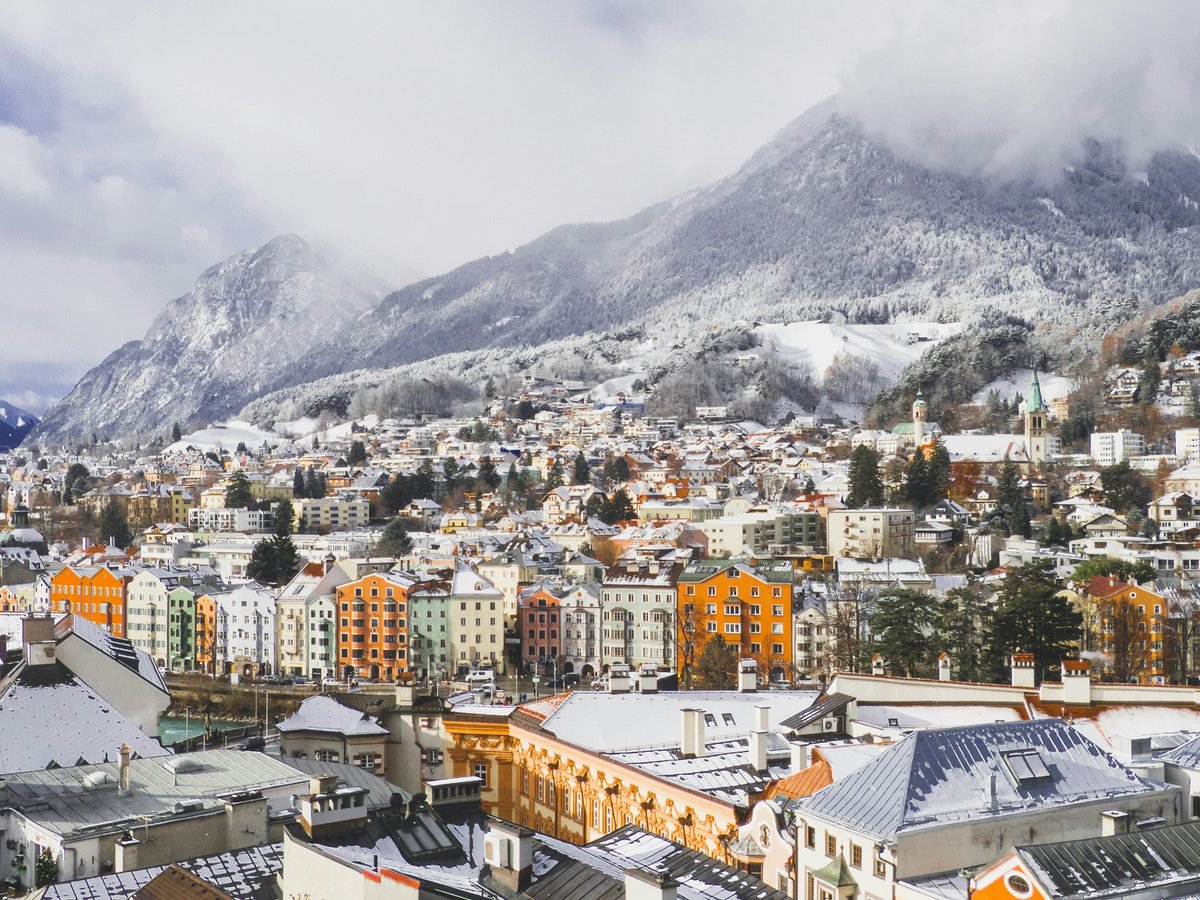
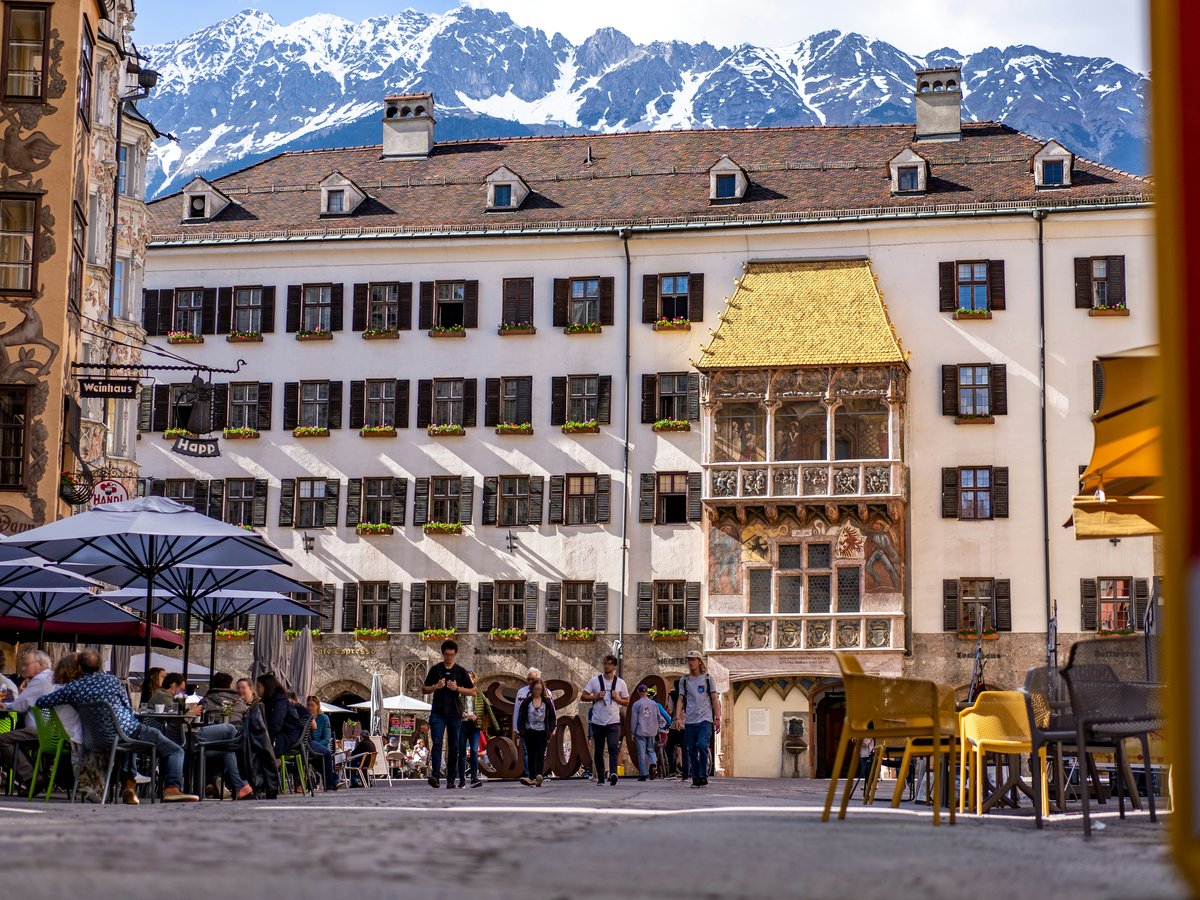
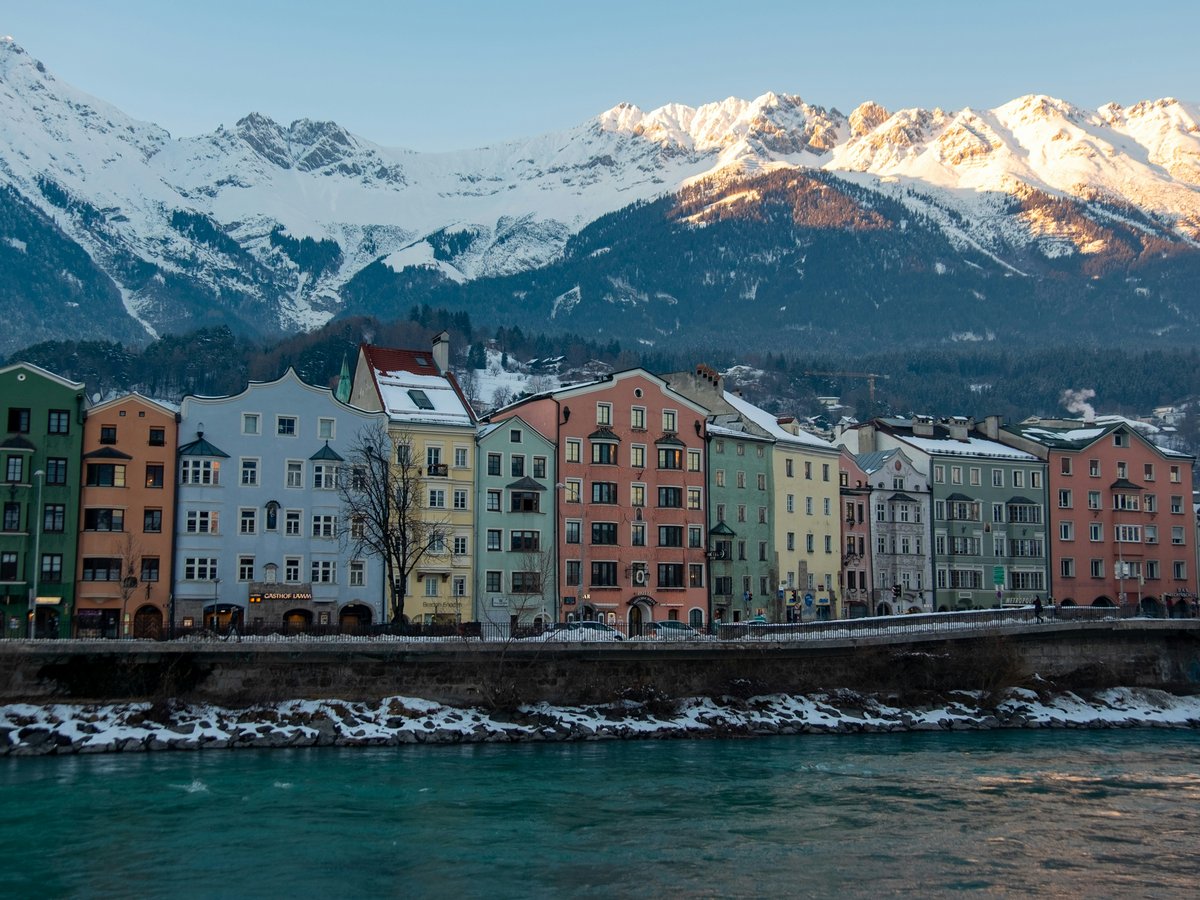
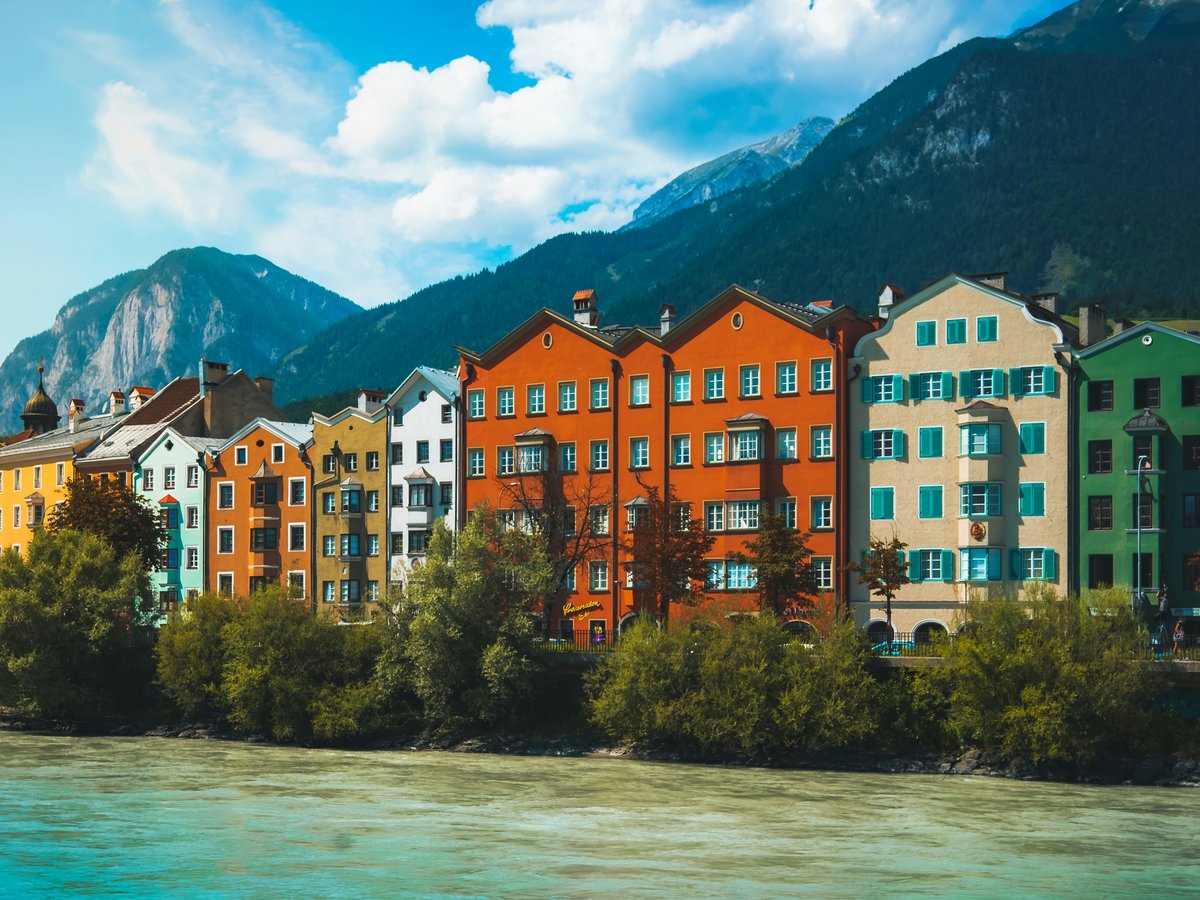
Innsbruck sits in the Inn Valley at roughly 574 metres above sea level, pinched between the Nordkette range to the north and the Patscherkofel to the south, which means you can stand on Maria-Theresien-Straße and watch the afternoon light crawl down limestone faces that rise more than two thousand metres above the rooftops. This is not decorative backdrop: the mountains define the city's shape, its weather, its identity, and its economy. With around 131,000 residents, Innsbruck is small enough that the old centre, the Altstadt, takes twenty minutes to cross on foot, yet it has hosted the Winter Olympics twice, in 1964 and 1976, and the infrastructure from those Games: the Bergisel ski jump redesigned by Zaha Hadid, the Olympic ice rink, the bobsled track at Igls: still threads through daily life. The Altstadt itself clusters around Herzog-Friedrich-Straße beneath the Goldenes Dachl, the gilded loggia balcony that Maximilian I built around 1500 to watch tournaments in the square below. South of the river, Wilten is the residential neighbourhood where university students and young families fill the cafés along Leopoldstraße, while across town St. Nikolaus, tucked against the northern slope, keeps a quieter, almost village pace. A first-time visitor's day here tends to split naturally: mornings in the flat centre browsing the Markthalle for Tyrolean cheese and Speck, afternoons riding the Nordkettenbahn; a funicular-and-gondola chain that climbs from the Congress station downtown to the Hafelekar ridge at 2,334 metres in about twenty-five minutes. By evening you are back along the river, where the coloured façades of Mariahilf catch the last sun and the restaurants along the Inn serve Tiroler Gröstl and local Weißbier. Innsbruck's particular trick is compression: genuine alpine wilderness and a fully functioning, walkable European city share the same postcode, and neither feels like a concession to the other.
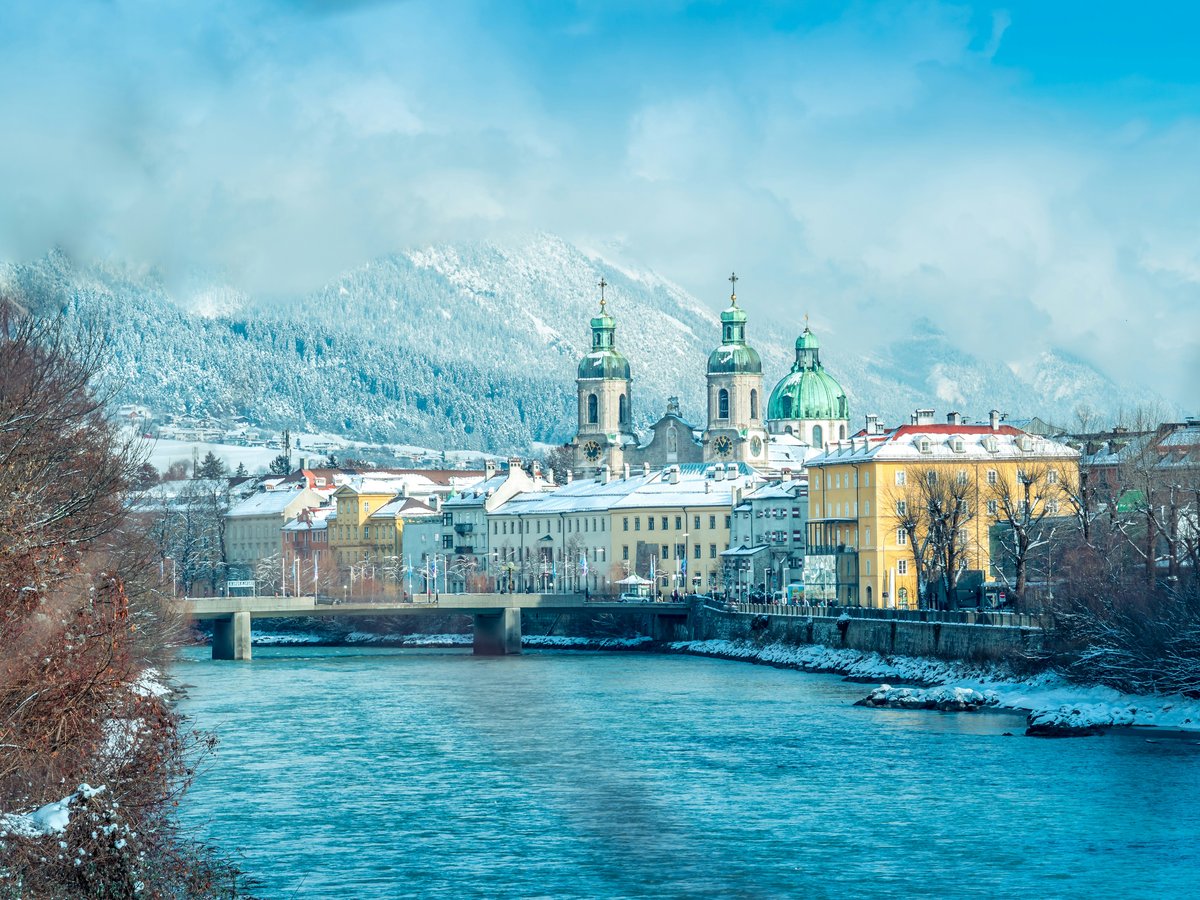
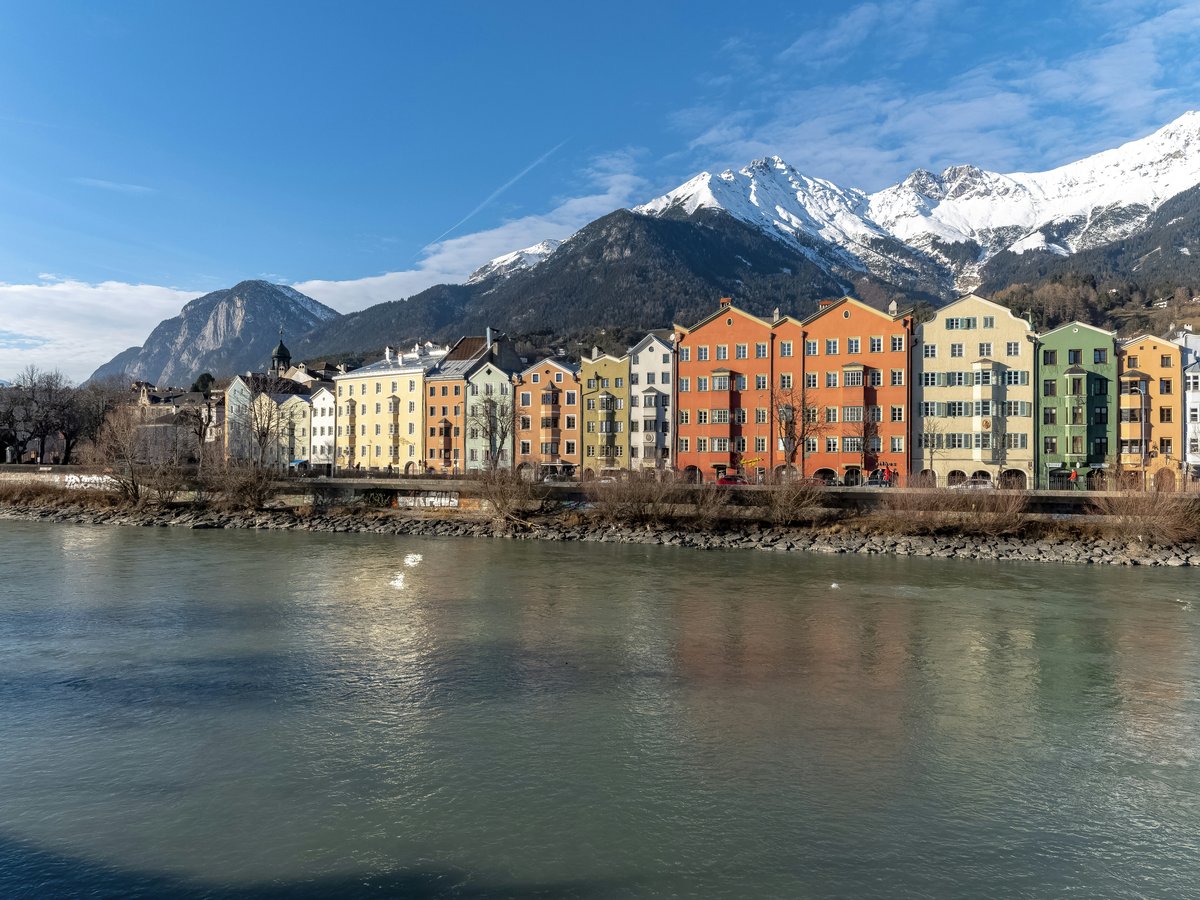
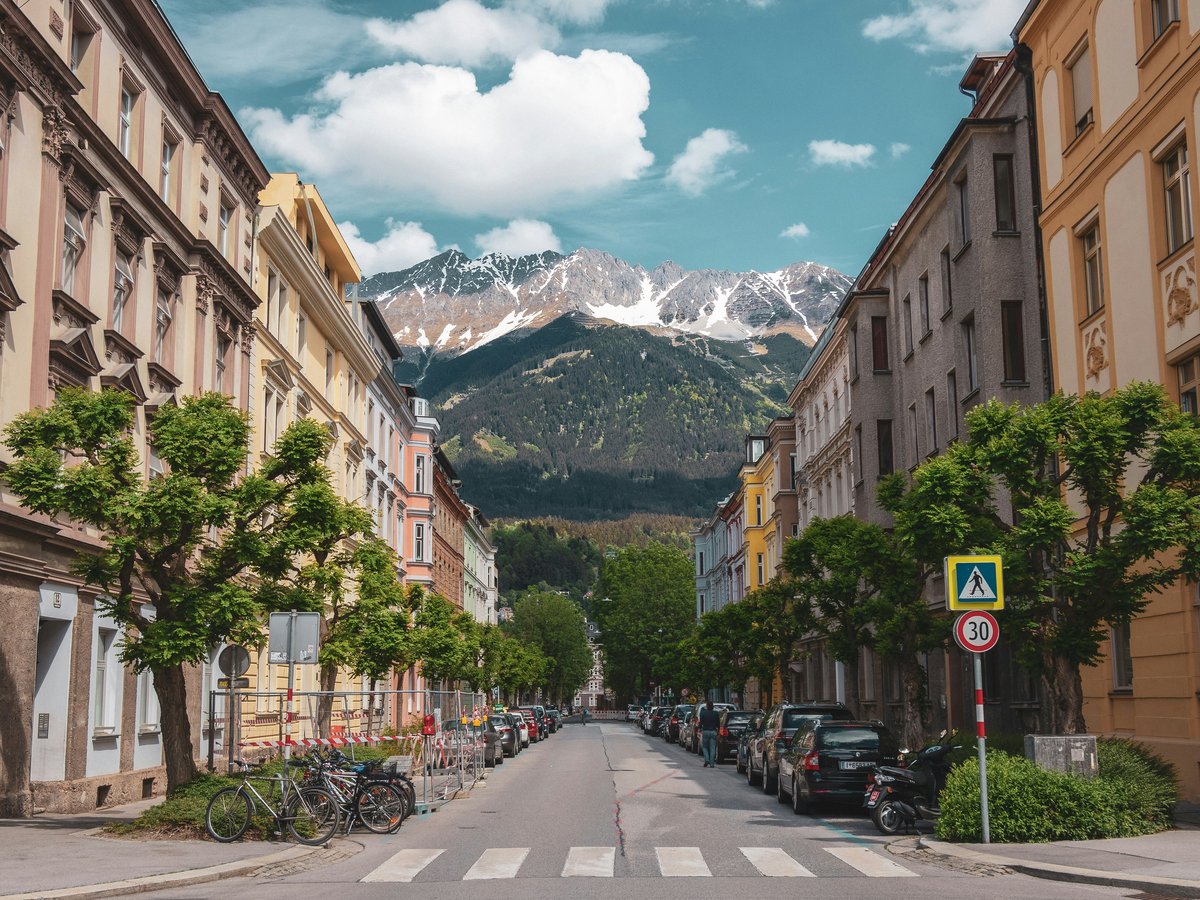
Innsbruck in photos
Innsbruck right now
Answers about Innsbruck
-
Airport to city
Innsbruck Airport (INN) sits 4 km west of the Altstadt. Bus Line F runs every 15 minutes to Hauptbahnhof for €2.40 ($2.70), taking about 18 minutes. A taxi covers the same distance in 10 minutes for €10-15 ($11-17). The airport is small enough that you'll be at the bus stop within 5 minutes of clearing baggage claim.
Read the full answer → -
Best time to visit
June and September. June brings 16 hours of daylight and highs around 23°C, with the Nordkette cable car running full schedule from the Altstadt. September clears the summer crowds and afternoon thunderstorms. Hiking trails above 2,000m are snow-free in both months. Ski visitors should target January through mid-March for reliable snow at Axamer Lizum and Patscherkofel.
Read the full answer → -
Cost per day
Innsbruck runs €48-55 ($54-62) per day on a tight budget. A hostel dorm costs €25-30, kebab and bakery meals add €15, and a 24-hour IVB transit pass is €5.50. Midrange lands around €160 ($180) with a three-star near the Altstadt. The Innsbruck Card at €53 for 24 hours bundles cable cars and museums but only pays off if you hit 3 or more paid sites.
Read the full answer → -
Cultural etiquette
"Grüß Gott" replaces "hello" in Innsbruck. Say it when entering any shop, café, or mountain hut. Tipping means rounding up by 5-10% and stating your intended total aloud to the server. Cover shoulders and knees inside the Hofkirche and Innsbruck Cathedral. Sundays are legally quiet. Never confuse Tyroleans with Germans.
Read the full answer → -
Best day trips
Hall in Tirol sits 10 km east, 12 minutes by S-Bahn for under €5 round trip. Sterzing (Vipiteno), the first Italian town past the Brenner, is 35 km south and 30 minutes by regional train. Salzburg works as a full day at 190 km on a 1h45 Railjet. Achensee and the Stubai Valley cover lake and glacier options within an hour by bus.
Read the full answer → -
Digital nomads
Innsbruck is a niche pick for nomads. A university city of 130,000 with 100-300 Mbps fiber in most apartments, but limited coworking and alpine-tourism rents. Monthly all-in runs about $2,400. The 90-day Schengen limit is your ceiling without a residence permit. Best for nomads who ski or climb and treat work as the thing between mountains.
Read the full answer → -
Family-friendly
Innsbruck is family-friendly, 8 out of 10. Alpenzoo, Swarovski Crystal Worlds in Wattens, and the flat Hofgarten park anchor the under-10 set. The pedestrianized Maria-Theresien-Straße handles strollers fine, though Altstadt cobblestones need bigger wheels. Kaiserschmarrn solves picky eaters at nearly every restaurant. Mountain cable cars sometimes have age or height rules worth checking before you queue.
Read the full answer → -
Food culture
Innsbruck eats Tyrolean mountain food built on cured speck, bread dumplings, and browned butter. The Markthalle on Innrain is the best single stop for regional producers, open weekdays until 6:30pm. Lunch peaks at noon, dinner by 7pm. Skip the tourist menus near the Golden Roof and eat where university students crowd the tables in Wilten and St. Nikolaus.
Read the full answer → -
Getting around
Walk. Innsbruck's Altstadt is 800 metres end to end, and the IVB tram network fills the gaps beyond it. Buy a 24-hour IVB pass for €5.80 or the Innsbruck Card from €53 for transit plus Nordkettenbahnen cable cars and museum entries. No metro, no reliable ridehail. Taxis run metered at about €4 flagfall.
Read the full answer → -
How to get there
Innsbruck Airport (INN) sits 4 km west of the Altstadt, but most long-haul travelers land at Munich (MUC), 190 km north, and take a 2-hour ÖBB train through the Inn Valley. Direct European flights serve INN from London, Amsterdam, and Vienna in ski season. Round-trip fares from the US run $800-1,400 via one stop. From the UK, £80-350.
Read the full answer → -
Is it safe?
Innsbruck scores 8.2 out of 10 for solo-traveler safety (see the TTDI Solo-Safety Index). Violent crime against visitors is close to zero. The compact Altstadt stays well-lit and populated past midnight. Real risks are altitude-related hiking injuries and icy sidewalks from November through March. Emergency number 112 covers all services. Police direct line is 133.
Read the full answer → -
Language basics
German. Austrian German specifically, with a Tyrolean dialect (Tirolerisch) that can sound closer to Swiss German than to the Hochdeutsch you studied in school. English proficiency around Maria-Theresien-Straße and the Nordkette cable car stations runs about 7/10. Staff at the Hofburg and Swarovski Crystal Worlds switch to English readily; vendors at Markthalle and older Tyroleans often don't.
Read the full answer → -
Layover guide
Innsbruck Airport sits 4 km from the Altstadt, and Bus F reaches Maria-Theresien-Strasse in 18 minutes for €2.40. With a 5-hour window, you can walk the Golden Roof, Hofkirche, and Hofgarten, grab Tiroler Gröstl at the Markthalle, and return comfortably. Schengen-zone travelers skip immigration entirely. Non-Schengen passport holders should verify their visa status before leaving the terminal.
Read the full answer → -
LGBTQ-friendly
Innsbruck scores 8/10 for LGBTQ+ friendliness (sourced from TTDI's editorial rubric). Austria's full marriage equality and the city's 28,000-student university population make Innsbruck more progressive than surrounding Tyrol. Same-sex couples walk the Altstadt without drawing a second look. The dedicated queer scene is small, but acceptance runs through daily life rather than concentrating in a single district.
Read the full answer → -
Where locals go
Innsbruck locals drink under the railway arches on Ing.-Etzel-Straße, shop for Speck at Markthalle on Innrain before noon, and fill Bäckerei cultural center in Dreiheiligen for €3.80 beers and live music. Wilten and Pradl south of the Altstadt are the residential neighborhoods where longer-term visitors integrate fastest, with studios from €650 to €900 per month.
Read the full answer → -
Must-see
The Hofkirche on Universitätsstraße, built in 1553 for Emperor Maximilian I. Twenty-eight bronze figures, each over 2 metres tall, stand guard around an empty marble sarcophagus in a cold stone nave that smells of beeswax. The visit takes 30 minutes, costs under €10, and needs no reservation. Nothing else in the Alps looks like this.
Read the full answer → -
Solo travel
Innsbruck suits solo travelers well. The compact Altstadt is walkable in 15 minutes, IVB trams run until midnight, and 30,000 university students at Leopold-Franzens-Universität keep bars and cafés social year-round. Single-supplement pain is real at ski-season hotels, but Tyrolean pensions along Innstraße price singles at 60 to 70 percent of the double rate. Safety after dark is excellent across all central neighborhoods.
Read the full answer → -
This week
Innsbruck's week turns on two rhythms. Saturday morning brings the farmers market at Markthalle Innsbruck by 7:30am. Summer afternoons, typically Tuesday through Friday, see thunderstorms build over the Nordkette by 2pm, pushing cable car rides to before noon. Monday closures hit the Hofkirche and Tiroler Landesmuseum. Sunday mornings the Altstadt stays quiet until 10am.
Read the full answer → -
3-day itinerary
Day 1 covers the Altstadt on foot. The Golden Roof, Hofkirche, Hofburg, and Dom zu St. Jakob all sit within 800 metres of each other. Day 2 rides the Nordkette cable car to 2,256 metres and visits Alpenzoo on the descent. Day 3 heads south to Ambras Castle and the Bergisel ski jump. About 22 kilometres of walking across three days.
Read the full answer → -
What to avoid
Skip the €22-26 Schnitzel below the Golden Roof and eat at Markthalle Innsbruck on Innrain for €14-16 instead. Check the Seegrube webcam before paying €39.20 for the Nordkettenbahnen on foggy days. Take IVB bus Line F from the airport for €3.30, not a €15-20 taxi. Sunday closures in Austria are near-total, so stock up Saturday. Innsbruck's Karwendel tap water is free and excellent.
Read the full answer → -
What to pack
Innsbruck sits at 574 meters in the Alps, where the Nordkette summit at 2,334 meters runs 8-10°C cooler than the valley floor. Pack sturdy walking shoes for Altstadt cobblestones, layers for altitude swings, a packable rain shell for summer afternoon storms, and a Type C/F plug adapter for Austria's 230V outlets.
Read the full answer → -
Where to stay
Stay in the Altstadt for a first visit to Innsbruck. The old center measures about 600 meters end to end, with the Golden Roof, the Hofburg, and the Dom zu St. Jakob all within a 5-minute walk of each other. Three-star hotels along Maria-Theresien-Strasse currently run €90-140 ($100-160) per night. Saggen and Wilten are solid lower-cost alternatives.
Read the full answer →
Deep guides for Innsbruck
-
Innsbruck Restaurants: What's Worth It
Twelve kitchens across two tiers, tested against one question. Which Innsbruck rooms cook for the neighbourhood, and which ones are worth rearranging your morning to find. A tier-by-tier verdict from the everyday excellent to the one Konditorei counter worth crossing town for.
Read the guide → -
Best Time to Visit Innsbruck, by Season
Innsbruck's average highs swing from 5.9°C in January to 25.7°C in June, a 29-degree gap that makes the calendar your most consequential travel decision. This guide walks every month's trade-off between weather, crowds, and price, naming the single best window for five kinds of traveller.
Read the guide →
Curated lists for Innsbruck
accommodation
-
Best boutique hotels
Innsbruck fits in a valley floor between the Nordkette range and the Patscherkofel, and the city's accommodation neighborhoods spread along the Inn River in a corridor narrow enough to cross on foot. The Altstadt and Innenstadt hold the medieval core where most visitors start; eastward, Pradl and Amras flatten into residential grids with lower rates and tram connections back to the center. Across the river, Hötting climbs the north bank toward the Hungerburgbahn funicular, while Mariahilf and Mühlau sit quieter on the same side. Wilten stretches south toward the Bergisel ski jump and the Hauptbahnhof. The city runs a tight tram and bus network, and most of these neighborhoods sit within a short tram ride of the Maria-Theresien-Strasse axis. Price tiers overlap more than you would expect: the core commands a premium for proximity to the Goldenes Dachl and the river views, but stepping one or two districts out drops rates noticeably without losing access. What matters more than the star rating is which direction you want to walk out the door: toward the old lanes and the river, toward the mountains and the funicular, or toward the station and the road south.
See the picks → -
Where to stay
Innsbruck folds into a narrow valley between the Nordkette ridge and the Brenner corridor, and that geography compresses the hotel map into a tight band along the Inn river and the streets south of it. The Altstadt and Innenstadt clusters sit within a few blocks of each other under the baroque facades of Herzog-Friedrich-Strasse. Pradl and Amras spread east along the tram lines toward the Olympic stadium and the trade-fair grounds, trading historic density for apartment-style space and lower rates. Hötting climbs the slope north of the river, quieter and residential. Wilten stretches south from the Hauptbahnhof toward the Bergisel ski jump, well connected but removed from the pedestrian core. Mariahilf lines the north bank of the Inn opposite the Altstadt, close enough to hear the Marktplatz but separate enough to sleep. Mühlau sits further north, a village pocket where the price drops and the walk into town takes real commitment. The mid-range tier dominates Innsbruck's inventory; budget beds are scarce and genuine luxury is concentrated in a handful of converted heritage buildings. Picking the right neighborhood here is less about price band and more about proximity: to the lifts, to the trains, or to the cobblestones.
See the picks →
attractions
-
Best free attractions
Free Innsbruck is not the free of a big capital, no imperial museum nights, no monumental public squares programmed to the hour. It is, instead, the free of a city wedged into a valley: parks laid out to be walked in, and gardens that exist because a university needed somewhere to grow plants. The four below are all outdoors, all genuinely gratis, and all mapped and described in the public record so a visitor can find them. Two sit inside the city: one a protected historic park on Rennweg, the other a neighbourhood park east of the centre, and two are botanical: one on the valley floor kept by the university, the other high on the Patscherkofel above town. Read together, they are a short course in how Innsbruck treats its green space: as working infrastructure for residents and students, not as ticketed spectacle. This list is for the traveller who has already done the Altstadt loop, wants an unstructured hour or three, and would rather spend it under trees than in a queue.
See the picks → -
Best museums
Innsbruck's museums are mostly about who ran the place and how it got run: a Habsburg palace ranked among the most significant cultural buildings in Austria, a former arsenal that now works as a museum, a castle with its own collection of art and curiosities, and in Hall in Tirol a castle that doubled as a mint. Alongside the imperial material sit museums built around alpine clubs, folk art, and railways, and that mix suits a visitor who would rather understand a valley than tick off a gallery. This list is for people who get more from a rack of tools, a well-used ticket counter, or a painted chest than from another gilded ceiling, and for anyone who wants a rainy afternoon to add up to something. Most entries sit on central streets in the 6020 postal area, so you can string two or three together on foot, though the castles need their own half-day, and so do the railway sites. Treat the order as a suggestion, not a ranking of worth.
See the picks → -
Must-see attractions
Innsbruck's must-see roster is not a museum trail: it is a walking inventory of churches, columns, arches and fountains packed into a compact Alpine capital where the Habsburg court left its receipts in stone. The list below is heavy on ecclesiastical architecture because that is what Innsbruck has: a cathedral on Domplatz, a Jesuit hall built from 1627 to 1646, a court church on Rennweg, and a basilica in Wilten. It is bracketed by civic set-pieces on Maria-Theresien-Straße: a victory column and a triumphal arch, and it makes room for the buildings you will walk past in the old town, like Helblinghaus at Herzog-Friedrich-Straße 10. This is a list for visitors who want the city's civic and religious spine before they head for the funicular, and who prefer a short, honest inventory over a long, padded one.
See the picks →
food
-
Best cafes
Innsbruck's cafe culture sits at an odd, useful crossroads: Austrian Konditorei tradition on one side, Italian espresso-and-pizza spillover from the Brenner on the other, and a working university town's appetite for breakfast and long afternoons wedged in between. What that means, practically, is that you can eat a properly laminated cake at a marble counter in the morning, a Neapolitan-style pizza under the arcades at lunch, and a Flammkuchen with a coffee at 16:00 without ever leaving the 6020 postcode. The list below leans away from the Maria-Theresien-Straße souvenir traffic where it can, and toward the Konditoreien, the Italian rooms, and the neighbourhood cafes in Pradl, Wilten, Hötting, and Amras that locals keep in rotation. Hours are the tell: places that close at 18:00 sharp are for the after-work Kaffee-und-Kuchen crowd; places open until 01:00 are for a different night entirely. Twelve rooms, in rank order, each with the address, the phone, and the site: everything you need to walk in without a reservation and eat well.
See the picks → -
Best restaurants
Innsbruck eats better than a city of 130,000 has any right to, and the reason is the Inn valley itself: an alpine crossroads where Tyrolean regional cooking sits shoulder to shoulder with the food that migration and the university have brought in. The twelve below are working restaurants, not scenery: they are mapped, they answer the phone, they keep hours you can plan a day around. You will find Nepalese momos on Museumstraße, a halal tandoor under the railway viaduct, Thai kitchens two doors apart on Kaiserjägerstraße, and a diner on Brunecker Straße that stays open until one in the morning on a Friday. The list leans away from the Altstadt's schnitzel-and-strudel routine because the visitors who eat well here are the ones who walk five minutes past it. Every address, phone number, website and opening hour below traces back to OpenStreetMap or the restaurant's own site: cited fact by fact so you can verify before you sit down. Read it as a working reference, not a ranking of taste.
See the picks →
Browse by traveler type
Browse by interest
Find a flight to Innsbruck
Live fares to Innsbruck appear here once cookies are accepted.
Last verified by automated review (v1.7.2) on . What is automated review?