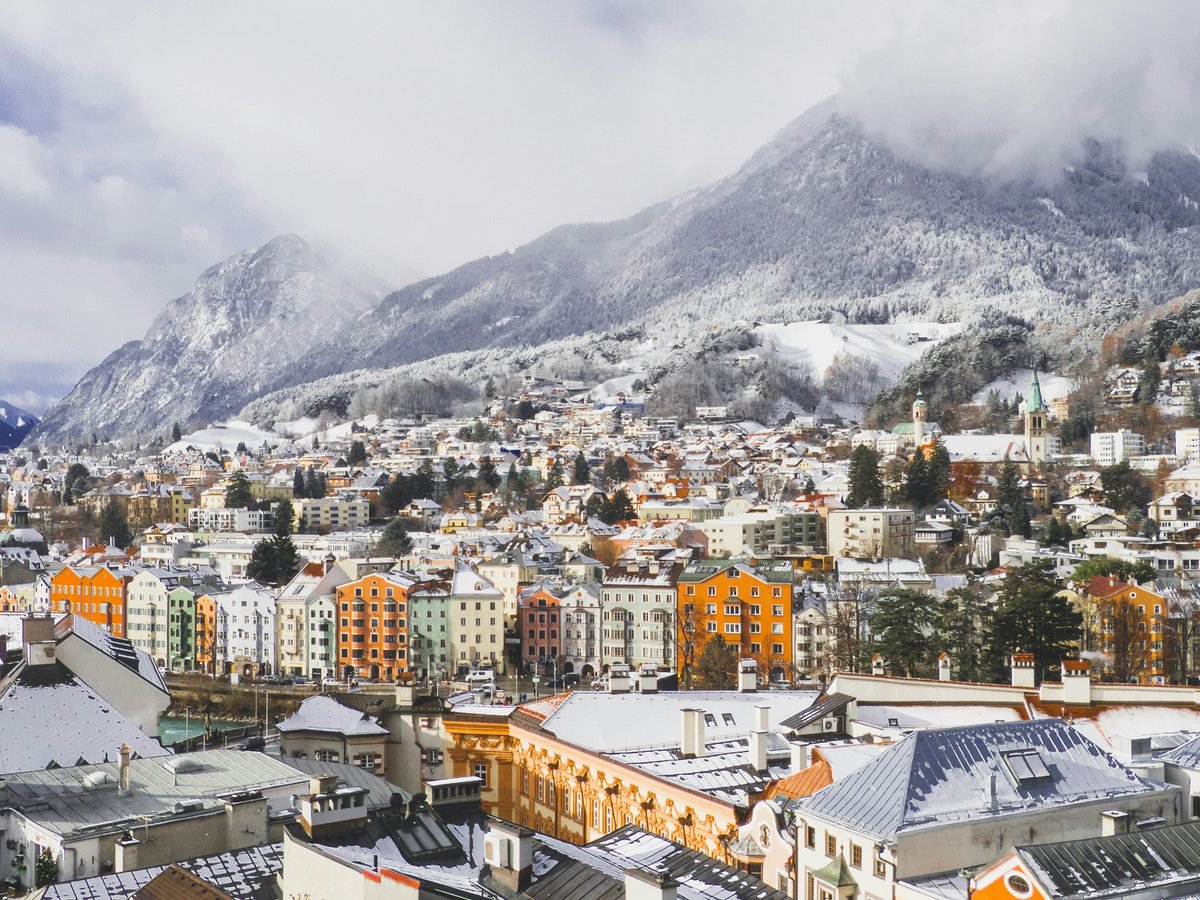
Innsbruck sits in a valley where the Inn River curves through the Northern Limestone Alps, and the city tends to be unusually generous to visitors spending nothing at all. The compact Altstadt covers roughly 500 meters between the Triumphpforte at the south end of Maria-Theresien-Straße and the Inn River to the north, lined with free-entry Baroque churches, painted medieval facades, and the Hofgarten, a park that has been open since Emperor Maximilian I had it planted in the late 1400s. The Nordkette range rises directly behind the old town to 2,334 meters at the Hafelekar summit. While the Hungerburgbahn and cable car cost around 39 EUR return, the mountain panorama from street level in Innsbruck is likely better than paid viewing platforms in most other Alpine cities. Three of the city's finest churches charge nothing, walking routes along the Inn River extend for kilometers, and the Markthalle lets you wander past wheels of Tyrolean Bergkäse, dry-cured speck, and warm Strauben without any pressure to buy. Innsbruck still draws fewer day-trippers than Salzburg or Vienna, so the free sites feel less crowded, particularly during May and October.
Free attractions
-
Goldenes Dachl
The balcony covered in 2,657 fire-gilded copper tiles on Herzog-Friedrich-Straße was built for Emperor Maximilian I around 1500. It is free to view from the street below. You'll notice reliefs of court life and tournament scenes on the balcony facade, and morning light tends to hit the tiles best between 9 and 11 AM. The small museum behind the balcony charges around 5 EUR, but the exterior itself, which is the main draw, costs nothing.
Altstadtlandmark -
Dom zu St. Jakob (Innsbruck Cathedral)
This Baroque cathedral was rebuilt between 1717 and 1724 after earthquake damage. Ceiling frescoes by Cosmas Damian Asam cover the nave, and the high altar holds Lucas Cranach the Elder's painting of Maria Hilf, a work that has drawn pilgrims since the 17th century. Entry is free. The interior smells of old stone and candle wax, and the acoustics make even quiet footsteps carry. The cathedral sits on Domplatz, a 2-minute walk north of the Goldenes Dachl.
Altstadtchurch -
Jesuitenkirche (University Church)
Built between 1627 and 1640 on Universitätsstraße, this is one of the earliest Baroque churches in the Tyrolean Alps. The twin towers and restrained facade feel almost austere next to the Dom a few streets north. Inside, the proportions run tall and narrow. Free to enter, and it rarely draws crowds, so you'll often have the space to yourself.
Altstadtchurch -
Wiltener Basilika
A 10-minute walk south from the Altstadt brings you to this rococo church in the Wilten district, completed in the 1750s. The interior is almost overwhelming. Gilt stucco, ceiling paintings, and carved saints cover nearly every surface. It receives far fewer visitors than the Dom, so on a weekday morning you might have the nave entirely to yourself. Free entry, no donation box pressure.
Wiltenchurch -
Hofgarten
Innsbruck's imperial garden stretches north of the Hofburg palace, with mature plane trees, open lawns, and crunching gravel paths. Emperor Maximilian I had the grounds planted in the late 15th century. The current English landscape layout dates from the 1800s. A bandstand pavilion hosts free summer concerts. The park is open daily, year-round, at no cost. In autumn, fallen chestnuts and thick leaf cover make it feel a different park entirely.
Saggenpark -
Triumphpforte (Triumphal Arch)
The stone arch at the southern end of Maria-Theresien-Straße was built in 1765. Its south face celebrates the marriage of Archduke Leopold to Maria Ludovica of Spain. Walk around to the north side, which mourns the death of Emperor Franz I during the same wedding festivities. That dual message, celebration and grief on the same monument, is unusual for 18th-century Habsburg architecture. Always accessible, always free.
Wiltenlandmark -
Annasäule (St. Anne's Column)
This column stands in the center of Maria-Theresien-Straße, erected in 1706 to mark the Bavarian withdrawal from Tyrol on St. Anne's Day, July 26, 1703. The Virgin Mary tops the column, with Saints Anne, George, Vigilius, and Cassian at the base. The Nordkette peaks frame it from the north, which is why the column appears in nearly every photograph taken along the street.
Maria-Theresien-Straßelandmark -
Helblinghaus
At Herzog-Friedrich-Straße 10, right beside the Goldenes Dachl, this late-Gothic building received its elaborate rococo stucco facade around 1730. White plasterwork flowers, shells, and ornamental figures cover the entire front wall. It is now a private building, but the facade is fully visible from the pedestrian street and free to admire and photograph at any hour.
Altstadtlandmark -
Rapoldipark
This large public park sits east of the city center in the Pradl district. Flat paths loop through lawns and mature trees, and local runners use the perimeter track year-round. It tends to be quieter than the Hofgarten and has more open space for sitting. Free and open daily. On warm summer evenings, the smell of cut grass and barbecue smoke drifts across from the adjacent residential streets.
Pradlpark -
Schlosspark Ambras
The wooded grounds and walking paths around Renaissance-era Schloss Ambras, about 3 km southeast of the Altstadt, are open to the public at no cost. The castle museum and Spanish Hall inside require a ticket of around 16 EUR, but the surrounding park, with its old trees, sloping meadows, and views toward the Patscherkofel, costs nothing to walk through. Tram 6 from the center reaches the area in about 15 minutes.
Amraspark -
Tiroler Landesmuseum Ferdinandeum
Innsbruck's main art and history museum sits on Museumstraße, with collections running from archaeological finds to 20th-century Tyrolean painting. The Ferdinandeum has offered free admission on the first Sunday of each month as part of the Tiroler Landesmuseen group, though the specific policy has shifted over the years. Worth confirming the current schedule before building a visit around it. Under-19s have typically entered free regardless of the day.
Innere Stadtmuseum (free on first Sunday of the month, confirm current schedule) -
Das Tirol Panorama am Bergisel
This purpose-built museum on the Bergisel hill houses the Riesenrundgemälde, a circular painting of roughly 1,000 square meters completed in 1896. It depicts the Battle of Bergisel on August 13, 1809, when Tyrolean fighters led by Andreas Hofer held the hill against Bavarian and French forces. The museum opened in 2011. As part of the Tiroler Landesmuseen group, it follows the same free-admission-day policy as the Ferdinandeum. If the first-Sunday program is currently running, it applies here as well.
Bergiselmuseum (free on first Sunday of the month, confirm current schedule)
Free activities
-
Altstadt walking loop
Start at the Triumphpforte and walk north along Maria-Theresien-Straße, past the Annasäule, through the medieval lanes to the Goldenes Dachl and Helblinghaus. Turn east toward the Dom zu St. Jakob, then continue north to the Inn River. The full loop covers about 1.5 km and takes roughly 45 minutes without stops. The cobblestones on Herzog-Friedrich-Straße are uneven enough to notice underfoot, especially in wet weather.
Altstadtwalking route -
Innpromenade and Mariahilf houses viewpoint
The promenade along both banks of the Inn River extends for several kilometers. The most photographed stretch is the view from the Innsteg footbridge toward the Mariahilf-St. Nikolaus district, where tall, narrow houses in pinks, greens, yellows, and whites line the north bank with the Nordkette rising behind them. The river itself runs fast and cold, a pale green-gray color from glacial melt. Free to walk at any time. Early morning light on the colored facades tends to look best.
Mariahilf / St. Nikolauswalking route and viewpoint -
Markthalle Innsbruck (browsing)
The covered market hall at Herzog-Siegmund-Ufer sits along the south bank of the Inn River. Inside, stalls sell Tyrolean cheeses, cured meats, bread, mountain honey, dried herbs, and prepared foods. Browsing costs nothing, and the warm yeasty smell of fresh bread hits you at the entrance. The hall is open Monday through Saturday, typically from around 7 AM to 6:30 PM, with some stalls closing by early afternoon on Saturdays.
Altstadtmarket -
Bergisel hill walk
Walking paths loop around the Bergisel hill south of the Altstadt, passing through mixed woodland with views over the Wipp Valley and the Inn Valley. The Andreas Hofer memorial and the grounds around the Tirol Panorama museum are free to access. The Zaha Hadid-designed ski jump tower (opened 2003) charges for its observation deck, but you can see its cantilevered profile clearly from the free paths below. Allow about 30 to 45 minutes for the loop.
Bergiselwalking route and viewpoint -
Sillschlucht gorge trail
The Sill River cuts a narrow gorge south of the city, and a walking trail follows the riverbank through it. The path is accessible from the Bergisel area and runs for about 2 km. The air temperature drops noticeably inside the gorge, and the sound of rushing water echoes off the rock walls. The trail surface is mostly gravel and can be slippery after rain. Free, no ticket or gate.
Wilten / Bergiselwalking route -
Zaha Hadid Hungerburgbahn stations
The four stations of the Hungerburgbahn funicular, designed by Zaha Hadid and opened in 2007, are pieces of public architecture visible from the street. The Congress station near the Hofburg and the Löwenhaus station in Saggen have the most distinctive curved-glass and concrete forms. Riding the funicular costs around 9 EUR one way, but viewing the station architecture from outside is free.
Saggen / Hungerburgpublic architecture -
Bauernmarkt at Sparkassenplatz
A farmers' market has been running on Sparkassenplatz near the Altstadt, typically on Friday mornings. Local producers sell vegetables, fruit, eggs, cheese, and baked goods. Browsing is free. The market tends to be small, maybe 15 to 20 stalls, and wraps up by early afternoon. Availability and schedule can shift seasonally, so it is worth checking locally.
Altstadtmarket
Free events
-
Promenadenkonzerte im Hofgarten
Sundays in July and August (confirm exact schedule each year)Free open-air concerts in the Hofgarten bandstand pavilion have been a summer tradition in Innsbruck. The Militärmusik Tirol (Tyrolean Military Band) and other local ensembles typically perform. The concerts draw a mix of locals and visitors who sit on benches or on the grass. The sound carries well across the flat park. No ticket, no registration.
Hofgarten pavilion -
Christkindlmarkt in der Altstadt
Late November through approximately December 23, annuallyInnsbruck's main Christmas market fills the Altstadt streets around the Goldenes Dachl with wooden stalls selling ornaments, candles, roasted chestnuts, and Glühwein. The smell of cinnamon and hot wine is thick in the cold air. Browsing the market is free, though eating and drinking cost money. A second smaller market has typically run at Marktplatz.
Altstadt (around Herzog-Friedrich-Straße) -
Innsbrucker Festwochen der Alten Musik (free fringe events)
July and August (specific free events vary by year)The Festival of Early Music is one of Europe's leading Baroque and Renaissance music festivals. The main concert program is ticketed, often selling out months ahead, but the festival has offered free open-air performances and fringe events in the Altstadt and at the Hofburg courtyard. These tend to be listed separately on the festival's program closer to the dates.
Various locations in the Altstadt and Hofburg area -
Silvester in der Altstadt
December 31, annuallyInnsbruck's New Year's Eve celebrations in the old town have included free live music, food stalls, and a midnight fireworks display visible from the Inn River bridges and Maria-Theresien-Straße. The atmosphere is cold, loud, and crowded, with temperatures typically around minus 5 to minus 10 Celsius. No ticket needed for the outdoor events.
Altstadt and Maria-Theresien-Straße
A free 90-minute walk through the Altstadt
Begin at the Triumphpforte on the south end of Maria-Theresien-Straße. The arch is worth a full circle to see both faces, the celebratory south and the mourning north. Walk north along the wide pedestrian street, passing the Annasäule at roughly the midpoint. On clear days, the Nordkette fills the northern sky behind the column. Continue through the narrowing streets into the medieval Altstadt. Herzog-Friedrich-Straße is the main lane, where the Goldenes Dachl and Helblinghaus face each other. The cobblestones here are 15th-century originals in places, worn smooth and slippery in rain. Turn right toward Domplatz and step inside the Dom zu St. Jakob. The Cranach painting is on the high altar. Back outside, walk north to the Inn River. Cross the Innsteg footbridge and turn left along the north bank promenade. From here, look back south across the river at the colorful Mariahilf houses. This view, the painted facades against the mountains, is what ends up on most postcards. The full loop runs about 2.5 km. At a relaxed pace, with stops inside the Dom and at the Goldenes Dachl, it takes around 90 minutes.
What costs money (often confused as free)
Several well-known Innsbruck attractions appear on free-things lists but currently charge admission. The Stadtturm (City Tower) on Herzog-Friedrich-Straße, right next to the Goldenes Dachl, costs around 4 EUR to climb its 148 steps. The Goldenes Dachl museum, inside the building behind the famous balcony, charges about 5 EUR. The Kaiserliche Hofburg (Imperial Palace), adjacent to the Hofgarten, charges around 10 EUR for the state rooms. Schloss Ambras has free grounds but charges approximately 16 EUR for the castle museum and Spanish Hall. The Alpenzoo, perched on the hillside above the city, runs about 14 EUR for adults. And the full Nordkettenbahnen trip from Congress station to the Hafelekar summit costs roughly 39 EUR return. These are all worth the money, but they are not free, and listing them as such would be misleading.
Seasonal timing for free Innsbruck
The free outdoor attractions in Innsbruck shift significantly by season. From June through September, the Hofgarten concerts tend to run, the Altstadt stays light until after 9 PM, and the Bergisel and Sillschlucht trails are fully accessible and dry. July and August bring the Festwochen der Alten Musik and its free fringe events. October is quieter, with thinner crowds at the churches and museums, and the first dustings of snow on the Nordkette above 2,000 meters. From late November, the Christkindlmärkte open. Winter walking in the Altstadt is free year-round, but temperatures from December through February regularly drop below minus 10 Celsius overnight, and the Sillschlucht trail can ice over. The Ferdinandeum and Das Tirol Panorama offer their free-admission Sundays year-round regardless of weather, which makes them particularly useful in January and February when outdoor options narrow. Spring, from late March through May, brings longer days and gradually warming temperatures, though April rain is common enough to plan around.
FAQ
Is the Goldenes Dachl free to visit?
The exterior of the Goldenes Dachl, the famous fire-gilded balcony on Herzog-Friedrich-Straße, is free to view from the street at any time. That is what most people come to see. There is a small museum inside the building behind the balcony, which currently charges around 5 EUR admission. The museum covers Emperor Maximilian I's life and the history of the balcony, but the gilded roof tiles themselves are fully visible from outside at no cost.
Can you hike from the Innsbruck city center without paying for transport?
Yes. The Bergisel hill walk and the Sillschlucht gorge trail are both reachable on foot from the Altstadt in about 20 to 30 minutes. The Schlosspark Ambras grounds are accessible via tram 6, which costs a fare, but you can also walk there in roughly 40 minutes from the center. For the Nordkette mountain trails, you would need the Hungerburgbahn and cable car (around 39 EUR return), so those are not free. The valley-floor walks along the Inn River and around Bergisel are the best no-cost options.
Are the churches in Innsbruck free to enter every day?
The Dom zu St. Jakob, Jesuitenkirche, and Wiltener Basilika are free to enter during their regular opening hours, which are typically from early morning to early evening. During services, you can still enter but are expected to sit quietly rather than walk around photographing. The Hofkirche (Court Church), which houses Emperor Maximilian I's tomb and the famous bronze figures known as the Schwarze Mander, is a separate case and charges around 9 EUR admission. Do not confuse it with the free churches.
When does the Ferdinandeum offer free admission?
The Tiroler Landesmuseum Ferdinandeum has offered free admission on the first Sunday of each month, though this policy has shifted over the years. Before planning a visit around it, check the museum's current schedule on the Tiroler Landesmuseen website or call ahead. Under-19s have typically entered free on any day. The same policy tends to apply to the other museums in the Landesmuseen group, including Das Tirol Panorama am Bergisel and the Zeughaus.
What is the best free viewpoint in Innsbruck?
The view from the Innsteg footbridge looking south toward the Mariahilf colored houses with the Nordkette behind them is probably the most rewarding free viewpoint in the city, and it takes no climbing to reach. For an elevated perspective, the walking paths on the Bergisel hill give a wide view over the Inn Valley and Wipp Valley at no cost. The Hafelekar summit at 2,334 meters has the most dramatic panorama, but reaching it requires the Nordkettenbahnen cable car at roughly 39 EUR, so it does not qualify as free.
Last verified by automated review (v1.7.2) on . What is automated review?